Interview with Rosa Maria Paya / Lilianne Ruiz, Rosa Maria Paya

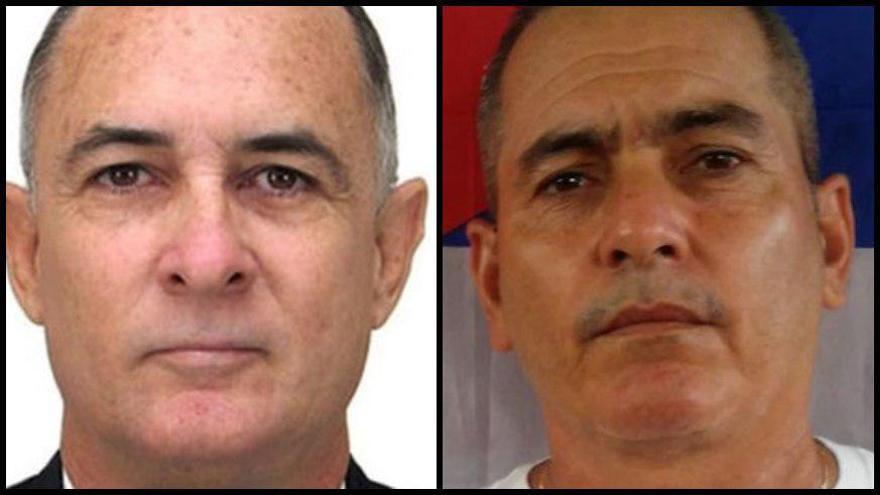
Harold Cepero, center, and Rosa Maria Paya, right.

By Lilianne Ruíz

HAVANA, Cuba, May, www.cubanet.org.- Rosa María Payá, daughter of the late leader of the Christian Liberation Movement, returned to Cuba after finishing a tour with the main objective of promoting an international investigation to clarify the circumstances that led to the tragedy on July 22, 2012 that killed Oswaldo Paya and Harold Cepero.

The daughter of Oswaldo Paya and Ofelia Acevedo agreed to an interview for Cubanet. Having captivated the public through the media, she insists that neither his undisputed leadership nor she herself that is the most important thing. To discover whether or not there was government responsibility in the events of July 22, 2012, would end with a cycle of violence and impunity for State Security, and the alleged immunity of the authorities to the consequences of the systematic violation of the human rights of all Cubans.

Lilianne Ruiz: What is the situation of the demand to international organizations that they investigate the Payá case?

Rosa María Payá: In the Universal Periodic Review report, there was a statement on the matter. We presented the case to the Rapporteur on Extrajudicial Crimes of the United Nations Human Rights Council, headed by the High Commissioner Navi Pillay. A few days later, the Special Rapporteur answered us saying that they accepted the case and are in contact with the parties. In fact, I think the words that they used in contact with the families of the victims, which implies a judgment about what happened. Beyond that, the United Nations has its mechanisms of action, directly with the government of the country, of sending a request for information or of sending emergency measures, not all of which are public. What we do know is that they are working on the case.

I asked Mrs. Navy this question directly because after the speech to the Human Rights Council — in that two minute speech, I was interrupted by seven countries with “human rights standards,” including Cuba, Russia, Belarus — after that there was a plenum with the High Commissioner, and I was able to directly ask her the question of whether she knew about the case (i.e., the request for an international investigation) and she gave me her condolences, told me they knew about the case and put me in touch with the Rapporteur on Extrajudicial crimes; and that’s when we presented demand, and a few days later they responded by saying that they have the case. It is a process. I’m not saying they are doing an international investigation, I’m just saying what they said: they are working on the case with the United Nations mechanisms, not all of which are public.

How did your speech before the United Nations Human Rights Council go?

RMP: During the Human Rights Council there are some weeks when NGOs can speak. There was an NGO called U.N. Watch who gave their time to me. I had two minutes at the Human Rights Council, and when it came time for my speech I hadn’t been speaking for thirty seconds when “Cuba” started to make noise and demand the floor. The president, of course, stopped me, and gave the floor to the representative from the Cuban mission to the U.N. I can’t find the exact words, but the tone was the same threats as always, “How is it that this mercenary can come before the United Nations Human Rights Council?” They asked that I not be allowed to speak, that I not be allowed to finish the two minutes.

I believe that later the United States got up and said something like, “Fine, in any event, we all have the right to speak. We are going to listen to what she has to say.” The United States sat down and the following began to stand up consecutively: China, Russia, Belarus, Pakistan, Nicaragua, I don’t remember which other countries who say they are “standard bearers of Human Rights,” standing up to support “Cuba,” to say, “just to support Cuba’s motion.” But fine, after the last one sat down, the president turned to give me the floor and I could finish.

At this Council they listen to all kinds of things, every day that it lasts — from the slaves of Mauritania, to torture in Iran, and most of the countries don’t react against the Human Rights activists who are talking there. This reaction, apparently planned — because they would have had to talk with China, Pakistan, Russia, Belarus, Nicaragua, because they jumped up at this moment and supported “Cuba” — also indicated their arrogance, their inability to deal with the truth. What we were asking for there was an investigation, we were asking for a plebiscite. We were not accusing anyone, on the contrary, we were proposing a dialogue.

What can you tell us about your interview with Angel Carromero?

RMP: Well, I talked with him upon arriving from the airport. I arrived from the airport — I was very tired, I was going to go to sleep — and he was at my house. My cousin’s house. He was very close, very coherent, very rational; he explained everything to me. He wanted to explain everything to me step by step, what had happened. He was angry at how he had been treated in Cuba, at how he had been treated in Spain, about the things that they continued doing, the attitude of the press. I say angry because he was frustrated that what had come out was not the truth, and with regards to his own situation, he was being treated as guilty though he was innocent. Continue reading


A New Trial for Angel Santiesteban / Lilianne Ruiz

Lilianne Ruiz, Angel Santiesteban, Yoani Sanchez, Lia Villares

Lilianne Ruiz, Angel Santiesteban, Yoani Sanchez, Lia Villares – Taken in Yoani’s apartment

I always remember from Oedipus: I am a toy in the hands of destiny. Maybe the life of Angel Santiesteban, prominent Cuban writer and opposition blogger, is also marked by that concept. But the Kafkaesque style of totalitarian societies where fatum is a metaphor for the State, has to be taken into account.

Making the apology that friends usually make would detract from the objectivity of this article, and would not be taken into account by the readers. What I am going to try to show is that in his trial there are evident arbitrary procedures that yield as a consequence an extremely severe sentence for a crime that was not sufficiently proven.

Last January 15 the Supreme Court denied the appeal by Santiesteban’s lawyer; without responding to the doubts that led to the filing of the Appeal under the grounds set forth by current Cuban law, which were not recognized in the final ruling of the Supreme Tribunal.

One must remember that it is the mother of the writer’s son who initiated the suit for “unlawful entry” and “injuries.” But she changed her statement four times, and if she could not damage him more it was because her main witness “after having testified in police headquarters, agreed to make a home video, which is in the file, where he alleged that he lied under the guidance of the plaintiff, who made promises of personal benefits,” as stated in the appeal documents.

The defense witnesses were dismissed by the Chamber, in spite of the fact that “after having been advised to tell the truth and of the criminal penalty for failing to do so,” they swore that on “the day of the events, July 28, 2009, at the time in question, Santiesteban was to be found in a different place and distant from the home of the complainant.”

Santiesteban’s younger son testified that his father was not at his home on the day on which the events supposedly took place. But that does not disprove, but rather corroborates, the statement of the two people who testified that on July 28, 2009, between noon and 6 pm, Santiesteban was with them, so that he could not have committed the crime of which he was accused, or it can’t be proven; as it also is true that he was not at home with his son.

Yahima Lahera, a teacher at and director of the primary school of Angel Santiesteban’s son, testified that the boy confessed to her that his mother made him make statements that incriminated his father.

According to the defense attorney, Lic. Miguel Iturria Medina, proper use of the Penal Code was not made because a sanction for the crime “unlawful entry” was imposed that exceeds by a year the maximum limit provided for by the Code. And as far as the crime of “injuries,” the maximum sanction was applied without having proved the causal relationship, and once again, without the presence of the accused at the place of the events having being sufficiently proven.

Santiesteban’s attorney also said: “We believe that the chamber has rejected all exculpatory evidence and welcomed, against the accused, every detail detrimental to him, in order to arrive at an extreme judgment that leaves him defenseless.”

May these words serve as a call to international public opinion asking that, as stated in the Appeal, Angel Santiesteban is entitled to have all the errors and obscurities that his lawyer has discovered heard, and because of which he has petitioned for the sentence to be nullified in order to hold, in the future, a more objective process.

Angel Santiesteban has received several national and international recognitions such as the Juan Rulfo Mention Award of 1998, the UNEAC award in 1995, the Cesar Galeano Award in 1999, the Alejo Carpentier Award in 2001, and the House of the Americas Award in 2006. He is also author of the blog The Children Nobody Wanted.

Translated by mlk

8 February 2013


Drugs in Cuba: They Exist / Ivan Garcia

ivang2Whether the glass looks half full or half empty is the best way of describing the consumption of drugs in Cuba.  Let’s make a trip through different neighborhoods of Havana in which marijuana, psychotropics and different kinds of cocaine are sold and consumed.
Emilio has been smoking marijuana since age 13.  “My father told me, if you’re going to have harmful vices, it’s better to smoke herb than drink alcohol.”  And he not only smokes marijuana. He also sells it. Right now, he offers a Creole marijuana cigarette for a convertible peso.  Months ago he sold several ounces of “yuma” herb.”  A premium quality joint costs 5 CUC.

“Business is booming. You invest 400 convertible pesos and serving the client well, you earn a little more than half. Of course you run the risk getting caught by the police,” says Emilio on a pleasant January night.

Contradicting what was expressed by General Raul Castro in Santiago de Chile during the CELAC Summit, that in Cuba drugs do not exist except for “a little marijuana,” an anti-drug police body specialized in combating the sale and consumption of drugs operates in the country.

If they catch someone selling drugs, the criminal penalties can reach 30 years. Even a life sentence. Since 1998, combined police and State Security forces have conducted lightning operations trying to dismantle the emerging Havana drug trafficking cartels.

On these raids people have fallen that years ago were outside of the business. Like Samuel, a habitual drug addict.  “I give him anything.  When I have money, I prefer crack or sniffing powder. But these are luxury drugs. The usual is smoking herb or drinking ’methyl’ or Ketamina.”

Samuel has been to prison twice for drug possession. “I’ve never been involved in selling,” he explains.  In the old part of Havana, probably the township with the highest level of drug consumption in the country, crack and melca are in fashion.

A gram of powder is through the roof.  From 30 to 35 convertible pesos four years ago to 80 to 100 CUC that it costs today.  “And it’s flying.  The prices have shot up because of the scarcity of the product.  The police are doing a better job.  Every day it is harder to find a fisherman or farmer that will offer you cocaine from the packets that arrive on the shores,” notes a retailer.

The flow of drugs in the seas adjacent to the archipelago is intense.  Residents of coastal regions are dedicated to hunting for the stray packages because of maritime accidents or due to harassment by the coast guard when the traffickers get rid of their merchandise and throw it into the sea.

Not just the marginalized

Hitting a bale of cocaine floating on the coast is like winning the grand prize in the lottery.  A kilo of melca at wholesale represents a good quantity of money.  And that’s why many risk their hides without stopping to think about the dire consequences that consumption causes.

According to a source that preferred anonymity, another route for drugs to Havana is through corrupt recruits that appropriate a share of the confiscated narcotics.  “When they go to burn the confiscated drugs, I assure you, many times part is missing,” he says.

In the capital there are people dedicated to the retail trade.  In Central Havana crack, that lethal mix of chemical products with melca is much in demand.  Also the “yuma” — that is foreign — marijuana.  The dispensers claim that it is Colombian.

Drugs in Cuba are not just a thing of the marginal slums or incurable drug addicts.  In the intellectual world also a joint or a gram of cocaine is appreciated.  Above all among the Havana show business world.  “Reggaeton musicians and certain cinema and television artists pull more dust than a vacuum cleaner,” claims a melca” seller.

And drugs on the island are not a new phenomenon.  If in the ’80’s consuming marijuana or amphetamines was a minority thing, in the later decades, at a glance, consumption has grown.  For lack of governmental statistics, the streets speak for themselves.

When asked, ten young people ages 18 to 26 years assured this journalist they consume marijuana frequently.  They have snorted cocaine.  And they are fans of methylphenidate, a substance that is similar to amphetamines but whose pharmacological effects according to doctors are similar to those of cocaine.

Although the official press barely speaks of the phenomenon, in all the townships of Havana there are clinics for assisting people hooked on drugs and psychotropics.  An anonymous telephone number exists to help those affected.

Also, radio and television air publicity about the harmfulness of narcotics. It is evident that the military autocracy prefers to live with its head in the sand, fueling a discourse about the purity of the Revolution commanded by Fidel Castro that no longer exists.

The authorities prefer to hide stains like corruption, prostitution, and drug addiction.  But, let there be no doubt, drugs exist.  Their nonexistence in Cuba is another myth that now can be thrown in the trash can.

From Diario de Cuba

Translated by mlk

February 2 2013


Poor Profits / Fernando Damaso

Archive photo

Archive photo

Last week, according to the official Cuban press, between the First Summit of CELAC in Chile and the UNESCO-sponsored Third International Conference for World Equilibrium, the elections and homages to Jose Marti, it seemed that we were on the international hit parade. Nevertheless, if we make a dissection of each event, we show that it is not exactly so.

In the First Summit of CELAC, as is usual in this type of event, there was a lot of talk about the same as always, and the same words were allowed to be heard that are always heard: peace, justice, development, mutual understanding, consensus building, integration, sovereignty, solidarity, cooperation, dialogue, and many others. Now it remains to be seen how the gap between the words and the deeds is overcome.

In the Conference about World Equilibrium, a group of old Latin American intellectuals from the left (those on the payroll), accompanied by some from other latitudes (also on the payroll) digressed about how to resolve the world’s problems, and came to the conclusion (there could be no other), that it was necessary to banish capitalism at once, and implement a system that might or might not be called socialism of the 21st century. A pity to waste time and resources to arrive at such a genial conclusion.

Also, as in these days Jose Marti is remembered for the 160th anniversary of his birth, they felt obliged to introduce some aspects of his worldview, as much to shore up the principal thesis as to, out of the blue, condemn the Spanish daily El Pais, as an example of manipulation by the mainstream media. Also, proclaimed by one of the speakers was the process of global extinction of the written press, and he even said that, if Marti were alive today, he would be a blogger, on facebook, on twitter, with that unhealthy habit of transferring people from eras, through ideological spiritualism, and making them talk. It was not clear if forming part of the official camp or the alternative.

In case that were not sufficient, in the elections of February 3, the presence of the Apostle — as we call Martí — was not lacking, this time admonishing the young people to vote in demonstration of their Marti vocation, together with revolutionary principles. As it is easy to prove, once again, and it already constitutes an epidemic, Marti has been used and used again, according to the convenience of everyone.

Taking into account these events, the profits January left to us are quite poor. Hopefully the coming months will be more rewarding.

Translated by mlk

February 4 2013


The Bad Sleep Well / Julio Cesar Galvez

Foto tomada de Internet

Photo taken from the Internet

By:  Julio Cesar Galvez

General Raul Castro will visit Chile in the next days, January 26-27, in order to participate in the First Summit of the Community of Latin American and Carribean States and the European Union (CELAC-EU).  On this date he will again meet face-to-face with Cristina Fernandez, president of Argentina; Evo Morales, of Bolivia; Ollanta Humala, of Peru, and of course with Nicolas Maduro, Fidel Castro’s new pretty-boy, who now serves as the hand-picked president of Venezuela.

Maybe in the Chilean capital they will again meet to continue tracing the strategy that permits them, although one day the dream of glories will end, to become the new Latin American colonial masters of the 21st century.

They all passed through Havana recently in order to see and talk with Hugo Chavez during his post-operative process, but the truth is that the press only published and reflected conversations and handshakes with Fidel and Raul Castro.  Not a shadow of Chavez.  Nothing.  No commentaries about how they had seen him, or photos at his side, to say the least.  As the grandmothers in Cuba used to say years ago:  “If I have seen you, I don’t remember.”  Just in case, “Solavaya.  Pa llá pa llá.”*

The meeting with the president of Brazil Dilma Rouseef is not to be missed, she will surely inquire how the South American giant’s investments go on the island; nor that with the Nicaraguan commander, Daniel Ortega, although a little distant from the clan at the moment, in spite of how much he praises the Castros and Chavez fearing to lose the subsidies with which Venezuela favors him.

It will surprise no one that he talks animatedly with Mariano Rajoy, the president of Spain, or with his Foreign Minister, Manuel Garcia Margallo. In the end, one must be grateful to the Mother Country.  Ah, so it is, don’t talk to me about Carromero. That’s all in the past, and the main thing, in times of crisis, is business.

Santos, of Colombia, will laugh in the photo that they will take together and they will agree that many of the FARC can continue on vacation, as it may be, another month in Cuba.  “The poor guys, after so much time in the scrublands, they well deserve a rest!”

Rafael Correa will tell him, whispering in his year ear, how his presidential re-election campaign is going, and Pinera, who is not disposed for anyone to tarnish the handover of the Pro Tem presidency of CELAC on the 28th of this month, is not worried about delivering the top leadership of a democratic organization to a man accused of complicity in a political assassination.  Simply, he washes his hands like Pontius Pilate.  Done!  Castro as president of Cuba enjoys diplomatic immunity.

We do not doubt, something that is in the calculus of probabilities, that Holland, the president of France, and even the German Chancellor herself, Angela Merkel, will hold bilateral meetings with the leader of Cuba.

Everything will be a celebration, hugs, congratulations, photos, good omens, while they think of the juicy investments and fabulous commercial agreements they will establish. They will all be complicit, nothing new under the sun, in the repression and the beatings by the political police against all who don’t go along with the official discourse; from the legal violations of civil and constitutional rights of the inhabitants of the Greatest of the Antilles by the regime; from the hunger, misery, physical, psychic and moral impoverishment, through which the Cuban people traverse.

For the 90 political prisoners who currently find themselves in Cuban jails, especially Sonia Garro Alfonso and her husband Ramon Munoz Gonzales, detained since March 18, 2012, and who they keep incarcerated without informing them of any charge.  For journalist Calixto Ramon Martinez Arias, in prison since September 16 of last year, for unveiling the existing cholera cases in the country, and the regime refuses to this moment to recognize the number of deaths from this epidemic.  The case of American Alan Gross, sentenced to 15 years in prison, for the supposed crime of subversion, for the simple fact of providing to the Cuban Jewish community internet communication equipment.

Many things will be talked about in the days of the CELAC summit with the European Union, except the problems that in reality affect the whole world.  Latin America will keep exporting its in-demand raw materials.  Europe will try to take advantage of its former colonies in order to solve the severe economic, political, ethical and social crisis through which it is passing.  The people of these countries will fight to improve their standard of living and to exit from the usual routine, while the leaders — ah, the leaders! — as always:  Mine first.

*Translator’s note: These two expressions are both incantations to ward off evil.

Translated by mlk

January 24 2013


A Man of His Time / Fernando Damaso

Today marks the 170th anniversary of the birth of Jose Marti, our deceived and manipulated Apostle. After dying in an absurd military action, his image and ideology have been used by some and by others, according to the utility of each age: in some cases, in order to throw in our faces not being as he had wanted us to be, and in others, in order to serve as an example for us to imitate in times of disbelief and misery, as much material as human.

Since his fall in Dos Rios, Marti has weighed on the shoulders of Cubans like a glorious burden difficult to carry. Everyone who has had something to say or still has, proclaims himself a follower of Marti, although in reality he has never been nor is. To be a follower of Marti has become more of a wild card than a feeling, the same as wild cards have been (and in some cases, continue being) to be Marxist, Trotskyite, liberal, conservative or leftist, to cite only some examples. The wild card serves as a facade for what is found hidden inside, many times totally different from it, but it confuses and deceives; taking into account accumulated practice, it gives results. Continue reading


Open the Wall! / Jeovany Jimenez Vega #Cuba

Granma-informaba-migratoria-Habana-octubre_PREIMA20130114_0138_40The implementation, as of this January 14th, of the Cuban political migratory reforms has generated hope unprecedented in more than 50 years for a people who suffered already for too long family separation and the grief of terrible deaths at sea. It is supposed that from this day forward that monster of the “white card” — the equivalent of the sacrosanct Exit Permit — ceased to exist and with it also the execrable figure of the “permanent exit” with which every Cuban who decided to leave his country for a specified time was banished against his will and which implied the automatic “outlawing” (that is seizure) of all he left behind, really serious things if you look at them from the correct perspective. Continue reading


Cholera Came to Stay / Anddy Sierra Alvarez #Cuba

images

Avoid cholera. Wash your hands well.

With the outbreak of Cholera in the eastern provinces, to cite an example: Granma province.  Result of contaminated or stagnant water for several days.  Citizens obliged to store water because of declining supplies on the part of state entities.

When the outbreak’s development reached its peak, the government took small, practically secret measures.  Many of the Cuban citizens resident in other provinces, principally the Havanans, found out about the problems in the east of the country by rumors finally proven by an advisory notice from the Minister of Public Health, in which he said that there was a total of three deaths, all of them older (elderly) and several infections.  “But the outbreak was controlled,” said the source.

When the government decided to take measures on the trips from any province to the affected corners.  Already many Havanans with relatives came and went from the affected places.  Because of having taken the measure of suspending trips to the affected provinces, it was not the correct solution.  With a short note of important character, alerting Cuban citizens that no matter the means or how important the problems were, not to travel to the country’s east.  Because of having a Cholera outbreak in said areas.

The government knows that Cubans do not use the state transportation routes to the provinces. More trips occur on their own than as passage from the bus terminal, on trains, or the airport.

Today in the Cuban capital we are facing the same problems as in the east.  We have an outbreak of Cholera that the authorities have not wanted to recognize.  With meetings in the education centers alerting their workers that there is an outbreak of “acute diarrhea.”  A township like that of “Cerro,” already four known deaths from the virus.

How did said outbreak occur?

Preparation for years that the island had in losing little by little the public sanitation, the international doctors or the foreign students.  Many of them coming from poor places and away from civilization.  Where illnesses like Cholera, AIDS, etc., have developed strongly.

Drinking water contaminated by sewage water, result of the exploitation that the hydraulic networks suffer that on letting the water flow gives way to the entry of rubbish.  By having breakdowns in the main networks mentioned.

Today the country has a very poor public health service, the loss of customs on the part of Cuban society, bureaucracy that delays taking action to eradicate something.  They make of the locality an area where illnesses are favored.

Translated by mlk

January 21 2013


Raul Castro’s Government: A Crime Against Public Health / Juan Juan Almeida #Cuba

AguaWithout being very skilled in medical matters, and with onlyslight knowledge, I read that cholera is a very infectious disease, sometimes serious, produced by bacteria of the genus Vibrio. Itmanifestsas an epidemic where deficient sanitary conditions, overcrowding,war and starvationexist. And, its high mortality because ofdehydration is due fundamentally to the delay of patients in going to hospitalor to the lack of access to health services.

It was a sickness eradicated on our island, and according to information extracted by the Medical Sciences Information Center of the Matanzas Province, before this reappearance, the last cholera patient in Cuba was Manuel Jimenez Fuentes, who died of this illness August 3, 1882, when the island was still a colony of Spain.

Nevertheless, the number of people afflicted with this gastrointestinal infection exceeds four figures; and a well-informed friend from theMinistry of Health assures me that the institution expects this epidemic to affect more than 15 thousand people across the national territory because already the illness hascrossed the borders of the eastern provinces; today cases are reported in Camaguey, Santa Clara, Matanzas, Havana and Pinar del Rio.

The health authorities are urgently developing measures and, it is believed, a system of epidemiological vigilance over acute diarrheal illnesses. The international doctors arrived from Haiti have experience in treating patients with this disease. But this is not a task onlyfor the Ministry of Health; it should also include each and every one of the areas of government. They are all responsible.

It is true that with the absence of cholera cases on the island for more than a century, they managed to maintain in the population a low perception of risk; aside from the terrible conditions of national unhealthiness.

The fault, the abundant rains and high temperatures. In Cuba it has always rained cats and dogs, and the heat is geographic; the true cause is the lack of cleanliness, the lack of social awareness, and the inaccessibility of the population to information and themeans of prevention and keeping good hygiene. The epidemics are inextricably linked to — among other factors — the consumption of poor quality water, contamination, and thecrowding of the population in slums that lack basic infrastructure.

What is unfortunate and brazen is that Raul Castro’s government opts again for silence, complicity and deceit.

Why manipulate opinion and lie? Why say that they are working on the creation of a vaccine capable of fighting the epidemic if the available vaccines against cholera in the world only offer partial protection, 50% or less, and for a limited period (from three to six months at the maximum)? That is exactly the reason why immunization is not recommended, because it offers a false sense of security to the people vaccinated and, also, to the health authorities.

The most effective prevention in the face of an epidemic is personal and collective hygiene. Even so, this government applies taxes to imported hygiene and cleaning products, which makes them scarce, and basically they can only be acquired with convertible currency. For me, that is profiting from the health of the country; and in the penal code those are wellestablished as CRIMES AGAINST THE PUBLIC HEALTH.

I remind the General; for he who does not know how to lead, resigning is an excellent option.

Translated by mlk

January 19 2013


Of Euphoria in the Streets and the Cuban Reality / Juan Juan Almeida #Cuba

This Monday, January 14, many news agencies paid special attention to the implementation of the anticipated migratory relaxation that eliminates restrictions for Cubans to take trips abroad.

And it was logical, although I doubt that “the exit prohibition” will stop being applied by the Cuban government as a control, sanction or coercive measure to those citizens whom I will not mention now because you are quite familiar; it is interesting to know that Cubans may (at least according to the law), travel abroad with only their passport and, if appropriate, the visa that the destination country may demand.

But look, let’s put everything where it goes, we must not confuse this euphoria in the streets with the Cuban reality. The Government, using this measure as an anti-depressant for desolate times, is returning to its owners what it should never have stolen from them: the basic right to emigrate and to travel abroad. It is not a change of policy, it is a Kafkaesque metamorphosis.

Charity is good business. It is true that this measure seems an act of generosity, but it is purely economic. We are only witnessing another usual uproar of marketing and deception, organized by the same people who spent years trafficking mercilessly in the illusion of the Cuban people.

Let’s look at a little history. A while back the low demand of passengers and the worse direction of the country caused a big impact on the operational costs of Cuban Aviation. The country’s air transport was completely broke. Cuba was without airplanes and had to sell its sky, its transoceanic and domestic routes.

It was then that foreign businesses (and exiled Cubans) helped resuscitate a dead man who did not want to close his eyes. The matrimonial well-being of these foreign companies lasted a short while with the olive-green monarchy, on feeling itself reanimated but very pressured by international companies, and intense and voracious in their ambitions, remembered that its “business” was not in the price of the letter of invitation, the white card or the exit permit, but in the juicy earnings that the sale of passages in a monopolistic regime could bring in.

The refrain says it well, “The rooster never remembers when it was a chicken.” It is because of that that today, with the obscene quantity of millions of dollars annually that come from Venezuela, Cuba restores its air park and stimulates, through “the approval of this migratory maneuver publicized as human decency,” an urgent flow of desperate travellers obliged to buy round-trip passage.

And, being poorly planned, maybe that is why last November they withdrew the travel permits of the Airline Brokers agencies, whose company operated seven weekly flights from airports in Miami and Fort Lauderdale to Havana and Cienfuegos; and of C&T Charters.

Does it seem a coincidence that, after thousands of Cubans have become nationalized Spaniards, Friday, December 7, the giant Iberia would announce the cancellation of its flights to Cuba because of poor passenger traffic heading to Spain?

No, it is all a question of money. I do not need to go to Africa to recognize these vultures who from the cross prefer the nails.

Translated by mlk

January 15 2013


About the Migratory “Reforms” / Jorge Luis Garcia Perez Antunez #Cuba

In February 2008, the United States government granted me a special humanitarian visa for my consequent admission into Jackson Memorial Hospital in Miami in order to treat my severe cardiovascular infection which I still have. Because I put as a condition real guarantees of returning as soon as I finished the examinations, and not accepting the humiliating condition of permanent exit from the country, the political police denied me the famous exit permit.

Friend who follows me on Twitter, it still has not occurred to me to reactivate my passport, foreseeing the little Castro-communist game. But if I ask myself, in the case of seeking it, will the tyranny permit me to leave to go to the hospital and then return, knowing that I will neither shut up nor leave?

Camarioca, in the ’60’s. Mariel in the ’80’s. The rafter crisis in 1994. And now, the migratory reformers: the escape valves continue, the strategies continue, the bleeding of our nation by the Castro-communist tyranny continues.

Alert, compatriots. Alert, compatriots. This can be a little game of incalculable and dire consequences for our nation.

Translated by mlk

January 15 2013


Patient No. 1 in Object 20 of CIMEQ Hospital / Juan Juan Almeida #Cuba

From: http://www.lanacion.com.ve

From: www.lanacion.com.ve

Since the Venezuelan president remains admitted in Havana, conjecture about his health seems to revert against the most conservative sectors, and to undermine the credibility of the serious enterprises dedicated to communication.  It is no coincidence, it is a very well laid out plan; because as my grandmother used to say, “In a game of patience, you have to think like a man who acts, and act like a man who thinks; when your exits are exhausted, the best thing is a strategy.”

About President Hugo Chavez’s state of health, we believe that we know a lot, but we do not know everything.  It is pure and simple manipulation; from one side, we have this reduced group with access to the commander that ably has decided to dispense the truth in order to gain time and legislate; and from the other, those that, consciously or unconsciously speculate with the information.

The Cuban government is expert in managing secrecy in order to boost with it the media roar and profitable mystery that death and immortality always create.  Its bunker par excellence is the quasi-inaccessible, impenetrable and murky “Object 20,” nestled in the labyrinthine CIMEQ Hospital, built in the style of Stalinist gigantism.

With audacious engineering and appalling decoration, since 1986 Object 20 has been a temple to the Egyptian belief in life after death.  A construction attached to CIMEQ Hospital but with its own autonomy, built for the purpose of satisfying the ego and paranoia of power and security.  My experience with that place is stormy; therefore, in my personal opinion, it represents a threat more than a seduction.

Object 20 is a kind of sanctuary. When we enter through the basement, we go directly to a spa designed in accord with the ludicrous taste of whoever still longs for the nights of the erstwhile Communist Moscow. Thick walls, soundproofed and fortified by immense slabs of Jaimanita stone darken the Olympic-sized pool, which the sun never touches; on the side a darkened and unused gymnasium fitted out as an Italian fashion statement follows a musical therapy space, two steam rooms, a sauna, two pools for contrast baths, a jacuzzi, equipment for hydromassage, an area to soothe stress, and a well-stocked pantry. All this is watched by four guards who stay on alert, in front of closed circuit cameras.

Exiting through the rear one finds a squash court and a running track. As the spa is built with very high ceilings, this place has no first floor; on the second are situated the intermediate and intensive therapy rooms.  And on the third and last level, after a room for bodyguards, an infirmary and a pantry, there are five patient rooms from which and through a wide, one-way window (of high impact and German fabrication) that they always keep spotless, one can see a pretty countryside with yagruma trees.

The strategical fort turned into a center of international political relations can only be accessed by obtaining authorization from the office of General Raul Castro. And to top it off, when there is a High class or VIP patient, as is the case, neither doctors nor nurses, service personnel, bodyguards, telephone operators – absolutely no one is permitted contact with friends or relatives, let alone with the outside. The comments that come out, either the Cuban government releases them in order to control opinion, or they are scurrilous inventions.

Of one thing you can be sure, the Venezuelan president is the best attended patient on the planet, with products ranging even beyond the world of medicine and pharmacopoeia. A competent team works unceasingly for his improvement. They know that if the Bolivarian leader were to die in Havana, the cause of death would be questioned immediately, divisions within the ranks of ALBA would be created and the little reliability that remains in the Cuban health system would be destroyed.

Translated by mlk

January 14 2013