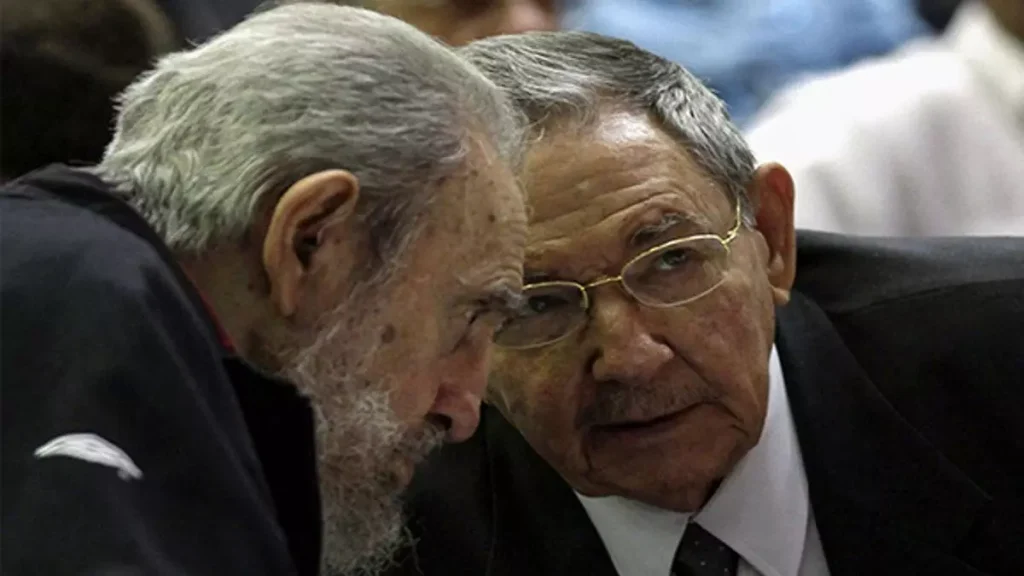
Fidel Castro, shortly before his death, confessed to a journalist that “the Cuban model doesn’t even work for Cubans.”
 14ymedio, Ariel Hidalgo, Miami, November 30, 2025 — I’m not talking, of course, about the society idealized by Marx, where the State would supposedly dissolve and all the means of production would pass directly into the hands of the workers—something never actually achieved in any country. Socialism supposedly referred to a system that would benefit all of society, because back then workers labored long hours for meager wages that was barely enough to survive and they lived in tenements in the poorest slums, so the whole family—women and children—had to join in that hard work as well.
Marx and Engels labeled all the socialists who came before them as utopian. And yet, paradoxically, Marx turned out to be the most utopian of them all. His proposal for a workers’ State that would expropriate capitalists and landowners, and would transform that state into a new, gigantic, and absolute monopoly that would no longer represent the workers and, therefore, would not stop in its voraciousness, dispossessing even the people themselves, anyone who possessed any means of subsistence, however modest. Thus, even self-employed workers would be subjected to administrators appointed by the State itself, giving rise to a colossal bureaucracy, a new social class above the entire population. And at the top would be established a small group as the elite of a party, the only one legally permitted, supposedly the vanguard of the entire proletariat.
This “socialism” that was not socialism, created by “communists” who were not communists, was what became known as state socialism.
This “socialism” that wasn’t socialism, created by “communists” who weren’t communists, was what became known as state socialism or “real socialism,” which most people would later simply call “communism.” But state socialism isn’t socialism; it’s statism.
Why did all those Eastern European governments implode without coups, wars, insurrections, or assassinations—not even Romania, erroneously presented as an exception? (Communism continued after Ceausescu’s death with Iliescu, who was worse than him until his peaceful defeat in 1996 by a democratic coalition.)
Why did China and Vietnam have to make radical changes, introducing capitalist elements into their regimes? Why did Cambodia end in a genocide of over 1.5 million people? Why does Cuba always require an external ally to subsidize it and must resort to mass exoduses every fourteen or fifteen years to alleviate tensions? Why is it now facing a humanitarian tragedy of prolonged blackouts, famines, and epidemics, the true number of deaths of which is still unknown?
All these questions have one answer: an economically unsustainable system. Why unsustainable? Because it suffers from what I call, for clarity, degenerative pathogens — contradictions of interest among large groups of people that negatively affect the production process in different socio-economic formations. In these systems, one party lacks productive interest, thus requiring extra expenditure to pay foremen or supervisors, and in the case of slavery, overseers, who are responsible not only for the smooth operation of the work but also for ensuring it doesn’t stop, since neither the slave nor the day laborer owns what they produce.
A clear example is reflected in a parable of Jesus: “The good shepherd lays down his life for the sheep. The hired hand, who does not own the sheep, sees the wolf coming and runs away because he is a hired hand and cares nothing for the sheep.” (John 10:12).
Even those pathogens can lead to collapse, in the case of capitalism, to productive units such as several US airlines
Even those pathogens can lead to collapse, in the case of capitalism, to productive units such as several US airlines at the end of the 20th century, three of which closed permanently due to strikes by their employees demanding wage increases.
However, when another airline, United Airlines, ran into crisis for the same reasons, and an eminent man, Robert Reich, President Clinton’s Secretary of Labor, mediated between them, the employers argued that they could not grant wage increases without the company being affected by fierce competition. Reich suggested granting them company stock instead. This was done, and the workers called off their strike. Later, having become owners themselves, they not only relinquished the wage increase but, on the contrary, agreed to reduce it. What Reich had done, in this case, was simply to eliminate the degenerative factor.
In all socio-economic formations, the number of people with a real interest in productivity, such as slave owners, feudal lords, and capitalists, is a minority, because they have been the ones who appropriated most of the value produced, and these degenerative pathogens have caused great human tragedies throughout history, such as the tens of thousands of slaves killed in the first century BC during the Spartacus rebellion, and the more than one hundred thousand in 1525 among the feudal peasants who rose up against the Holy Roman Empire.
What happens to communist regimes? They suffer from two degenerative pathogens, twice as many as the capitalist system. On the one hand, there are the workers, who have no incentive because their wages don’t cover all their needs and they can’t demand better conditions from a single owner who simultaneously makes the laws, judges, and enforces them by force. On the other hand, there are the thousands of administrative bureaucrats controlling means of production that they don’t own, but which they exploit as if they did. Hence, there are two conflicts: labor and administrative.
Neither the workers nor the administrators have a real interest in productivity; only an elite, incapable of exercising effective control over those thousands of bureaucrats, does. As this author wrote 44 years ago in the manuscript that earned him an eight-year prison sentence: the revolutionary leadership, like Dr. Frankenstein, created a monster that it was then unable to restrain.
Fidel Castro, shortly before his death, confessed to a group of students that the “Revolution” could be overthrown from within.
That is why Fidel Castro, shortly before his death, confessed to a group of students that the “Revolution” could be overthrown from within, and told a journalist that “the Cuban model is not even good for Cubans.”
The late intellectual Carlos Alberto Montaner demonstrated, from a liberal perspective, the superiority of capitalism over communism, arguing that while in the former there were hundreds or thousands of people – the capitalists – with a genuine interest in productivity, in the latter that interest only existed in twenty or thirty people of the Political Bureau of the single Party and the Council of Ministers.
This is true in the sense that while capitalism has only one degenerative seed, communism has two. So, taking Montaner’s reasoning to its logical conclusion, we could ask ourselves: What would the situation be like when that interest is shared not just by the twenty or thirty in communism, nor by the hundreds or thousands in capitalism, but by millions? In other words, what would a society without any degenerative seed be like? It would be a country with unprecedented prosperity.
In the Cuban case, this could only be possible through a profound change in the structures of society, which is what defines a revolution. If in the 1959-68 revolution almost all private property was nationalized, now it would be the State itself that should be nationalized, giving workers in all those centers and companies a share of the profits they themselves generate and dissolving all the monopolies created by that State.
If during the period from 1959 to 1968 almost all private properties were seized, now it would be the State itself that should be seized.
Most of those who theorize about democratization processes in Cuba see the return of confiscated properties to their former owners as one of the first steps, without considering the changes that have occurred over more than six decades; many have even disappeared. Those owners, except for the many who have already passed away, would very likely prefer compensation. But in the early years of this transition, the country would not be in a position to pay such compensation due to all the devastation caused by that regime. What is most urgent, beyond ideologies, is a pragmatic policy to incentivize all productive sectors.
If Martí said that “the monopoly was an implacable giant at the door of all the poor,” it is time for those poor to hold the most gigantic of all accountable, to intervene against the great intervener.
____________
COLLABORATE WITH OUR WORK: The 14ymedio team is committed to practicing serious journalism that reflects Cuba’s reality in all its depth. Thank you for joining us on this long journey. We invite you to continue supporting us by becoming a member of 14ymedio now. Together we can continue transforming journalism in Cuba.
