In Marianao, rubbish is set alight to block a street; demonstrations in San Miguel del Padrón, Diez de Octubre, Alamar and Regla, as well as Las Tunas and Baracoa, in the east of the country.
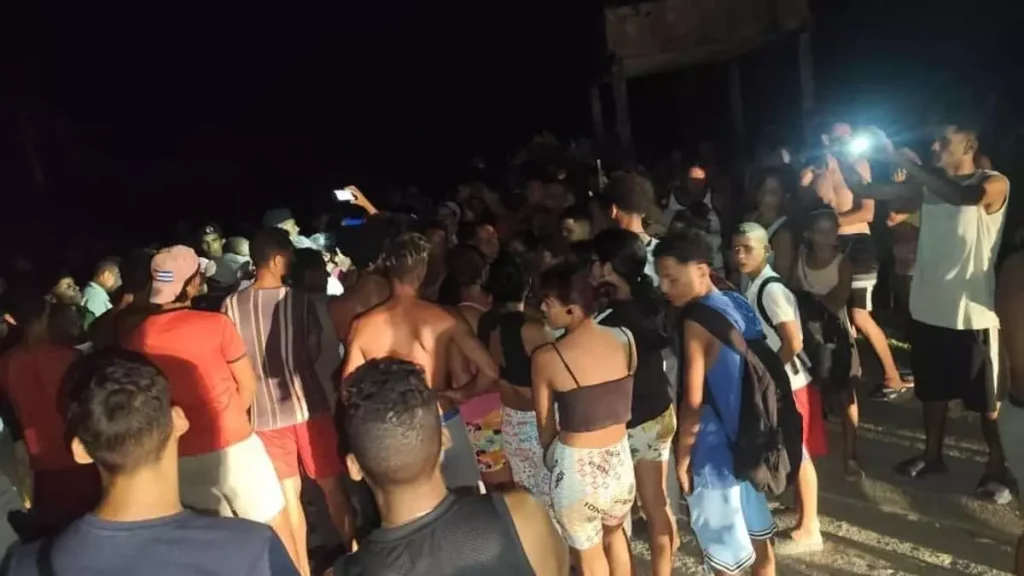
 14ymedio, Havana, 9 December 2025 — On Monday, the streets of Marianao, in Havana, were crowded with people angry about more than 12 hours of power cuts. A dozen videos have shown unhappy and tired people yesterday facing yet another night of “insufficient generation capacity”, as journalist Bernardo Espinosa described the 61% shortfall in national electricity production for the night (more than 2,000 megawatts for a demand of 3,300 MW).
Omar Ramírez Mendoza, an engineer at Unión Eléctrica, explained on Noticiero Estelar that three of the four largest units in the national electricity system (SEN) were “out of base generation” and a total of ten, which were damaged or under maintenance, were also out of service. Added to this is the unavailability of some 1,000 MW in distributed generation. This situation has been developing on the island for months, but it is affecting the capital, which is especially prone to outages, more than ever before.
The worst situation was in Zamora, one of the poorest neighbourhoods in Marianao, where not only were they hitting pots and pans, but lighting bonfires in the middle of the street, rubbish bins were being knocked over and people were shouting that they were fed up. The police quickly arrived at the scene of the protests, and although there were no clashes or arrests at first, many assumed that arrests would follow later.
The worst situation was in Zamora, one of the poorest neighbourhoods in Marianao, where not only were they banging on pots and pans, but lighting bonfires in the middle of the street.
“As normal, the same vicious circle: now they catch three or four ringleaders, [because] the neighbourhoods are full of security forces, and the blackout gives money to the regime, which saves thousands of dollars with the power cuts, and also to the gossipers on social media, shameless people who are profiting from the misfortunes of the poor Cuban people,” wrote one user on social media.
Some videos show how, in the course of the protests, the power eventually comes back on in the area. “It worked,” writes one user who shared images of the moment. “It didn’t work. They know how to keep the slaves happy. Give them a couple of hours of power,” replied another.
The protests spread to other municipalities, including San Miguel del Padrón, Diez de Octubre, Alamar and Regla, where people were also shouting about how nobody cares because not only
was there no electricity, but also no water or sanitation.
People are getting more upset at a time when, not far away, the El Vedado Film Festival is on, where they are trying to keep things normal. Havana residents are unhappy at seeing the lights on in the event’s cinemas while their homes are in a permanent blackout. “In El Vedado there are lights, music, screens. In my house, I can’t even charge my phone,” one resident told this newspaper over the weekend. In reality, it is just an illusion. More than one screening has been cut short by a sudden blackout.
With things as bad as they were in the capital, the east of the country was in an even worse situation. From Bayamo, a social media user claimed that there had been no electricity for more than 20 hours, encouraging theft and the spread of viruses, with mosquitoes everywhere in the darkness. “It should be the whole country, this out and out abuse of the people is too much,” she cried.
The protests also reached Baracoa, in Guantánamo, where it was a pro-government account that gave the most coverage to the event, claiming it was a spontaneous gathering “to express concerns related to water supply and electricity service, both affected by known and objective causes”.
The account claims that the authorities engaged in dialogue with the population, who did not utter “any offensive slogans” and that, afterwards, the residents withdrew “peacefully”.
The information, put out by the Primera Trinchera account, argues that this is not a protest against the government, as “some media outlets and profiles linked to anti-Cuban propaganda have spread” in order to “sow mistrust, foment disorder and create an image of chaos that does not correspond to reality”. The account maintains that the authorities engaged in dialogue with the population, who did not shout “any offensive slogans” and that, afterwards, the residents withdrew “peacefully”. “The people of Baracoa, known for their civic-mindedness and attachment to the Revolution, are not swayed by these smear campaigns or by those who thrive on discrediting others and spreading lies,” they wrote.
In Las Tunas, residents of the El Marañón neighbourhood in Yarigua took to the streets on Saturday, banging pots and pans and shouting, “Electricity schedule! Respect the people!” Those affected, who walked along the Carretera Central, partially blocking the road, said that in the last week they had been getting an average of 25 minutes of electricity per day.
The promises made by the Minister of Energy and Mines for a year in which no great improvement is expected, and Qatar’s recent announcement that it will contribute four and a half million dollars through the United Nations Development Programme (UNDP) to help the situation, come too late for an exhausted population. If they arrive at all.
Translated by GH
____________
COLLABORATE WITH OUR WORK: The 14ymedio team is committed to practicing serious journalism that reflects Cuba’s reality in all its depth. Thank you for joining us on this long journey. We invite you to continue supporting us by becoming a member of 14ymedio now. Together we can continue transforming journalism in Cuba.
