Xi responds to the president that his country “is willing to continue providing assistance and support to Cuba, to the extent of its ability”
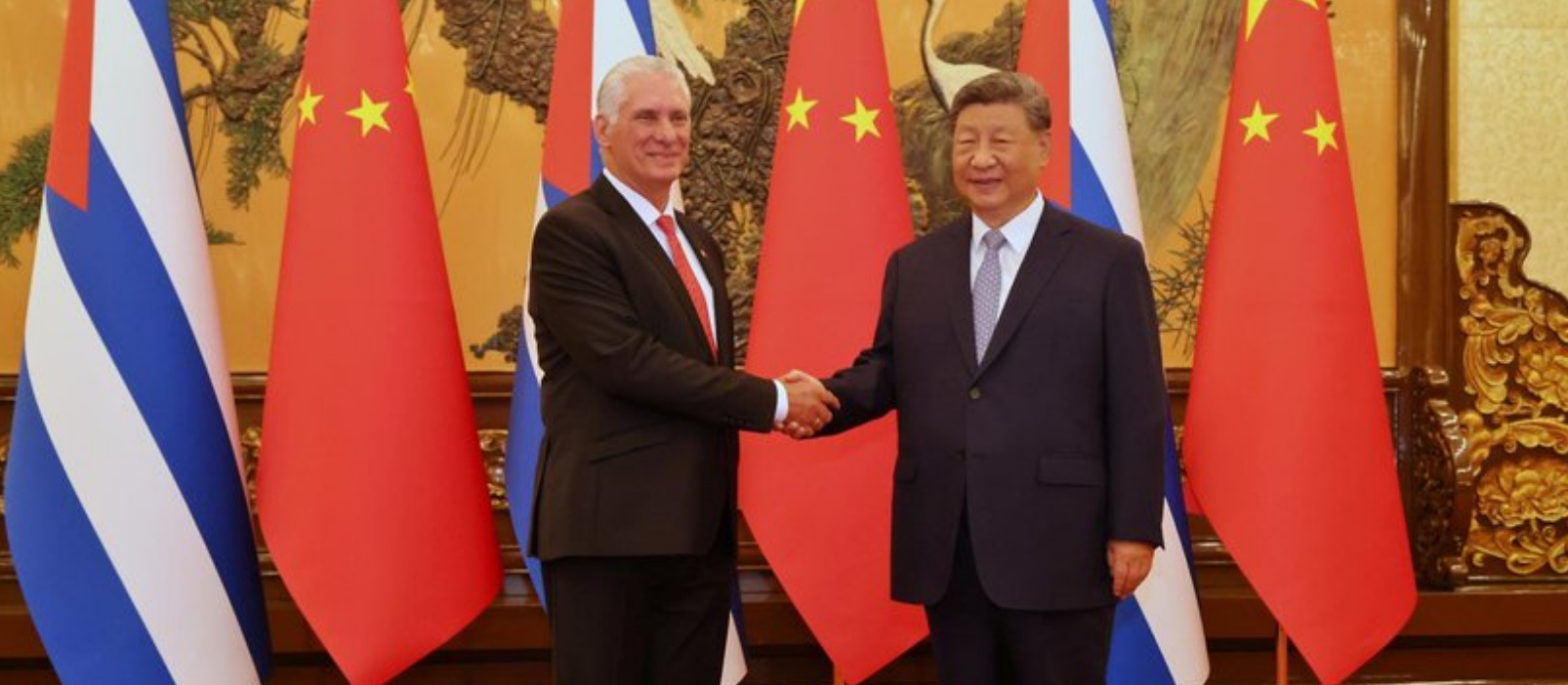
 14ymedio, Havana, 4 September 2025 — Miguel Díaz-Canel made a promise to Xi Jinping this Thursday during their meeting in Beijing: “Cuba is ready to provide a better business environment for Chinese companies,” said the Cuban leader. It is the second time he commits this week, after saying the same thing in Hanoi to the Vietnamese authorities; however, China is not a country with strong growth like Vietnam, but the second world power.
More skillful than his counterparts, Xi gave a measured response: His country “is ready to continue providing assistance and support to Cuba, to the extent of its ability.”
The Chinese president called for “strengthening the integral strategic cooperation and continuing coordination and cooperation” between Beijing and Havana, according to a statement issued by state agency Xinhua. At the same meeting, the two leaders also signed bilateral agreements on agriculture, territorial cooperation, artificial intelligence, traditional medicine, infrastructure, press, cinema and television.
They also signed bilateral agreements on agriculture, territorial cooperation, artificial intelligence, traditional medicine, infrastructure, press, cinema and television
But beyond that, it was all words. Xi spoke of the “iron friendship” between the two countries and assured that his country “will continue to firmly support Cuba in its just struggle against interference and the blockade.” There was nothing new that, for the moment, suggests such good results as those obtained by Díaz-Canel in his December 2022 tour, when he obtained a donation of 100 million dollars and the cancelation of the debt.
Díaz-Canel thanked China for “its selfless support and assistance to the economic and social development of Cuba.” The Chinese ambassador in Havana, Hua Xin, already made it clear in an interview this Wednesday with the official weekly Workers that the aid of his country has a more strategic than economic reward. “Cuba is the starting point of relations between China and Latin America and the Caribbean, the cradle of the China-Celac Forum and a bridge for relations in the area,” he said.
In Beijing, Díaz-Canel attended the military parade commemorating the 80th anniversary of the end of World War II in the Pacific, together with other leaders – the Russian, Vladimir Putin, and the North Korean, Kim Jong-un, in addition to Xi himself, who reviewed the troops.
Putin and Kim had the preferred place for escorting the Chinese host, but Díaz-Canel had to settle for a discreet fifth row in the line of followers.
Following his meeting with Xi and the signing of documents, including those relating to the Belt and the Silk Road Initiative, political consultations, practical cooperation, cultural exchanges and the Global Security Initiative, the Cuban leader went to the Monument to the Heroes of the People, where he presented a floral offering. The memorial is located on Tiananmen Square, where in August 1989 there was a serious crackdown and massacre of students protesting against the communist regime.
There, Díaz-Canel placed a floral arrangement inspired by the same one that Fidel Castro placed in 1995. “To the memory of the heroes of the Chinese people, in the name of the Cuban people, Communist Party and Government,” indicates the commemorative ribbon, with the colors of the national flag.
The Cuban leader also met with Li Xi, a member of the Standing Committee of the Political Bureau of the Central Committee of the Communist Party of China, recently in China. Also in the entourage were Chancellor Bruno Rodríguez Parrilla, the head of international relations of the Communist Party of Cuba, Emilio Lozada García, and the Cuban ambassador to China, Alberto Blanco Silva.
The meeting was attended by some of the other ministers most interested in getting something from China, including Oscar Pérez-Oliva Fraga, of Foreign Trade and Investment; Vicente de la O Levy, of Energy and Mines; Mayra Arevich Marín, of Communications; and the president of the Central Bank of Cuba, Juana Lilia Delgado.
In the early afternoon, the Cuban leader also met with comrade Han Zheng, vice-president of the People’s Republic of China.
At the end of this visit, Díaz-Canel will leave for Laos on what will be the last stop of his Asian tour before returning to the Island.
Translated by Regina Anavy
____________
COLLABORATE WITH OUR WORK: The 14ymedio team is committed to practicing serious journalism that reflects Cuba’s reality in all its depth. Thank you for joining us on this long journey. We invite you to continue supporting us by becoming a member of 14ymedio now. Together we can continue transforming journalism in Cuba.