
Los Van Van, Chucho Valdés, Leo Brouwer and Other Cuban Artists Take ‘The People’s Side’

Cuban musician and producer Leo Brower. (DC)

14ymedio bigger14ymedio, Madrid | 14 July 2021 — Voices of international Cuban artists, critical of the repression unleashed by the regime since Sunday’s protests, are multiplying. Among them are those of figures formerly related to the regime, and those of figures who have been very prudent in expressing their political opinion are striking, for example the musicians Leo Brouwer and Chucho Valdés, who signed a letter in 2003 justifying the execution of three young people for hijacking a ferry in an attempt to leave the country.

“The abuse of power has reached such sadness and pain!” Brouwer writes on Facebook. “I never imagined that the sectors in charge of order in Cuba would attack the ordinary and peaceful people of Cuba. When Cubans protest, there is no doubt that politics, or rather, political and military power, has been exceeded”, and he asks: “How can they live in peace?”

The members of the famous Van Van orchestra also spoke via social networks. “Cuba’s Van Van exists thanks to our people; therefore, we will always support the people, whoever they are, whatever they think, defend the ideology they defend, always with the utmost respect”, they publish. “We support the thousands of Cubans who demand their rights, we must be heard. Let’s say “no” to violence and outrage, let’s call for peace in our streets.” continue reading

“I am very saddened by what my people are suffering, including my family”, Valdés wrote in his official networks. “Enough of deceit and lies! International humanitarian aid is essential”

Chucho Valdés and Haydée Milanés spoke in the same sense. “I am very saddened by what my people are suffering, including my family,” Valdés wrote on his official networks. “Enough of deceit and lies! International humanitarian aid is essential”.

Milanés, who sided with artists who on November 27th achieved, in a peaceful demonstration, dialogue with the Vice Minister of Culture, Fernando Rojas, stated on Monday that the Cuban people “have peacefully taken to the streets with their demands” and that the Government has “the obligation to listen to them”. It is inadmissible, he asserted, “that the authorities are calling for a confrontation among Cubans. Enough of the repression, enough of the violence!”

Singer Leoni Torres, who had already spoken out in favor of Sunday’s protests and released a video clip with Willy Chirino last month, made a live broadcast from Havana on Tuesday, with his wife, actress Yuliet Cruz, condemning “the violence unleashed by the Government of Cuba against its people”. “There is no justification,” Cruz declares, “all this could have been avoided”. “You cannot repress people who are asking to be heard”, the actress continued. “They have their total and legitimate right to state what they don’t want, and it’s the rulers’ duty to listen and respond to that demand”.

Torres adds: “Fostering a civil war among Cubans is not the way. That was the worst decision the rulers could have made”.

Other musicians, who until now had never spoken out, are Pupy Pedroso, Elito Revé or Adalberto Álvarez.

Yunior García Aguilera, one of those arrested last Sunday, made public his resignation as a member of the Union of Cuban Writers and Artists

“With pain and indignation, I see how my people are mistreated,” Pedroso wrote, “just for disagreeing with what they do not want, just for protesting”. And he expressed: “My people, I am on your side”.

Revé, for his part, stated that “violence is the incompetent’s last resort”. “Say no to violence against my people, brothers, friends, public and family”.

“It is impossible to remain silent about everything that is happening in our country”, said Álvarez. “The blows and the images I see of violence against people that go out to the streets to express peacefully what they feel, hurt me … The streets of Cuba belong to Cubans”, he argued. “To these people I owe what I am today and I do not care about anyone’s way of thinking” because “beyond political thought is the human right”.

Artist Lázaro Saavedra has gone further and, in a video comment that he shared on Monday, in which officers, dressed in uniform and civilian clothes, are observed attacking with sticks an individual who is defending a young man. He stands: ” I will no longer exhibit in any State institution in this country, and I am canceling my personal exhibition with my children for this year at Galería Habana”. There is no justification, says the artist among exclamations, “for this excessive use of force against civilians and particularly with the intervention of special troops.”

Similarly, playwright Yunior García Aguilera, one of those arrested last Sunday, announced his resignation as a member of the Union of Writers and Cuban Artists (UNEAC). “I cannot continue to belong to an organization that turns its back on a considerable part of the population, and chooses to show obedience to an abusive power. I cannot remain in a choir that sings praises to those who ordered the repression against young people and battle against Cubans. I cannot be part of a group of artists and intellectuals who have preferred silence or complicity”, García wrote on his Facebook page.

On Wednesday, popular comedian Ulises Toirac stated that the Cuban government “has taken the path of repression and has closed itself off from any possibility of understanding”. “I cannot support the people’s claims be answered with violence. It is not a people’s government that beats and subdues. I beg the forces of power not to comply with orders of unjustified violence. They are facing their relatives, their friends, those that they swore to defend”, he said.

Carlos Acosta, an outstanding dancer and choreographer, joined the expressions of support for Cubans who took to the streets this Sunday: “I am absolutely opposed to all kinds of violence and all kinds of intolerances. It is not a crime to want to be heard, it is not a crime to aspire and want a better country. Cuba deserves to reach maximum capacity in its development. The people need to be heard. A better future is possible for everyone, but in order to achieve it, we must know how to listen and live with our differences. In this, I trust and believe”.

“To be aired live in Spain, I hold the Government responsible for anything that may happen to me”

So far, there are no official deaths, injuries, or arrest figures. The Government has only acknowledged one deceased so far, a 36-year-old man who participated in a protest on Monday in the marginal neighborhood of La Güinera, in Havana. Civil organizations estimate about 5,000 arrested or investigated since July 11th, including 120 activists and journalists.

One of the arrests could be seen by Spaniards, live on open television this Tuesday. The well-known Cuban YouTuber Dina Stars, who had published a video of her participation in a peaceful demonstration in Havana on Sunday, was in an interview with the program Todo es Mentira, on channel four, when State Security agents broke into her home to take her to the Zapata and C station, according to the promoter. “Spain Live, I hold the Government responsible for anything that may happen to me”, she said, before having to cut off the communication.

According to Efe news agency, Edy Suárez, who witnessed the arrest, he and other friends went to the central station to inquire about the young woman’s whereabouts, but the agents explained that she had been transferred to another detention center several kilometers away, east of Havana.

“We don’t know her whereabouts. We are concerned”, Suárez told Efe, who hopes “that Dina’s example will help people show solidarity with other missing Cubans who were arrested on Sunday and whose whereabouts are unknown”.

Translated by Norma Whiting

____________

COLLABORATE WITH OUR WORK: The 14ymedio team is committed to practicing serious journalism that reflects Cuba’s reality in all its depth. Thank you for joining us on this long journey. We invite you to continue supporting us by becoming a member of 14ymedio now. Together we can continue transforming journalism in Cuba.
Cuban Man’s Corpse Left Unattended for Days in a Varadero Hotel

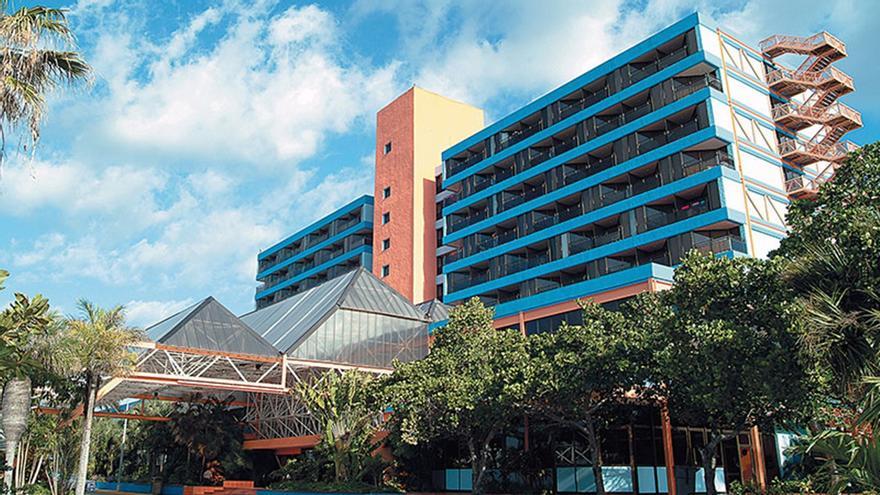
The Cuban died in a room at the Puntarena hotel in Varadero. (Solwayscuba)

14ymedio bigger14ymedio, Havana, 8 July 2021 — Warning signs of a pandemic collapse keep coming from Matanzas, a province that has been leading the list of daily infected cases for days. In a room at Puntarena, a hotel in Varadero that functions as medical center for positive Covid-19 cases, the corpse of a traveler was left unattended for over two days by the authorities.

The man died on Tuesday morning, as reported by other travelers from the island who are quarantined at this hotel. In a video published on social media, the entrance of the room with an oxygen tank can be seen, as well as the silhouette of the legs of a corpse laying on a bed covered with a white sheet.

“I lent them my phone so they could film the video. I don’t have the guts to see it, but it hurts,” said Katia Jiménez, a Cuban who uploaded the video to Facebook showing what was taking place. The woman, who tested positive for Covid-19, said that the deceased person was continue reading

a fellow traveler who was staying in a room one floor above hers.

“Everyone who knows me, knows that I have a strong character, but I am very sympathetic. He was not my friend, but he was a human being who lost his life due to medical negligence,” she added.

Jiménez also denounced “the lack of medical attention and medicine” at the isolation center. She added that she was treated with Interferon which gave her adverse reaction, and she was not examined by medical personnel. “It is easy to talk about it, but it is harder to go through it like I am.”

Since June 5, the government established that all travelers, who are Cuban residents, arriving at international airports in the tourist towns of Ciego de Avila and Varadero, have to pay a mandatory isolation package at a hotel in foreign currency (MLC).

According to health officials, travelers will have to stay quarantined for seven days. The isolation package includes, besides lodging, transportation from the airport to the isolation center.

https://www.facebook.com/100028332881168/videos/847735256180896/

People, I am broadcasting live something that happened at this hotel, this hotel [grab this] this hotel Puntarena, in Varadero. Were are people who traveled to Russia and [returned home and] we are here quarantined in this hotel but they really haven’t even treated us with Interferon here. 

You can see there an oxygen tank. What we are going to show you is a human being who passed away three days ago, and this is the time that nobody has come to pick him up. [keep talking]

Three days ago, he passed away.

You can see it there. There he is. [keep talking] There he is, still laying in bed. Waiting. Waiting. We do not go inside because the room is infected. He has been in that bed for… like the boy says, approximately three days, and the doctors, nothing, not even the funeral car, nobody has come to check on him. Not even his family, I think,  because nobody wants to enter the room.

Likewise, isolation packages are also enforced for travelers arriving at Havana and Santiago de Cuba airports, at prices ranging from 378 to 1,907 dollars.

This past Wednesday “a new protocol to confirm positive cases” was announced, which gives prevalence to antigen tests over PCR.

However two days before that, new regulations for travelers arriving from Russia were being implemented. After their stay at the isolation center, they needed to complete  a 14-day quarantine in their respective homes, “complying with all the regulations indicated by the health department,” published by the official media this past Monday.

Health personnel is in charge of “watching” protocol compliance, provided that the homes were these travelers reside are identified, explained Dr. Neil Reyes Miranda, director of the Health Department for Villa Clara province. After ten days, the PCR test will be repeated because “some cases have turned positive on the ninth day. If they have symptoms, they have to report it to the health department so that they can be admitted into a healthcare facility.”

However, these regulations are not enforced for Russian tourists. Around 230 visitors from Russia were in isolation in Varadero because, allegedly, they tested positive for Covid-19. After many of them expressed their discontent on social media, saying that they were vaccinated and had traveled to the island after testing negative on PCR tests, Moscow demanded that Cuba “release” their quarantined tourists.

After the increase of infected cases, the country lives in a dramatic scene where social media has become one of the few channels to voice the collapse of medical centers. Patients and their relatives have demanded medical care, PCR testing, or ICU care.

This is the scene in Matanzas where some healthcare workers and residents denounced the conditions in which several hospitals were at maximum capacity, with no extra beds and patients confined waiting in hallways.

Translated by: Rita Ro

____________

COLLABORATE WITH OUR WORK: The 14ymedio team is committed to practicing serious journalism that reflects Cuba’s reality in all its depth. Thank you for joining us on this long journey. We invite you to continue supporting us by becoming a member of 14ymedio now. Together we can continue transforming journalism in Cuba.
The Cuban People Have Already Started Walking and Are Not Going to Stop

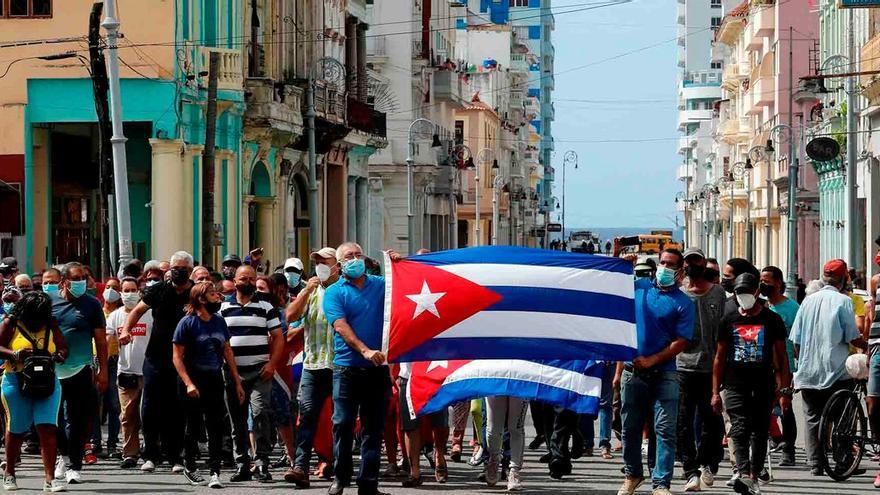
A moment of the demonstration this July 11th in the city of Santiago de Cuba. (14ymedio)

14ymedio bigger14ymedio, Ariel Hidalgo, Miami, July 13, 2021 — The Cuban president de facto (because he was never elected by any vote) has blamed U.S. policy for the social explosion that shook the entire country this past Sunday. According to him, it was this policy that generated the critical situation, both in the economic and health spheres, which caused the people to despair.

But any Cuban who lives or has lived in Cuba knows very well that the responsibility for most of the calamities they have suffered for many years does not lie in a supposed external blockade, but in the internal blockade imposed by the government leadership itself against free economic initiative – through high taxes, high cost of licenses, and multiple prohibitions.

The well-known policy of not doing and not letting do: they neither carried out the structural reforms that could have freed the population from so many tribulations, nor did they allow them to improve their living conditions by their own means.

They were not even being asked to return to capitalism with a neoliberal policy. Congress after congress of that ruling party, intellectuals and groups of Cubans formed within that system, demanded an opening toward a more democratic and participatory socialism that would encourage greater productivity and generate an improvement in the country’s economic situation. As that path meant having to renounce the absolute power continue reading

that they have enjoyed up to now to the detriment of a population in the worst conditions, they did not want to listen.

This government has even rejected offers of humanitarian aid on several occasions, especially in recent months, with the worsening of the epidemic, and has refused to open a humanitarian corridor to help the most affected regions.

Sick people of all kinds deteriorate from lack of medication. The elderly die from lack of antibiotics, and children die, not only from the virus but from malnutrition. Many patients are sent home to die because nothing can be done in the hospitals. The suicide rate, especially among the elderly, has risen alarmingly. All of this they try to hush up. Moreover, during the first quarter of this year, the Government has allocated only 0.003% of its budget to public health and social assistance.

So who are the real instigators of these protests?

Díaz-Canel has also said that “counterrevolutionary” elements within the country have been instigated from abroad, but as he cannot deny that the protests have been massive in more than twenty important towns in all provinces – something in the style of the now disappeared Commander in Chief would be a plebiscite with a very clear result: “out” – he argues that many people are “confused”. But for more than six decades that dictatorship has maintained a monopoly on information by controlling the mass media of communication and dissemination. Who’s carried out the job of confusing the people?

No one can say that they were not alerted. Yesterday’s social explosion was like a chronicle of announced rebellion. At the beginning of 2021, the two survivors of the original nucleus of half a dozen political prisoners that started the dissident movement published in this newspaper and sent to Díaz-Canel’s office a proposal to begin, peacefully and in an orderly manner, a process of changes for the solution to the Cuban problem that would be satisfactory for all, and we warned that discontent “could explode massively with serious irreparable consequences.” The author of these lines himself published on May 21, in the Havana Times digital magazine, the article “The Cuban Leadership is Sleeping on a Powder Keg.”

The government response was not only to ignore the calls, but to further increase the precariousness of the population. In January, with the unification of the currency, purchasing power fell despite the increase in nominal wages, because the prices of goods and services rose greatly. And on June 21, it suspended deposits in dollars, which had allowed citizens access to the products of the basic shopping basket.

Did you think that the population was going to continue indefinitely with folded arms and bowed head, enduring so much neglect and so much injustice?

Now, his response is brutal repression: “The order to fight is given. Revolutionaries take to the streets!” And he clarified, so that there would be no doubts: “We are ready for anything!”

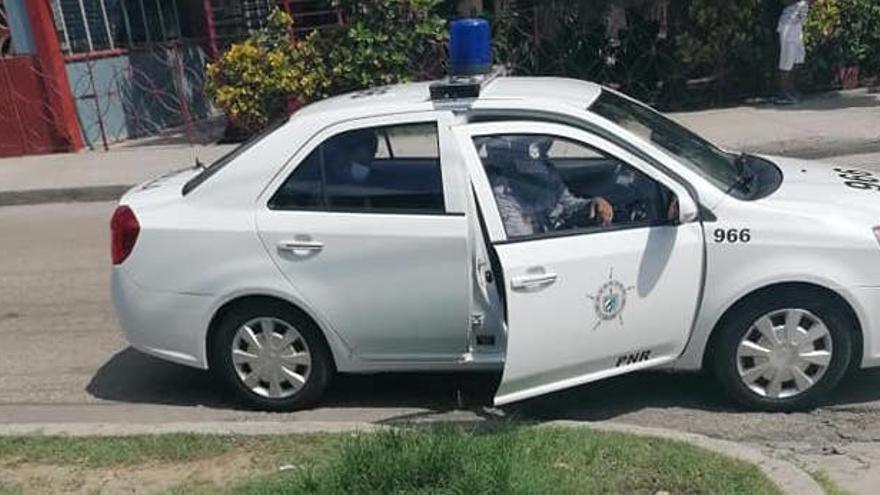
The demonstration was peaceful, a universally recognized right, until police repression and government mobs began, generally repressive agents in civilian clothes.

Many wonder what will happen now. The only thing I know is that the Cuban people have already started walking, and they are not going to stop.

Translated by Tomás A.

____________

COLLABORATE WITH OUR WORK: The 14ymedio team is committed to practicing serious journalism that reflects Cuba’s reality in all its depth. Thank you for joining us on this long journey. We invite you to continue supporting us by becoming a member of 14ymedio now. Together we can continue transforming journalism in Cuba.
Human Rights Organizations Report There Were More Than 700 Repressive Actions in Cuba During the month of June

The Cuban Observatory for Human Rights (OCDH) registered 713 repressive actions on the island in June. (Facebook / Héctor Valdés Cocho)

14ymedio bigger 14ymedio, Havana, 9 July 2021 – “The dictatorship has lost much socially and this is what is going to explode in a moment.” This is how resoundingly Martha Beatriz Roque portrayed the situation in the latest monthly report of the Cuban Center for Human Rights (CCDH), which she directs. The Cuban government has imprisoned up to 36 dissidents so far this year, the organization reports, in what it continues to call “the new version of the [2003] Black Spring.”

The figures are corroborated by the Cuban Observatory for Human Rights (OCDH), which registered 713 repressive actions on the island in June, of which 114 were some kind of detention, and 599 “other abuses.”

The main abuses consisted of harassment at activists’ homes, fines, threats, citations, and acts of repudiation. Of those arrested, three ended up in prison, as did five of those issued citations.

Martha Beatriz Roque highlights, among them, the arrest of rapper Maykel Castillo Osorbo, catalogued by Amnesty International, she recalls, “as one more example of the repression and racism of the Government of Miguel Díaz-Canel.” In addition, she mentions the case of the artist Hamlet Lavastida, arrested upon returning from Germany from a residence in a Berlin gallery. continue reading

Roque points to the economic situation as the main factor for popular discontent. “At this time, there is nothing that is representing so much damage to the dictatorship, as the dictatorship itself, because the rejection of the people is very great,” says the activist. She recalls the announcement of the return of nationwide blackouts, a scenario similar to that experienced during the Special Period in the 1990s. The power outages, “together with the serious water supply situation, irritate the Cuban family in general,” Roque says.

The report also refers to the European Parliament resolution on human rights and the political situation in Cuba, which was approved by an absolute majority on June 10. For Roque, this document shook the foundation of the Political Dialogue and Cooperation Agreement between Cuba and the European Union. However, the activist is sure that the dictatorship skillfully put that matter in the background “with the announcement of the elimination of the use of the dollar in the country.”

The resolution indicates “the lack of commitment and will” of the Government to make more than “minimal” progress towards a change that will allow the reform of the Cuban political system to improve “social and political participation, in addition to the living conditions of the citizens.”

These claims join those of other organizations such as the Cuban Observatory for Human Rights, which denounced the Government of Cuba to the United Nations for more than 30,000 arbitrary detentions committed in the last five years. Added to this are the alerts from the Cuban Center for Human Rights and Cuban Prisoners Defenders about the increase in political prisoners and convicted on the island. There are currently 152, of which 14 were incarcerated last May, considered the highest monthly number since March 2003, and 11 in June.

Translated by Tomás A.

____________

COLLABORATE WITH OUR WORK: The 14ymedio team is committed to practicing serious journalism that reflects Cuba’s reality in all its depth. Thank you for joining us on this long journey. We invite you to continue supporting us by becoming a member of 14ymedio now. Together we can continue transforming journalism in Cuba.
European Union Asks the Cuban Government to ‘Allow’ and ‘Listen’ to the Protesters

Protesters this July 11 in front of the Cuban Capitol, in Havana. (EFE / Ernesto Mastrascusa)

14ymedio biggerEFE (via 14ymedio) – The High Representative of the European Union (EU) for Foreign Policy, Josep Borrell, urged Cuban authorities on Monday to “allow” peaceful protest demonstrations and to “listen” to their participants.

“I want to ask the government to allow these peaceful demonstrations and listen to the demonstrations of discontent from the protesters,” Borrell said at a press conference after a Council of EU Foreign Ministers.

The Spanish politician explained that the situation in Cuba was not on the Council’s agenda, since events on the island had been developing in the last hours.

“I have discussed with colleagues the news that was arriving from Cuba. As far as we know, there have been important demonstrations in a significant number of cities to protest the lack of medicines, the increase of those affected by Covid, and also protests in against the regime,” he said.

Borrell acknowledged that it has been a “manifestation of discontent that, as far as we know, has reached a dimension that continue reading

has not been known since 1994.”

He noted that there have been a “significant number of demonstrations and there has also been a response from law enforcement authorities that, for the moment, has not been been of a character that has produced particularly violent clashes, according to the news I have available.”

In any case, he asserted that “everything must be said very carefully and with much attention because events may change in the next few hours.”

“The issue has not been the subject of discussion but, certainly, I want to express the right of the Cuban people to express their opinions in a peaceful way,” he stressed.

According to European sources, Borrell mentioned the situation in Cuba in the Foreign Council “without elaborating”, “without commenting” and without evaluating “in a very descriptive” or “in depth” way.

The sources justified that the discussion of the protests in Cuba had not gone further in this meeting of Foreign Ministers due to the fact that it is an “ongoing” situation and, therefore, it is “premature” to pronounce on the matter.

This “political-social” process must see “if it is prolonged or acquires a more consistent appearance” in order to be able to analyze the situation on the island with greater perspective, according to the sources.

The United Nations, for its part, said on Monday that it is following the development of the protests in Cuba and stressed the need for the authorities to fully respect the freedom of expression and assembly of citizens.

“We are simply monitoring what happens and … we want to make sure that the basic rights of the people, especially freedom of expression and the freedom of peaceful assembly, are respected,” said spokesman Farhan Haq when asked about it in a press conference.

Haq stressed that, in the face of these protests, the United Nations maintains its “position of principle” on the importance of respecting these fundamental freedoms and said that he hopes that will be the case in Cuba.

Asked about the alleged attacks suffered by journalists, including a photographer for the AP agency, the spokesman for the UN Secretary General, António Guterres, stressed that “anywhere in the world the press must be free to do their work without harassment and without violence or threats of violence. ”

Translated by Tomás A.

____________

COLLABORATE WITH OUR WORK: The 14ymedio team is committed to practicing serious journalism that reflects Cuba’s reality in all its depth. Thank you for joining us on this long journey. We invite you to continue supporting us by becoming a member of 14ymedio now. Together we can continue transforming journalism in Cuba.

Shopping Visas for Cubans for the Colon Free Zone Reactivated

The Deputy Director of Migration, María Isabel Saravia, clarified that it was not a new visa category. (Wikimedia)

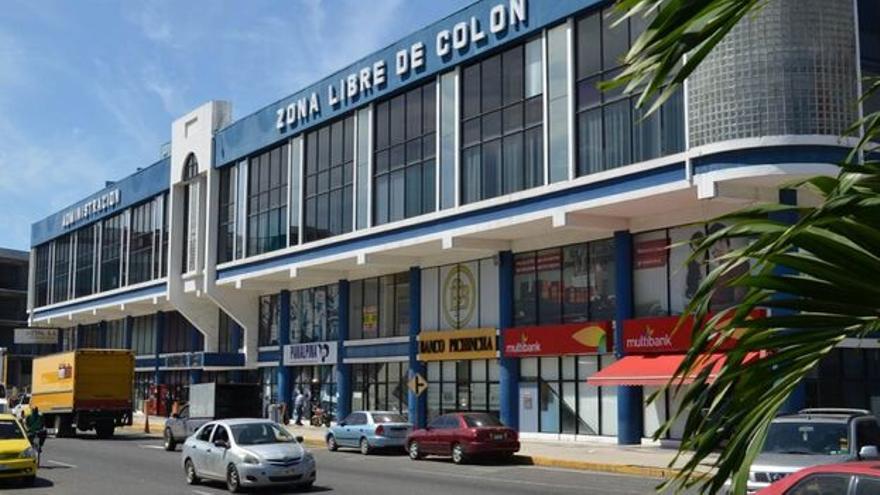
14ymedio bigger14ymedio, Havana, July 12, 2021 — Businessmen from the Colón Free Zone and representatives of the National Migration Service of Panama reached an agreement to resume the granting of tourism shopping visas to citizens of Cuba and the Dominican Republic. In a meeting on July 8, with local media gathered, they highlighted as an objective the economic reactivation of the shopping plaza.

The Deputy Director of Migration, María Isabel Saravia, clarified that it was not a new visa category. The provision is included in the Administrative Procedure Resolution adapted to the reality of the Colón Free Zone. In it, a person who demonstrates economic solvency to enter the country and take care of their own expenses is established as a possible visa applicant.

At the meeting, the manager of the free zone, Giovanni Ferrari, affirmed that the goal “is to reach figures in the tens of thousands with buyers from the Caribbean islands that positively impact the finances of the companies in the free zone and the city of Colón.” continue reading

The new agreement, he added, seeks to meet the requests of citizens with restricted nationality, and that could be extended to other countries in the future, “analyzing case by case, according to their specifics.”

For her part, Saravia said that to access the visitor’s card, applicants must present a plane ticket at the respective consulates once the visa is approved. According to the law, they will not be able to enter Panama with “dependents” and the document includes multiple entries as established by the immigration scheme of “entry-purchase-exit from the country.”

The tourism card, known as a “shopping card” among Cubans, simplified the procedures to enter the country for nationals of the Island. Created in October 2018, the document allowed the arrival and stay in Panama for up to 30 days by citizens, the self-employed or artisans.

In mid-2019, the Migration Service of Panama temporarily suspended the issuance of the visa, alleging irregularities detected by the Government in the allocation and use of this procedure. On March 16, it issued an order permanently eliminating the tourist card.

On that occasion, the Panamanian Administration declared that from that moment on, both Cubans and Dominicans had to apply for a Tourist Visa before “the Panamanian Consulate of their country of origin or residence, or through a legal representative at the headquarters of the National Migration Service,” complying with current regulations.

Before being eliminated, the “shopping card” had cost 20 dollars in Cuba and could also be requested by Cuban citizens who had previously traveled to Panama or to a third country and who did not have a stamped visa.

The ease of entering Panamanian territory allowed many Cubans to increase their personal wealth by importing all kinds of merchandise that they later sold in Cuba on the black market.

In 2018, 57,251 Cubans visited Panama, and by mid-2019, more than 17,000 Cubans had arrived there, leaving Panamanian merchants in the Colón Free Zone a profit of more than 100 million dollars, according to figures for those years provided by the authorities of that commercial center.

Translated by Tomás  A.

____________

COLLABORATE WITH OUR WORK: The 14ymedio team is committed to practicing serious journalism that reflects Cuba’s reality in all its depth. Thank you for joining us on this long journey. We invite you to continue supporting us by becoming a member of 14ymedio now. Together we can continue transforming journalism in Cuba.
The Schemes of Cuban State Security

A young man is arrested by police and State Security agents in the July 11 protests in Havana. (Screen capture)

14ymedio bigger14ymedio, Frank Calzón, Miami, July 14, 2021 — In the midst of the enthusiasm, and as a result of the spontaneous and eminently peaceful protests on the island, there is speculation about what should be done to bring an end to the dictatorship that has so badly governed Cubans for more than 60 years.

A growing number of young Cubans, on the island and in exile, continue to demonstrate, demanding the end of the tyranny.

If the opposition on the island, democratic and peaceful, is a reflection of the composition of the Cuban people–men, women, whites, blacks, believers, atheists, homosexuals, artists, independent journalists, priests–the vault of power is not.

As can be seen in the photos published by the state newspaper Granma, the Castro leadership is composed mainly of white, fat, elderly men, some of them soldiers who accompanied Fidel Castro in the Sierra Maestra exploit.

In the search for ways to the future, Cubans ask themselves: what triggered the protests of thousands of compatriots in many parts of the country? In addition to what everyone recognizes–the prevailing hunger, arbitrariness, and corruption–Cuba undoubtedly entered a new stage with continue reading

the death of the dictator Fidel Castro.

It is the rebirth of civil society, despite the government’s measures, and a new generation that does not want to be like Che, nor leave the Island, and that opposes the state of affairs openly, not clandestinely in the least, the same as the Poles of Lech Walesa, the electrician and union leader of Solidarity, and the Czechs of Václav Havel, the playwright who organized artists, poets and musicians against his Marxist government.

Both are models for the Cuban opposition, whose intellectual forebears are headed by José Martí, who defended freedom at all costs, and wrote that “dictatorship is the same in all its forms.” They are also guided by Mahatma Gandhi, who defeated the British Empire, and Martin Luther King, who ended racial segregation in the American South.

They all have many things in common and put into practice a strategy of peaceful resistance that, precisely for this reason, extended to the populace in general. That has been denied by the Cuban government, which claims that it faces a violent opposition, and tells the international community that these young people from the poorest neighborhoods are Yankee mercenaries.

In this scenario, an understandable reaction has recently surfaced, due to despair, and the lack of knowledge of, on the one hand the nature of Castroism, and on the other the way Central Europeans and others managed to achieve freedom.

Despite the statements of the San Isidro Movement, despite José Daniel Ferrer, despite Cuba Decide, and of religious leaders of all confessions, opposing violence and an armed uprising, in recent hours young people have emerged abroad who say they are preparing several small boats with weapons to “liberate Cuba.”

We must ask those young people, many who act in good faith, to listen to the Patriotic Union of Cuba, and to study how, without shedding Cuban blood, the San Isidro Movement and the song Patria y Vida have put the Plaza of the Revolution on the defensive like never before. Naturally, many of these young people are not State Security agents, any more than were those who many years ago came to the island in commando operations (resulting in a few sugar-cane fields being burned) and were frequently intercepted and killed when disembarking.

Let us remember that the second-in-charge of one of the organizations best known for such actions told the Miami Herald that for years he had been an infiltrator for State Security, that he had worked as a double agent, that the Cuban authorities knew in advance the details of each disembarkation, and that when the diaspora did not provide resources for the purchase of boats and weapons, the funds came from the Cuban Government.

The message, as the most distinguished and courageous leaders of the opposition have recognized, is that, just as in Central Europe, it is the dictatorship that benefits from violence and the use of arms against it.

If that handful of young people does arrive on the island with their initiative, the regime will surely say that they are CIA agents, salaried employees of imperialism, and will imprison them, claiming that the opposition movement in Cuba is part of such nonsense. Hopefully this does not happen, not only to save those lives, but also to deny excuses to Raúl Castro and Miguel Díaz-Canel in their discrediting campaigns in this country, in the European Union, and in the international press.

Translated by Tomás A.

____________

COLLABORATE WITH OUR WORK: The 14ymedio team is committed to practicing serious journalism that reflects Cuba’s reality in all its depth. Thank you for joining us on this long journey. We invite you to continue supporting us by becoming a member of 14ymedio now. Together we can continue transforming journalism in Cuba.

‘Lay Down Your Arms,’ Asks General Lopez-Calleja’s Nephew

Rodríguez Halley is an actor and an audiovisual creator. (Captura)

14ymedio bigger14ymedio, Havana, 14 July 2021 — Carlos Alejandro Rodríguez Halley, nephew of General Luis Alberto Rodríguez López-Calleja, sent a strong message to his uncle and to the island’s power leadership: “Lay down your arms.” The young man called for the beginning of a “process of transition to democracy” after the protests that took place throughout the island in recent days.

López-Calleja, Raúl Castro’s ex-son-in-law, although he has kept a low profile within the regime’s politics, is a member of the Central Committee of the Communist Party, executive president of Grupo de Administración Empresarial, S. A. (Gaesa) and is considered by analysts as the man behind the economic power of the Castro family.

“At the moment I am not in Cuba, I left for fear of reprisals from my own family for projecting myself in my social networks in favor of human rights and continue reading

dialogue between intellectuals and artists with the government,” said Rodriguez Halley.

The young man said that his family is part of the power elite on the island and mentioned that his words were addressed to them, to the Cuban military, and with special emphasis he mentioned his uncle López-Calleja and his cousin Raúl Guillermo Rodríguez Castro, Raúl Castro’s grandson.

“I call for harmony and for them to lay down their arms. Let a process of transition to democracy begin in Cuba. The people have shown that they no longer want you in power, listen to your people,” he added.

Rodríguez Halley called for an end to violence, imprisonment and repression: “do not be responsible for more bloodshed.” The people demonstrated in the streets, he said, “that they do not agree with their government, a failed government that has led to a situation of health, economic, social and political crisis.”

Lopez-Calleja’s nephew also rejected the position of the island’s regime of blaming the U.S. Government for what is happening in the country. The U.S. Administration “has demonstrated that it is not going to intervene militarily in Cuba,” he said.

“Enough repression, lay down your arms. I make a call from the love I have for my family, for my country, for all Cubans and for humanity. Let us not forget that ’homeland is humanity’,” he concluded.

At the Eighth Party Congress held last April, López-Calleja was appointed a member of the Political Bureau. The military consortium Gaesa controls a large part of the tourism business and other strategic sectors on the island. Analysts had been predicting for years the military man’s rise to positions closer to the top of Cuban power.

Rodríguez Halley is an actor and audiovisual creator, and has worked in films such as Caballos, by Fabian Suárez and in 2019 he independently wrote and directed the short film Un chino cayó en un pozo, awarded a Diploma al Mérito by the jury of the Panama Human Rights Film Festival (BannabáFest).

Translated by: Hombre de Paz

____________

COLLABORATE WITH OUR WORK: The 14ymedio team is committed to practicing serious journalism that reflects Cuba’s reality in all its depth. Thank you for joining us on this long journey. We invite you to continue supporting us by becoming a member of 14ymedio now. Together we can continue transforming journalism in Cuba.
Cuban Telecommunications Monopoly Etecsa Censors SMS Texts Containing the Words ‘Psiphon’ and ‘VPN’

This Monday and Tuesday, most of the cell phones on the Island were without a web browsing service. (Facebook)

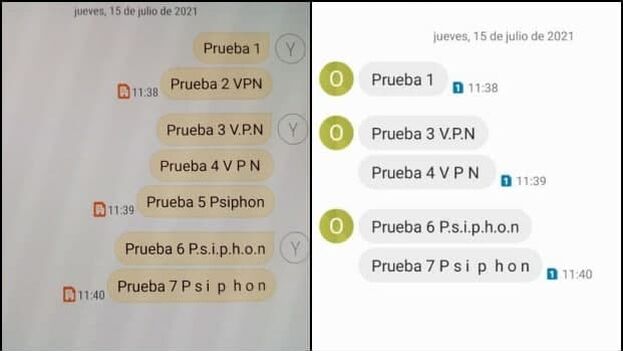
14ymedio bigger14ymedio, Havana, July 15, 2021 – After the popular protests last Sunday, the Cuban Telecommunications Company S.A. (Etecsa) has not only censored instant messaging services such as Telegram and WhatsApp, but has also implemented a filter that prevents mobile phones from sending text-only messages that contain the letters VPN (Virtual Private Network) and the name of the Psiphon tool.

With this censorship, Etecsa could be trying to prevent the users of the state monopoly from passing on details about the use of VPNs (virtual private networks), essential to circumvent the blockade against the independent press media, the only ones reporting on the July 11 demonstrations, and also block the uploading of videos of these protests to social networks.

“I wanted to tell my cousin in Cárdenas that if he couldn’t open Facebook Messenger, he could use the Psiphon VPN, but he never responded to the text messages I wrote him,” Darío, a 22-year-old young man who used the anti-censorship tool only a few days ago, tells 14ymedio.

“When I called my cousin to check, he told me that he hadn’t received anything by SMS. That’s when I sent him another message, in which I separated the letters “V P N”, and then he received it,” he said. “The worst thing is that Etecsa charged continue reading

me for all the previous messages as if they had sent them and they had reached their destination. It’s a scam!”

The Etecsa customer is never warned that messages will be subjected to a content filter.

Another customer of the company reported that the word “Psiphon” is also blocked in SMS, and messages sent from Cuban nationals that include the name of this tool never reach the recipient’s inbox. “They don’t want people to find out how they can access certain services that have been blocked since Sunday.”

This newspaper conducted the same test with several combinations of messages in which the initials VPN were included together, separated by spaces, and by periods. The same procedure was repeated with the word “Psiphon” and all of these checks, carried out from a dozen mobile numbers in five provinces of the country, produced the same results: the SMS only arrived if a space or a period was inserted between each letter.

Psiphon is a widely used tool in Cuba, but for three days its use exploded due to the cutting of many internet services. The application includes different mechanisms to avoid censorship that are used by a variety of servers, proxy servers, and VPN technologies. Several press outlets recommend using it to read their content from countries with censorship.

For years, users of the only cell phone company in the country have suffered from online congestion and limited areas of coverage, but also from the strict blocking of key terms and phrases on mobile messaging, also known as SMS, its acronym in English.

Five years ago, this newspaper published a list of words that were censored at that time. Several users, annoyed that their messages were collected but not delivered, then verified that SMS containing references to “human rights,” “hunger strike,” and the names of various dissidents and independent journalists, never reached their destination.

The contract that each user signs with Cubacel (Etecsa’s cellular network) when activating a mobile phone line specifies that among the causes for terminating service is any use “that violates morality, public order, the Security of the State, or serves to support the carrying out of criminal activities.”

Customers are never warned that their messages will be subjected to a content filter or that part of their correspondence will be blocked if it refers to dissidents, concepts uncomfortable for the ruling party such as “human rights,” or blogs critical of the Government.

With more than six million cell phone users, telecommunications censorship in Cuba is not a new tool for the Plaza de la Revolución. This Monday and Tuesday most of the cell phones on the island were without a web browsing service. Activists frequently denounce the blocking of their mobile phones on December 10 (Human Rights Day) or when they try to meet.

Blocking uncomfortable digital sites has also been a frequent practice for the ruling party. On the list of the inaccessible you’ll find everything from foreign sources such as Cubaencuentro to local newspapers such as 14ymedio. Many users manage to circumvent censorship by sending news by email and making offline copies of the pages, which are passed from hand to hand thanks to technological devices such as USB memory sticks or external hard drives.

With the arrival of internet connection service to mobile phones in December 2018, instant messaging services such as Telegram, WhatsApp and Facebook’s Messenger have become very popular among citizens, activists, and informal merchants. More difficult to control than SMS, these platforms played an important role in last Sunday’s assemblies.

Translated by Tomás A.

____________

COLLABORATE WITH OUR WORK: The 14ymedio team is committed to practicing serious journalism that reflects Cuba’s reality in all its depth. Thank you for joining us on this long journey. We invite you to continue supporting us by becoming a member of 14ymedio now. Together we can continue transforming journalism in Cuba.

Cuban Officials Mobilize Public Sector Workers to Confront ‘Mercenaries’

“Acts of revolutionary reaffirmation” were reported at several locations in Havana.

14ymedio bigger14ymedio, Havana, July 14, 2021 — While key locations in Havana, such as the Capitol, continue to be heavily guarded by police, there are increasing reports of large scale mobilizations of “rapid response brigades” at workplaces throughout the city.

Simultaneously, young Cubans of military age are being recruited and reservists are being mobilized.

An employee at a state-owned textile plant was summarily fired after refusing to participate in a counterdemonstration.

“I was at the Sunday protest at Ayestarán and Aranguren and saw people in civilian clothes with rocks and baseball bats in their hands. Several protesters had been hit in the head and were bleeding,” Natasha Medina told 14ymedio.

“I went with my cousin, who was very frightened, so I couldn’t stay long,” said the young mother, who works as a translator. “I took a lot of photos but, as we were leaving, eight guys told us we had to delete the photos and videos. I refused but continue reading

they told us that, if I didn’t, they would arrest us and my cousin freaked out.”

Something similar happened when employees of a publishing house went to “a farm owned by the UJC (Union of Young Communists) looking for sticks” to hand out to company workers to “defend themselves from provocations by mercenaries.” A source at a publishing house told 14ymedio that several employees at the farm said they were not going to be giving sticks to anyone.

In the city of Cardenas elite troops from the Revolutionary Armed Forces barged into the house of Daniel Cardenas Diaz, beat him, shot him and took him into custody. The incident was recorded on video, which was widely distributed on social media. This incident, which occurred on the corner of Velazquez and Palma streets, followed a speech by President Miguel Diaz-Canel in which he called upon government loyalists to confront the protesters who were calling for freedom throughout the entire country last weekend.

“Why did they do this in my house? There’s nothing here. The broke everything. They took everything away,” laments Marbelis Vazquez, wife of the detainee. A puddle of blood remains in the middle of the living room floor, evidence of military aggression. “They shot him down… and loaded him in the back of a truck like a pig,” she adds.

“Acts of revolutionary affirmation” were also reported on Wednesday in Vedado’s Mariana Grajales Park, where loudspeakers were installed early in the day to play a selection of songs by pro-government songwriters. “They are already mobilizing factory workers from here in the neighborhood to attend the event. I also see groups of people have arrived from nearby workplaces,” says one resident.

“This is unheard of,” noted a young Sancti Spiritus resident outside a Havana hard currency store on Wednesday morning. “The place is closed and heavily guarded but there’s no explanation why, though everyone knows it’s because of fear it will be ransacked, as happened other parts of Cuba.”

“But even with all of this, and the alarming pandemic figures, jeeps with loudspeakers roam the streets, exhort people to come out and defend the Revolution,” he adds. “Isn’t all movement supposed to be restricted after 2:00 PM because of the virus?” For the young man from Spiritus, it is becoming increasingly difficult to “understand these people.”

The use of force does not seem to have affected the morale of protesters, as indicated by an act of repudiation directed at two women suspected of being chivatonas, or state security informants. The scene, in which loud voices were heard but no acts of physical violence against the alleged offenders were witnessed, seems to have occurred in a small town somewhere in the country’s interior, though no one has said exactly where.

____________

COLLABORATE WITH OUR WORK: The 14ymedio team is committed to practicing serious journalism that reflects Cuba’s reality in all its depth. Thank you for joining us on this long journey. We invite you to continue supporting us by becoming a member of 14ymedio now. Together we can continue transforming journalism in Cuba.
Against the Wall, The Cuban Government Authorizes Unlimited Imports of Food and Medicine

Travelers arriving to the country via Cayo Coco and Varadero are exempt from this new measure. (Canal Caribe)

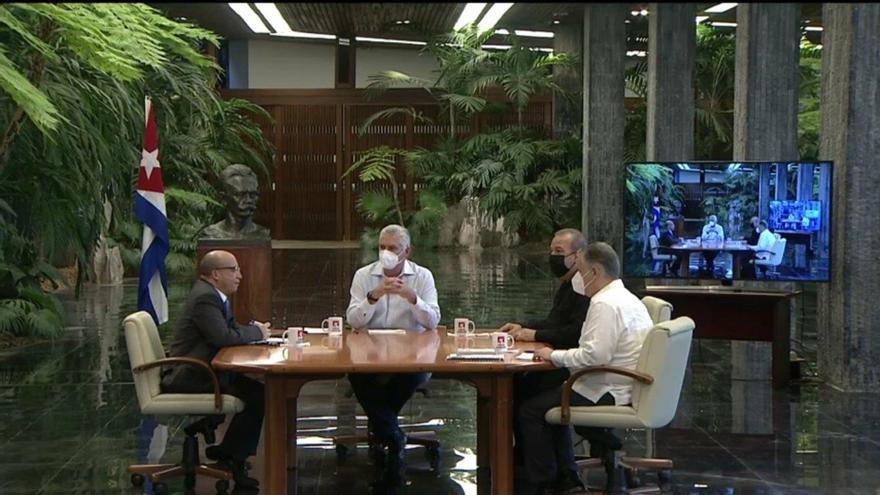
14ymedio bigger14ymedio, Havana, July 14, 2021 – The Cuban Government announced this Wednesday that it authorizes “under special circumstances” imports of food, cleaning products, and medicine for passengers arriving to the island. The entry into the country of these goods will be “without limit of import value and free of tariffs,” said Prime Minister Manuel Marrero Cruz.

The measure, which will be in effect until December 31, 2021, was announced by Marrero in the Roundtable program, where he also explained that these products “must be differentiated from the rest of the luggage.”

Marrero emphasized that currently the entry of medicines is exempt from payment of customs duties and that their non-commercial import of up to 10 kilograms is authorized.

The prime minister pointed out that tourists arriving in the country via Cayo Coco and Varadero are not eligible for these new measures, and that, according to a recent measure, they can only enter with one suitcase.

Marrero acknowledged the shortage of drugs in continue reading

hospitals and pharmacies. He said that the current crisis is due to the foreign exchange deficit and this has caused drug shortages. According to him, antihypertensives, antibiotics, analgesics, contraceptives, vitamins and products for stomatological use are the ones in short supply.

Last April, amid the precipitous economic deterioration and aggravated by the pandemic, several activists launched a petition via Change.org for the Government of Miguel Díaz-Canel to open a “humanitarian corridor” that would allow the introduction of medicines and basic necessities into Cuba.

The request intensified this weekend on social media with the hashtag #SOSCuba and trended on Twitter after dozens of international artists offered their support to the hundreds of Cubans who called for “a humanitarian corridor.”

Ernesto Soberón, general director of Consular Affairs and Cuban Residents Abroad, had assured this Sunday that this is a campaign “to represent Cuba in total chaos” and that it does not correspond to the real health situation or its indicators of COVID-19.

The new import measures come after protests, Sunday, July 11, which have left people dead, arrested and injured throughout the country.

Translated by: JGR Penton

____________

COLLABORATE WITH OUR WORK: The 14ymedio team is committed to practicing serious journalism that reflects Cuba’s reality in all its depth. Thank you for joining us on this long journey. We invite you to continue supporting us by becoming a member of 14ymedio now. Together we can continue transforming journalism in Cuba.

We Started Speaking the Same Language and Suddenly Dozens of People Were Joining In

“There was a police cordon on San Rafael where they tried to disperse us. Then there was an altercation with protesters who were marching ahead.” (14ymedio)

14ymedio bigger14ymedio, Natalia López Moya, Havana, July 12, 2021 — “It was very moving, something I had never experienced. I had seen it in videos from other countries but, here in Cuba, never in my lifetime,” confesses Yonder, one of the young Havana residents who, on Sunday afternoon, left their homes to call for freedom in Cuba.

“As I was walking towards 23rd and Malecón, I saw kids randomly hanging out, looking all around, and they began to join us. We started speaking the same language and suddenly dozens of people were joining in,” says Yonder, who is 32.

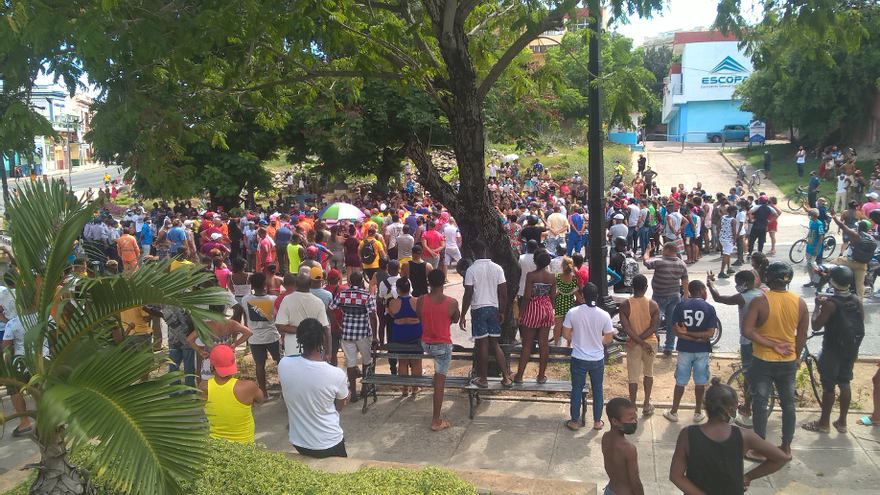
“Police officers were just standing there because they couldn’t do anything,” he adds. By the time he and his friends got to Galiano Street, there were already about five-hundred marching against the dictatorship, he claims. “A sea of people shouting ’homeland and life’, ’freedom’, ’we are not afraid.’”

A few hours after videos of protests in the town of San Antonio de los Baños went viral, thousands of Cubans in several cities across the island continue reading

raised their voices and peacefully took to the streets to join anti-government demonstrations.

https://www.facebook.com/watch/?v=1699489226925997

“One of the most emotional things I experienced was when an incredibly enthusiastic older man in flip-flops joined us. He hadn’t finished putting on his shirt and face mask when people began applauding him,” says Yonder.

He describes bystanders appearing to be “surprised, astonished,” applauding them as they walked past. Others shouted “strength” or “freedom” from their windows or from the street.

“At certain points — never with us on the street — some people shouted slogans like ’Long live Fidel’, ’Long live the revolution’, ’Look at the worms.’ The marchers yelled back, ’Go hungry, we’re doing this for you too.’”

Police had blocked the main streets so Yonder and other protesters had to take alternate routes to get to the Capitol. When they got to San Rafael Boulevard, he noticed a man in a wheelchair was marching too. He notes that many older people joined them but, unable to keep up the rapid pace, shouted “enough already,” “freedom” and “right now” in support.

“There was a police cordon on San Rafael where they tried to disperse us. Then there was an altercation with the protesters who were marching ahead. We reorganized a little but I had to run. It was a stampede. I didn’t see anyone on the ground. We were all helping each other. We changed direction and headed towards the Chinatown gate.”

Along the way, the police arrested anyone they saw filming or shouting cheers. “I saw a lot beatings; they hit a lot of people. Many were taken away in trucks. When they had fifteen or twenty people in a truck, they took off. People with head injuries who were still bleeding. They were put on those trucks and taken directly to the police station, not to a hospital.”

The police also arrested a taxi driver who had stopped his vehicle in the middle of the street as a form of protest. “They dragged the driver away to jail, beating him. Then one of the soldiers got in the taxi and drove off.”

As this was happening, a large crowd near the Marti Theater in Central Havana was trying to move towards the Capitol while another large group was approaching Central Park.

Shortly before leaving for home, Yonder saw stones flying overhead, directed at the police. “I tried to get out, out of safety concerns. but I was worn out. I hadn’t eaten anything since the day before and I was dying of thirst.” Between Ayestaran and Aranguren streets he saw a sign that stuck in his mind: “Diaz-Canel, resign.”


____________

COLLABORATE WITH OUR WORK: The 14ymedio team is committed to practicing serious journalism that reflects Cuba’s reality in all its depth. Thank you for joining us on this long journey. We invite you to continue supporting us by becoming a member of 14ymedio now. Together we can continue transforming journalism in Cuba.
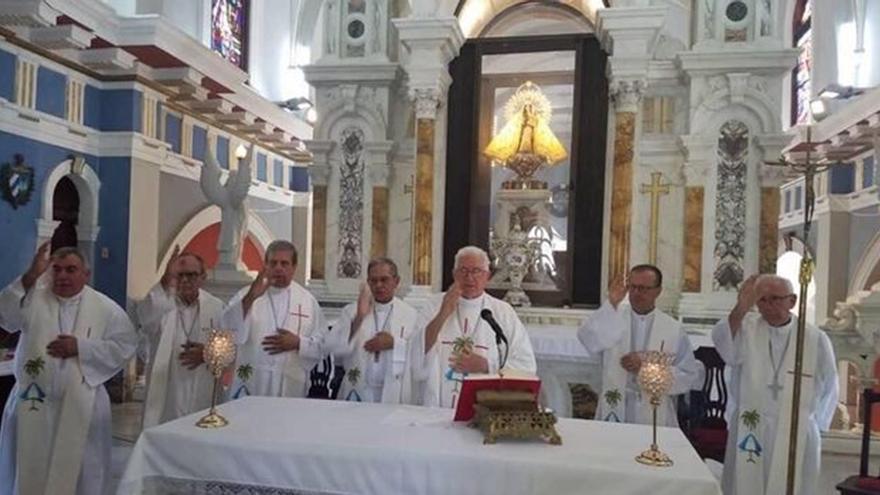
The Bishops Say the Cuban People Have the Right to Express Their Hopes and Needs

“Crises are not overcome by confrontation but by seeking understanding,” says the COCC. (14ymedio)

14ymedio bigger14ymedio Havana, July 13, 2021 — “In light of events our people have experienced, we cannot close our eyes or look away as though nothing was happening,” declared the Cuban Catholic Bishops Conference (COCC) on Monday. The statement followed protests that that took place across the island in which thousands expressed their frustration at the nation’s deteriorating economic and social situation.

The Catholic church expressed concern that “these appeals will be met with inaction, which is helping to perpetuate the problems rather than resolving them.”

“Not only do we see that the situation getting worse but that we are moving towards a rigidity and hardening of positions that could produce negative responses with unpredictable consequences that would harm us all,” the COCC said.

In their statement the bishops assert the government “has responsibilities and has tried to adopt measures to alleviate these difficulties.” They insist, however, that “people have the right to express their needs, desires and hopes and, in turn, to publicly express how some measures that have been taken are seriously affecting them.

The bishops insist that “a favorable solution will not be reached by decree or by calls for confrontation.” They emphasize the importance of open dialogue, common agreements and “concrete and tangible steps which allow all Cubans, without exclusion, to contribute to building the nation.”

“Crises are not resolved by confrontation but by seeking understanding,” says the COCC, which warns that “today’s aggressiveness opens wounds and feeds resentments for tomorrow that will require great effort to overcome.”

The bishops urge Cuba’s leaders “not to encourage the crisis situation but, with serenity of spirit and good will, to listen, understand and adopt an attitude of tolerance in order to seek a common path towards a just and appropriate solution.”

“We ask the Virgin of Charity, Queen and Mother of all Cubans and constant source of reconciliation, to make of the Cuban nation a home for brothers and sisters in which truth and the common good shall prevail,” the statement concludes.

Among the hundreds of those arrested since Sunday was a Catholic priest, Fr. José Castor Alvarez, who was beaten by government forces in Camagüey after joining demonstrators at a protest.

“I tried to prevent confrontation. I was trying to protect someone when I was hit with a bat.” he says in a video shared on social media. “We are well, thank God, and hope that we can all live in peace, that there is no violence, and that we have peace and justice.”

Cuban priest Fr. Castor Valdés after being hit in the head with a bat and arrested during the protest #11JCuba#SOSCuba De: Janisset Rivero-Facebook pic.twitter.com/WPwPIfVZ0z

— Rolando Nápoles (@RNapoles) July 13, 2021

____________

COLLABORATE WITH OUR WORK: The 14ymedio team is committed to practicing serious journalism that reflects Cuba’s reality in all its depth. Thank you for joining us on this long journey. We invite you to continue supporting us by becoming a member of 14ymedio now. Together we can continue transforming journalism in Cuba.
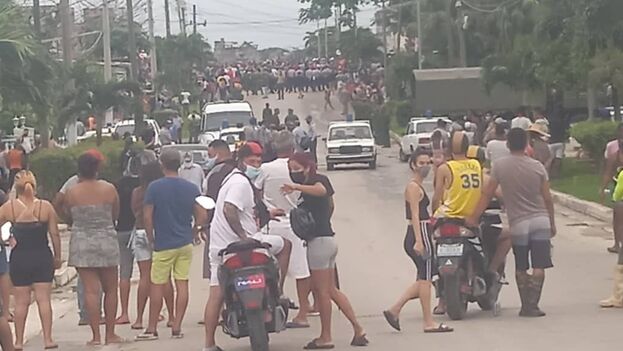
Cuba Changed on July 11th

Thousands of Cubans went out into the street to protest and numerous citizens shouted “We have no fear.” (Facebook).

14ymedio bigger14ymedio, Reinaldo Escobar, Havana, 14 July 2021 — Despite government efforts to make people believe that the popular protests on Sunday, July 11, were organized from the United States and that they were only isolated incidents carried out by antisocial elements, most Cubans have a new perception about the prevailing level of disagreement with the government.

The images showing protesters in numerous cities shouting “we have no fear,” “we want a change” or the simple repetition of the word “freedom” made it clear to each individual that what they pondered and did not dare to say was not an extravagant personal thought but rather a shared feeling.

With the intention of discrediting the testimonies of what actually happened, the official media strive to give examples of the false news that some spread on the networks, but that only raises the suspicion that much of this fake news or hoaxes may have been manufactured precisely with the intention of affecting the credibility of what is disseminated on the networks.

It is enough to recall the time when State Security agent Carlos Serpa Maceira infiltrated the opposition behind the facade of continue reading

an independent journalist who, at the time of his unmasking, appeared before the television cameras, calling Radio Martí by telephone to offer false information and thus “prove” that the independent journalists were lying.

It’s not just about what people have seen and shared on their Facebook accounts. What has more weight is the personal experience of having participated in a spontaneous demonstration, or at least having seen it from behind your window curtains. There are many who have a child, a relative, a friend, at least one acquaintance who shouted or who heard others shout.

This massive exit from the closets of fear will have consequences. The Cuban Foreign Minister may be able to say that on July 11 there was no social uprising, but what he cannot deny is that on that day an explosion in consciences was triggered: the awakening that occurs when it is discovered that it is possible to say aloud in the public square what until now could only be whispered into the ears of the most trusted friends.

Cuba changed and they know it.
____________

COLLABORATE WITH OUR WORK: The 14ymedio team is committed to practicing serious journalism that reflects Cuba’s reality in all its depth. Thank you for joining us on this long journey. We invite you to continue supporting us by becoming a member of 14ymedio now. Together we can continue transforming journalism in Cuba.

‘There is No Popular Uprising, Only an Aggression by the United States, Says Cuba’s Foreign Minister

Cuban Foreign Minister Bruno Rodríguez during the press conference with foreign correspondents, this Tuesday in Havana. (Screen capture)

14ymedio bigger14ymedio, Havana, 14 July 2021 — For the island’s foreign minister, Bruno Rodríguez, “there was no social outbreak in Cuba” on July 11, but rather an “information war” with the participation of large US companies such as Twitter.

During a nearly two hour appearance before 25 foreign correspondents on Tuesday, the minister accused the US of “taking advantage of the pandemic situation” to attack the revolutionary government. “

The Foreign Minister said he had seen scenes of repression “worse in Europe” than those that have occurred on the island since Sunday, when thousands of people rose up against the regime in numerous cities in the country. For the chancellor, the demonstrations of unarmed citizens are nothing more than “riots,” “disorders” and “vandalism,” the blame for which he placed directly on the northern neighbor.

Rodríguez defended the actions of the regime offering the official arguments: the “increased aggression” of the United States, through the “blockade” and the financing with “hundreds of millions of dollars” to “subversive agents” to “interfere in continue reading

the internal affairs” of the island.

The US saw in the virus, said Rodríguez, “an opportunity” to reinforce “the blockade” with political motives and apply what it called “maximum pressure measures to reinforce the aggression against our country.”

Regarding a possible flotilla with humanitarian aid launched to Cuba from Florida, the minister dropped a veiled threat. “I hope (the United States) does not repeat experiences that had tragic consequences in the past,” while not directly mentioning the shooting down of two American Brothers to the Rescue planes in 1996, which left four dead and caused then-President Bill Clinton to sign the Helms-Burton Act.

Far from mentioning these facts, Rodríguez asked the current president, Joe Biden, to suspend the implementation of Title III of that Law, put in place by the previous Administration in 2019, which allows US citizens to sue both Cuban and foreign companies that are benefiting from properties that were expropriated after the triumph of the Revolution in 1959.

At the same time, he continued to warn that “their irresponsible policy may have serious consequences that damage the national interest of both countries.”

“Calling for a humanitarian intervention in Cuba,” he asserted, referring to messages associated with the #SOSCuba hashtag, “is asking for a US military intervention,” which he illustrated with the NATO bombings in Yugoslavia and the 1983 “invasion” of Granada.

“I can say that I have seen really strong scenes of police violence and repression of protesters in European capitals before and during the pandemic, in really different conditions,” the foreign minister replied to the Efe correspondent, who asked him if the suppression of the Internet was will of the Cuban Government.

Three days after the protest the island continues almost incommunicado, something that affects accredited journalists themselves, as they revealed at the press conference.

On Monday, Josep Borrell, the European Union’s High Representative for Foreign Affairs and Security Policy, urged the Cuban authorities to “allow” peaceful protest demonstrations and to “listen” to the participants.

“It is not in Cuba where there has been a repression like the one that has occurred in some European countries,” the minister added, saying that “some police arrest action may have been seen.”

According to the Chancellor, “it is true that (on Sunday) there have been limited violations of order and law, in which the application of the law and the forces of order have been used with absolute moderation.”

Cuba’s diplomatic head also affirmed that during the demonstrations and riots that during in Washington last January, “around 400 journalists were badly treated.”

During the protests on Sunday, photojournalist Ramón Espinosa, from the Associated Press agency, was injured by blows from Cuban police that fractured his nose and caused other injuries.

Cuban President Miguel Díaz-Canel has also denied that there was police repression in the protests, which contrasts with videos disseminated on the networks in which violent repression is observed on the part of police officers and plainclothes agents, and also with statements by witnesses and facts reported by independent and foreign media that covered the events.

For the first time, this Tuesday, the Government admitted one dead, a man who died on Monday during a confrontation between protesters and security forces in La Güinera — a marginal neighborhood of Havana — which also left several injuries between civilians and agents.

The authorities have not yet released the official number of detainees or investigated, which civic associations put at around 5,000.

____________

COLLABORATE WITH OUR WORK: The 14ymedio team is committed to practicing serious journalism that reflects Cuba’s reality in all its depth. Thank you for joining us on this long journey. We invite you to continue supporting us by becoming a member of 14ymedio now. Together we can continue transforming journalism in Cuba.