Father Alberto Reyes points out that “the people want and expect” international intervention. Many Cubans say they “prefer a horrific end to endless horror.”
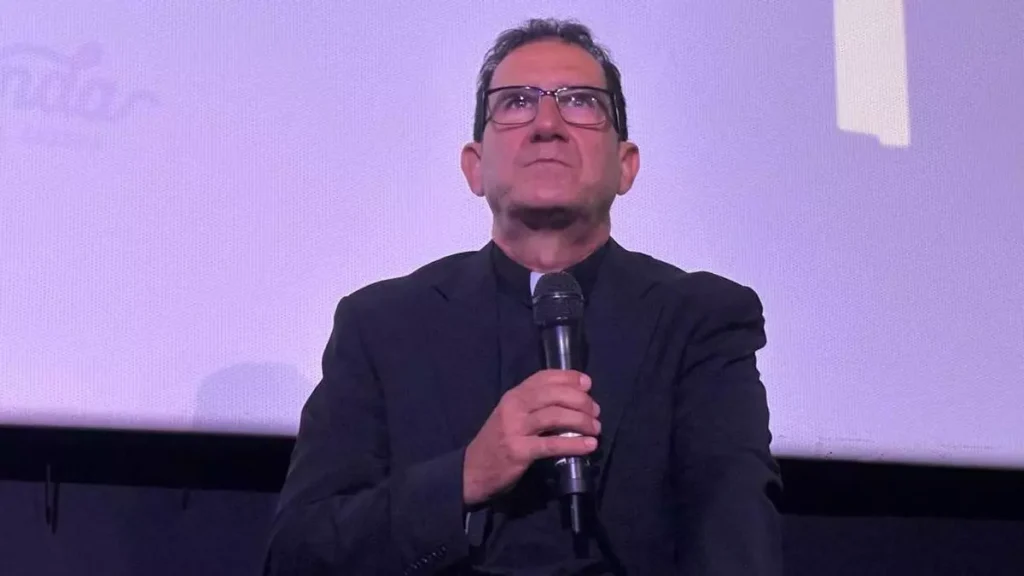
 14ymedio, Dayana Prieto, Madrid, May 23, 2026 / “Cuba is not that happy, Caribbean, beautiful paradise of propaganda.” The phrase, uttered by Cuban priest Alberto Reyes before a packed auditorium in Madrid this Friday, summed up the sense of despair felt by a large part of Cuban society. Amid applause, laughter, and tears, the audience experienced the bitter realization of a country where, according to the priest from Camagüey, “life is unlivable” and “misery is insurmountable.”
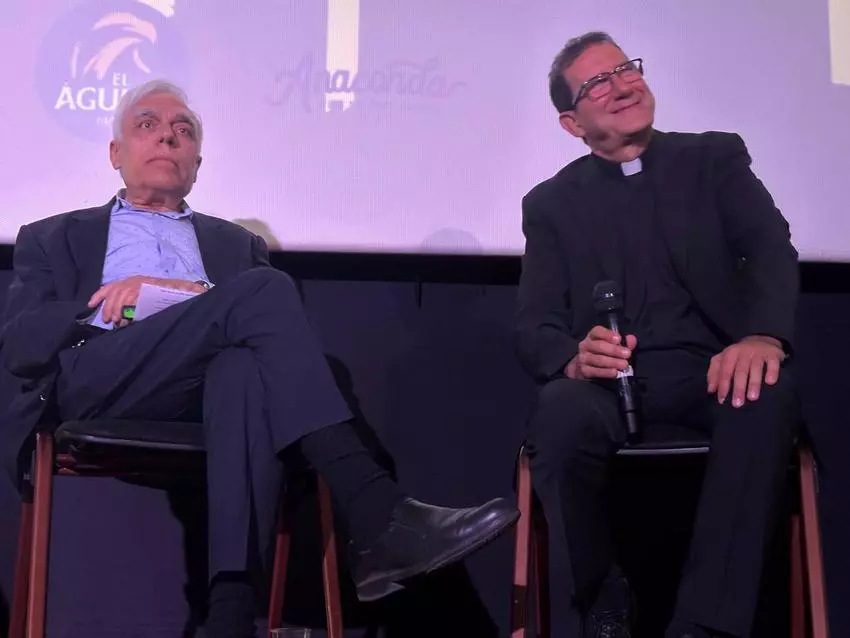
The Palacio de la Prensa in Madrid hosted the presentation of the documentary Cuba’s Eternal Night on May 22nd. The film is by British-American filmmaker, journalist, and human rights advocate Jordan Allott, founder of In Altum Productions and senior advisor to the organization In Defense of Christians. The screening of the film—whose title is inspired by Oswaldo Payá’s famous quote, “The night will not be eternal”—was followed by a discussion of more than two hours with Reyes, one of the most critical Catholic voices in Cuba.
🇨🇺 “Life in Cuba is unlivable”: Father Alberto Reyes’ testimony shakes Madrid / 14ymedio
The event was part of the Fourth Wall project, organized by “It’s Time to Think”, also known as “the thought movement.” The hall, with a capacity of about 200 people, was completely filled with Cubans, Spaniards, and people from various other countries. Before it began, the priest personally greeted the attendees at the entrance, in a gesture that combined pastoral warmth and a sense of community.
One of the most harrowing stories is that of Emilio, a father of three who participated in the La Güinera protests.
Cuba’s Eternal Night delves into the aftermath of 11 July 2021, when thousands of Cubans took to the streets chanting “freedom.” The documentary follows several families marked by repression, exile, surveillance, and imprisonment. In a video submitted for the presentation, Allott explained that he met Reyes in Mexico and, from that moment on, knew that his testimony had to be included in the film.
Among the stories collected is that of Ariadna, a protester on July 11th and mother of two girls. After the protests, she had to leave the island after authorities threatened to imprison her or harm one of her daughters if she continue reading
Also featured is Camila Acosta, a journalist for Cubanet and contributor to the Spanish newspaper ABC, arrested on July 12, 2021, and still subjected to surveillance and persecution by State Security in Cuba. And Raúl appears, the son of an evangelical pastor, who participated alongside his father in the demonstrations and is presented as a young man who believed, for a few hours, that Cuba could become free.
But one of the most harrowing stories is that of Emilio, a father of three who participated in the protests in La Güinera—on the outskirts of Havana—one of the neighborhoods hardest hit after July 11. His daughter was the one who came to the aid of Diubis Laurencio, shot in the back by the police. Then came the punishment. Emilio’s three children were sentenced to ten years in prison.
Since then, that father’s life has become a pilgrimage through prisons, scarcity, and exhaustion. He must find food in a country where everything is in short supply, pack bags, scrape together money for transportation, and travel from one end of the country to the other to visit his children. One daughter is incarcerated in a women’s prison, one of his sons is in a juvenile detention center, and another is in a men’s prison. The sentence, in practice, didn’t fall only on them. It also fell on the father, who grows old standing in lines, traveling, carrying packages, and trying to support three lives unjustly imprisoned.
The figure of Alberto Reyes plays a central role in the film. The images show him in his pastoral work in the province of Camagüey, in remote and hard-to-reach villages, delivering medicine and humanitarian aid to communities in need, but also denouncing human rights violations. In Madrid, the priest once again dismantled one of the regime’s favorite arguments: the constant justification of the disaster by blaming “the blockade.”
“Something in Jonathan Muir has already died. Something of his innocence, of his childhood, has already died, and no one has been able to do anything about it.”
“Cuba has very effectively exploited the technique of the external enemy,” he stated. “In Cuba we say this phrase: if Yankee imperialism hadn’t existed, Fidel would have invented it.” For Reyes, the embargo—“blockade, embargo, whatever we want to call it”—functions as “the easy excuse to justify the unjustifiable.”
The priest maintained that Cuba trades with numerous countries and that the United States itself sells products to the island, on the condition that the government pays in cash. “The chicken consumed in Cuba comes from the United States,” he noted. “So, in reality, the embargo is a justification.”
The conversation turned to the possibility of a U.S. intervention. Reyes didn’t sugarcoat what, according to him, is being said on the street. “What does the average Cuban say? They want it and they’re waiting for it. That’s the reality of my people.” To explain, he used a simple image: if an eight-year-old is bullied by another child of the same age, they can stand up to them; but if the aggressor is a 16-year-old, it takes “a higher power” to stop them.
“We prefer a gruesome end to a horror without end.”
“There is no rule of law in Cuba,” he said. “Civil society is extremely vulnerable.” He then mentioned the case of Jonathan Muir, a 16-year-old who went out with his father to demand freedom. He is imprisoned, has a health condition, is accused of sabotage, and faces an eight-year sentence. “He was beaten the other day,” Reyes reported. “I think he’s a broken child. He’ll get out of prison, he’ll get through this, but something inside Jonathan Muir has already died. Something of his innocence, of his childhood, has died, and no one has been able to do anything about it.”
That sentence silenced the room. Because Jonathan is not just a court case. He is, above all, a warning. To young people, to parents, to churches, to anyone who thinks that demanding freedom can come without consequences.
As the night drew to a close, there were no easy answers. Nor does the documentary offer them. Cuba’s Eternal Night portrays an island where repression is inherited, imprisonment extends to the family, and exile begins long before the airport. But it also reveals something that the regime has failed to silence: the voice of those who still dare to speak out.
Reyes left the Press Palace in Madrid with several masses scheduled for the weekend in the Spanish capital. Many approached to greet him. Others remained in their seats, some in tears, others in silence. Many were left with the phrase that, according to Reyes, is heard throughout the island: “We prefer a horrific end to a horror without end.”
______________________
COLLABORATE WITH OUR WORK: The 14ymedio team is committed to practicing serious journalism that reflects Cuba’s reality in all its depth. Thank you for joining us on this long journey. We invite you to continue supporting us by becoming a member of 14ymedio now. Together we can continue transforming journalism in Cuba.