
17D*: How Optimism Fades / 14ymedio, Reinaldo Escobar

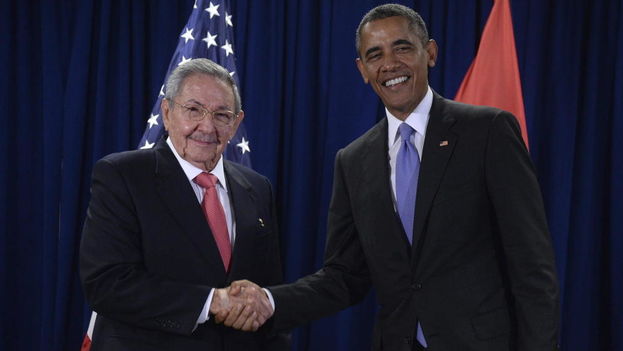
President Barack Obama and his Cuban counterpart Raul Castro, at the headquarters of the United Nations. (EFE)

14ymedio bigger14ymedio, Reinaldo Escobar, Havana, 17 December 2015 – Perhaps the most visible impact of the restoration of relations between the US and Cuba, begun a year ago today, is expressed in the hopes that it awoke in third countries. Governments, businesses and independent institutions, sensing that the starting pistol had been fired, raced to position themselves, not in today’s Cuba, but in the one they imagined it would soon be, by virtue of the announced change.

Letters of intent from the capitalist world multiply and presidents and ministers, musicians and baseball players, filmmakers and entrepreneurs arrive on the island. All of them calculating that the streams of dollars will soon flood the country.

What has happened here is just like in the stories about the simple announcement of the coming of a railroad; the land on either side of the proposed tracks goes up in price. But the date when the train will arrive remains unknown. continue reading

The Americans have been clear that they have not changed their objectives, only their methods. The Cuban leaders insist on not moving even an inch from positions they classify as “the unshakable principles of the Revolution.”

Raul Castro’s advantage over Barack Obama is that he doesn’t have a parliament demanding equity in the steps taken, nor does his party have to subject itself to the scrutiny of an electorate jealous of every concession, calculating every gain. But this advantage only helps him do nothing. The American negotiators no longer know how they are going to alert the Cuban side that Obama is not the dictator of the United States, but only its president, and that if there are no signs from Havana in the hoped for direction, those in Congress who oppose the policy of rapprochement will be proven right.

What are the signs that the Americans are eager to see? First, guarantees that they can invest and reap dividends from their investments. Second, respect for all human rights. The relationship between both aspirations deserves a book, but can be reduced to the idea that an atmosphere of economic and political freedom is the environment most supportive of a market economy.

The resistance to turning the wheel in that direction is adorned or masked – according to how one prefers to see it – with the political will to guarantee certain margins of social justice expressed in the highly publicized achievements in health and education within reach of everyone. Behind it all, there is a group of hierarchs obsessed by power who do not want to risk it. Venezuela just proved it: authoritarian regimes cannot trust in democracy, “not the least little bit,” as an Argentinean* was known to have said.

In Cuba there is a repressive apparatus made up of tens of thousands of individuals charged with blocking opponents from expressing themselves or meeting together. If the country democratizes, they will not only lost their jobs and privileges, but they feel they would be victims of revenge. So the officials in charge of each case strive to make their reports convincing and every opponent appears as a traitor and a dangerous agent of imperial forces. This troop, well trained and well armed, has been educated in the principal that the only order that can and must be disobeyed is the order to “cease fire.” If Raul Castro were to try to decriminalize political dissent in order to democratize the country, he would be converting his most loyal and submissive servants into his potential enemies. And he knows it.

One year after that hopeful 17 December, it can be affirmed that each party has reached the ceiling of its possibilities. Repealing the embargo, suspending the American-taxpayer-financed radio and TV broadcasts from Florida to Cuba, paying compensation for damages caused by American policies, returning Guantanamo to Cuba, all seem to be gestures too difficult for the White House; as difficult as it would be for the Cuban government to introduce a multi-party system, ratify the United Nations covenants on human rights, allow free enterprise, or legitimize independent civil society.

The lands purchased on either side of the railway line began to depreciate today, because the damn train is not about to run down the rails any time soon.

Translator’s notes:
*Like Americans say “9-11” instead of “September 11, 2001,” Cubans say “17D” instead of “17 December 2014,” the day Barack Obama and Raul Castro jointly announced the restoration of relations between the United States and Cuba.
**The phrase is associated with Ernesto “Che” Guevara. In Spanish: “ni tantico así.”
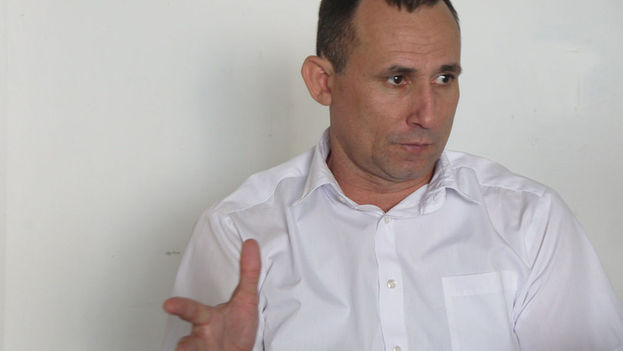
Jose Daniel Ferrer Arrested at UNPACU Headquarters in Havana / 14ymedio

Jose Daniel Ferrer, UNPACU leader

14ymedio bigger14medio, Havana, 17 December 2015 – Early this morning State Security arrested Jose Daniel Ferrer at the national headquarters of the Cuban Patriotic Union (UNPACU), in Havana, according to sources of the opposition organization.

Several UNPACU activists denounced through the social networks that the assault was carried out violently early in the morning after military and police forces were seen around the building late at night. The headquarters of the organization in the capital is the home of Arcelio Rafael Molina Leyva, an activist in Havana, located at 2103 Calle 30, Apartment 5, between 21st and 23rd Streets.

This is the third assault on the headquarters of the organization in Havana in less than a month. The previous one took place on the eve of Human Rights Day and the police seized a laptop, organizational documents and several CDs with audiovisual material. Activists believe that the UNPACU’s growing strength in the capital is the reason it is being subjected to so much police harassment.

The Inebriated Pupil / 14ymedio, Eliecer Avila

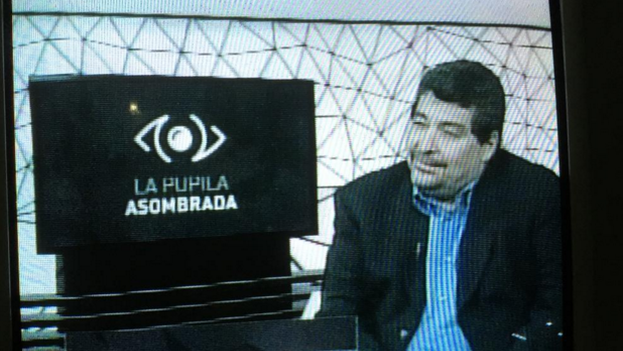
Screen shot of the Cuban television program 'The Amazed Pupil’ directed by Iroel Sanchez.
Screen shot of the Cuban television program ‘The Amazed Pupil’ directed by Iroel Sanchez.

14ymedio bigger14ymedio, Eliecer Avila, Havana, 14 December 2015 – The Astonished Pupil is a recent program on Cuban TV directed by Iroel Sanchez. The show continues the logic that has characterized Sanchez in recent years. Every time the gentleman opens his mouth it is to speak badly of everything modern, free and useful, from the internet and Facebook to denouncing “the great lie represented by Western democracy.” It seems that he and his friends know best about another world of which they don’t have the vaguest positive memory.

Continuing in this theme, his media program has a chaotic script, tries to mix entertainment with the most leftist of propaganda, and broadcasts materials such as speeches by radical separatists in Catalonia. continue reading

The strangest thing about it is that it is presented as something new and accepted without question, when enough time has passed that all these arguments have been profoundly dismantled by excellent political and intellectual analysis, demonstrating the lack of both logic and principles in such positions and their manipulated reasoning.

Today they presented a documentary called something like “Modern Slaves,” a phrase that refers to almost everyone on the planet, according to Sanchez, who believes that representative democracy and respect for human rights and the natural laws of markets are the most effective way to achieve development.

The voiceover narrating the materials appears to come from someone who has drunk disproportionate amounts of alcohol mixed in every possible variation and without eating any food. There is no other way in which a human being could affirm so much nonsense all at the same time.

It is precisely the freedom of expression achieved with these “slave societies” which allows any failure to make a “documentary” with his very particular vision of the world and to broadcast it, so that later on someone else can come along and use it against a country deprived of the opportunity to access YouTube and choose what they like and discard the rest.

The program offers the example of Ada Colau, a woman who became known for her activism against evictions in Spain and was elected mayor of Barcelona. It is a perfect example of Colau’s good luck to live in an “evil Western democracy,” because if she lived in the Cuban paradise, instead of important responsibilities and recognition, she would have received only kicks in the butt right up to today and called a CIA agent and counterrevolutionary for defending the rights of thousands of eastern Cubans fleeing poverty to settle in makeshift neighborhoods in Havana, who are treated inhumanely in many cases, despite having small children and being vulnerable.

It is a shame and untenable that works consistent with our reality are censored – works produced by Cuban theater directions, filmmakers, documentarians and writers – while television time is given over to programs paid for by public funds produced by these people who over and over again sell these same ideologies of eternal failure.

_______________________________________________________________

Editor’s note: The author is president of the movement Somos+ (We are more)

The Path To Learning, Paved With Politics / 14ymedio, Lilianne Ruiz

“We give her a lot of fantasies, fairy tales, and craft books to read, to offset what she receives in school,” says her grandmother. (Lilianne Ruiz)

14ymedio bigger14ymedio, Lilianne Ruiz, Havana, 15 December 2015 — “On the path of Martí, with the guidance of Fidel, for the homeland and socialism: Moncadistas* always ready.” With that motto the school day begins every morning for Claudia Martinez, a fifth grader in Havana’s Plaza district whose parents try to soften at home the ideological excesses of Cuban public education.

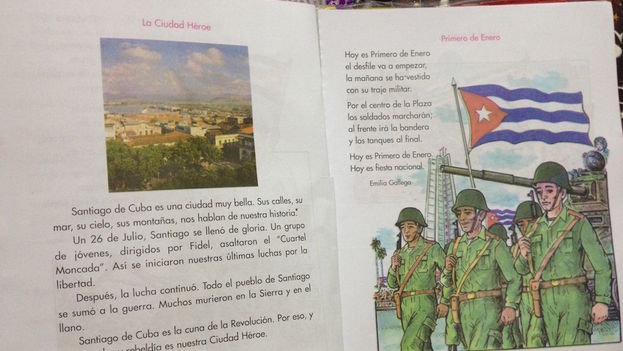
The girl learned to read with stories of combat, biographies Sierra Maestra fighters and anti-imperialist slogans. Of the 222 pages in the current edition of the first grade reading book, 21 pages are dedicated to teaching the official version of the Cuban Revolution and its political figures. Guns and olive green uniforms abound in its illustration, although few would expect such a profusion of military themes in a children’s reader. continue reading

When she reached the fourth grade, Claudia was already skilled in repeating slogans and phrases taken from Fidel Castro’s speeches. The book that perfected her reading in this grade started with some words spoken by the former Cuban president and another similar fragment was waiting on page 215 of the same volume. Overall, 10% of the reading book is dedicated to recounting the exploits of the figures in power or praising the system. Here, “The path to learning is paved with politics,” said Claudia’s mother, wryly.

Education in Cuba is “a function of the state and is free,” according to the Constitution, which also, in Article 39, calls for “promoting the patriotic and communist education of the new generations and preparing children, youth and adults for social life.”

“Why does education promote values associated with communism?” whispers Claudia’s father, who dreams of being able to choose the education his daughter receives, but sees this as “impossible for now.”

Now 34, and also schooled under the same education system, this Little Pioneer’s mother recognizes that “it’s true that the teachers have a program they must follow.” However, the parents have never been able to meet with the methodologists “to influence these programs,” she complains. She is aware that in the current circumstances, the parents “have no involvement in the design of the curriculum.”

Daniela, a young schoolteacher who prefers not to give her last name, says that using the schools to promote an ideology “is normal” and adds that the teachers are trained to “include elements in every class that develop the students politically.” In her classroom she talks to them “about socialism, the Revolution, and all the past history that none of them have experienced.”

By hiring private teachers and tutors, many families not only try to improve the academic performance of their children, but also to reduce the level of ideology in the teaching. “I’ve spoken with the math teacher who comes here to the house,” says Claudia’s grandmother, “so that the math problems don’t keep putting political examples in front of the child.”

In one of last year’s schoolbooks, the student solved an arithmetic word problem that said, “If Rene Gonzales, one of the Five Heroes, was sentenced to prison in 2001 and released in 2011, how many years did he spend in jail?”

“We give her a lot of fantasies, fairy tales, and craft books to read, to offset what she receives in school,” says her grandmother.

Claudia dreams of becoming a lawyer someday, but her parents are more concerned with the present. “We fear she will become someone who shouts slogans and lose this desire to debate and search for the truth that we teach at home,” explains her mother. “I have a dilemma,” she confesses, “I know that we are raising her to cause trouble for herself.”

As the children advance to the higher grades, ideology becomes even more present. Leo studies technology in Pinar del Rio where, a few weeks ago, the teacher lashed out against a dissident. He called him a “millionaire, traitor and enemy of the country,” although he didn’t know that Leo knew the man through his family. The young man stood up in the middle of the classroom and shouted that it was all lies. When he told his parents, they supported him, but this is an isolated case.

As a general rule, teenagers listen passively to the political harangues delivered in the classroom and their families call on them not to contradict the official discourse. “I warn him to say yes to everything they tell him, because why set himself apart?” says Layren Lopez, the mother of seven-year-old Harold who already knows how to read and write. “This is nearing its end,” says the woman.

Recently, Harold’s parents obtained Spanish nationality, through the so-called Spanish Law of Grandchildren. “I have a contact who will help me to enroll the boy in the school for children of diplomats,” says the mother. The school, in an exclusive area of Havana’s ​​Playa district, has its own curriculum, which in no way resembles the education system on the island.

“We will have to pay tuition in convertible pesos and his grandmother will take him there in the car, because it’s a long way from us. But there he will not have to say Viva Fidel!” says the relieved Lopez, who receives financial support from her father, who lives in Barcelona, ​​to avoid what he calls “the brainwashing of the child.”

Ideology reaches its highest levels in the teaching of history. At the Tenth Congress of the Young Communists Union (UJC), several delegates called for teaching the subject “creatively, in order to make the class ideal place to promote patriotic and revolutionary sentiments,” and, in particular, to develop youth leaders for the organization who are well trained “politically and ideologically.”

Classes on national history do not support nuances. The Cuban Republic was not sovereign and was “corrupt”; José Marti is the “intellectual author” of the assault on the Moncada barracks; the armed struggle in the Sierra Maestra is “a continuation of the wars of independence” and, “before 1959, children in Cuba had no schools or shoes.” Deviating from the script could result in a note of disapproval.

*Translator’s note: Moncadistas refers to those who launched a failed assault on Santiago de Cuba’s Moncada Army Barracks on 26 June 1953, generally considered the start of the Revolution.

Cuban Immigrant Crisis in Costa Rica Still Unresolved a Month Later / 14ymedio

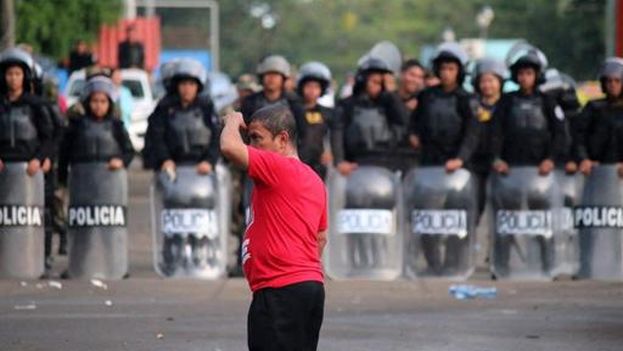
A Cuban migrant faces police on the border between Costa Rica and Nicaragua, on 16 November. (EFE / Alvaro Sanchez)

14ymedio bigger14ymedio, San Jose, Costa Rica, 15 December 2015 — The crisis of thousands of Cuban migrants stranded in Costa Rica has gone on for a month, as of Tuesday, and the authorities of that Central American country still have not found a regional solution that would allow the Cubans to resume their journey to the United States.

Since 14 November, Costa Rica has issued 5,366 transit visas to Cubans who arrived at their border with Panama, and 2,238 more are waiting to enter, according to data released to the press agency EFE today by the Department of Immigration (DGME). continue reading

The crisis began on 15 November when the government of Nicaragua decided to close its border with Costa Rica to Cubans and the police and army repelled some 800 who tried to cross illegally.

Costa Rica accused Nicaragua of “provoking” and “manipulating” the crisis to be able to blame the US immigration policies that benefit Cubans migrating without visas.

Since then, thousands of Cubans have been amassing in Costa Rica, a country that is maintaining 26 shelters, mostly in communities near the border with Nicaragua, which provide the Cubans with humanitarian aid, and altogether host some 4,000 islanders.

Costa Rica has never before had to deal with so many people for such a long time, not even during natural disasters.

The migrants have organized themselves and to take advantage of the free time they have decided to volunteer in the Costa Rican communities that have embraced them, as a way to show their appreciation for the hospitality.

Among the thousands of migrants there are children, pregnant women and professionals in medicine, architecture, education, and engineering, among others.

Almost all the Cubans carry passports because they left the island legally by plane for Ecuador, a country that until 1 December did not require a visa from them.

From Ecuador they traveled by sea and land through Colombia and Panama to reach Costa Rica.

The president of Costa Rica, Luis Guillermo Solis, is on an official visit to Cuba, where he hopes to address the immigration issue today with Cuban president Raul Castro.

Solis has ruled out the possibility of deporting Cubans back to the island, as he has said he is not willing to “play games with the migrants’ plans for their lives.”

Costa Rica has tried to find a solution, but on 24 November its proposal to create a regional humanitarian corridor failed to be approved at a meeting of foreign ministers of the Central American Integration System (SICA), along with Mexico, Ecuador, Colombia and Cuba.

According to Costa Rica, Mexico is willing to allow the passage of Cubans but only if they come through a land border, that is from Guatemala or Belize, countries that have refused to allow an airlift, to bypass Nicaragua, from Costa Rica.

Costa Rica’s government has criticized the “lack of solidarity” of the Central American countries and has called on SICA to “prove it can be useful” in situations like this.

President Solis will participate next Friday at the SICA Summit in El Salvador, where the Cuban migration crisis will be a priority issue.

Neither McDonald’s, nor Freedom / 14ymedio, Yoani Sanchez

In response to the measures taken by Barack Obama’s administration, the Plaza of the Revolution has not taken the necessary steps so that they might effect the daily lives of the island’s people. (EFE)

14ymedio bigger14ymedio, Yoani Sanchez, Havana, 15 December 2015 — A year ago, at noon on 17 December, the national clock was restarted and we became a country filling the headlines and people’s expectations. With the reestablishment of relations between the governments of Cuba and the United States, our island became fashionable among political scientists, Hollywood actors and soothsayers. The year 2015 promised to a be a year of economic boom times and of openings, but twelve months later actual events fall far short of the dreams.

It is true, we have been saturated with photo ops, flags hoisted, press conferences to explain that the road will be long and complicated. For months, Cubans have been charged with hopes, but now it the time to look at the results. It is not enough for the officials of both countries – enemies until yesterday – to now shake hands in front of the cameras, smile and call themselves allies on issues such as the fight against drug trafficking, piracy, or the protection of sharks. So many diplomatic gestures should have improved the lives of Cubans. continue reading

In response to the measures taken by Barack Obama’s administration, the Plaza of the Revolution has not taken the necessary steps so that they might affect the daily lives of the island’s people. Instead, the official Castro discourse has played at maintaining a verbal confrontation with our neighbor to the north, and continues to use the argument of the “blockade” to justify its own failures.

Shortages have gotten worse in Cuba’s retail markets and it is now more difficult to buy the foods that were available last December. Corn from California is not filling store shelves, nor have McDonald hamburgers displaced the local version we call “fritas,” as those against globalization predicted. Putting food on the table has become an even more difficult, agonizing and expensive task.

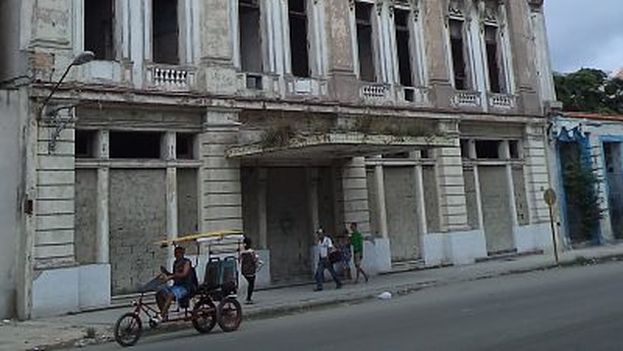
Visitors looking for “beautiful ruins” and antique cars to photograph will not be disappointed, the theme park of the past is still intact. Modernity and development have hit the wall of reluctance in the face of the new. Cuban leaders have managed to convey and maintain their ailing old age over the entire country. No Apple store has opened in the heart of Havana, nor has public transport gotten any better.

No ferry has docked at Cuban ports since the date we enshrined in the shorthand of “17D.” Nobody has managed to connect from the island with roaming on their US phone cards, nor has any visitor managed to get money with their Visa or Mastercard at an ATM anywhere in our insular geography.

The international press has been filled with speculation about US airlines’ return to Cuba, but only charter flights land at our national airports. Relaxations allowing local entrepreneurs to be supplied from goods purchased in the US have failed to overcome the iron customs controls that block commercial imports to private hands. All the improvements decided in Washington have been held up in the thicket of prohibitions and controls that this system imposes on its own people. The internal blockade has closed ranks, before the fear of losing the justification provided by the external embargo.

Telecommunications, the cornerstone of US policy towards the island, has hardly benefited from the announcements launched from the White House. In a race to keep customers captive to the country’s only telephone company, the government has opened several dozen outdoor wifi zones for web browsing, at exorbitant prices, with service as unreliable as it is controlled. A year after 17D, this continues to be the country with the least extensive information technology in the entire hemisphere.

Freedom… well thanks. Raul Castro has been legitimized and recognized by most governments in the world and starred in a Summit of the Americas in Panama, between the flashing cameras and his meeting with Barack Obama. As for opening doors inside the country, he has refused to allow even the slightest belligerence from his critics, against whom he has maintained arrests, acts of repudiation and the painful execution of reputations. The latter is launched from the impunity of a power that can turn a dissident into a criminal in the eyes of public opinion.

However, that popular wisdom that scans the horizon and knows when changes are serious and when they are pure masquerade has emerged with force this year. The instinct for self-preservation, that ancestral pull that keeps us safe, has decisively given the lie to predictions made twelve months ago. Pushed by this conditioned reflex to avoid the danger of an existence without hope, thousands of Cubans have taken the route of emigration, in many cases risking their own lives.

Now it is left to us to again reset the clock. Both governments will call for calm, and to not despair. The occupant of the White House will say goodbye in 2016, perhaps after visiting our island, and Raul Castro has announced he will retire in 2018. This desperate time of history and politics passes step by step, without leaps, barely perceptible. Meanwhile, the hours of the lives of millions of Cubans inexorably drain away. 17D has become a date in the past.

Cuba Warns About The Increase In Teen Pregnancy / EFE, 14ymedio

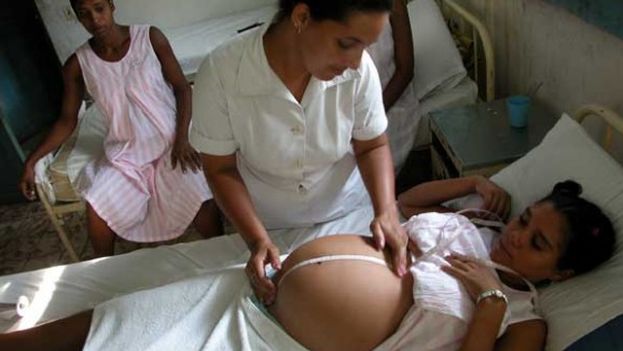
A pregnant woman receiving medical care in Cuba. (Interpress Service)

14ymedio biggerEFE (via 14ymedio), 13 December 2015 — Teenage pregnancy has increased in Cuba, where in 2014 the recorded fertility rate for minors younger than 20 was 51.6 births per thousand women, representing more than 15% of the country’s total fertility, according to data released today in the official press.

Starting sex at increasingly younger ages, between 12 and 13 on average, has set off alarm bells among doctors, nurses, employees of the Ministry of Public Health (MINSAP), and researchers from the Center for Demographic Studies , among other entities, reports an article in the official newspaper Juventud Rebelde (Rebel Youth). continue reading

In the eastern provinces, and particularly in Granma, Las Tunas and Holguin, the highest number of teenage pregnancies are recorded, while at the national level, there is a slight increase in adolescent fertility in the age group between 10 and 14 years of age, while a slight decrease of the phenomenon can be seen in those between the ages of 15 and 19.

Researcher Daylin Rodriguez from the University of Havana’s Center for Demographic Studies (CEDEM) reported the data this week in Havana, at the 13th Workshop of Dialogs About Youth, organized by the Center for Youth Studies (CESJ), according to Juventud Rebelde.

The researcher found it “troubling” that teenage fertility has recently grown in the cities, although pregnant teenagers are still more predominate in rural areas of the island.

Mistaken beliefs, the naiveté of that stage of life, misinformation and the immature conviction that nothing bad can happen, lead more than a few teenagers to initiate sexual intercourse without the appropriate responsibility that comes with that decision, the report warns.

Also notable were the results of the CESJ study, “Adolescents and Young Cubans in the Areas of Family and Relationship,” concluded last February, which noted that it is common for teenage pregnancies to be “unwanted or unplanned” within a weak relationship.

The reports points out that these circumstance lead teenagers to reject and hide their condition for fear of the reaction of their families, leading to “late or insufficient” prenatal care.

“Pregnancy bursts into life at a time when teenagers have not yet reached physical and mental maturity, sometimes in adverse circumstances such as nutritional deficiencies, and in a family environment not receptive to accepting it, sharing in it and protecting it,” says the study.

It further notes that among the psychological and social repercussions of a pregnancy at this stage of life is the fact that these are young people who are still at school or starting out on their working lives, so that this process “interferes with their schooling, work and professional futures,” in addition to creating economic and family challenges.

The Latin American Spring / 14ymedio, Carlos Alberto Montaner

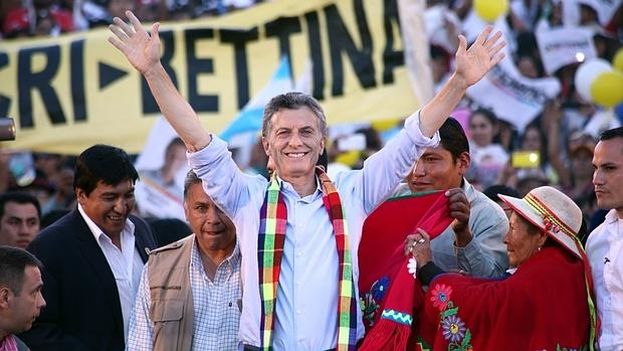
Mauricio Macri, the new president of Argentina (Photo EFE)

14ymedio bigger14ymedio, Carlos Alberto Montaner, 12 December 2015 — Has the Latin American Spring finally sprung? Perhaps. There are signs. Antonio Machado records the doubt in his Canciones: “Spring has come, nobody knows how.”

All springs are different.

Eastern Europe’s, in the second half of the eighties, was possible because the stars surprisingly aligned themselves under the firmament of absolute disgust with Real Socialism, sunk in economic failure and political disrepute. It was the glorious moment of Havel, Walesa, Reagan, John Paul II, Sakharov and especially Gorbachev, a naïve and melancholy gravedigger for that sinister undertaker forged by the KGB and the Red Army. continue reading

The blaze quickly spread to Egypt, Libya, Syria and Yemen. It seemed that there was, in the Arab world, a curdled desire to establish Western-style regimes, but that was not the case. What did exist, in reality, was the will to put an end to corrupt and incompetent military tyrannies that kept a substantial part of the population in poverty. To “the people” it didn’t matter if the substitutes were curacas from radical Islam, who imposed sharia and stuffed women into burkas to prevent the lewd exhibition of their faces.

What are the signs that allow us to speak about the emergence of a Latin American spring? There are at least three.

First, tentatively in October, Guatemalans elected Jimmy Morales – a television actor from the center-right with no political experience – over Sandra Torres, a woman from the left. Morales’s motto was simple and clear: “Neither corrupt nor a thief.” With this promise, he got twice the votes of Torres. Morales did not promise a revolution, but rather to return to republican roots, good management, honesty, and markets, and to combat poverty freeing the productive energy of the country.

In November it was the turn of Mauricio Macri in Argentina, another politician from the center-right. He did something that seemed impossible a few months earlier: defeating Peronism in its Kirchner variant, although his opponent, Daniel Scioli, was the most presentable face of that tendency, because, at bottom, he was oblivious to it. Macri also promised good government, tranquility, less populism, less cronyism, and, especially, to fight against corruption and drug trafficking.

The third symptom of the Latin American spring was the parliamentary elections of 6 December in Venezuela. The democratic opposition managed to gain a two-thirds majority in the National Assembly, with which it can curb the totalitarian drift of Chavismo and begin to rebuild the country after 17 years of stupidity and abuses.

Voters punished Maduro for the atrocious shortages, the highest inflation in the world, the murderous violence that has turned the country into a slaughterhouse, the limitless corruption, and for the pathetic ignorance of a president who trills and can talk to the birds, but not to the people, because his little head is filled with “millions of penises” and uncontrollable fish, as if he were premiering a comical version of Tourette Syndrome.

http://www.nydailynews.com/news/world/venezuelan-president-nicolas-maduro-freudian-slip-multiply-christ-multiplied-penises-article-1.1441650

The Latin American Spring is based on a rejection of corruption, as we have seen in the three countries mentioned, and as seen in Brazil and Chile. It can be seen in the conviction that populism, with its constant violations of the law, high public spending, welfare cronyism, constant demagoguery, and that obscene anti-market, anti-American and anti-Western language, all leading to economic disruption and catastrophe that invariably results in a painful adjustment.

Latin America is tired of the incendiary talk of the Sao Paulo Forum, of the devastating madness of 21st Century Socialism, of the ALBA sect launched by Hugo Chavez and financed by Venezuelan petrodollars.

This Spring will carry away Bolivia’s Evo and his anti-Republican multinational invention, Correa’s Ecuadorian experiment, Sandanista Daniel Ortega’s “neo-Somoza-ism,” and will leave Cuba abandoned, more alone than ever, languishing in poverty, while the leaders who made possible this incredibly cruel way to mortify human beings are disappearing.

https://en.wikipedia.org/wiki/Evo_Morales

Converting Expropriations Into A Springboard For Investment / 14ymedio

The huge building on Dragones Street that formerly housed the Hotel Nueva York, the first expropriation by Fidel Castro after the Revolution. (14ymedio)

14ymedio bigger14ymedio, Havana, 11 December 2015 — Financial compensation for small claimants; tax breaks for big companies, principally multinationals, who want to start businesses on the island: this is Richard E. Feinberg’s proposal in his report, Reconciling US Property Claims in Cuba, to resolve the United States claims for the expropriations that occurred after Fidel Castro took power in 1959. “Transforming Trauma Into Opportunity” is the subtitle of the report.

In his study, Feinberg, a professor of international political economy, analyzes the nearly 6,000 U.S. claims, divided between companies and individuals, large and small, and suggests a hybrid formula by which large conglomerates – which make up 1.7 billion dollars of the total 1.9 billion in claims, not counting interest – could have a range of opportunities for investing with advantageous conditions, for example through preferential rights of acquisition or through bonds that can be redeemed for the payment of taxes.

This week, Cuba and the United States addressed, for the first time, the issue of compensation, one of the thorniest issues in the dialogue opened by both parties on 17 December 2015.

Participating in this “informational” meeting, according to U.S. officials, were the Cuban Deputy Foreign Minister, Abelardo Moreno Fernández, and a legal adviser to the State Department of the United States, Mary McLeod.

Cuba, in its latest annual report on the impact of the embargo that it presented to the United Nations, claimed that the economic damage of more than half a century of the embargo amounts to over 833 billion dollars, based on the value of gold. At current prices, the economic losses total over 121 billion dollars.

For its part, the United States says that the expropriations carried out after the Revolution amounted to nearly 2 billion dollars.

Opposition Coalition Elects New Executive Secretariat / 14ymedio

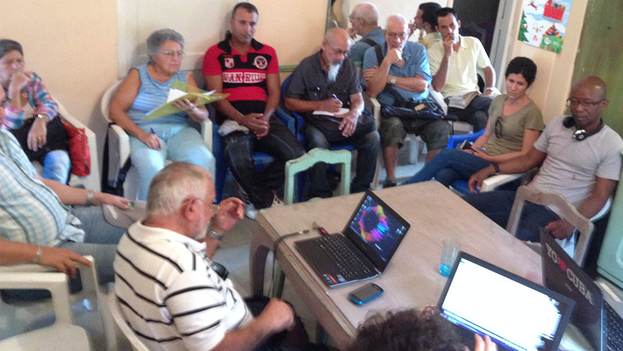
Activists of the Democratic Action Unity Roundtable (MUAD) gathered Friday in Havana. (14ymedio)

14ymedio bigger14ymedio, Havana, 11 December 2015 — After months of gestation and discussion, the opposition Democratic Action Unity Roundtable (MUAD) elected its executive secretariat Friday. With this structure composed of various organizations and independent activists, the coalition expects to gain in unity and visibility on the stage of democratic activism within the island.

During a meeting held in Havana, participants voted for who will represent them between now and June 2016. The organizations chosen include The United Anti-totalitarian Front (FANTU), the Pedro Luis Boitel party for Democracy, the Support Center for the Transition, Cubalex, the Social Democratic Party, the Patriotic Union of Cuba (UNPACU), the Progressive Arc, and the independent activists Boris Gonzalez Arenas and Pedro Campos Santos.

Elected to represent the exile, were the Christian Democratic Party and activist Ciro Castillo.

The executive secretariat, whose function will be coordinating between members, will be renewed every six months .

At the same meeting, a decision was made to appoint a team that will be responsible for drafting MUAD’s program, which it will circulate to all members starting 20 January, for further discussion and approval.

The Democratic Action Unity Roundtable is a project that began to take shape in June of this year when a group of organizations on the island and in exile met in the city of Cuernavaca, Mexico, in order to strengthen the unity between Cuban dissidents.

Characterized by its openness, MUAD has integrated many major entities of the Cuban opposition and civil society.

Elections In Venezuela And Cuban Experiences / 14ymedio, Pedro Campos

”Thank you Venezuela, we won!” Message of the Bureau of Democratic Unity (MUD) after the results of parliamentary elections on 6 December 2015. (Youtube / screenshot)

14ymedio bigger14ymedio, Pedro Campos, Havana, 11 December 2015 — The victory of the Democratic Unity Roundtable (MUD) in Venezuela brings an endless list of implications for Cuba, depending on how events develop there. We will have to wait some time to make a comprehensive assessment of the phenomenon.

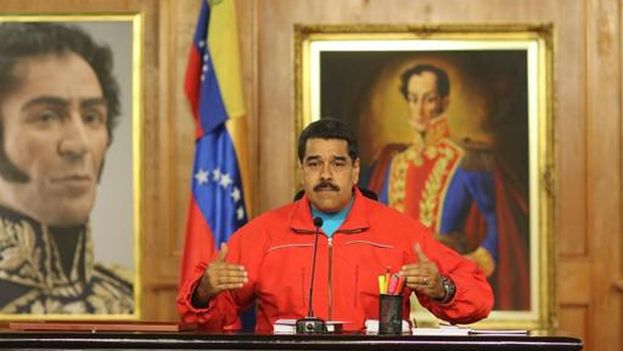
According to Maduro’s speech, the blame for his crushing defeat in parliamentary elections last Sunday belongs to imperialism, its internal acolytes, and their economic and media war. We Cubans know this justifying discourse, which is incapable of self-criticism.

Madurismo” says that the counterrevolution triumphed in an election where the United Socialist Party of Venezuela (PSUV) lost overwhelmingly, due to its own mistakes. The popular majority who voted for democratic change, according to this version, were counterrevolutionaries, including the forces of the left and the Chavistas who voted for opposition candidates: this is a misreading. continue reading

This approach is part of the philosophy of traditional authoritarian populism of a “left” that has seen as revolutionary and socialist centralized state control over the economy and politics, and the Manichaean “with me or against me”… “because the Revolution is me.”

A constructive vision of the future obliges the PSUV, along with the Cuban and international left, to make a calm, deep and dialectic assessment of the MUD’s triumph in the Venezuelan parliamentary elections, which seem to mark the failure, perhaps announced, of the statist experience of Chavism, as it deviated from its initial socialist currents.

To begin with, such a crushing defeat cannot be attributed solely to the “economic and media war waged by imperialism and the opposition,” which undoubtedly did exist. No support could be expected for a broad populist policy of vast government spending, restrictions on domestic investment and support of a huge bureaucracy all paid for by oil revenues, whose prices could not recover for many reasons. In addition, the government – authoritarian and engaged in systematically harassing the opposition – has close ties with and financially contributes to the only non-democratic state in the region.

In recent years, the center of focus of Nicolas Maduro’s government was the violent actions of extreme right groups, to which he linked all opposition — off-center, right or left — forgetting the causes of the phenomenon: the absence of effective policies to tackle the growth in insecurity, government corruption, inflation and shortages.

This, coupled with the abandonment of the initial process of installing socialism, already present in Chavez’s last years, alienated the government from its original base. All very typical of Cuban voluntarism: pay attention to the effects and not the causes.

There was a lot of fanfare about imperialism, a lot of unnecessary repression, and little in the way of political and economic practice to address these problems. Time and resources were dedicated to trying to raise the price of oil, to “international solidarity” in search of friends and supporters, to arbitrarily increasing the salaries of workers in the public and private sector, and little effort was directed to diversify the economy and tap into and make use of national productive capital. A lack of production and liquidity equals inflation. Good Cuban advice!

While the “missions” and general plans focused on social benefits for lower income sectors supported by oil revenues, with prices systematically undervalued in the international market, centralized distribution of resources brokered by the State was prioritized at the expense of making participative local budgets work and of promoting free, private or associated work, initially promoted as the pillars of Chavista socialism.

Those modalities, which many of us viewed with enthusiasm, were drifting to the Cuban approach of state monopoly capitalism, not socialism, where the main role of economic development does not lead to private and social initiative, but rather to employees of state enterprises attempting to violate laws and control the economy, and to an underestimation and even dismissal of forms of private and associated self-management of production, while different types of private capitalism are frankly rejected or only reluctantly accepted.

Instead of the originally democratic, self-managed and socializing Chavismo influenced by authoritarian Fidelismo and state control of labor, the opposite occurred and that is one of the causes of the disaster now facing the PSUV. Here and there, “socialism” has been swept away.

History has demonstrated everywhere that centralized control of labor – where the state is the main employer – along with centralized control of the markets, is contrary to the sustainable development of the economy.

Other Latin American governments, who felt solidarity with Havana, were careful not to fall into the same rut, as in the case with the presidents of Nicaragua, Ecuador and Bolivia.

In Cuba, the authoritarian and undemocratic political system of absolute control of the Communist Party over the state and society prevent the democratic opposition and the socialist left from organizing, publicly disclosing their programs and working for political change from democratic structures, as the PSUV opposition has been able to do.

Cuba’s leaders from the Sierra Maestra, who capitalized on their success of 1959, have never allowed a democratic election and, with what has happened in Venezuela, possibly conclude that the democratic system has nothing to do with their political interests. Sadly, they have not learned the lesson of the “socialist camp”: it is preferable to share and lose power democratically, power that will definitely be lost by other means.

A year after the announcement of the restoration of relations with the United States, and nine years since Raul Castro took the reins of government, improvements for the people come in dribs and drabs and are unstable.

As there are no democratic mechanisms of participation in Cuba that allow the manifestation of forces opposed to and distinct from the Government-Party-State forces, a telluric movement has been building that could erupt like a volcano, with all its consequences. But the people do not want a volcano, they want a channel for their concerns. The sustained exodus of Cubans, recently increased, is the most obvious proof of popular discontent.

But within the Cuban Government-Party-State the predominate forces appear to be those contrary to a process of democratization, due to their fears of losing all the levers of power. The recent statements by the president of the official National Union of Writers and Artists of Cuba (UNEAC) demonstrate the dread of the powers-that-be in the face of a democratization growing from below and the lack of political realism on high.

These blind and dark forces are responsible for everything negative they generate.

It’s easier to do things for the good of all: an observance consistent with the main agreements of the 6th Cuban Communist Party Congress – real opening for self-employment, cooperatives, entrepreneurial autonomy, the decentralization of budgets, foreign investment and especially investments by Cubans who are outside the country – along with a clear democratic opening to eliminate repression for political reasons and to expand the freedom of expression and association.

All of this would strengthen the environment for dialog and national accord, support almost immediate growth in the national economy with prosperity for all Cubans, and renew the desire to live in this country for so many young people who leave. In addition, it would be crucial for the United States Congress to begin eliminating all the outstanding restrictions of the blockade/embargo.

A change in this inclusive democratic direction would permit a soft landing in the inevitable denationalization and decentralization of the economy and politics, consistent with a fundamental principle of political science: The power of the state is inversely proportional to the power of the people.

Fidel Castro Congratulates Maduro Without Referring To His Crushing Defeat / 14ymedio

The president of Venezuela, Nicolas Maduro (Photo EFE)

14ymedio bigger14ymedio, Havana, 11 December 2015 — While security forces were deployed in the streets of Havana to prevent the celebration of Human Rights Day, Fidel Castro wrote a letter to the glory of the Venezuelan president, published today by the daily Granma.

Under the anodyne title, Fidel’s Message to President Nicolas Maduro, Cuba’s former president joins “the unanimous opinion” of those who have congratulated Maduro for his “brilliant, valiant speech made on the night of December 6, as soon as the election results were announced.” He does not refer at any point to the crushing defeat suffered by the heir of Hugo Chavez at the hands of the opposition, represented by the Democratic Unity Roundtable (MUD), which has achieved a two-thirds majority in the National Assembly. continue reading

The president reiterated in his message several ideas already addressed in previous “Reflections of Fidel,” such as fears of a possible global conflict because, he said, “There are nine states which possess nuclear weapons.”

However, as countries that avoided the debacle he points to “the People’s Republic of China and Russia,” who “know the world’s problems much better than the United States,” and have “their own revolutionary experience.”

Castro did not mention, however, the serious obstacles that will face the Venezuelan executive starting in January, with a National Assembly where the opposition, with its 112 MPs out of a total of 167, has the power to initiate a recall referendum against President Maduro. Among the the fears that are already spreading across the island, is a possible cut in aid, in the form of oil shipments, sent from Caracas, and the end of programs that have allowed tens of thousands of Cubans, in recent years, to serve on medical and other missions in the South American country.

In his text, Castro believes that Venezuela has “the largest and most modern system of public schools in the world,” and says the same is true of “the country’s network of medical care centers and the attention paid to the health of a brave people.” These statements contrast with the social and economic indicators released in recent weeks, which show that the country has the highest inflation in the world and suffers a serious shortage of commodities, medicines and food.

Private Restaurants Rescue Cuban Cuisine / 14ymedio, Fernando Donate Ochoa

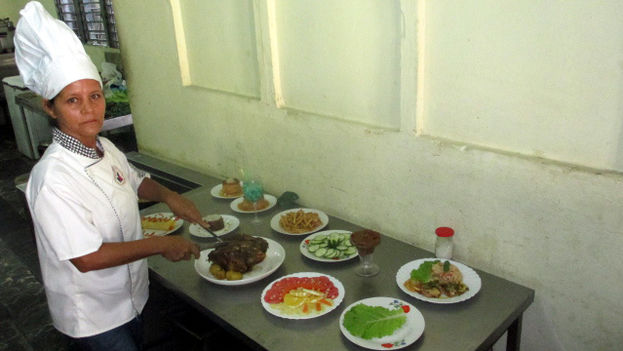
Denia Sao Blanco, cooking teacher at Casa del Chef, in Holguin. (Donate / 14ymedio)

14ymedio bigger14ymedio, Fernando Donate Ochoa, Havana, 10 December 2015 – Denia Sao Blanco has spent over 20 years teaching top level native cuisine at the Casa del Chef in Holguin, an institution created to maintain and rescue the culinary culture of the region, where several generations of cooks have trained.

As part of her work, she has visited all the restaurants in town and has offered advice on the preparation of the dishes. Now, she is surrounded by young people completing a cooking course she taught this week. The final exam is to prepare a typical Holguin dish.

In this conversation with 14ymedio Denia speaks of tradition, culture and mistakes in the culinary arts in the region.

Donate Fernando Ochoa. How is culinary research conducted at La Casa del Chef?

Denia Sao Blanco. It is the work of several cooking teachers along with the students. New generations of cooks do not know the history and Holguin recipes that are always the basis for the rescue of these dishes. continue reading

It took us a few years trying to rescue these dishes at different events, like “Young Chef of the year” and “The Flower of Cuban Cuisine,” which has run since 1992 and is only for women professionals and amateurs, regardless of age.

DFO. What traditional dishes are prepared in Holguin now?

Denia Sao Blanco. There are many, among them is the “465,” created by Ramon Carbonell, which includes chicken, ham, pork steak grilled and served with vegetables. We offer it here for 30 pesos national currency.

Another is chicken “a la Periquera” created by José Rafael Pernas Iglesias, and “Paneque” sausage created by the late Rodolfo Gonzalez Paneque, founder of our social house.

DFO. Do Holguin restaurants keep typical native dishes on the menu?

Denia Sao Blanco. Unfortunately not. Very little is being done with these dishes. On the Holguin restaurant menus international cuisine predominates at the expense of traditional dishes. For example, the customer can’t find guava in syrup with cheese, jam with cheese, rice pudding, which are some of the basic dishes of our cuisine. This shows that there is a lack of knowledge about how to make these dishes; we are losing our identity.

In most restaurants, the customer finds the same menu, there is no variety, no dishes that identify a restaurant. Cooks appeal to the easiest, such as fried chicken, roast chicken and steak.

DFO. In your exchanges with students I heard about rice with chicken…

Denia Sao Blanco. I talk to my students about rice with chicken because it is not common to see it on restaurant menus. However, when it is on the menu it is not prepared like it should be, because they do it with a by-product mixed with rice; meanwhile in other restaurants they mix shredded chicken into the rice which is a mistake. The traditional plate is chicken cut into eighths with the chicken on the base of the plate, covered in rice and a crown of hard cooked egg with strips of bell pepper. This is the real chicken with rice and it is not seen in most restaurants.

DFO. What are the consequences of turning to easy cooking?

Denia Sao Blanco. Tradition is lost because each dish is, as we say, “its name and surname”; each course was designed, studied, approved and patented in order to maintain its identity and characteristics.

Holguin has little culinary culture left and this ignorance prevents people from demanding originality in the food they put on the table.

DFO. What do think about State restaurants?

Denia Sao Blanco. They have lost their originality and identity in the dishes offered, because the administrators who run the State restaurants do not know cuisine and because they don’t know it they can’t demand it: for them all the dishes are well prepared.

DFO. Is it the same with the private restaurants?

Denia Sao Blanco. These are different, because they deliver the originality of the dishes quite well. The owners and chefs come to ask us for evaluations and suggestions, which the managers of State restaurants do not do.

Another positive aspect is that private restaurants have created new dishes that distinguish them, and this does not happen with the State restaurant. So I think that, with the opportunity to privatize the restaurants, Cuban cuisine has gained in quality, originality and variety.

DFO. What else restricts the freedom of creation in the places managed by the State?

Denia Sao Blanco. There is no freedom of creation because the cooks are required to abide by a technical chart and the products available are very limited and of poor quality, while the private restaurants are always looking for the best merchandise, the freshest produce and they maintain an original menu.

Another aspect that affects State restaurants is that the supply of spices and condiments is sometimes insufficient, forcing chefs to buy these products paying out of their own pockets.

Cuban Parliament Will Meet On December 29 / 14ymedio

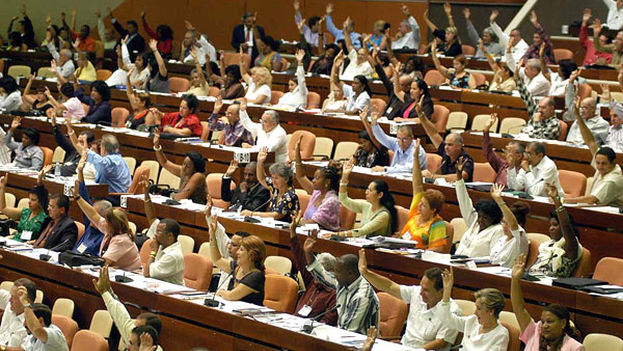
A session of the National Assembly of People's Power (voting unanimously, as usual).
A session of the National Assembly of People’s Power (voting unanimously, as usual).

14ymedio bigger14ymedio, Havana, 9 December 2015 — The National Assembly of People’s Power, which will begin its next session on December 29, will meet in an important political moment, marked by the first anniversary of the new relationship with the United States and by the climate of uncertainty following the electoral defeat of the ruling party in Venezuela, the Cuban government’s main ally.

On December 4, the National Assembly’s Committee on International Relations expressed “its firm rejection of constant, systematic and increasing acts and statements of interference in the internal affairs of our sister Bolivarian Republic of Venezuela.”

In that statement the deputies accused “external opposition spokespeople” of trying to “deny or ignore the achievements of the Bolivarian Revolution.” However, since the overwhelming victory of the Venezuelan opposition in legislative elections on December 6, the Cuban parliament has not issued any formal statement.

The National Assembly holds two regular meetings a year, the second in December. The Assembly consists of 612 members representing 168 municipalities and is elected every five years, most recently in 2013.

Tribute to Ricardo Bofill / 14ymedio, Carlos Alberto Montaner

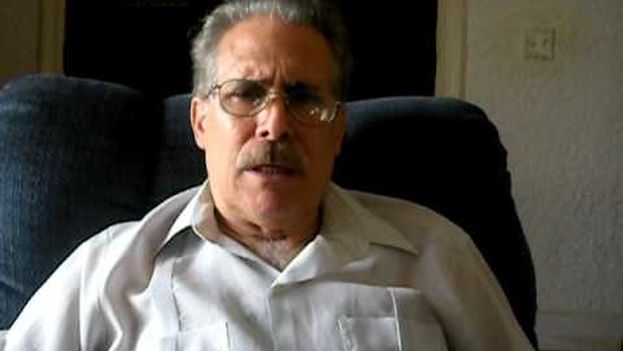
Cuban activist Ricardo Bofill. (Youtube)

14ymedio bigger14ymedio, Carlos Alberto Montaner, Miami, 9 December 2015 – We are gathered on Human Rights Day, a great opportunity to offer Ricardo Bofill the tribute he deserves.

Bofill, Gustavo and Sebastian Arcos, Martha Frayde and another handful of patriots, changed the history of Cuba from the depths of a cell. They were imprisoned for opposing the Stalinist dictatorship of the Castros and everyone from the ranks of the Revolution.

Imprisoned and isolated, they modified the axis of the Cuban struggles. Starting with the creation of the Cuban Committee for Human Rights, in the remote decade of the seventies, the political battle, where it was anything goes, became a battle for the dignity of the individual.

And it was not anything goes. They could not achieve good ends through violent means. continue reading

The struggle for the respect for human rights is a fundamental milestone in the evolution of ideas. It means that there are certain rights that are not granted by the state but that are inherent in the nature of human beings.

Like many elements of our civilization, the struggle began in Athens, at the entry to the Stoa. That was when Zenon de Citia, 300 years before Christ, a Cypriot of Jewish or Phoenician origin, a  red-haired bow-legged doctor, as described by his contemporaries, preached that the rights of people did not proceed from the phratry – the brotherhood – to which they belonged or from the cities in which they had been born.

To paraphrase Martí, to be a man was much more than being Athenian or coming from an illustrious lineage. This idea of the Stoics, the philosophical current founded by Zeno, was picked up by Christianity and thus reached the present day. It is in the papers of the American Revolution and of the French. It is in the liberal revolutions of the nineteenth century.

Subsequently, the communists tried to refute this notion, which was tantamount to depriving us our right to a backbone. The argument put forth was that every right was positive and could be abolished or granted by the State, because the human being was nothing but an evolved infant.

Only the key to this evolution was, precisely, the increasing need that this infant has to freely make its own decisions. Without freedom the human being is a mutilated and sad infant. Without freedom, life is worth much less.

We do very well, in commemorating this celebration of human rights, to pay tribute to Ricardo Bofill and all the Cubans who accompanied him on the glorious adventure of changing the tragic sign of Cuban history.

Let us also dedicate this commemoration to Leopoldo Lopez and our Venezuelan brothers and sisters who today offer an unparalleled example of patriotism. Unfortunately, the struggle for human rights and freedom still consumes lives, but it is worth fighting this fight.

_________________________________________________________________

14ymedio Editor’s Note: These words were spoken by the author at Miami Dade College on the eve of Human Rights Day.