Cuban Faces of 2015: Yordanka Ariosa, Actress / 14ymedio

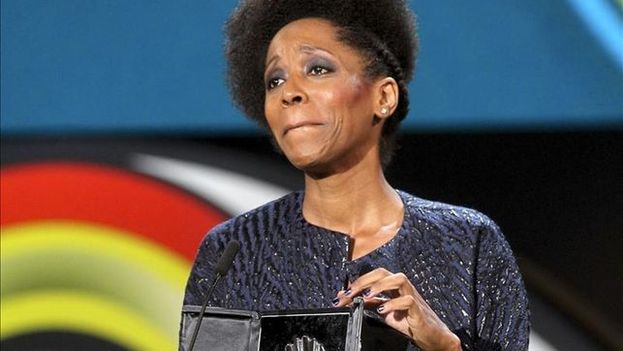
Cuban actress Yordanka Ariosa receives the Silver Shell for Best Actress at the San Sebastien Film Festival. (EFE)

14ymedio bigger14ymedio, Havana 28 December 2015 — If a face reflects Cuba of 2015, it is that of Yordanka Ariosa. Her voice, her laughter and her shyness were unforgettable to those who watched her receive the Silver Shell for Best Actress at the prestigious San Sebastian Film Festival. The actress thus became the first Cuban to receive such an acknowledgement for her role in the film The King of Havana.

The name of this woman from Sancti Spiritus born in 1982 has continued to echo among actors, directors and playwrights of the national cultural scene in recent weeks. However, Ariosa has not received formal recognition on the island. The movie, by Agusti Villaronga, never received permission to be filmed on the island and has not been shown, despite being inspired by the novel of Cuban writer Pedro Juan Gutierrez.

Right now, this actress, a graduate of Cuba’s Instituto Superior de Arte, has returned to the island to rehearse with the group Teatro de la Luna and – cross your fingers — to win the Goya Award, for which she has also been nominated for her portrayal of Magda The King of Havana.

Cellphones Widen Social Differences in Cuba / 14ymedio, Zunilda Mata

A 'clinic' to repair cellphones. (14ymedio)
A ‘clinic’ to repair cellphones. (14ymedio)

14ymedio bigger14ymedio, Zunilda Mata, Havana, 28 December 2015 – A house in Havana’s Vedado neighborhood, a German Shepherd dog, or a Rolex watch were some of the most prestigious status symbols in Cuba some years ago. But with the new technologies, these now include having a latest generation computer or cellphone. Cellphones increasingly reflect the purchasing power of their owners.

Some 800,000 new mobile phone lines have been established in the country this year, but only 324,400 physical phones have sold through the State networks. The difference suggests that more than half of the phones in customers’ hands have been acquired through illegal networks or brought in from abroad. continue reading

The limited number of models available and the high prices for cellphones in the State stores contrasts with the diversity offered by the informal market. While the illegal networks offer latest generation models and operating systems that support the installation of apps, the “Telepuntos” of the Telecommunications Company of Cuba SA (ETECSA) display a limited supply of outdated models at prohibitive prices.

“We have everything, original and Chinese imitations of almost all the phone models on the market,” says “El Micky,” a technology seller exhibiting his wares in a doorway on centrally located Carlos III Street in Havana. “Most buyers are looking for touch phones, although we also have simpler models with large keys, targeted more towards older people,” the young man explains.

Prices in the black market vary according to the performance of the device. “We have them from 15 CUC (under $20), to the iPhone 6 Plus, which is hard to find for under 450 CUC,” El Micky elaborates, adding that the most popular are the ones with removable micro SD memory because customers want, “to put their own music or videos on the phone, or save files.”

State phone offerings are a very different picture. Currently the only models available cost more than 50 CUC, are made by Alcatel, and feature technology several years out-of-date.

“Few people buy these phones, because right there in the doorway there are illegal vendors selling something cheaper and of better quality,” an employee of a State Telepunto located in the Miramar Trade Center told 14ymedio. On the other side of the window two men with a backpack where whispering what they had for sale, among them the latest Samsung Galaxy phones which just appeared in the international market.

Last Tuesday, Cuban television also addressed this issue through a report presented by journalist Manuel Lazaro Alonso. Yisel Fernandez, head of ETECSA’s marketing department, said in the program that they are selling “about five different cell phone models ranging from 37 to 166 CUC.”

State prices are related to “the quality of the products we sell. Our company is charged, of course, with finding phones with better features, better benefits,” added Fernandez. Customers, however, do not feel the same.

“I also need a phone I can use to connect in the wifi zones, and these models won’t let me do that,” said a customer who, after waiting in a long line outside the Bishop Street Telepoint found that they had run out of the device he wanted.” I’ll have to check on Revolico [Cuba’s illegal “Craiglist”] to see what I can find,” concluded the young man.

The State telephone monopoly has never offered plans that include the phone when a customer contracts for service. “Here everything has to be paid for in advance, and they don’t offer any incentives,” complained José Manuel, a 47-year-old Spaniard working for a Cuban joint venture company. “I recently managed to change my pre-paid mobile for a contract plan, but I am able to do that because I am a foreigner with a work contract here, but Cubans can’t do it.”

The problems, however, don’t end with the purchase of the physical phone. Customers complain that there are few spare parts and limited services provided by the State-owned repair shops.

Since 2008, the year when Cubans were legally allowed to open a cell phone contract, prices to activate a line have been dropping. There have also been ​​some reductions in the cost per minute for national and international calls or for sending text messages, but cellphone service still remains a luxury for many people .

With the recent opening of the wifi hotspots that provide access to international e-mail and digital pages, the modernity and performance of handsets has become a determining factor. This is now the border that separates the true internaut from the disconnected Cuban.

Central American Agreement Will Transfer Cuban Migrants By Air In January / 14ymedio, Reinaldo Escobar

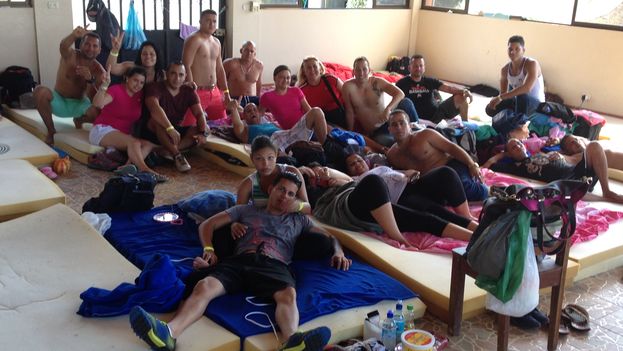
Cubans in a hostel in La Cruz, a few yards from the border between Costa Rica and Nicaragua. (Reinaldo Escobar / 14ymedio)

14ymedio bigger14ymedio, (With information from EFE), Mexico, 28 December 2015 — A total of 250 Cuban migrants stranded in Costa Rica will benefit from a pilot project agreed to this Monday in Guatemala, among the member countries of the Cental American Integration System (SICA) along with Mexico, according to the office of the Mexican Secretary of Foreign Affairs, who spoke with this newspaper. The test will take place at the beginning of January, the Foreign Ministry said, and if all goes well Cuban migrants will continue to be evacuated via this route.

After hours of meeting, the Guatemalan Foreign Ministry made a brief public statement, without offering more details, declaring, “It was agreed to undertake a pilot project of humanitarian transfers in the first week of January, and a working group has been formed that will be responsible for the necessary coordination for the first transfer.” continue reading

Minutes later, the Costa Rican Foreign Ministry added that the Cuban migrants will leave by air from Costa Rica to El Salvador, from where they will be taken by bus to Mexico.

Once in Mexico, the Cubans will be granted an exit permit already allowed under that country’s immigration laws. This exit permit, according the Mexican National Institute of Migration, is valid for 20 days and is granted to citizens declared “stateless.” In the case of Cubans, this happens when the Cuban Consulate is advised by the Mexican authorities of the entry of a citizen with a Cuban passport, and the consulate remains silent or denies that the citizen is Cuban.

According to the Mexican Foreign Ministry, there are no plans to accompany the Cubans arriving from Costa Rica to the US border.

Costa Rica has granted nearly 8,000 special transit visas to Cubans since 14 November, but last week announced that it no longer has the capacity to continue receiving the islanders, and so has ceased to issue these documents in most cases.

The crisis was generated on 15 November when Nicaragua closed its border to Cuban migrants, citing security risks to its sovereignty and stranding thousands of Cubans who are now in Costa Rica and Panama waiting to continue their journey through Central America.

Representatives of Guatemala, Belize, El Salvador, Honduras, Costa Rica, Panama and Mexico, as well as the International Organization for Migration (IOM), met Monday on the outskirts of the Guatemalan capital to discuss this immigration crisis, which finally found a solution more than a month after the Cubans began to be stranded in Costa Rica, which led Costa Rica to leave the political discussions of the Central American Integration System (SICA).

Costa Rican Foreign Minister Manuel Gonzalez described the results of Monday’s meeting as “positive” and said in the official statement released in San José that he could not fully detail the technical and logistical aspects of the transfer, out of respect for the discretion requested by some countries.

“We hope that these agreements can materialize in the short term. Unfortunately, this season of the year makes it impossible to move faster,” he said.

On 18 December Costa Rica suspended its participation in the political affairs of SICA due to the lack of solidarity among countries in the region to allow the passage of Cubans and solve the humanitarian crisis.

“It is satisfactory and a reason to thank those countries who showed their good will,” said the Costa Rican Foreign Minister Monday, after the agreement reached in Guatemala, but he did not specify if the government had decided to fully restore relations with SICA.

But this decision, celebrated by Costa Rica and all the participating nations, should not be interpreted as “a precedent” in the region, but an action to address “a temporary situation,” said the Guatemalan Foreign Ministry, which also said that it would convene the Regional Conference on Migration (CRM) to address this issue in its entirety.

The participating countries also reaffirmed their commitment to combat human trafficking networks, and said they would apply “without delay” the law which severely penalizes this illegal activity, and that “unfortunately obliges countries in the region to return to their country of origin all persons entering their territory in an unauthorized manner.”

“This will be addressed to prevent irregular migration and to firmly combat the crime of human trafficking, and primarily to protect the integrity of migrants and ensure respect for their fundamental rights,” said Guatemala, a country through which migrants transit and that every year suffers migration firsthand.

Hard Times for Cuban Sugar Cane Harvest / 14ymedio, Orlando Palma

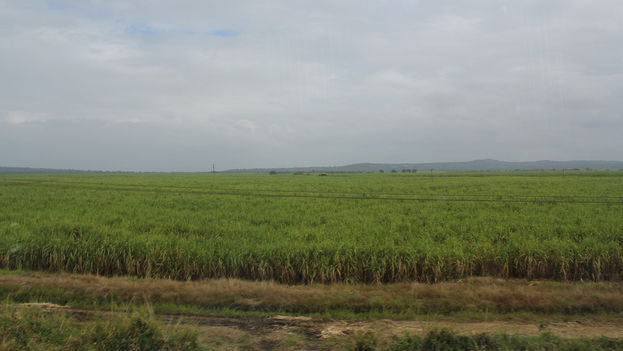
A sugar cane field in Cuba. (Flickr / CC)

14ymedio bigger14ymedio, Orlando Palma, 28 December 2015 – Guarapo,  sugarcane juice, may be harder to get in 2016, thanks to the climate, obsolete technology and missed payments to producers, all of which are affecting the current sugar harvest, according to information presented to the National Assembly on Sunday by the directors of the AzCuba Group.

Delayed payments from the last harvest to private, lessee and cooperative producers total more than 95 million pesos and are of particular concern in the provinces of Holguin, Mayabeque, Matanzas, Camagüey and Granma. continue reading

According to AzCuba president Orlando Celso Garcia, the drought in July and August and the excessive rain in the months of November and December also will negatively affect the sugar harvest.

The delay in starting by a group of centers in the so-called “little harvest” is another negative factor, and is due to the immaturity of the cane and infrastructure problems in the sugar mills.

According to AzCuba’s official figures, the technological and input needs of the sector required 173 million pesos in imports, but only 98 million pesos worth was approved.

Data from the last harvest were handled very discreetly in the official press, and no figure was given for the number of tons produced. A summary of the report prepared by AzCuba and published in the newspaper Granma limited itself to saying that although “the plan fell 4% short of what was expected,” production “grew 18% over the previous harvest.”

Cuban sugar production reached 8.5 million metric tons in 1970 and fell to 1.1 million metric tons in the 2009-2010 harvest, a figure that had already been reached on the island in the early years of the twentieth century.

Cuban Activist On The Brink Of Death After A Prolonged Hunger Strike / 14ymedio, Reinaldo Escobar

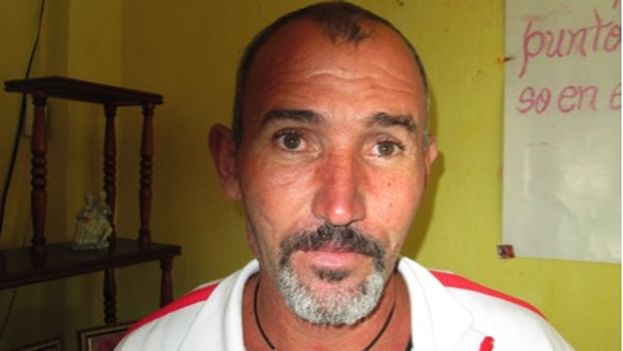
Union activist Vladimir Morera Bacallao. (Source: Twitter)

14ymedio, Reinaldo Escobar, Havana, 26 December 2015 – A blacksmith by profession, he never imagined that after so many years of fabricating bars for his neighbors’ homes, he would end up locked behind prison bars. The activist Vladimir Morera Bacallao will mark 80 days on a hunger strike this Monday, 28 December, the Day of the Holy Innocents. That is, if the authorities don’t release him or he doesn’t starve to death first.

Right now, Morera Bacallao languishes in intermediate care at the Arnaldo Milian provincial hospital in the city of Santa Clara. He was taken there less than a week ago, after his family and colleagues in the Cuban Reflection Movement (MCR) carried out a campaign demanding that the prison authorities pay attention to his case. continue reading

MCR leader Librado Linares told 14ymedio that morera Bacallao now weighs less than 95 pounds, and within the next few hours his health could deteriorate “to the point of no return.” Saturday afternoon, Linares, a former prisoner of the 2003 Black Spring, said “he is so weak now that he doesn’t recognize anyone.”

Linares says that he is “knocking on the doors of the Bishop [of Santa Clara] and some of the province’s fraternal organizations,” to prevent the hunger striker’s death and to achieve his immediate release. The dissident is calling on the national and international community to do everything possible, “to not let him die.”

Morera Bacallo, was sentenced to four years in prison in case 404 of 2015, accused of the crime of “injuries.” The basis of this accusation, according to his family members who attended the trial, was a blow to the head received by Ivis Herrera, second secretary of the Communist Party in the municipality of Manicaragua, in the province of Villa Clara.

Several witnesses confirmed that the injury occurred when the official fell to the ground while sliding on melted asphalt that had been thrown down in front of and around Morera Bacallao’s house. The dumping of the material was part of the aggressions of the area’s “rapid response brigades” against the dissident, instigated by Ivis Herrera himself.

The events, classified as “public disorder,” happened on 19 April of this year, on the eve of the elections for the People’s Power. The opponent decided to put a sign on the door of his house where he proclaimed, “I vote for my freedom and not in some elections where I cannot elect my president.” The text unleashed the fury of the town’s government rulers.

Most of the working-age people in Manicaragua work in military factories or are active members of the armed forces. Thus, the residents of the area respond with a special intolerance and violence against any public display of differences with the government.

Rapid response brigades assaulted Morera Bacallao’s house in April, breaking windows, beating the inhabitants without distinction to sex or age, and throwing bricks. The operation included the spreading of melted asphalt, along with insults and abuse. In the early morning hours, when it seemed that everything was over, the uniformed Special Brigade of the Ministry of the Interior arrived and arrested the activist.

From the moment he fell into prison, the dissident declared himself on a hunger strike and only abandoned it in June, 40 days later, when he was hospitalized and they promised they would review his case. As the authorities did not fulfill their promise, on 9 October he resumed his hunger strike in the Guamajal prison hospital on the outskirts of Santa Clara. There he lost more than 88 pounds, according to Arsenio Lopez Roa, an inmate who provided the information.

Last Monday, the medical team informed the family that the striker had “vomited blood at least eight times, during the transfer from prison to the hospital.” The same source predicted that “at any moment he could experience digestive bleeding.”

In November 2013, Morera Bacallao was sentenced to eight years in prison for reasons very similar to today’s, after suffering an act of repudiation. He was released after one year, on 14 December 2014, after consecutive hunger strikes. Two months later, his name appeared on the list of the 53 prisoners released after talks between Barack Obama and Raul Castro; a list that was not initially made public at the time of their release.

Cuban Faces of 2015: Zaqueo Baez Guerrero, Government Opponent / 14ymedio

Zaqueo Baez, activist

14ymedio bigger14ymedio, Havana, 24 December 2015 — About to turn 40, Zaqueo Baez was completely unknown until 20 September 2015, when he mocked the seven security cordons protecting Pope Francis minutes before his first Mass in Havana’s Plaza of the Revolution. Clinging to the railing of the Popemobile, Baez, managed to deliver a letter to the pontiff and loudly denounce the “new evil” that violates human rights in Cuba.

Baez, a member of the Patriotic Union of Cuba (UNPACU), was immediately arrested along with three other activists. After a several day hunger strike he was released, but not before being accused of public disorder, disrespect and resistance. Today he is in legal limbo, having no single document clarifying his situation.

His bold action had admirers and detractors. Some described him as heroic, others as disrespectful, but the event was recorded in a video that showed it to the world. After his release, the activist has been arrested on each of the multiple occasions in which he has participated in a protest. Nevertheless, he wants to stay in Cuba to continue fighting for his ideals.

Teacher’s Day in Cuba: Gifts and Taking Stock / 14ymedio, Zunilda Mata

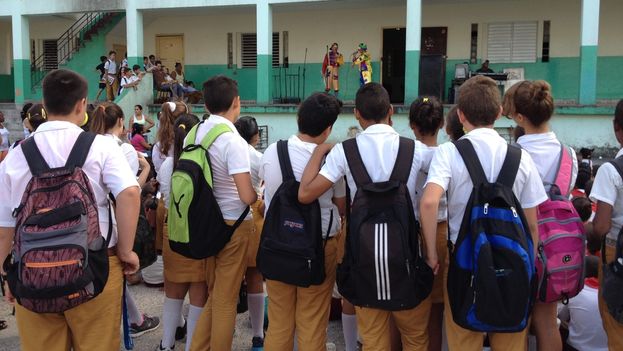
Secondary school students during a cultural activity. (14ymedio)

14ymedio bigger14ymedio, Zunilda Mata, Havana, 22 December 2015 – On Tuesday there will be no classes in any elementary or secondary school in Cuba. Educator’s Day is a time of celebration, when teachers receive congratulations and gifts. The practice does not compensate for the rigors of the profession, but at least it is a gesture of thanks from parents and students toward professionals who suffer from low salaries and the precarious material conditions of their classrooms.

In the more than 10,350 educational institutions throughout the country, this will be a day of celebration and taking stock. The 2015-2016 school year has barely made it to the end of its first semester, but since the beginning has been hobbled by the deficit of thousands of teachers at the front of the classrooms. Last September, only 95.2% of the demand for teachers was met, but the situation has worsened as the weeks have passed and more teachers have deserted the profession. continue reading

Better economic rewards would contribute to reducing the movement to other work, most education professionals agree. Teachers have been waiting for years for a pay increase consistent with the effort they expend, but its coming has been postponed over and over.

“I have been putting off retiring, waiting for a raise, but I can’t wait any longer,” says Melba, 68, a fourth grade teacher in a Havana primary school. After more than three decades of work, the educator says she stays in her job “for love of the profession.” And she adds, “Many of my students today are the children of others I’ve had in the classroom, so I owe it to them.”

In 2014, workers in the public health sector were given a wage increase, some of them seeing a doubling of their salaries to more than 1,000 Cuban pesos a month, the equivalent of about $40 US. However, personnel in the Ministry of Education have not enjoyed a similar benefit.

The authorities in the sector have seized on student volunteers to fill the void left in classrooms by the continued migration of professionals towards better paid activities. More than 10,000 students are helping to meet the deficit in classroom teachers right now, the newspaper Juventud Rebelde (Rebel Youth) reported last Wednesday.

Substitutes, however, fail to resolve the problem. “They do not come with sufficient preparation and do not last long in the job,” the director of a primary school in Havana’s Cerro district told 14ymedio. “Previously teachers loved their work and prepared the students in different subjects, as well as passing on ethical values, and this is harder and harder to find,” explained an official who asked to remain anonymous.

Yosvel, who served as a teacher of Spanish and literature for a decade, now manufactures footwear for the casual market. “I loved my job, but I love my family and I could no longer bring home the little I was earning,” he says. However, he says he is willing to return to his profession if a salary increase is decreed, because “this is the most beautiful job in the world.”

On the border between Costa Rica and Nicaragua, where thousands of Cubans throng on their way to the United States, Yordon “the prof” sleeps on a makeshift mattress. Born in Sancti Spiritus and trained in the pedagogical institute in his province, he spent four years teaching teach math at a junior high school, but now longs “to work at least in construction in Miami.”

The exodus and desertions affect the whole country, although the situation is more difficult for teachers in the capital and in Matanzas province, according to Minister of Education Ena Elsa Velázquez Cobiella. Education authorities call for a greater sacrifice and awareness from teachers, but the slogans do not seem sufficient to keep them in front of the blackboard.

In a message sent by the minister for Educator’s Day, she calls on teachers to march “in the vanguard embracing the future.” She adds, “The success of our socialism will depend largely on what we are capable of doing.” The text was read at the morning assembly at countless Cuban schools this morning, a few minutes before the teachers entered the classrooms to share a piece of cake and refreshments.

“Today is one of those days when I was glad I hadn’t asked to retire, but the rest of the year I think about it all the time,” says Melba, whose students, this Tuesday, have brought her gifts ranging from scented soaps to a pen-shaped USB flash drive.

Cuban Middle Class Takes Over ‘Proletarian’ Neighborhoods / 14ymedio, Lilianne Ruiz

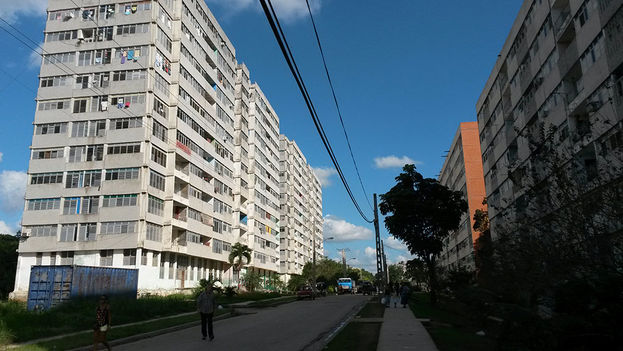
The 12-story buildings are the most common, followed by those with 18 or 14 floors, built with the technique of prefabricated pieces. (14ymedio)

14ymedio bigger14ymedio, Lilianne Ruiz, Havana, 22 December 2015 — “These buildings are earthquake resistant,” says the owner of an apartment for sale in a Havana neighborhood. The potential buyer listens incredulous, looking out from the balcony at other concrete blocks in the surrounding area. What was once a working-class neighborhood, where work and political “merits” were needed to get an apartment, is now becoming the scene of an emerging middle class.

Across the whole country, especially in the provincial capitals, tall buildings were erected in the decades of the seventies and eighties. Twelve stories is most common, followed by those with 18 or 14 floors, constructed from prefabricated pieces. The highest, at 26 floors, were built using the then novel approach of sliding formwork technology.

The so-called Microbrigade* Buildings, have become synonymous with the socialist architecture of Eastern Europe, transplanted to the tropics. It came to be predicted that these giants would replace Cuba’s traditional architecture, and shelter the New Man. Today, despite their exterior ugliness, many of the apartments are bought by an emerging middle class that aspires to see Cuba “from above.” continue reading

In 1979 Orestes Figueroa won a three-bedroom apartment he now wants to sell for 25,000 convertible pesos. “I won it because I had spent almost seven years working as a bricklayer and they awarded it to me based on my merits,” he says wistfully. Located near the Rancho Boyeros Avenue, the colossus in which the home is located is still maintained with a certain dignity, unlike others plagued by hydraulic problems, broken elevators and deteriorating construction.

Now retired, Figueroa has never forgotten the moment when they read out at an assembly the number of volunteer hours he had amassed to obtain that apartment. It was an afternoon of questioning glances and whispers among those vying for a roof. His Communist Party membership and participation in political activities helped him to rise on the list of those deserving an apartment. That night he couldn’t sleep he was so happy.

Those were the days when “loyalty to the process” functioned as an invisible currency with which one could acquire things ranging from appliances, to the right to a vacation in tourist facilities, to the allocation of housing. However, the happy owner had to pay 6,000 Cuban pesos for their new home: 10% of a 250 peso monthly salary for 20 years.

With the legalization of the dollar in the early nineties and the subsequent appearance of the convertible peso, a new form of “natural selection” emerged, where money regained its value for transactions. However, it was not until late 2011, when the buying and selling of homes was legalized, that thousands of apartments in proletarian neighborhoods hit the market.

The microbrigade members of yesteryear, like Figueroa, now weigh the possibility of exchanging the homes they won for the hard cash that would allow them to buy a smaller place and have something level over to supplement their very low pensions. They dream of finding some nouveau riche willing to pay cash for what was once acquired through labor and ideological efforts.

Lizbeth is part of the growing sector of Cubans with access to hard currency. She has always dreamed of living on a high floor, but does not have enough resources to buy a property in one of the buildings built “under capitalism” – i.e. before the Revolution. In a country that grows more horizontally than towards the clouds, the number of apartments in the heights is limited and there is not much to choose from. In 2014, over the whole island, just 25,037 homes were built, of which more than half were built by their residents’ own efforts.

“I didn’t want the Alamar neighborhood, east of Havana, because I don’t like the haphazard crowding of the buildings,” says Lizbeth. With family abroad and a thriving interior design business, the professional inquired in Vedado, looking at the buildings constructed by the microbrigades from the Ministry of the interior, the Cuban Institute of Radio and Television and other state entities. However, prices are higher in areas like Vedado, closest to the Malecon.

Her next choice was the Nuevo Vedado neighborhood, where most of these piles that were built in Havana are concentrated. Properties built by sponsors as diverse as the Ministries of Transport, the Armed Forces, the Interior, Labor and Social Security, or Basic Industry, among others.

“This is neighborhood of bosses and Party fanatics,” says the buyer scornfully, looking at prices that start at 25,000 convertible pesos and go up from there. She finally found something in Alta Habana that fit her budget, between the Electric Company building and the National Poultry Company. Despite the prejudices against housing constructed by the inexperienced microbrigades, the young woman believes that, given its recent construction, it is unlikely to collapse or be declared uninhabitable.

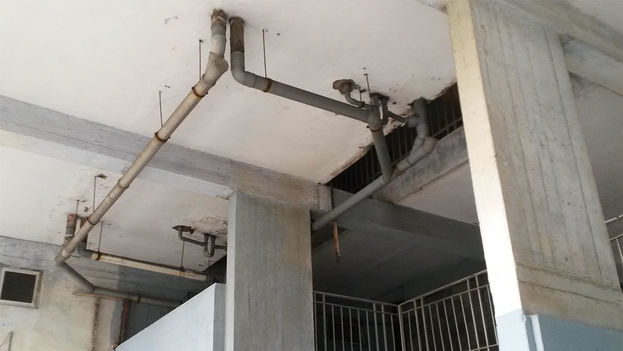
New plumbing installations. (14ymedio)

Indoors, many residents have invested in redoing the bathrooms and kitchens of what were once standard apartments, but most of the facades show the inexorable passage of time, with chipped balconies, unsealed aluminum windows and unpainted common areas with no lighting. In almost all, the water supply lasts only a few hours a day, so the terraces and small courtyards are filled with backup storage tanks.

These concrete giants, once the symbol of revolutionary architecture, have not been maintained for more than three decades. Water pipes have given way in several places and countless apartments are marked by ceiling leaks, while neighbors complain that their new concrete colossus has become “a great big tenement.”

The initial inhabitants, like Figueroa, leave slowly. While Lizbeth makes plans for what color she will paint the walls of her new home, the LED lights she will place in the entryway, and the tub she will install where now there is only an inconvenient shower. The earthquake safety measures built into these tall buildings did not foresee the earthquakes of the economy.

* Translator’s note:
For more information about microbrigades see page 26 of this report by Cuban architect Mario Coyula.

Cuba’s Energy Revolution is in a Tailspin / 14ymedio, Luz Escobar

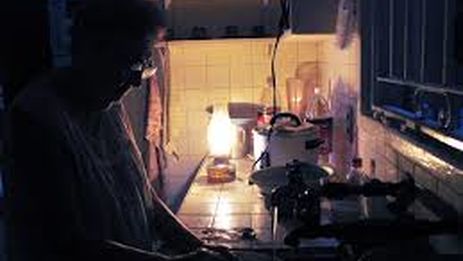
apagone

14ymedio bigger14ymedio, Luz Escobar, Havana, 21 December 2015 – “Hurry! Get in! The patient is dying,” the driver warned the young man flagging him down at the corner of Calzada del Cerro. At the wheel was Carlos Alberto Valdes, a technician from the Electrical Generators Group of Havana, who was on a mission worthy of a movie. He had to repair the power plant at the Diez de Octubre Clinical Surgical Hospital, before an eventual power failure ended the life of a woman in a coma.

Connected to the life-support equipment was a 30-year-old woman who was taken to the Diez de Octubre intensive care unit after a complicated operation carried out at Hijas de Galicia Hospital. Her life depended on one of the frequent blackouts plaguing the Cuban capital not happening, an otherwise common occurrence since the hospital’s power plant wasn’t working. continue reading

Stories like this are repeated across the island, along with others where a power failure does not cost the life of a human being, but aborts a working day, cancels some bureaucratic paperwork, thwarts a tryst, or stops a movie halfway through. Power failures continue to be a constant in the lives of Cubans, despite the Energy Revolution launched a decade ago.

Among the main programs of this marathon campaign, led by Fidel Castro, was the placement of emergency generations in places key to the economy and public services. By 2007, 6,301 generators had been installed in the country, most of them of Chinese origin, of which 3,798 are still in place.

Although they continued to be imported and installed in different locations, the number of active installations did not grow significantly. Cuba 2014: Economic and Social Landscape noted that as of the end of that year 3,855 of these pieces of equipment were working, some 10% fewer than in 2013, and they were generating 19.9% of the country’s electricity. Each of these power plants uses 198 to 227 grams of diesel fuel per kilowatt.

Technological obsolescence, lack of spare parts and the diversion* of the fuel intended for these devices have combined to diminish their effectiveness and limit their social utility. This is confirmed by the testimony of Valdes himself who, upon detecting that the failure of the hospital generator was caused by the battery, told this newspaper: “There are no batteries in the whole country.”

This reality contrasts with the 2006 comments of Eusebio Martinez Rios, director general of the company belonging to Unecamoto Group which managed the installation of the equipment in the country. The official told the official press at that time, “They can last more than 20 years before undergoing major repairs.” A decade later, the number of faulty generators taken out of service exceeds a thousand per year. The Energy Revolution is in a tailspin.

Most of the equipment was installed in economically and socially prioritized locations, such as hospitals, polyclinics, hotel facilities and water pumping stations. In the heyday of the Energy Revolution consideration was also give to placing them in multi-story buildings, to maintain the elevators and water pumps in case of blackouts, but this did not happen. In some of these buildings you can still see the concrete structures meant to serve as bases for the “power giants.”

“The problem is that all the equipment has a certain lifespan and you cannot abuse them, and above all they need to be well maintained,” says Valdes, noting that presently the company has “no parts for these electric generators.” The equipment runs off fuel oil or diesel and they are also frequent victims of vandalism and “diversion of resources.”

“When we try to start up the electrical plant the fuel has been stolen,” a technician of the Cuban Institute of Radio and Television (ICRT) told 14ymedio. He experienced a power failure some years ago that shut down television across the whole country. “It had been assumed that the generator would allow us to continue broadcasting, but we couldn’t turn it on because it was dry,” he said. It took a very long 40 minutes to get the signal back up, while viewers were left in suspense in front of the screen.

In addition to technical problems and theft, this equipment generates pollution, especially the smoke they emit and the noise they make when they are running. Complaints by residents in the vicinity of the generators have become so frequent that Jorge Alvarez, director of the Environmental Regulatory Office, said in an edition of the official TV show Roundtable that the generators “pollute the environment with fumes, noise and vibration.”

Carlos Alberto Valdes resolved the hospital’s emergency — and protected the life of the patient — by taking a battery from another generator at the Surgical Clinic and moving it to the one in need. “Robbing Peter to pay Paul,” a hospital employee kept repeating as he stood by watching. The young woman who survived didn’t even know how close she came to dying, thanks to a capricious blackout and a broken generator that wouldn’t start.

*Translator’s note: “The diversion of resources” is an expression commonly used in Cuba in place of the more accurate phrase, “the theft of resources.” The thieves are often the managers and employees of the enterprise itself, who supplement their pitiful wages with “a little something off the back of the truck “ as one might say in the U.S.

Critical Times for Cuba / 14ymedio, Pedro Campos

The change in the Venezuelan Assembly involves the loss of one of Raul Castro’s biggest supporters (EFE)

14ymedio bigger14ymedio, Pedro Campos, Havana, 21 December 2015 – The year 2015 is drawing to a close and Cuba is living in critical times. There are five main factors that contribute to the Cuban situation: the breach of the fundamental agreements of the 6th Communist Party Congress; the aging and political exhaustion of the “historic leadership”; the spasm in Cuba-United States relations; the reversal of the leftist wave in Latin America – in particular the parliamentary defeat of the Maduro government in Venezuela; and growing popular discontent with the centralized economic and political model, evident in the exodus of Cubans from the country and in the growth and improved organization of the opposition.

The situation is leading to an economic and social crisis and, predictably, to a political crisis, that obliges all Cuban actors – especially the government – to think in terms of the general interests of the people and to put aside those of specific groups.

1. Clearly, had the principal agreements of the 2011 6th Congress of the Communist Party of Cuba been implemented with respect to self-employment, cooperatives, business autonomy, and the opening to foreign investment, the situation today would continue reading

, at least, be one of prosperity. Instead, the staunch support for the Statist model continues to depress farm output and cause retail prices to rise, and the awful dual currency system continues.

Although slight changes have improved the situation of minority groups and strengthened the development of an emerging middle class, economic and social conditions for the dispossessed majority continue to worsen. The impoverishment of state employees – who are the majority – has also worsened, aggravated by problems in transport, food and housing, which are everyone’s greatest concerns.

2. Raul Castro has said he will retire from the government in early 2018. His legitimacy, like that of Fidel Castro and the other “historic” leaders who have ruled this country for more than half a century, comes from his participation in the assault on the Moncada Barracks, his presence on the yacht Granma that brought the revolutionaries from Mexico, and his presence in the Sierra Maestra during the Revolution, not from being elected by a direct and secret vote of the people. Among this group, who may arise enjoy their legitimacy, and so would have to pass the test of direct and democratic election to achieve that legitimacy before the people.

This situation requires that, in Raul Castro’s remaining time in power, a process of democratic negotiation is undertaken in Cuban society that enables a broad inclusive national debate, a new constitution and a new multi-party Electoral Law that allows his successor to run as a candidate in democratic elections.

These are also the two years left to the “historics” to finish dismantling the calamity of the Statist model imposed in the name of socialism, and to develop a free market economy that includes free cooperatives of every kind and size and self-employment without restrictions, and, in addition, where the state enterprises that remain are indispensible they must have a high level of autonomy and for the most part be co-managed with their workers. Alongside them, private businesses of all sizes should be developed, including with Cuban capital from outside the country and with foreign capital.

Should Cuba not advance in this process of democratization and the expansion of the economic system to one that supports new entrants of all kinds, the nation’s future could be very uncertain and bleak.

This is also the time remaining to Fidel Castro’s brother to resolve the fundamental problems with the United States, to ensure that relations with the neighboring country benefit Cuba without jeopardizing its sovereignty.

3. The spasm in relations between Cuba and the United States stem from the Cuban government’s demands for a total lifting of the blockade-embargo, the elimination of the Cuban Adjustment Act and the return of the Guantanamo Naval Base. Also contributing are the emigration crisis and the presence of 8,000 Cubans stranded in Central America, as well as the upcoming election year in the United States, which will make it more difficult for the Obama administration to move forward in normalizing relations. All this suggests a somewhat grim picture, although the president of the United States and some US lawmakers are pushing Congress to address the issue of Cuba.

The underlying problem is that the United States Congress has indicated that it will condition any progress on the issue of democratic changes in Cuba, “concessions to imperialism” that the “revolutionary” government is not willing to concede.

Nobody understands what concessions to imperialism could devolve political and economic sovereignty to the Cuban people, who fought a revolution that triumphed in 1959 to restore institutionalized democracy and the 1940 Constitution violated by Batista; objectives that have always been postponed by this “revolutionary” government. It is not a concession to imperialism; it is a debt to the people.

There are indications that this impasse might be being supported by figures within the Cuban government itself opposed to the necessary changes, those who say they would prefer to see the island sink into the sea rather than compromise on these positions. This sinking does not enjoy majority support among Cubans.

4. The reversal of the leftist wave in Latin America is creating conditions for greater pressures on the Cuban government to advance toward democratic changes. The great parliamentary defeat of the United Socialist Party of Venezuela (PSUV) will probably lead to a drastic reduction in Venezuelan oil flowing to Cuba, and in part to the exchange of doctors for oil, which will significantly affect the Cuban economy and Cuban society in general. This will force Raul Castro’s government to pay for the oil it consumes, but now from other nations, with payment conditions that will not be as beneficial as those contracted with President Maduro.

It should also serve to make the government embark on the path of the economic reforms approved by the 6th Communist Party Congress, to date only narrowly applied, and open spaces for democratic participation, where all sectors – including the opposition and those who think differently – can engage publically without repression.

5. The disaster sustained by the economy due to lack of government willingness to advance the economic reforms approved by its own Communist Party, the lack of democratic advances, the hopelessness because there are no tangible improvements in the changing relations with the United States for those at the bottom, and the loss of Venezuelan aid have increased popular discontent, the exodus of Cubans to other countries, and the size and organization of the opposition.

Accustomed to ruling for more than half a century with the opposition crushed by repression, the government doesn’t know how to deal with a growing peaceful alternative that, banned and lacking outlets, manifests itself in dissimilar ways, both in the heart of the Communist Party and in official institutions, as well as in the streets.

This entire set of circumstances puts Raul Castro’s government up against a very clear dilemma for 2016. Either advance in the fulfillment of the agreements of the 6th Party Congress and start a process of internal democratization that facilitates a greater relaxation of the cords of the blockade-embargo, or watch the Cuban economy and Cuban society become involved in a serious period of turbulence with unpredictable consequences.

2016, Expect the Unexpected / 14ymedio, Reinaldo Escobar

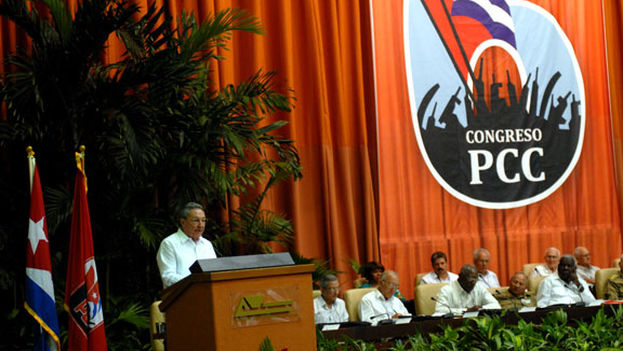
President Raul Castro at the inauguration of the Sixth Congress of the Communist Party of Cuba

14ymedio bigger14ymedio, Reinaldo Escobar, Havana, 20 December 2015 –The current first secretary of the Communist Party of Cuba turns 85 in 2016 and, if re-elected at the Seventh Congress to be held in April, he will be seated in an unacceptable precedent, because at that age it is only appropriate to lead a circle of grandparents.

Although the First Party Conference, held in January 2012, did not specify an age limit for a functionary to serve in a political or governmental post, it did establish “limits with regards to term and ages, according to the functions and complexity of each responsibility.” continue reading

As they say in the movies, “it’s nothing personal” against Raul Castro, it’s that the country doesn’t need to re-experience the disruptions of mid-2006, when ill health prevented the then “Maximum Leader” from continuing to rule the nation.

In his speech at the Sixth Congress, Raul Castro warned that this would probably be the last with the presence of the “historic generation.” And in the Seventh Congress that warning would be a source of major drama. The risk now run by the octogenarians, is that the longer they delay in passing the baton, the more probable an unexpected rupture.

It is hard to believe that the Communist Party of Cuba does not have a single member under 65 (or even under 70), with sufficient capacity to assume the leadership of the organization. Perhaps it is not just about intellectual preparation, indispensible for a “correct application of Marxist-Leninist theory to the revolutionary practice,” nor the experience accumulated in “direct work with the masses,” nor should there be a scarcity of virtues such as integrity, diligence, capacity for teamwork, and others that are in demand in these cases. Most likely it is a lack of confidence that the anointed one would want to maintain continuity. It’s enough to look at what Raul Castro himself has done with the legacy of his brother to imagine the changes that would be introduced by a man without so much ballast.

Obviously, the optimal would be the Communist Party renouncing its constitutionally mandatory hegemony, and opening the opportunity to other political tendencies, but that is another topic.

The year 2016 will be terminal for Raul Castro, at least according to the Chinese horoscope, because on 8 February the Year of the Goat will end, which is the sign under which he was born in 1931. Now begins the Year of the Monkey, whose motto is, “I am the unexpected.”

One Year After December 17, Who Took The Lead? / 14ymedio, Pedro Campos

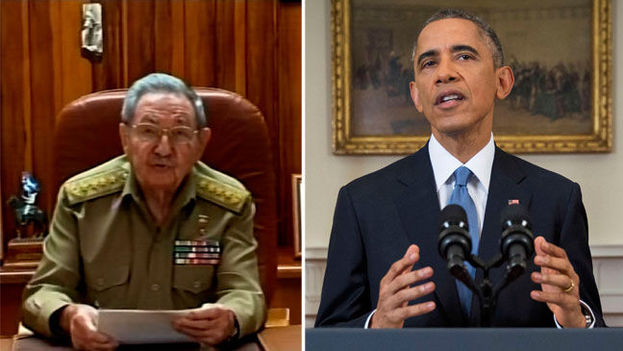
Raul Castro and Barrack Obama announced on December 17, 2014 the normalization of relations between Cuba and the US

14ymedio bigger14ymedio, Pedro Campos, Havana, 17 December 2015 – Several articles have already appeared alluding to the first anniversary of the normalization of relations between Cuba and the USA and evaluating the results.

For some nothing has happened: nothing has changed. But diplomatic relations were restored and there have been some institutional agreements on drug control, human trafficking and postal services.

For his part, President Obama issued several resolutions which, according to various political analysts, converted the embargo into Swiss cheese, and he started to talk about the issue of compensation, while several high-level political, diplomatic and economic delegations from the United States have come to Cuba to study and propose solutions and agreements, although little or nothing has been achieved. continue reading

The Cuban government also has a proposal of its own: “There can be no normalization of relations between the two countries while the blockade and the Cuban Adjustment Act are maintained and Guantanamo Naval Base is not returned,” it says, adding, “we will not take a step back… we will not make concessions,” which in good Castilian means: the investments that we are going to allow here are those of interest to the Cuban government, under the conditions we set.

One thing has become very clear: the Obama administration’s willingness to advance the development of multilateral relations, and to cooperate in various fields with the Cuban government and society, and the unwillingness of the government in Havana to take concrete steps that do not benefit the narrow interests of the Government-State-Party, by which they do not mean those of the entire Cuban people.

The Obama administration, responding to strategic interests in the region, has demonstrated to the world, to its own people and to the Cuban people its readiness to advance in the normalization and strengthening of relations with Cuba, taking a series of steps within the purview of the executive branch. It has made ​​clear that there are a number of laws related to the blockade-embargo which can only be repealed by Congress, which has been working to try to lift them.

The Cuban government is “standing its ground.” It knows that for there to be movement in Congress with regards to the laws of the embargo-blockade, it would have to start a clear process of democratization in Cuba, there would have be an amnesty, decreeing freedom of expression and association and it would have to initiate a dialog with the opposition and those who think differently, and with the whole nation, about a new constitution and a new democratic electoral law.

But it gives no signals in that direction, as much as it is the only existing party and according to the current constitution directs the destiny of Cuba and resists implementing the agreements of its own 2011 6th Communist Party Congress. These agreements addressed the establishment and development of self-employment, cooperatives, business autonomy, and the opening to foreign investment. Meanwhile, the economy continues to tank and the Cuban government’s image constantly deteriorates.

It is clear: if there is freedom, if there is democracy, if there is respect for human rights, no one is going to come to demand you comply with these precepts. It was written long ago: a political democratization and a diversification of the economy would permit a cushioning of the impact of investment and closer relations with the United States. Falling on deaf ears.

Moreover, in the last month, Nicaragua’s closing of its border with Costa Rica, to block Cubans from heading to the United States, has created a regional immigration issue with many sharp edges. Everything indicates that Cuba is behind the Nicaraguan decision, as part of its announced interest in eliminating the Cuban Adjustment Act. However, what it seems to have done is demonstrate to the world the inability of its unproductive statist economic system and the lack of political and civil liberties in Cuba which, instead of attracting young people pushes them to emigrate, at the same time it has shown its interest in complicating, rather the solving, the Cuban-US referendum.

Who has come out ahead in this process? The government of the United States has demonstrated flexibility, tolerance and a willingness to resolve the dispute with Cuba. And this has been a point in its favor.

The government of the Cuba has demonstrated the exact opposite: inflexibility, intolerance and an unwillingness to resolve the dispute, and in addition, the inability to anticipate changes, and even its flouting of its own constitution by failing to comply with the guidelines of the Communist Party, because, in its Stalinist fashion, it believes that it would be “like delivering the Revolution to its class enemies: the self-employed, the cooperatives, the small, medium and large capitalists.”

Cuban leaders have confirmed that in order to remain in power, they are capable of reneging on Party agreements that they themselves shaped, agreements that should guarantee the economic, political and social development of the country, decentralize power, diversify and broaden the productive forces and the productive relationships that expand the economy.

One would have to conclude, therefore, that even the Communist Party, under pressure from its bases, conceived solutions that go against the interests of populist and decadent statism represented at the highest levels of the Party and the government. This also would be another point in favor of Obama’s policy which, instead, favored economically aiding Cuban entrepreneurs, for which the Cuban government has not provided the necessary facilities.

Today, the Cuban government does not want to walk the blue carpet laid out by Obama, nor the red one laid out by its own Communist Party, nor a combination of both. It prefers to continue riding on the old nag, lame and battered by the most vulgar Stalinism that does not help to solve the problems with the United States, and that leads to the abyss Raul once spoke of, although I do not think that is the path he wants to travel.

Clearly, what happened in the presidential elections in Argentina and in the parliamentary elections in Venezuela points to a complication of the Latin American scenarios for this stagnant Cuba. In addition, it makes a democratization of politics and the economy more urgent than ever.
Ladies in White Headquarters Surrounded by State Security / 14ymedio, Orlando Palma

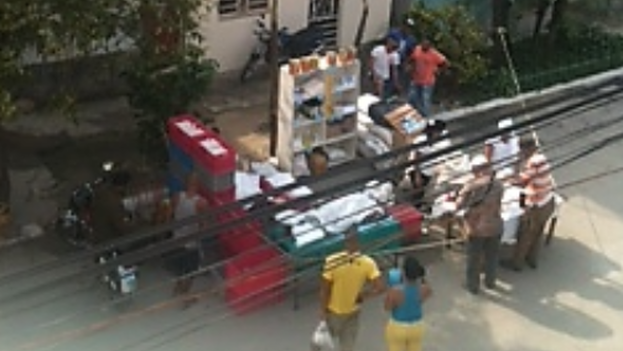
Kiosks selling food and drink in front of the headquarters of the Ladies in White. (bertasolerf)

14ymedio bigger14ymedio, Orlando Palma, Havana, 18 December 2015 — On Friday morning, the political police surrounded the headquarters of the Ladies in White in the Havana’s Lawton district, blocking entrance to several activists who arrived for the traditional literary tea held every Friday, as confirmed to 14ymedio by Juan Angel Moya, former prisoner of the Black Spring and husband of the movement’s leader, Berta Soler.

The opposition also reported that as of last Wednesday several kiosks selling food and drink to the public were placed around the site. State Security in Cuba frequently uses this practice to close access to the homes of activists. continue reading

Despite the arrests and the police cordon, dozens of women have made ​​it to the headquarters of the organization where, as part of the meeting, the film The Empty House, by Cuban director Lilo Vilaplana, was shown.

Opposition figure Martha Beatriz Roque reported that the police took Ladies in White Mayelín Santiesteban and Mirta Ricardo Tornés off the bus they were taking to Havana from Artemisa, to prevent them from reaching the activities at the headquarters in the capital city.

The police operation also seeks to prevent the activists approaching the courtroom for crimes against state security, in the court located at Juan Delgado and Carmen streets in Havana’s 10 de Octubre district, where the trial of Ariel and Ricardo Gonzalez Sendiña will be held on Friday. The young men are the children of Lady in White Lazara Barbara Sendiña and are charged with the alleged crime of theft and slaughter of livestock.

Jose Daniel Ferrer Barred from Havana and Warned He Could Return to Prison / 14ymedio

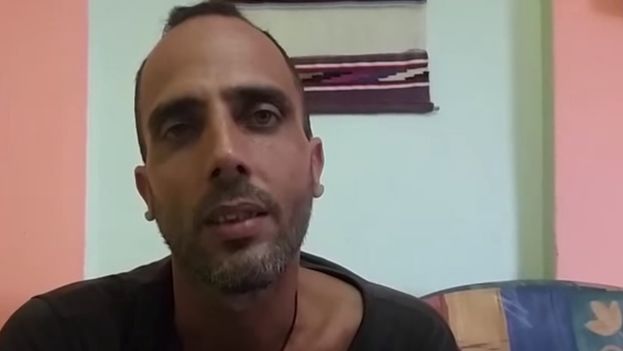
Jose Daniel Ferrer, executive secretary of UNPACU.

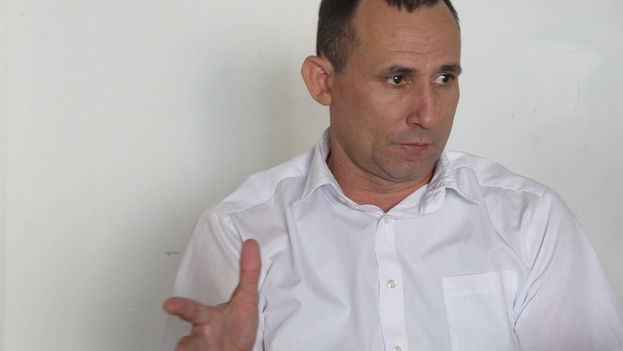
14ymedio bigger14ymedio, Havana, 18 December 2015 — The leader of the National Patriotic Union of Cuba (UNPACU), Jose Daniel Ferrer, was deported to Santiago de Cuba by order of a Havana judge who warned him that he could return to prison to serve his sentence (25 years) if tried to leave his province again. The opponent has been on parole since 2011, the year he was released, after being convicted during the Black Spring of 2003.

Ferrer was arrested Thursday morning, the 17th, at the headquarters of the organization in the capital and taken to the police station on Acosta street.  continue reading

The detainee told 14ymedio by telephone that after remaining there until noon, man who called himself Vicente Rodríguez Hernández appeared, accompanied by a lieutenant colonel of the Interior Ministry (MININT).. “He came dressed in a judge’s robe and carrying numerous documents. When asked to identify himself as a judge, the man said he had forgotten his identity card, but in ay event he did not have to show it to me.”

The presumed judge informed the opposition leader that, according to the law, he is subject to the regulations of parole and cannot leave his province nor file for residence outside Santiago de Cuba, without court authorization. He added that if he violated these measures, he could return to prison.

Ferrer said that he told him, “Save yourself the explanation and take me to jail now, because that is an order I will not obey.” He continued, “They would not give me a copy of the documents they read from, so I refused to sign anything.”

The “court session” was filmed at all times by a man in uniform, and his captors told him that the recording would be proof that he had been duly warned.

At 3 pm, Jose Daniel Ferrer was taken in a van, escorted by two policemen, to the eastern provinces. They spent the night in Las Tunas and at approximately 11:30 am on Friday he was left in the city of Santiago de Cuba.