Obamamania / 14ymedio, Reinaldo Escobar

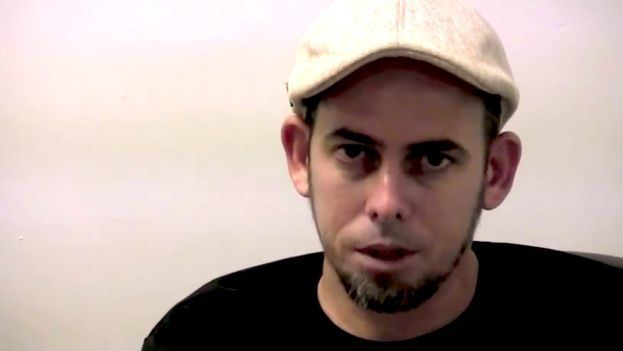
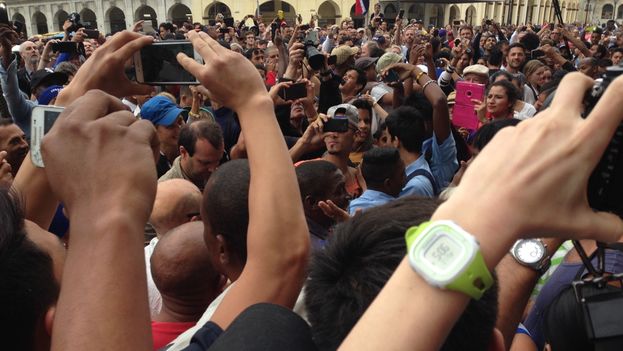
In the center, with white cap and telephone, the young man who was mistaken for Barack Obama

14ymedio bigger14ymedio, Reinaldo Escobar, Havana, 22 March 2016 — A crowd of Havanans that nobody had summoned formed two rows on Prado Street to greet President Barack Obama. It was not possible to determine who gave rise to the rumor that the illustrious visitor would spend Monday afternoon in front of the newly renovated Alicia Alonso Theater, where he has an appointment Tuesday with guests from the “Government authorized” civil society.

Young and old, men and women, workers, tourists, in short, everyone who for one reason or another passed near Central Park or the Capitol building around four in the afternoon joined in the enthusiasm caused by the strong desire of the people to see the US president in person and to greet him. continue reading

Police officers tried to persuade those gathered there not to spill into the street, because vehicles continued to circulate normally. One of them put forward the argument: “Do you think that if Obama were going to come by here there would be so few of us police officers looking after him?” To which a lady who looked like a schoolteacher replied: “And don’t you think that all these people are here because they know that he is going to come by, or at least because they want him to come by?”

Just after five in the afternoon a young man pointed at student in a high school uniform with a certain resemblance to the visitor and shouted, “Here is Obama!” and suddenly the lines fell apart; journalists fell on the student and everyone walking by with a camera or a cellphone was left with the face of the involuntary imposter on its memory card. Almost everyone knew it was a joke, but took the teasing good naturedly and there was a memorable hullabaloo.

At that point the “securities” – i.e. State Security agents – started to arrive, among them a nasty tempered guy known as Volodia, who stands out for his corpulence and for the mistreatment he doles out to dissidents. But nobody paid him much attention. Greeting Obama was permitted. There was no fear. If he had happened to pass this stretch of the Prado at that hour, I believe they would have ended up taking him out of “The Beast,” carrying him on their shoulders and heading off among cheers for Central Park.

Cuban Human Rights Group Reports 12 New Arrests Of Dissidents / EFE, 14ymedio

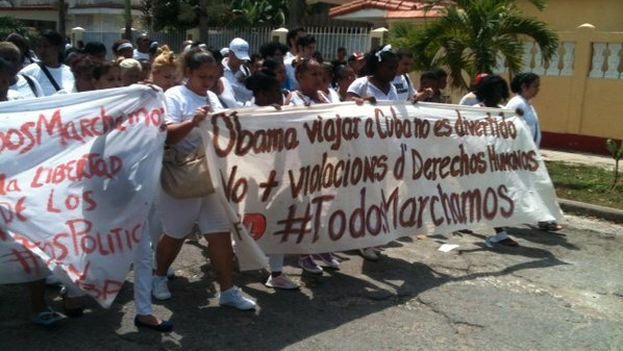
Cuban activists marching in Havana hours before the arrival of President Barack Obama. (@Jangelmoya/Twitter)
Cuban activists marching in Havana hours before the arrival of President Barack Obama “Obama traveling to Cuba is not entertainment. No more violations of Human Rights. We All March”. (@Jangelmoya/Twitter)

14ymedio biggerEFE/14ymedio, Havana, 21 March 2016 – At least a dozen government opponents were arrested this Monday in Cuba, according to the Cuban Commission for Human Rights and National Reconciliation (CCDHRN), which also identifies nearly 90 political prisoners on the island.

Among those arrested for the second day are the leader of the Ladies in White, Berta Soler, and some members of that women’s group, along with her husband, former political prisoner Angel Moya, according to Elizardo Sanchez, spokesman for the CCDHRN, the only group regularly documenting such incidents in Cuba.

Also on Monday the arrest of Antonio González-Rodiles, who heads the independent Estado de Sats (State of Sats) project, along with his partner, activist Ailer González, near continue reading

their home, a family source confirmed.

Elizardo Sanchez said his group is trying to specify the number of arrests on the island since Sunday, when US president, Barack Obama arrived in Cuba.

That same day, some 60 dissidents were arrested several hours after the Ladies in White’s habitual Sunday march.

With regards to the number of political prisoners in Cuba, Sanchez said he currently has in his record to 77 prisoners convicted for political reasons plus one who is serving a sentence of house arrest.

He explained that that group adds the 11 released under a “furlough,” a legal concept that does not annul the sentences imposed during the crackdown of the “Black Spring” of 2003 that led to the jailing 75 dissidents on the island.

Cuban President Raul Castro denied on Monday that there are political prisoners in the country, in the press conference he gave in Havana with President Obama.

Castro challenged a journalist to present a list of political prisoners and assured him that if they really existed they would be freed that very night.

“Give me the list of political prisoners to release them now,” Castro said in answering the reporter’s question.

The Independent Voices Obama Will Hear From / 14ymedio, Reinaldo Escobar

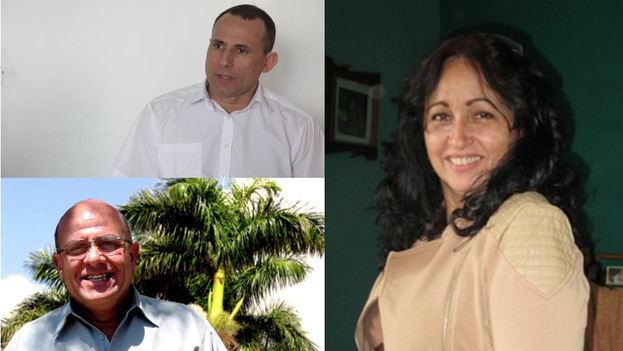
Counterclockwise from top left: Jose Daniel Ferrer, Dagoberto Valdes and Miriam Celaya.

14ymedio bigger14ymedio, Reinaldo Escobar, 21 March 2016 — A group of government opponents and activists from independent Cuban civil society have scheduled a meeting with President Barack Obama on Tuesday morning. This newspaper has contacted three of them to ask them what they plan to say at that meeting.

Jose Daniel Ferrer is one of the eleven former prisoners of the 2003 Black Spring who remains in Cuba and is also the leader of the Cuban Patriotic Union (UNPACU), one of the opposition organizations with the most members and one that maintains permanent action in support of human rights. Every time he crosses the capital city he has to do so almost clandestinely because State Security pursues him to deport him to continue reading

the province of Santiago de Cuba where he has permanent residence.

“In UNPACU we greatly appreciate President Barack Obama’s gesture of inviting us to a formal meeting at the United States Embassy in Havana and we also appreciate the gesture of solidarity of having invited colleagues from diverse civil society organizations, the opposition and independent journalists who have as a common cause the fight for the respect for human rights and for a free, just, democratic and fraternal Cuba.”

Jose Daniel Ferrer brings a charge from his comrades in the struggle. “This time that we are with the distinguished visitor we will use first to congratulate him for his bold decision to start this process of normalization of relations that has led even to his visiting the island. We are going to also congratulate him for the incredibly novel initiative he took to talk with the Cuban humorist Pánfilo which has had a tremendous effect on the population.”

I will ask that this position of solidarity that he is taking with the Cuban people be maintained even beyond his term as president, because being a high-ranking figure in the world, and even a Nobel Peace Prize laureate, he can continue to positively influence relations between the two nations and move others to support the suffering Cuban people who lack rights and freedoms and are living in deep misery.

Dagoberto Valdes is an agronomist who likes to present himself as a “yagüero” for the years he was sentenced to perform the humble work of collecting the “yaguas” (fronds) that fell from the palms in his province of Pinar del Rio. He is the director of the Coexistence Project, and the magazine with the same name, and of a Study Center that professes to be an authentic group of thinkers on Cuban matters.

“In the first place, I believe that the meeting with President Obama puts things in their place. It opens a new stage in which the historic enemy, necessary for these totalitarian systems, is turned into a visiting friend and therefore attention begins to focus on the real problem which is nothing more than the normalizations of democratic relations between the Cuban people and their government,” he told 14ymedio by phone.

He says he does not intend to ask for anything at the meeting. “The time our meeting lasts, at least the part that involves me, I will use to tell the president of the United States about the possibilities, the abilities, the projects with which the Cuban people are capable of being the protagonists of their own history.”

Miriam Celaya worked for a long time as an anthropologist, but obviously was born to be a journalist. She moved into the profession by way of blogs and now her byline is solicited by diverse media who request her penetrating analysis of Cuban society.

She says that the fact of being invited to a meeting of this kind, at this level, is an exceptional opportunity: “In addition to being a historical event, it is an opportunity to share with very valuable people about paramount topics.”

Asked if she has already noted what she wants to say this Tuesday, she clarifies, “I know that others will focus on repression, and the general issue of human rights and many other problems, including mentioning the concern that many have about how this rapprochement has advanced on the American side without seeing advances on the Cuban side. But I would like to concentrate on something that seems fundamental in the work of re-weaving our civil society and that is the issue of freedom of expression.

“It is not about our going there to ask for funding, like the official propagandists believe, but helping us with the desire to raise awareness about the need to support independent Cuban journalism. To empower the people they have to empower themselves with information, to be well informed at this stage when the government has an almost absolute monopoly on the media. And for people to know in depth the real scope of the measures the United States government is taking now, it is essential that an independent press has the ability to reach the citizens.”

If There Are Political Prisoners, They Will Be Released Before Nightfall” says Raul Castro / 14ymedio, EFE

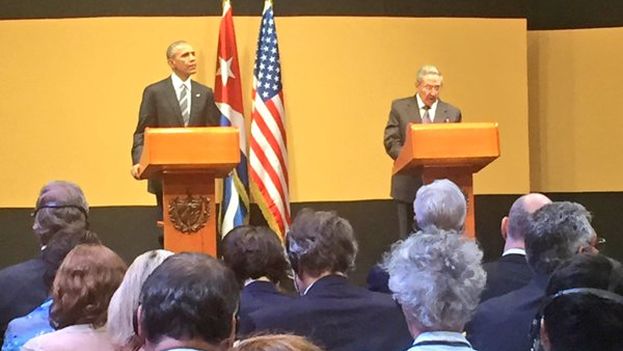
Press conference in Havana with US President Barack Obama and his Cuban counterpart Raul Castro. (White House)

14ymedio bigger14ymedio/EFE, Havana, 21 March 2016 – Nervous, tangled up in his headphones, with a discourse more appropriate for the Cold War than the 21st century, Cubans were able to see their president this Monday during the live broadcast of the press conference he gave with Barack Obama, after a more than two hour meeting behind closed doors. For Cubans, it was the first time they had seen Raul Castro being questioned by foreign journalists with no ties to the Cuban government.

The leaders took stock of the agreements reached since the reestablishment of diplomatic relations in July of last year, each from his own point of view, but both with the firm will to continue along the path.

Castro stressed his government’s readiness to advance normalization and insisted that the “blockade” continued to be the main obstacle to the development of his country. “I confirm that we must put into practice the art of civilized coexistence, that implies continue reading

respecting and accepting our differences and not making them the center of our relationship,” said the Cuban president.

He recalled that in the 15 months since the announcement of the reestablishment of relations, both countries have made concrete progress, for example in last week’s restoration of direct postal service, and direct regular flights that will start within a few months, among other things.

“Much more could be done if the US blockade was lifted,” said the Cuban president who nevertheless acknowledged the willingness of President Obama and his repeated calls to the US Congress for an end to the restrictions.

He described as “positive” the latest measures from Washington to alleviate the effects of the embargo, but called them “insufficient.” He notes that, “The blockade remains in effect and has elements and intimidating effects that hold back our extraterritorial reach.” Raul Castro did not forgot to demand the return of the lands of the Guantanamo Naval Base.

In his statement, Castro also referred to other “differences” between the two countries. “We believe that human rights are indivisible, interdependent and universal,” he said. “We cannot conceive of a government that does not defend and guarantee the right to healthcare, education, social security, food and development, and equal salary for equal work, and the rights of children,” he added.

Barack Obama’s words focused on the progress in the dialog that both countries have maintained since 17 December 2014, specifically those relating to trade, as well as health, education, science, agriculture, the environment and the internet. Obama also referred to the conversations that have been held to cooperate in the fight against drug trafficking.

Obama repeated two words in his remarks several times: “moving forward.” The president was measured in his speech and emphasized twice that the United States should not be seen by Cubans as a threat. “The future of Cuba will be decided by Cubans, not by anyone else,” he asserted.

“After five decades of difficult relations, Cuba and the United States still have serious differences as concerns the issue of human rights and democracy, matters about which we have held very frank and sincere talks,” he said.

He said that in their first meeting at the Summit of the Americas in Panama, in April of 2015, Castro assured him that he could speak on “any issue” and now “all issues are on the table.”

“Part of normalizing our relations means to directly discuss our differences and we are pleased with the dialogue on Human Rights that began in the last year,” said Obama. “We are looking to the future,” he reiterated.

When the press asked questions, Raul Castro was asked by an American journalist with a Cuban father why he was still holding political prisoners. Castro, visibly upset and nervous, replied harshly: “Give me the list of political prisoners now, to release them. Or give it to me after the press conference and before nightfall they will be released.”

Before answering, it was striking that the US president was listening, while Castro was speaking through his headset with an advisor in a loud voice while Obama was responding to the press, which gave rise to widespread laughter in the press room.

A second journalist took the floor and asked the Cuban president a question, and he responded sarcastically: “Many questions for me.” He was only asked three questions.

“The embargo will end. When? I’m not quite sure,” said Barack Obama to an NBC television network journalist who asked if the measures of opening to Cuba will take effect before the end of his term, this year. “This road will continue beyond my administration,” he said.

Obama said that the fact that about 40 lawmakers, including several Republicans, are accompanying him on this trip to Cuba is a sign that there is growing pressure within the US Congress to end the embargo.

“What we did for fifty years served neither our interests nor Cuban interests. If we repeatedly do something that hasn’t worked, it makes sense to try something new,” said Obama.

As for whether the embargo will be lifted before progress is made on human rights in Cuba, Obama said he has “faith in people” and that if both peoples meet each other, talk and establish trade relations, “change will occur.”

Raul Castro agreed to answer one last question from the same journalist, raising his voice, “I said I was going to answer one and I am going to answer one and a half,” and he again insisted that he give him the name of a political prisoner. “You cannot politicize the issue of human rights,” he concluded.

Elizardo Sanchez, president of the Cuban Commission for Human Rights and National Reconciliation (CCDHRN), which each month publishes a report with the arbitrary arrests and other attacks against individual and collective freedoms, told 14ymedio, “Right now we are reviewing the list and there are 80 names confirmed by the CCDHRN plus 11 who are in their homes under conditions of parole. We are trying to locate the CNN reporter who asked the question to deliver the list.”

After the press conference, Castro tried to raise hands with Obama but he did not let him.
Obama Paralyzes Havana / 14ymedio

Nobody wants to miss the opportunity to get a picture on their mobile phone of the Obama family, which so far has generated very good feelings among Cubans. (14ymedio)

14ymedio bigger14ymedio, Zunilda Mata, Havana, 21 March 2016 — Most bakeries in the humble neighborhood of La Timba could barely provide customers with baked goods this Monday. The security operation surrounding the Plaza of the Revolution for the US President’s visit to Havana prevented several workers in these state facilities from getting to the area during the morning. “With Obama, but without bread,” said an elderly woman who tried her luck at several places and went home with an empty bag.

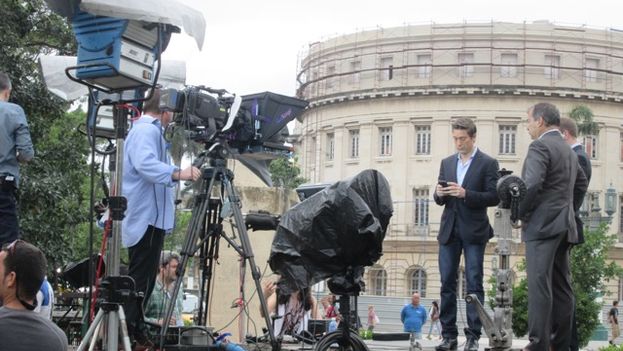
Traffic was cut off on several major arteries and the Cuban capital on Monday was characterized by clusters of journalists everywhere. With each gathering, people speculated that soon the president’s car, known as The Beast, would come down their street. No one wants to miss the opportunity to get a picture on their mobile phone of the Obama family, which so far has generated very good feelings among Cubans.

“The eldest daughter is wearing sneakers,” marveled Yusimí, 36, who expected the dignitary’s family to be continue reading

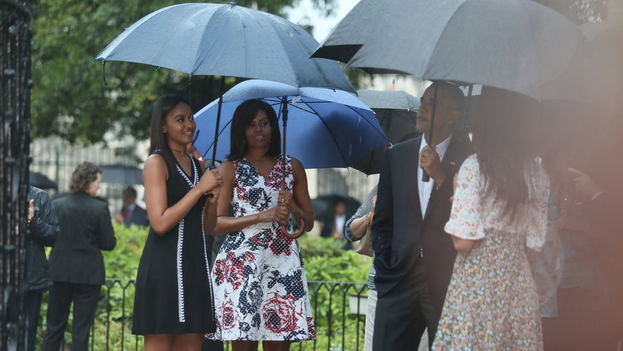
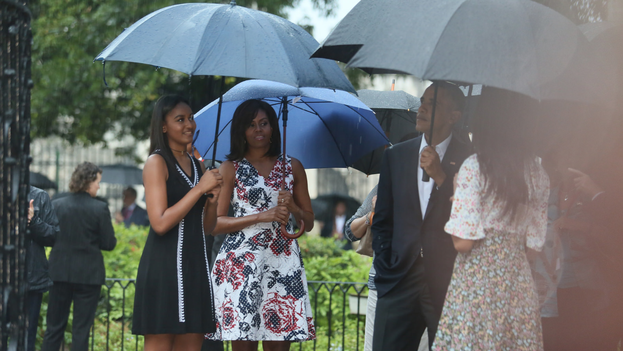
“more formal.” It has been a surprise and generated a lot of popular criticism that Raul Castro did not participate in the reception at the airport. People comment on the street that the US president held his own umbrella to protect himself from the rain, while Cuban officials relied on their sycophants to hold theirs.

The Cuban Art Factory in Vedado was surrounded by a hubbub this morning in advance of a visit by First Lady Michelle Obama. Word spread among the neighbors and in a few minutes the nearest streets were filled with onlookers. The presidential entourage set off spontaneous reactions of joy, despite the poor coverage on official TV of the American president’s visit.

“I had to come by way of Cerro Avenue because Boyeros Avenue is closed,” comments a man with a suitcase trying to get to the interprovincial Coubre Bus Station from Astro Station, a few yards from the Plaza of the Revolution. The collective taxis have also altered their routes to avoid the restricted areas.

“I had to go by interior streets, which are full of potholes because they didn’t fix them for the coming of Obama,” complains Rodney, driver of a deteriorated Cadillac that makes the trip between Fraternity Park and the Playa district. Several of his passengers in the car also criticized the closure of the shops and markets near places the occupant of the White House is expected to visit.

Residents of San Leopoldo, near San Rafael and Lealtad Streets, where Obama ate last night at the San Cristobal paladar (private restaurant), still couldn’t get over their astonishment. “He came here, to this neighborhood, which is not Miramar or Old Havana, said an astonished Xiomara, a flowerseller who heard the shouting last night and went out onto her balcony to find, “a ton of brand new cars.”

US President Barack Obama and his daughter Malia in a restaurant in Havana on Sunday. (White House)

The menu the family asked for in the private restaurant is also the talk of the neighborhood. “A sirloin, m’ijo,” says the woman. “In this block there are children who have never eaten beef,” says Xiomara. The cup from which the president took a sip of Cuban coffee should “end up in a museum,” she says.

The choice of the restaurant, away from the most exclusive circuit, caused people to feel warmly for the president who so far has won the favor of ordinary people. However, his presence has paralyzed a city where it is already complicated to get around and buy food. “It’s making me crazy!” a woman shouted midday at the corner of Carlos III, after waiting more than an hour for a bus.

Barack Obama Seduces Cubans / 14ymedio, Miriam Celaya

Barack Obama with his family on their tour around Old Havana (Yenny Muñoa / CubaMINREX)

Barely a few hours after his arrival in Cuba, President Barack Obama stole the hearts of Cubans.

14ymedio bigger14ymedio, Miriam Celaya, Havana, 21 March 2016 — First, there was an accomplice rain that intensified as the presidential plane taxied down the runway after landing at the airport. The initial image that Cubans had of the president of the most powerful country on Earth turned out to be a gentle and solicitous father, holding an umbrella to protect his wife and daughters from the cloudburst as they descended the plane’s steps together, while offering his hand in greeting and a wide, warm smile to the welcoming group.

Shortly thereafter, around six in the afternoon, during his televised visit to the Cathedral in the historic center of Old Havana, the first cheers were heard from the humble people in the surrounding neighborhoods, expressing their admiration and affection towards the visitor. The links of militants of the single party and other faithful of the Cuban regime were not adequate to avoid real contact between Obama and the people: this charismatic leader seems to exert such a natural power of seduction over the crowds that it causes them to upend the blockade of the official control. continue reading

The scene was repeated when Obama went to the Ceiba tree at the Templete, one of the symbols of the capital’s traditions, and later, when he unexpectedly dined at Restaurante San Cristóbal, an eatery located in the popular district of San Leopoldo, in the heart of Centro Habana. Soon, word that he was in the area spread, and immediately, a crowd spontaneously swarmed around, just to see and greet the American president. “Obama, Obama, Obama!” chanted a crowd of all ages, while the presidential car and his accompanying entourage retreated to the Malecón, and a smiling and happy Obama waved through the window.

It is clear that the 48 hours that Barack Obama will be among us are going to be more loaded with adrenaline than the Cuban authorities had anticipated. Now it seems obvious that, while high-level visitors, popes, presidents and others, have always complacently adhered to the script prepared by the choreographers at the Palace of the Revolution, the man in the White House has his own agenda, which he’s determined to carry out. It is clear that, though Obama will condescendingly participate in the official part of the altarpiece he’s required to perform, he is determined to feel his way around the Cuban people’s beat for himself. No one should be surprised if at some point he suddenly appears in the central courtyard of some dilapidated rooming complex in Havana.

This charismatic president appears to exert such power of natural seduction on the crowds that it causes them to upend the blockade of official control.

In fact, the talk in Havana is Barack Obama’s daring appearance in the comedy show with the greatest TV audience in the country, Deja que Yo te Cuente, with Epifanio Pánfilo as its main popular character, played by comedian Luis Silva. No doubt it is the most original way he has conceived to reach every household in Cuba, and Cubans are fascinated with that perspective. The natural and easy way Obama has chosen to mingle with Cubans contrasts stridently with the distant and hardbound historical leaders and their claque. It is known that autocrats not only remain isolated in a world that is unattainable for the ordinary Cuban, but that they also don’t know how to smile.

By now, Obama’s detractors here and yonder must be tasting their own bile. It turns out that the US President’s visit to Cuba is not really “legitimizing the dictatorship,” but those who some in the media have taken to calling “ordinary Cubans.” One can also imagine the bitterness and the powerlessness of the gerontocracy, that arrogant “historic generation,” witnessing Cuban’s sincere show of affection and admiration for the highest representative of what was, until barely fifteen months ago, the enemy Empire that hated us and was trying to smother us.

Two full days remain to see how many and how unforeseeable are the cards our visitor has up his sleeve, but one may ask if we should expect other surprises. Without a doubt, today’s emotions let us expect that, this US presidential visit to Havana leaves no room for doubt, even if only to show the world how much Cubans approve of the newest White House policies towards Cuba. It constitutes a resounding success for Obama.

Translated by Norma Whiting

Official Cuba’s Fear of Obama / 14ymedio, Eliecer Avila

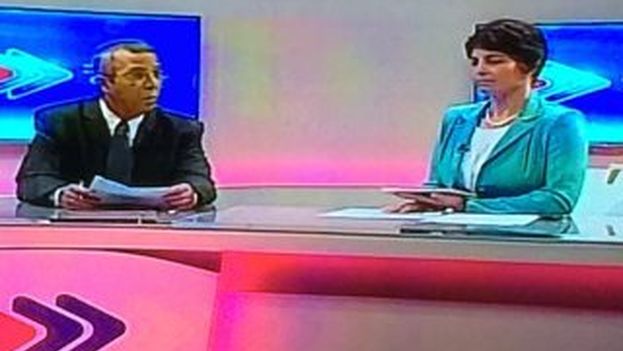
National television devoted several minutes to discussing the Cuba’s colonial past to avoid addressing Obama's visit. (@yoanisanchez)
National television devoted several minutes to discussing the Cuba’s colonial past to avoid addressing Obama’s visit. (@yoanisanchez)

Cuban TV gives Obama’s visit less importance than a potato planting event

14ymedio bigger14ymedio, Havana, 21 March 2016 — The coverage provided by Cuban media and Telesur on US President Barack Obama’s arrival in Cuba on Sunday was absolutely disrespectful, not only to him and with regards to this historic event, but to the millions of families who were glued to their TVs waiting for the “special minute by minute broadcast” which was previously announced and which, as a kind of mockery, could be read only on the sliding tickers at the bottom of the screen.

After showing a few minutes of the landing of Air Force One and the greeting from Foreign Minister Bruno Rodriguez, Telesur abruptly cut away for a special “analysis” delivered by the journalist from the Roundtable program, Arleen Rodriguez, along with two rancid anti-Americans, one Cuban and the other continue reading

Canadian. The short segment then gave way to the program A Dwarf for A Prince, broadcasting children’s movies.

Meanwhile, Cuban National TV broadcast brief excerpts during the arrival, which were shown again in a brief report on primetime news, then talked about the usual things, as if Obama’s visit was one more potato planting event or something even less important.

Hundreds of the world media are reporting the event to millions of people in dozens of languages. Only we Cubans are left with an immense thirst for information.

Thanks to limited and expensive internet access, some of us were able to download pages from newspapers and blogs to learn more. Thousands of messages also came from abroad via the State telecommunications company’s Nauta email server, full of news.

The Cuban government doesn’t know what to do to limit the impact of the visit. I think never before has Raul been more eager for three days to pass quickly.

Pastor Mario Félix Lleonart Detained on Leaving His Home in Villa Clara / 14ymedio

On Sunday, Pastor Mario Félix Lleonart Was Detained As He Tried Leaving His Home (Photo 14ymedio)

14ymedio bigger14ymedio, Havana, 20 March 2016 — Mario Félix Lleonart, a Baptist minister, was detained on Sunday as he attempted to leave his home in the town of Taguayabón, Villa Clara Province. A strong police presence had surrounded his home since Saturday. According to Lleonart’s wife, Yoaxis Marcheco, he was forced into a police car the moment he stepped outside his house.

A few hours before his arrest, Pastor Lleonart sent a statement to this newspaper’s editorial board. In it, he denounces the harassment to which he was being subjected. Here below we publish excerpts of his account. continue reading

The Cuba Barack Obama Will Find

By Félix Mario Lleonart, Taguaybón

The excitement of the past few days has given way to all types of news reports about Cuba. Apart from the ceaseless and flagrant violations of human rights that those of us on the island must endure, we are also aware that Cubans living abroad are having their rights violated as well.

It is no secret that the Communist Party is conducting an all out mobilization of its members in order to fill the Latin American Stadium for the baseball game between the Cuban National team and the Tampa Bay Rays. The President of the United States, Barack Obama, is expected to attend.

While this mobilization is under way, many people are being pressured to not even leave their homes. Moreover, genuine aficionados of our national sport, who always claim “not to care about politics,” because they are “just sports fans,” this time around are being forced to “sit out the game.”

We have also learned that (Cuban-American) Ana Lupe Bustos has been banned from entering Cuba as a reprisal for her work with the Ladies in White. This stands in complete contrast to an experience I had when I came across an émigré while walking around my hometown. When I greeted him, his response was akin to an act of repudiation. This man, who had been president of his Committee for the Defense of the Revolution, was still a genuine CDR supporter, regardless of the fact that he had left the country.

Furthermore, as of Saturday afternoon, numerous State Security and National Revolutionary Police agents have surrounded a property belonging to the Association of the Baptist Convention of Western Cuba. The Ebenezer Baptist Church, where my wife and I serve as pastors, and where our daughters live, is located on said property.

For weeks now we have been warned that we would be kept from moving around freely during Obama’s visit to Cuba. These warnings are now being put into effect. As declared by the United Nations, today is the International Day of Happiness, coinciding with Palm Sunday, the beginning of Holy Week observances. I will probably be arrested, although I have no plans of going to Havana.

Translated by José Badué

Invisible Discrepancies / 14ymedio, Reinaldo Escobar

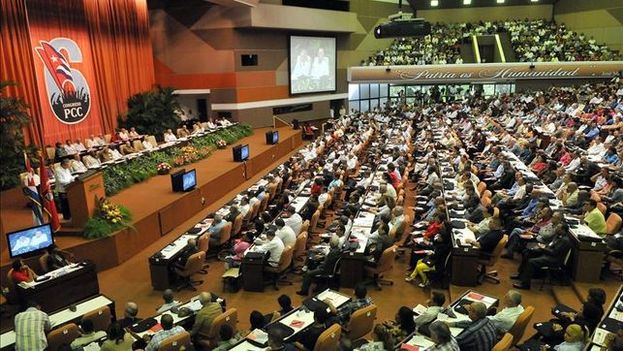
The Palace of Conventions during the Sixth Congress of the Communist Party of Cuba. (EFE)

14ymedio bigger14ymedio, Reinaldo Escobar, Havana, 21 March 2016 – The whole issue of the reestablishment and possible normalization of relations between Cuba and the United States, and its climax, President Barack Obama’s visit to the island, has put into sharp relief deep ideological differences and has brought to the fore long vested interests.

Rifts have appeared in the different scenarios involved, that is, internally within the government circles of both countries and among those in opposition to their governments. To add greater more complexity to the problem, opposition to the Cuban government has two territories, the Island and the exile, and in each of them are found arguments that have been made public on numerous occasions.

In the darkest cave, where only the faintest glimmer flares, is that vague state and partisan entity that sometimes calls itself “the Cuban Revolution with the historic leadership in the front,” and that others call, “the Government not elected by the people.” Not a single member of this fraternity has made public his nonconformity continue reading

with the approach to the “historical enemy”; however divergences exist and are based on real interests, though wrapped in the mystique of revolutionary slogans.

Who are those on each side? It would be irresponsible to put a couple of lists full of names here, but if we limit ourselves to the strictly materialistic point of view which says certain principles are nothing more than the justification of entrenched interests, we could venture a hypothesis.

In favor of the approach are those who presume they will enjoy some advantage in the area of business when détente arrives and conditions are conducive to jumping from the position of government official to that of business owner. There are those who already have their hands on the strings of the presumed piñata. They are the ones who envision a system change and don’t want to be left out of the game. Here we would have to include those who think that, if it is the case that the confrontation didn’t give our neighbor to the north its desired results, nor did it work for the development of the Cuba or for the promotion of its citizens prosperity.

First among those against the approach, are those who today enjoy innumerable privileges based on the existence of an enemy who threatens the system and, supposedly, national sovereignty. If the adversary makes commitments that it will no longer present a danger, the importance of these watchmen will be considerably reduced and the sources of undisputed power that they enjoy today will disappear. Those who fear being held to account for the abuses they committed will be worse off.

Obviously these motivations remain in the shadows, and those who choose to look beyond the transformations and see possibilities are echoing the slogan invented by Gorbachev in April 1985 when he repeated “More socialism!”, or grasping at the straws left them by Fidel Castro when in May 2000 he postulated that the Revolution was “changing everything that should be changed.” Others feel comfortable invoking the intransigence of Antonio Maceo – Cuba’s “Bronze Titan” from its early wars for independence – and affirm that they will not budge even one millimeter from their principles.

The real results of Barack Obama’s visit will become visible in April’s Seventh Congress of the Cuban Communist Party Congress. In the new Central Committee that will be chosen, and in the new figures who ascend to the Politburo, we will see who is winning the game in that muted struggle where no one takes off their mask. We will have to read between the lines of each agreement made, every word changed in the Guidelines, and what new words are added.

It is Forbidden to Applaud Obama at the Baseball Game / 14ymedio

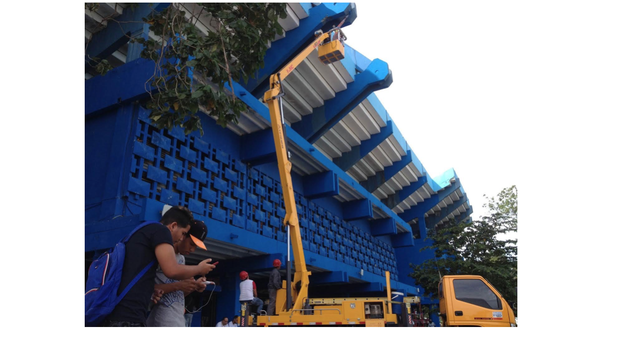
The Latin American Stadium has seen major repairs for Obama’s visit (14ymedio)

14ymedio bigger14ymedio, Havana, 19 March 2016 – “Do not applaud when Barack Obama enters and do not wear caps or hats,” are some of the verbal warnings that accompany the entry tickets that are being distributed for the baseball game between the Cuban team and the Tampa Bay Rays on 22 March at the Latin American Stadium in Havana. The National Institute of Sports, Physical Education and Recreation (INDER) has announced that the game will be by invitation only.

The tickets are being handed out to members of the Communist Party, the Young Communists Union and trusted officials, according to information from several sources. Military training schools such as Camilo Cienfuegos, located to the east of the capital, will also bring their students dressed in plainclothes, to fill the stands of the Cerro colossus.

Directions include not bringing bags or phones, “not even the key to your house,” says Gonzalez, continue reading

an accountant in a state company where the invitations have been distributed to party members and administrative cadres. “We must be there several hours in advance and we can’t bring bottles of water nor any other liquid,” he adds.

Inder’s decision was published Saturday and has already raised concerns among the followers of the national pastime. At the “Hot Corner” in Central Park where baseball is the constant topic of heated discussions among its avid fans, the measure has not been greeted warmly. “In the end, the real fans of the game are going to be left out,” complains Luisín, a frequent attendee of these sporting discussions.

The suspicion is shared among many baseball fans, although INDER has clarified that invitations will go to “fans from all the municipalities in the capital, labor and student centers, members of sports clubs and other faithful followers of this discipline.”

Around the stadium and in the access area strict security controls will consist of several cordons, and protection measures similar to those for an airport will be applied. “There will be metal detectors at the entrance,” said an employee.

The US president will visit the Latin American Stadium with a delegation including cabinet members, members of congress, senators, a part of the diplomatic corps settled on the island and other special guests. Raul Castro will also be present. Television and national radio will broadcast the game live.

The 30 Cuban players who, under the leadership of Victor Mesa, will face the Tampa Bay Rays franchise of Major League Baseball (MLB), trained for the moment at the San Jose de Las Lajas Stadium, while the final details were being worked out at the Latin American Stadium.

This week the Cuban Federation announced the selection of three catchers, 10 infielders, six outfielders and 11 pitchers, who will face the northerners, in what will be the second game of its kind since 1959. The first was 17 years ago between a national team and the Baltimore Orioles.

Ladies in White and Opponents Arrested After Sunday March in Havana / EFE, 14ymedio

Cuban activists marching in Havana hours before the arrival of President Barack Obama. (@Jangelmoya/Twitter)

14ymedio biggerEFE/14ymedio, Havana, 20 March 2016 – Some fifty Ladies in White and other opposition members such as the graffiti artist El Sexto and Antonio Gonzales Rodlies were arrested in Havana today after the usual Sunday march of the female dissident group, which was answered with a counter-repudiation-demonstration by government supporters.

At the end of the usual peaceful march after Mass at Havana’s Santa Rita Church, the Ladies in White tried to walk to other streets away from their route, where the ruling party had concentrated groups linked to the government which began to jeer at them.

The incident, which with varying intensity has been repeated every Sunday for 46 weeks, took place a few hours before the arrival on the Island of the president of the United States, Barack Obama, who during his historic visit continue reading

will meet with members of the dissidence.

The Ladies in White along with a group of dissidents and activists from other opposition organizations gathered under the platform #TodosMarchamos (We All March) and walked some hundred yards carrying a banner with the inscription, “Obama, coming to Cuba is not entertainment. No more human rights violations,” and threw copies of the Universal Declaration of Human Rights on reaching a side street.

At that point they encountered the counter-demonstration of several hundred government sympathizers carrying signs reading “#We All March for a prosperous and sustainable socialism,” and “#We All March for Cuba,” and shouting “Fidel, Fidel” in reference to the Cuban leader Fidel Castro.

Other male activists who accompanied the Ladies in White were handcuffed and put into police cars.

Even after the arrests, the pro-government group of protesters continued in the area and circled the block dancing to a popular conga headed by a contingent from the University Students Federation (FEU).

Previously, the leader of the Ladies in White, Berta Soler, told EFE that her group calls on President Obama during his visit to send “a clear message of support to the people of Cuba, given that the United States has always wanted good things and democracy for the island.”

“We also want to demand that the Cuban government immediately release all political prisoners, enact a general amnesty and to stop police violence,” added Soler.

Soler said that if she can talk with President Obama in Havana, she will him that “nothing has changed here nor is it going to change, he has come to a Cuba that is repressed and he will leave a Cuba that is repressed.”

The first visit by a president of the United States in the last 88 years will begin today with the arrival of Barack Obama, who in announcing his trip said one of its purposes was to influence the situation of human rights on the island, at a time when the dissidence has denounced an increase in repression.

The Orphaned Children Of “The Empire” / 14ymedio, Luz Escobar

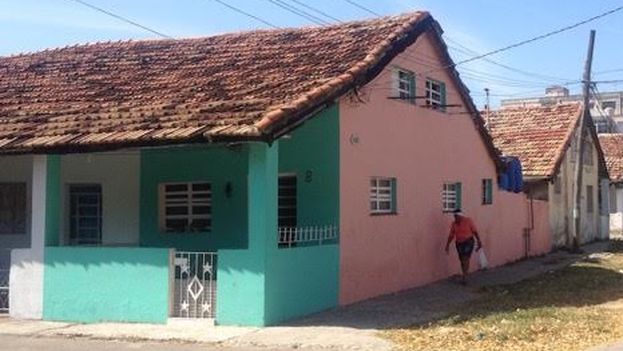
Kohly cottage in Havana. (14ymedio)

14ymedio bigger14ymedio, Luz Escobar, Havana, 20 March 2016 – They call them the “Kholy cottages” and they look out of place with their humble architecture in a neighborhood of mansions and well cared for buildings. In some areas, the roof tiles have fallen off and residents do a juggling act so as not to get wet when it rains. Their short-term hopes of renovations are centered right now on US President Barack Obama.

“The American soldiers slept here during their first intervention,” comments Rita, age 66 and a local resident. According to popular legend – gaining strength lately – the “cottages of 26,” as they are known, may have been camps for the US Army at the beginning of the 20th century. But that all appears to be the fruit of their inhabitants’ imagination. A fable that grows as Obama’s arrival approaches.

“I sleep every night looking at the same ceiling that a Marine looked at more than a century ago,” imagines Ramon, who lives in one continue reading

of the cottages at the intersection of 26th Street and Colón. The man hopes that “now that everything has been fixed with the yumas, surely they will declare this to be a Heritage property and fix them. A woman next to him can’t contain her laughter and denies it, pointing out that the cottages “were just workers’ dormitories for the Kohly family farm and have no ‘historical value’.”

The four long and narrow buildings, with their hundred cottages, are like a biopsy of Cuba. Some entrepreneurs have opened up small businesses. There is a bakery, a car repair and a little shop selling religious articles. The doors of several homes display For Sale signs and most of those who live within their walls are over 50.

Waiting to buy some candy is Tatiana, born in the place and with a three-year-old son. “We believed that Obama was going to come by here, but now we know he won’t,” she declares. Near the Chinese cemetery and the guarded building where Raul Castro’s family lived for a long time, the cottages are “a fly in a glass of milk,” says the woman. “This neighborhood belongs to the pinchos” – a Cuban slang term equivalent to Nomenklatura – “but nobody worries about us,” she complains.

Some years ago, a bus coming full speed down the avenue crashed into the façade of one of the buildings. The roof is still fallen in and many avoid standing in the doorways where the risk of a collision is highest. The complex has the atmosphere of an encampment, but several generations of Cubans have taken root there.

“I’ve lived here since I was a kid and my two daughters were born here,” says Eduardo. For this retiree, the American encampment is a fable. “In reality, this was a horse stable, but there were never blue-eyed blonds here,” he says. In his opinion the myth of the Marines barracks is bandied about because “people want the Americans to take charge and repair it,” he says. “They’re looking to be adopted by the rich uncle,” he sneers.

Every Havana neighborhood seems to be competing for the favor of the visiting tenant of the White House. Popular humor has expanded in recent weeks from the friendly “Bienvenido Mister Obama,” an allusion to the Spanish film “Bienvenido Mister Marshall,” to the incisive, “Obama, seguro, a los yanquis dale duro,” – a substitution of Obama for Fidel Castro in the old slogan: “Fidel, for sure, hit the Yankees hard!” This latter phrase expresses all the contradictions of the official discourse with regards to diplomatic normalization with the neighbor from the North.

In the Kohly cottages the anticipation grows. “Who knows if the caravan will be diverted and pass by here,” dreams Tatiana, excitedly. Military encampment, simple horse stable, or workers’ dormitory, the residents of this small neighborhood abandoned to its fate today remade their past, consistent with the times we are now living. They are like orphaned children, desperately seeking a father.

Obama Is Surrounded By Symbols To Win The Hearts Of Cubans / 14ymedio, Yoani Sanchez

Havana is preparing to welcome US president Barack Obama. (14ymedio)

14ymedio bigger14ymedio, Yoani Sanchez, Generation Y, Havana, 20 March 2016 – He arrives on the Island on Palm Sunday, will attend a baseball game, and has already spoken by phone with the most popular humorist on the Island. Barack Obama’s plane has not yet landed and already he has stolen the hearts of a legion of admirers through a series of symbols. A meal in a paladar (a private restaurant), a phrase from José Martí in his major speech, and a mention of Cachita, the Virgin of Charity of Cobre, would complete his upcoming gestures of enchantment.

On Saturday night Cuban TV broadcast a video in which the humorist Pánfilo called the White House to talk to the president of the United States himself. A masterstroke of the Obama administration, it thus placed itself miles away from Cuba’s powers-that-be, who lack any talent for laughter. Through the character of this old man who is obsessed with his ration book, the president of the United States addressed the Cuban people and did so in their own language. continue reading

This morning, for a few hours, people will put aside conversations about high food prices and complaints about the collapse of transportation, aggravated by the security measures that plague the city. On the streets there is a resurgence of jokes starring Pepito, the mischievous child of our folktales, who emerged from his long silence to laugh even about the great visitor’s mother-in-law.

Symbols are a part of Obama. For black and mixed-race Cubans his coming is a reminder of how remote the arrival of the Cuban president seems to some of them. Cuba’s historic generation, white and rancid, has ruled for more than half a century over the destiny of a people whose skin tones span the racial spectrum. In the poorest neighborhoods, the occupant of the White House has many fans, and in those same areas the popularity of the Plaza of the Revolution is taking a nose-dive.

The man who today will descend the airplane stairs with a firm step, trotting as usual, will present a strong contrast to the gerontocracy that dominates Cuba. In a country with a serious demographic problem, where the majority of young people dream of emigrating, this leader born after the events of the Bay of Pigs is read like fresh page in a history book with too many volumes dedicated to the past.

He is also coming, with his family, to a nation where we never knew who Fidel Castro was married to and where, for decades, his children were never officially presented in public. He will visit the cathedral in Havana and for his major speech on Tuesday they have chosen a historic theater, one of the few places on the island where ideology has not been able to remove its purely cultural connotations.

However, with each symbolic chord Obama touches in the popular imagination, he assumes a responsibility. The expectations are overflowing because Cubans want to cling to any hope that makes them believe the future will be better. The dreams of economic relief, the end of food shortages and improvements in the country’s infrastructure, are at their highest point this Sunday but have a short expiration date.

People want Saint Obama to work miracles. They have placed candles on his altar and said a prayer that he will bring them the prosperity promised by others for more than half a century. For many families, the most anticipated marvel is summarized in it being easier to get a plate a food, a desire expressed in the street with every possible rhyme that joins Obama’s name and the popular word for food: jama.

Thousands of parents across the country are putting on the shoulders of the visitor the responsibility of convincing their children not to leave on the rafts of despair. They believe that he will be able to stop this incessant flow that is bleeding the country, if only he manages to persuade them that a new Cuba is just around the corner. For the nine migrants who just died trying to cross the Straits of Florida, it is a chance that comes too late.

The marvel others are expecting from Obama is connectivity, as if in Air Force One the United States president will have brought the fiber optic cable that will lift the Island from the precarious state of its internet access. The man who has used social networks intensively in his political career is seen as someone who can do a great deal to sneak Cubans into cyberspace.

In the prisons, thousands are waiting for the president of the United States to achieve an amnesty. Opponents of the current government project major openings in political spaces and room for expression. In the hospitals, patients await the arrival of resources to upgrade deteriorating emergency rooms, and in the Cuban countryside expectation of access to machinery and seeds bears the face of Uncle Sam.

Obama arrives in Havana on the first day of Holy Week. Awaiting him is the glory of his popularity and the cross of excessive hopes.

An Agenda For Discussion / 14ymedio, Reinaldo Escobar

Activists of independent Cuban civil society. (14ymedio)

14ymedio bigger14ymedio, Reinaldo Escobar, Havana, 19 March 2016 – A few hours before US President Barack Obama will land in Cuba, a statement presented by independent civil society has been backed by thirty civil and political organizations, along with several individuals from the island and in exile. The document takes advantage of the situation to invite “the Cuban political class” to understand that “there is no longer any room for the philosophy of the besieged fortress.”

The document, which in its first day of publication accumulated 60 signatures, stands out not only for its content but for achieving the agreement of some opposition leaders who initially disagreed with the president’s trip. However, in a gesture that seeks unity, they now subscribe to the six core issues that should be present in a debate among Cubans. continue reading

Most of the signatories live in Cuba, but the support of individuals and entities has also come from the United States, Spain, Mexico and Chile. Even if there is no formal closing date, the total count of signatures will be made in mid-April of this year. Only then will the balance be clear of the lamentable abstentions from an initiative of inclusiveness that transcends the event of the presidential visit.

In the six issues addressed in this declaration, specific issues of concern to the Cuban people do not appear, such as shortages, the high cost of living, transportation problems, or the acute housing problem. Nor does it speak of the need to reunify the currency, increase wages or fight against corruption.

The drafters of the document and the dozens of activists who were consulted on the final declaration chose to include general issues of a political and legal nature, issues which in their judgment might lead to finding solutions to the many specific demands.

In short it can be said that the declaration calls for a social and democratic rule of law; free, fair, competitive and pluralistic elections; ratification of the International Covenant on Civil and Political Rights and the International Covenant on Economic, Social and Cultural Rights; the cessation of repression and the use of physical violence against political and human rights activists; the immediate release of all those unjustly incarcerated, especially political prisoners and prisoners of conscience, and those subjected to conditions of parole; the repeal of Law 88, known as the Gag Law; and the return of all the rights of citizenship to Cuban emigrants.

An inventory of signatures will be made in the days leading up to – this is not by chance – the holding of the Seventh Congress of the Cuban Communist Party, whose agenda is still unknown and which is very likely to exclude in its analysis the demands made known in this declaration.

The difference between what will occupy the attention of the Communists in power and what concerns the opposition will ideally be evaluated by the final recipient common to both sides: the people of Cuba, to whom some propose the continuity of the system and others propose a rupture. The paradox is that this assessment will not be possible until the current opposition demands are met.

The DECLARATION can be read in English here.

The initial signatories can be seen on the Spanish version here.

Obama in Cuba / 14ymedio, Carlos Alberto Montaner

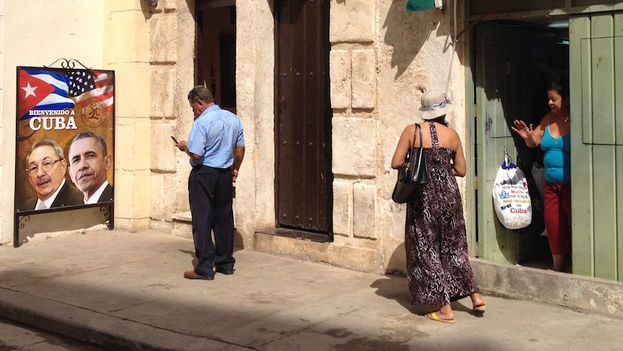
Havana preens for Obama's visit. (14ymedio)
Havana preens for Obama’s visit. (14ymedio)

14ymedio bigger14ymedio, Carlos Alberto Montaner, Miami, 19 March 2016 – The United States president has not yet set foot in Cuba and the regime has already begun the bombardment. First it was a long editorial in the Party newspaper Granma. The essence? Cuba will not move its socialist and anti-imperialist positions a single millimeter, including its support for the Chavista monster in Venezuela, a huge source of subsidies for Cubans, afflictions for Venezuelans and unrest for its neighbors.

Then diplomatic errand boy Foreign Minister Bruno Rodriguez warned that his government was not pleased that Obama spoke of empowering the Cuban people. Nor, that it would try to impose the internet on them. Cuba, he said, “will protect the technological sovereignty of our networks.” In plain language he meant that the political police continue to monitor communications. By this and for this they live. continue reading

The US president was not fazed. He will speak openly about human rights during his visit to Cuba. He has said it and he is going to do it. But there is more: Barack Obama, apparently, will not visit Fidel Castro. (Beware: never say never to this dictator.) At least for now he will inhibit the anthropological curiosity that this Tyrannosaurus Rex always awakens. Today he is a hunched caricature of himself, but there is a certain morbid fascination about conversing with a historic gentleman who has had the ingenuity to spend 60 years flitting through the news programs.

Obama, what’s more, will have the generosity to meet with some of the democrats of the opposition. There is a whole message there. It is a good lesson for the Argentine President Mauricio Macri, who has not yet been, and for French President Francois Hollande, who already passed through Havana and didn’t have the civic courage to make a gesture of solidarity with the dissidents. Obama will meet with the most hard line. He will give his blessing to the fighters. The most beaten up and toughened. Those whom the political police falsely classify as terrorists and CIA agents.

In any case, I think Obama has misjudged the hornet’s nest he has gotten himself into. He has unilaterally decreed the end of the Cold War with Cuba, despite the fact that the island insists on supporting the North Koreans militarily, supporting the terrorists of the Middle East, backing Syrian Bashar al-Assad and the Iranian ayatollahs. Nor does it matter that it directs the orchestra of the countries of 21st Century Socialism (Cuba, Venezuela, Bolivia, Ecuador and Nicaragua), all of them decidedly anti-American and determined to revive the battle left unfinished by the USSR.

Obama feels invulnerable. He is riding an enormous elephant, the largest history has ever known, and from his perspective as the primary planetary power these quaint Latin American dwarfs are like fleas that will naturally be crushed by the weight of an inevitable and overwhelming reality.

It could happen, but there is a serious problem of logic. At the Summit of the Americas in Panama, Obama declared that the United States had renounced trying to change the Cuban regime while, simultaneously, saying it would continue to promote the defense of human rights and a Western democratic vision. This is a clear contradiction.

The Castros’ dictatorship violates human rights precisely because it subscribes to the Leninist viewpoint that they are subterfuges of the callous capitalist bourgeoisie. They do not believe in them. “The Revolution” subscribes to other values, expressed in the so-called “social rights,” and, to achieve them, grants the Communist Party the sole and total direction of society. That is what the Constitution says, inspired by the one Stalin imposed on the USSR in the thirties

When a Cuban freely expresses her opinion and it contradicts the communist dogma, she is not exercising the right to free expression of thought, but committing a crime. When two or more Cubans try to get together to defend their ideals or interests outside of official channels, they are not exercising the right of assembly. They are committing a crime.

These outrages will not end as long as there is no change of regime on the island. It is clear that the vast majority of Cubans living in their own country will look on this visit with great enthusiasm. It is possible that the thaw will improve living conditions for some Cubans. And it is more than likely that certain US exporters will benefit from the opening of this famished market, but the bill will ultimately be paid by US taxpayers.

Nevertheless, there will be no freedoms, nor respect for human rights, nor will there be an end to militant anti-Americanism and the spirit of the Cold War, as long as the totalitarian regime continues and is not replaced by a real democracy. And that, painfully, means that unilateral concessions will continue to be made with no cost to the dictatorship. Appeasement has never been a good policy, as has been confirmed in North Korea with the dynasty founded by Kim Il-Sung, and as we have already seen in Adolf Hitler’s Germany. Bullies confuse kindness with weakness.