“Get on that plane or go to jail,” Cuban Authorities Tell American Lawyer / 14ymedio

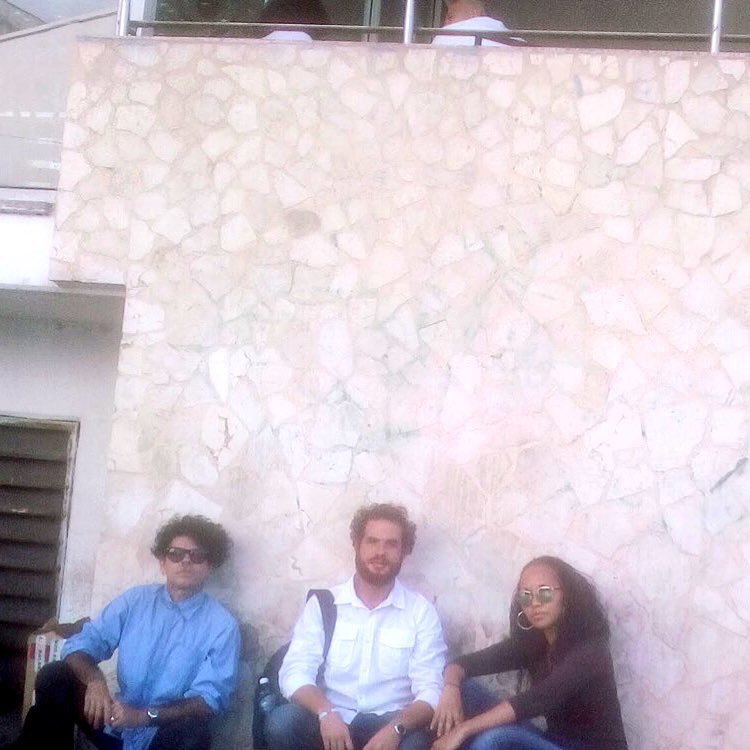
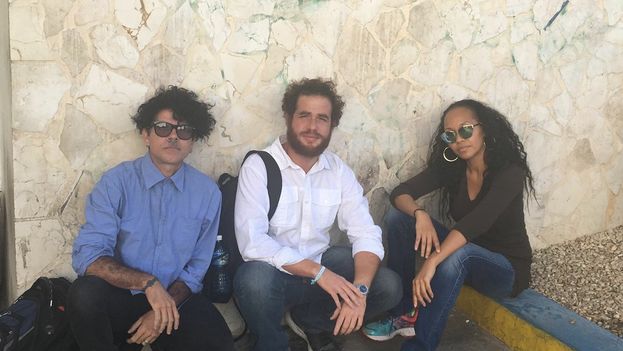
Activists Gorki Aguila and Luis Alberto Mariño and American lawyer Kimberley Motley. (Courtesy)

14ymedio bigger14ymedio, Havana, 18 December 2016 – The American lawyer Kimberley Motley, arrested Friday in Havana, returned to the United States after being subjected to three interrogations, the last of which, held at the Havana airport, made her miss her flight.

“Get on that plane tomorrow or go to jail,” Cuban officials told her the night she was interrogated at the Sheraton Four Points Hotel in Havana’s Miramar neighborhood. continue reading

Speaking to 14ymedio, the international litigator explained that she knew about the case of Danilo Maldonado, known as El Sexto (The Sixth), and had documented it.

The Human Rights Foundation (HRF) wanted to denounce El Sexto’s case before the United Nations. Motley offered to travel to the island and discreetly gather information to provide advice on the matter. She met the artist at the Oslo Freedom Forum and considers him a friend.

Once in Cuba, visiting the island for the first time, Motley tried to interview Maldonado in the Combinado del Este prison, but the authorities prevented her from holding the interview.

Nor was she able to obtain new information on El Sexto’s case from the Court.

According to Motley, she was interrogated three times after being arrested by uniformed and plainclothes officers in a sprawling police deployment that included four police cars and about 15 officers. Once she was taken to the station she was interrogated first by a policeman and then by an immigration officer.

The interrogations were in English and Spanish, although she was never provided with a translator.

The questions asked the American lawyer were: “What are you doing in Cuba? Are you an artist? Do you know the artist? And the other artists?” But they never mentioned Danilo Maldonado by name and never told her why she was under arrest.

In a second episode two immigration officers went to her hotel at midnight and threatened to put her in jail if she did not leave Cuba. They told her, “Get on that plane tomorrow or go to jail,” recalls the lawyer. In addition, the questions of the previous interrogation were repeated.

She was also held at the airport, this time by immigration agents who questioned her about why she was there and searched her backpack.

Motley says she did not call a press conference, although she knew that one would be held by the activists who accompanied her to talk with Maldonado’s mother, Maria Victoria Machado.

However, the lawyer did have a meeting scheduled with a national and a foreign journalist to discuss the case.

Although she did not communicate with the US embassy in Havana, the mediation of the diplomatic headquarters was crucial to her release.  According to Javier El-Hage, International Legal Director for the Human Rights Foundation who spoke with 14ymedio, that organization alerted American officials which speeded up the matter.

The lawyer has said she will continue to support El Sexto’s cause because “the arrest of Danilo Maldonado has no legal or moral basis.”

Kimberley Motley, The Lawyer Who Fights Against Outrages / 14ymedio


14ymedio bigger14ymedio, Havana, 17December 2016 — The US lawyer arrested Friday in Havana could become a nightmare for the Cuban government. Kimberley Motley traveled to Cuba to advise on the case of the artist Danilo Maldonado, known as El Sexto (The Sixth), and was arrested and held for some hours, prompting a wave of international condemnation.

Motley has worked in environments such as Afghanistan where she traveled in 2008 as part of a legal aid program. During her nine-month stay in the country she understood “how laws that were meant to protect people were being underused, while brutal and illegal measures were being overused.” continue reading

The American lawyer became the first foreigner to litigate in the Afghan courts, an experience that helped her realize that “the lack of justice is not only a problem in Afghanistan, but a global problem.”

During the more than ten years she has practiced law, Motley has represented people ranging from high-ranking executives of prestigious companies, to Afghan girls with few resources. The premise of her work is “to work the system from within,” and to use “the laws in the way they are meant to be used.”

Born in 1976 in Milwaukee, United States, Motley won the Miss Wisconsin beauty pageant in 2004 and is the mother of three children.

The lawyer believes that many injustices are committed because people do not know “what their rights are,” laws are “supplanted or ignored by tribal customs” or there are no “lawyers who are willing to fight for those laws.”

These premises brought her to Havana this December to advise on the case of the graffiti artist El Sexto, detained since November 26 after painting a graffiti about the death of Fidel Castro with two simple words: “Se fue” (He’s gone).

Motley’s arrest this Friday adds to the risks that she has experienced in her career. “I have been temporarily detained. I have been accused of running a brothel, accused of being a spy,” she says in a Ted Talk that has gone viral on the internet.

The lawyer points out that for all the risks she runs, her clients run “much greater risks, because they have much more to lose if their cases are not heard.”

This Saturday the attorney was released but the echoes of her arrest are just beginning. A figure with great media and public impact, Motley calls “to create a world economy of human rights and that we all become global investors in human rights.”

The Material Basis Of Joy / 14ymedio, Reinaldo Escobar

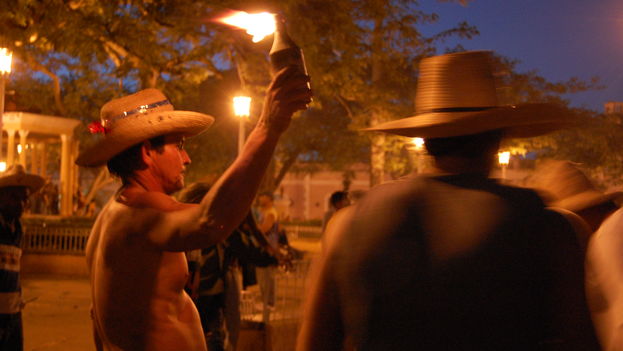
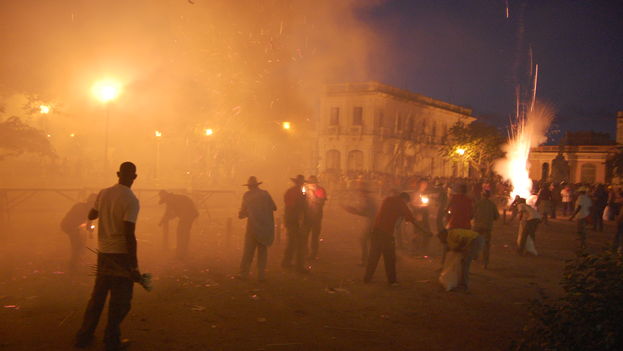
Traditional celebrations called ‘parrandas’ that are normally held in December in Remedios, have been postponed this year until January 6-7. (DC)

14ymedio bigger14ymedio, Reinaldo Escobar, Havana, 16 December 2016 — In the Marxist catechism it is established that the material is first, over the spiritual. From this conceptual Big Bang, is structured a doctrine in which all categories are concatenated more or less harmoniously; social property over the means of production, the fundamental law of socialist distribution, and the dictatorship of the proletariat.

From this key starting point it is explained that matrimonial fidelity is due to the appearance of private property, and that the ambition for riches will only be overcome in the human condition when material goods flow like a river due to the increased productivity that comes as a fruit of dominion over nature. continue reading

For the faithful followers of this form of thinking, joy in human beings is nothing more than the result of drinking alcoholic beverages in an environment where there is music and jokes, social contacts, smiles, cheers and laughter. That is, people do not drink, sing and laugh because they are happy, but the other way around.

At the end of December, Cubans usually indulge their desire to celebrate. Christmas and New Year’s come together to promote gift giving, Christmas Eve feasts, improvised choirs of nostalgic carols, resolutions for the future, furtive kisses at midnight, buckets of water thrown into the street to wash away the year’s evils, and taking a walk with a suitcase as an expression of the desire to take a magical trip to another part of the world.

With this cornucopia, joy prevails and bottles are uncorked, while others eat or dance and someone opens the door to receive the latest guest who didn’t want to miss the feast in which the discomfort of daily life is temporarily relegated to the background.

However, in these days that are left of the month of December, on the pretense of a tragic reason, from certain more or less official bodies, “the order has come down” to moderate the joy, postpone the parrandas, ban celebrations at workplaces and schools. Rumors are rife that alcohol will disappear as of the 20th, there will be no fireworks, and no loud music, not even within one’s own home.

Marxists are like that. They are intimately convinced that by eliminating or undermining “the material basis of joy” they can prevent joy from rising in hearts, crush feelings of gratitude for life itself, and smother the sparks of hope that light the way. At the end of the day, they maintain, the material is above the spiritual.

‘El Sexto’s’ American Lawyer and Two Activists Arrested in Havana / 14ymedio

(L to R) Gorki Aguila, Luis Alberto Marino and Kimberly Motley in Havana (Source: Rosa Maria Paya’s Twitter)

14ymedio bigger14ymedio, Miami, 16 December 2016 – Kimberly Motley, an American attorney, and the activists Gorki Aguila and Luis Alberto Marino were arrested this Friday as they prepared to hold a press conference outside the Provincial Court in from of the Capitol Building in Havana. The Cubans were taken to the Zanja police station, but there is no information about the whereabouts of the American lawyer.

“They were going to give a press conference about the situation of Danilo Maldonado, ‘El Sexto,’ who the authorities accuse of damage to public property,” according to Rosa Maria Paya, president of the Latin American Network of Youth for Democracy, who spoke to 14tmedio by phone. Motley also intended to take on the defense of Eduardo Cardet, National Coordinator of the Christian Liberation Movement (MCL).

Cardet his been under arrest since 30 November for “his political activity of leadership within the MCL” according to the Paya. He is accused of “assault,” a crime that carries a prison sentence from one to three years.

On 26 November, El Sexto was arrested after painting several graffiti on the walls of the Habana Libre Hotel, reading “se fue” (He’s gone), and loaded a video to his Facebook profile celebrating the death of Fidel Castro.

Recently he was transferred to Combinado del Este, a high security prison in Havana.

Threats and Arrests if Dissidents Continue in Cuba / 14ymedio

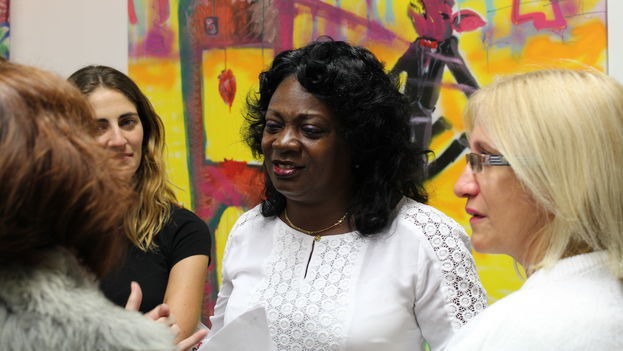
The leader of the Ladies in White, Berta Soler, during an exhibition of the work of Danilo Maldonado, known as ‘El Sexto’. (14ymedio)

14ymedio bigger14ymedio, Havana, 15 December 2016 –The leader of the Ladies in White, Berta Soler, was arrested Thursday in the morning when she was about to leave the headquarters of the organization in the neighborhood of Lawton, Havana, in order to connect to the Internet.

Angel Moya, a former prisoner of the Cause of 75 from the 2003 Black Spring and Soler’s husband, told this newspaper that neighborhood witnesses confirmed to him that the arrest had been made with excessive use of force. “She was arrested violently, neighbors testify that they even beat her,” says the dissident who was not at home at the time of arrest. continue reading

Moya speculates that Soler was taken to the detention center in Alamar, but was unable to confirm the information.

The former prisoner of the Black Spring told 14ymedio that the Ladies in White movement has not programmed any activities for today. “Right now, the only thing Berta did was to launch a call for Tuesday, 19 December, at two in the afternoon in Central Park, for the traditional Literary Tea, if State Security continues to operate around the group’s headquarters in Lawton, and prevents the activists from accessing it.

Around two in the afternoon the political police arrested another Lady in White, Marlen Gonazalez, when she went out with her husband to buy food at the agricultural market. “A patrol car came and asked for her ID card and they took her prisoner,” said her neighbors in the San Miguel de Padron area.

While all this was going on, at Jose Marti Airport the activist Jose Diaz Silva, a Cuban delegate to the Democracy Movement, he was approached by police before taking a flight to the United States. According to a report from the dissident, the officials warned him that on his return from Miami he would encounter very serious reprisals and that from now on the opposition’s “days are numbered.”

The latest report of the Cuban Commission for Human Rights and National Reconciliation (CCDHRN) said that during November there were at least 359 arbitrary arrests of peaceful opponents on the island, over a hundred cases fewer than in October. However, the independent organization warns of a possible increase in repression following the death of former President Fidel Castro.

Cuban Adjustment Act or Upheaval Act / 14ymedio, Rolando Gallardo

Cubans demonstrating against the US embassy in Quito, Ecuador. (14ymedio)

14ymedio bigger14ymedio, Rolando Gallardo, Quito, 14 December 2016 — I wake up and I see a report on the arrival of a group rafters on the coast of Miami. I’m surprised by the open declaration of one of them, who confesses having left Cuba in search of a better future, but says he has nothing against Fidel Castro. His words set me to meditating.

The Cuban Adjustment Act is a good deed on the way to hell. Thousands of Cubans arrive in the United States every year to take advantage of its benefits. Its repeal is a taboo subject among the exile and the emigration. Those who say they are in favor of its elimination or reform from abroad, receive avalanches of criticism and support, demonstrating the division of opinions about it. continue reading

The government of the island ascribes to the Cuban Adjustment Act the main reason for the exodus, dismissing internal conditions and policies that cause people to leave, this being a long-time strategy of the regime: Someone else is always to blame.

Authorized voices within the Cuban-American political establishment, such as Senator Marco Rubio, call for a revision of the Cuban Adjustment Act on the basis that not all Cubans arriving in the United States and claiming refuge under it meet the conditions to apply for asylum, and many of them demonstrate their political apathy by returning to the island as soon as they obtain a US residence permit, discrediting their supposed condition as a politically persecuted person.

Since the beginning of the most recent migration crisis in November of 2015, the division among Cubans stranded in Costa Rica and Panama is evident.

One group reaffirms, recklessly and motivated by an ignorance of the nature of the Adjustment Act, that they are economic migrants, which strengthens the arguments of the regime about the causes of illegal immigration.

Others, however, say that they left Cuba because of its repressive policies, lack of political and economic freedoms, and the impoverishment of the country, something imposed by an internal blockade that has plunged the Cuban people into despair.

Both sides agree that this mass escape was motivated by the fear of political transformations that would be generated by the “thaw,” leaving them inside a nation that sees no long-term changes in the relationship between the government and the people.

It is legitimate to question whether the Cuban Adjustment Act should continue under the current terms. The receiving government spends an annual average of 500 million dollars in aid to the “Cuban refugees.” Some estimates indicate that, from 2014 to late 2016, the United States has allocated 1.5 billion dollars for monetary aid for the first six months, food stamps for three months which are renewable for longer, health insurance for ten months for adults and more health insurance assistance for children, as well as supplementary services for the elderly.

Does every Cuban deserve such kindness? The final saga of the migratory crisis, which has had its most recent and dire chapter in Ecuador, demonstrated that some members of the regime are parasites benefitting from the Cuban Adjustment Act. They waste no time in leaving behind the claws of the tiger, and brazenly appear among the voices clamoring for an airlift to continue their journey to the United States, while in Cuba they were persecutors of the Ladies in White, Cuban counterintelligence officials, members of the National Assembly of People’s Power, and militant communist/opportunists who, tired of the perks of the regime, head north to take advantage of other perks in “la Yuma” – the United States. Many of them, who denied there was a political motive to this breakout, are now in the United States enjoying government help.

Another group, misunderstood and attacked, launched itself in courageous though reckless protest against the Cuban embassy in Quito, showing the political nature of the exodus and starring in one of the never before seen historic feats of the emigration. Unfortunately, it is an event little spoken of. Many of the protesters were deported to Cuba. Another group of people and protagonists of the protest camp in Quito’s Arbolito Park are already in the United States, justifying with their actions and political stance that they deserve the benefits of the Cuban Adjustment Act.

I support reform of the terms of the Cuban Adjustment Act. It is not fair that the American taxpayers’ money goes into the hands of those who enjoyed communism and now want to enjoy capitalism without deserving to. It is not fair that economic emigrants and future speculators head back to the island with their recently obtained residence permits, trampling on the spirit that gave rise to the law. Those who are unscrupulous and reject with their behavior – far from that of the politically persecuted – the refuge offered to them, should have their status reassessed.

I do not live in the United States and I have not benefited from the Cuban Adjustment Act, nor do I consider myself politically persecuted, despite my actions and opinions, but I condemn those who mock the law and discredit the support and sustenance that the United States government has offered to our people in the hard years of the exodus, which sadly does not end.

Cuban Authorities Block Travel Of Dissident Amel Carlos Oliva / 14ymedio

Carlos Amel Oliva was not able to fly from Havana to Warsaw via Madrid, as planned, because the airport computer system showed he is forbidden to travel. (14ymedio)

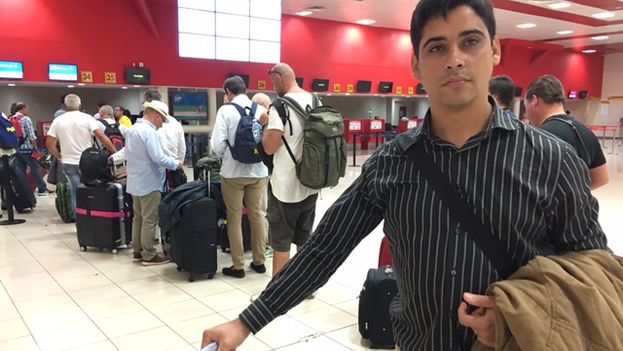
14ymedio bigger14ymedio, Havana, 14 December 2016 – Yesterday, Tuesday afternoon, Carlos Amel Oliva checked in well in advance with his ticket to take Air Europe Flight 052 that was leaving for Madrid just after 10:00 PM, intending to connect from the Spanish capital to travel on to Poland. However, the activist was not able to board because an immigration official told him he was prohibited from leaving.

Oliva was invited to participate in the third edition of Warsaw Democratic Dialogue as a representative of the Patriotic Union of Cuba (UNPACU).

Upon reaching the immigration controls he was separated from the line. “They took me to an office where there was an official who was apparently the shift manager, who explained that I appeared in their computer system as a person prohibited from leaving,” he explained to 14ymedio. continue reading

Carlos Amel asked for an explanation, which he felt he deserved, but the control officials responded that they “didn’t work on that part.”

The dissident told this newspaper what had happened a few yards from the check-in desk for his flight. “[The official] suggested that I direct myself to the appropriate entities, such as the prosecutor, so that I could find out the reasons and I replied that I already knew, because surely the only possible reason was my status as a dissident, a peaceful opponent.”

“I do not have any unpaid fines, nor am I in the midst of a judicial or police investigative process,” Amel Oliva stated, rejecting that he was subject to these established reasons for being denied the right to travel.

On December 10, International Human Rights Day, his father, also named Carlos, was also unable to take his plane at Terminal 2 at José Martí International Airport, heading to a meeting sponsored by Freedom House and the Venezuelan Institute of Parliamentary Studies that was being held in the United States. The UNPACU youth leader’s father also did not receive any satisfactory explanation.

“Obviously,” Carlos Amel Oliva commented before leaving the terminal to return to Santiago de Cuba, “this measure I have been the victim of is not consistent with the signing of agreements between Cuba and the European Union, which has set aside its so-called Common Position. The European Union has done something that could be called a goodwill gesture, having ceased to condition its relations with the Cuban government on issues of human rights, but this is how the government repays the gesture: preventing a peaceful dissident from attending an event organized by civil society in a European country,” he lamented.

The current Cuban immigration law, in force since January 2013, established different reasons for denying a Cuban citizen the ability to leave the country. Among them are motives of public interest or national security, or being subject to a pending court case, as with the former prisoners of the Black Spring of 2003 who refused to leave the country as a condition of their release, and so remain in Cuba on parole. They, however, were each granted the right to make one trip abroad earlier this year.

A common method to prevent a civil society activist or regime opponent from traveling abroad, is to detain them at a police station on the day they are planning to travel and to release them after their flight has already left.

Google Will Accelerate But Not Expand Internet Access In Cuba 14ymedio, Zunilda Mata

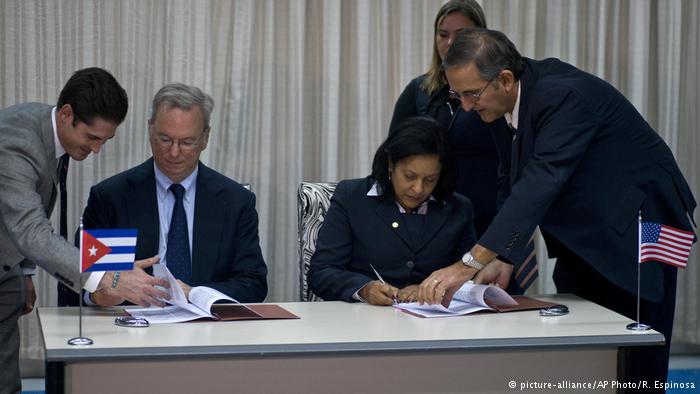
Eric Schmidt from Google and Mayra Arevich from the Cuban phone company ETECSA, sign an agreement in Cuba. @picture-alliance/AP Photo/R. Espinosa

14ymedio bigger14ymedio, Zunilda Mata, Havana, 13 December 2016 – The news made the headlines and generated a wave of enthusiasm. The agreement signed this Monday between the US information giant Google and the Telecommunications Company of Cuba (ETECSA) will improve the experience of Cuban websurfers, but will not, in the short term, affect the number of people who can access the internet from the island.

Google has taken a historic step to overcome official suspicion in the telecommunications sector. Google will install servers in Cuba that will increase the speed and quality of web connections, an improvement which will enable better access to services such as Gmail, YouTube and Google Drive.

However, accelerating, in this case, does not mean expand. The agreement signed by the chief executive of the Cuban state monopoly, Mayra Arevich, and Google CEO Eric Schmidt will only benefit those who already are connecting to the web from the island. continue reading

Cuba is at the forefront of the list of countries with the least internet penetration in the Western hemisphere. An hour of navigation from a state-provided wifi zone costs the equivalent of two days pay for a professional, and is plagued by crashes, service faults, and hackers who wirelessly steal the balance on your internet card, as well as being subject to the physical theft of phones, laptops and tablets by thieves who haunt the wifi zones for this purpose.

“This agreement allows ETECSA to use our technology to reduce latency to locally deliver some of our most popular content and a higher bandwidth, for example YouTube videos,” Google said in a statement.

Once stored on servers within Cuba, that content will reach internet users up to 10 times faster, according to expert predictions. But the agreement does not affect the customers’ bandwidth or allow access to sites that the government of Raul Castro keeps under strict censorship.

Google has been exploring service on the island since 2014, when Schmidt visited Cuba along with other executives and interviewed journalists with 14ymedio, students at the University of Information Sciences in Havana, and Cuban officials. Shortly after that trip, the company opened its products to Cuban users on the island – who previously could not access them – including products such as Google Chrome, Google Play and Google Analytics.

The news of the agreement with the US company spread by word of mouth among Cubans and was presented in the official media as an achievement by the government “to improve the computerization of Cuban society,” but few spoke about the details.

“I hope that now the ability to surf the internet from cellphones is closer,” said Vosvel Camejo, a customer of the only telephone company allowed in the country, and for whom Google is the only entity that can save the country “from underdevelopment.”

The signing of the agreement comes a few weeks from Republican Donald Trump’s inauguration as president of the United States, on 20 January 2017. President-elect Trump has been inconsistent in his position on the process of normalization of relations with the island, moved forward by his predecessor, Barack Obama. Google has rushed to sign the agreement, given the uncertainty presented by the tycoon’s arrival in the White House.

For the Government of Havana, the clock is ticking off certain emergencies in telecommunications. In February 2011, a fiber optic cable connecting the island to Venezuela reached land on Siboney Beach in eastern Cuba. This cable carries the major flow of data entering and leaving Cuba.

Access from home is only allowed for a very small group of officials, professionals with links to officialdom, and foreign residents of the island. “The ideal would be for this agreement to also bring internet to Cuban homes, so that the country can develop all the talent of its people,” says Camejo.

For now, the company, based in California, has committed to improve the browsing experience, a step that can be very important for the development of the independent sector that produces audiovisuals, and for the “YouTubers” who have begun to emerge in the country.

Independent organizations such as the Patriotic Union of Cuba (UNPACU) frequently use video services to publish reports, interviews and images of repression in the east. With the new agreement, their presence and effectiveness on the web can grow significantly.

New Anthology of ‘Fidelism’ / 14ymedio, Reinaldo Escobar

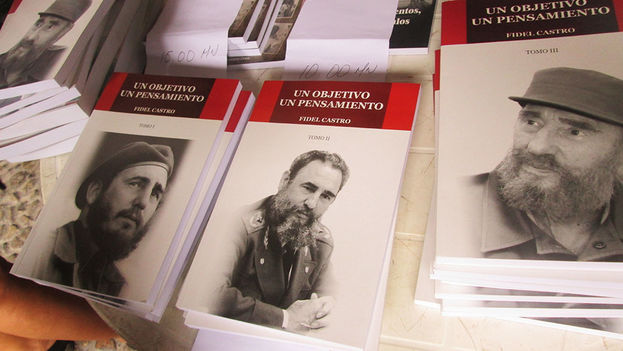
On the cover of each volume are portraits that show the physical and psychological transformation of the man. (14ymedio)

14ymedio bigger14ymedio, Reinaldo Escobar, Havana, 12 December 2016 – The first impression one gets of the book “One Objective, One Thought” is that throughout its three volumes the reader can assess the political evolution of Fidel Castro, author of the quotes contained in the tome. The initial assessment is owed to the portraits appearing on the covers of each volume, which show the physical and psychological transformation of the man.

The first cover shows the leader with a black beard, olive green beret and defiant gaze. It is the image of the guerrilla in power during the ‘60s and ‘70s. On the second volume he is seen in the dress uniform of the Commander in Chief, notably graying and with the look of someone who has an answer for everything, as he presented himself in the ‘80s and ‘90s. continue reading

The image on the third cover reflects a moment in Castro’s life in this millennium. The former president is on the brink of old age, with a certain halo of wise experience, but maintaining his willful authority. It is a snapshot from before 31 July 20016, when he announced his retirement from public life due to the serious state of his health.

However, beyond the impression of transformation offered by these three images, the book presented this Saturday at the Palace of the Captain Generals in Havana, is simply a compilation of the ex-president’s ideas organized chronologically around 50 topics. A bundle of carefully chosen quotations to show more the continuity of his thought than its evolution.

The edition was conceived to honor the leader’s 90th birthday, celebrated this last August, but its launch has taken place a few days after his ashes were placed in a vault in Santa Ifigenia Cemetery in Santiago de Cuba. The work thought of as a summary of a life has become, in reality, a condensed post mortem of Fidel’s legacy.

The work, priced at 30 Cuban pesos (less than $1.50 US), has as an antecedent the “Dictionary of the Thinking of Fidel Castro,” prepared by Salomon Susi Sarfati for Politica Publishers in 2008. Another compilation of high value is “Thus Spake Fidel Castro,” from Roberto Bonachea Entrialgo, issued by the Spanish publisher Ediciones Idea, also in 2008.

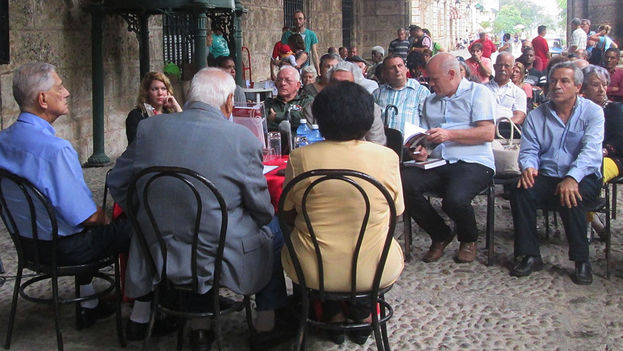
The text was presented by Eugenio Suarez, director of the Office of Historical Affairs of the Council of State, along with the main editor of the volume, Rosa Alfonso Mestre, as a guide for action and ideas for future generations. The presentation took place in front of 50 participants, among them, notably, the faces of officials, admirers of the deceased leader and members of the Communist Party.

The editors state that “for this compilation 4,000 bibliographic sources were consulted, covering a period from October 1953 to April 2011 (…) from which around 8,000 quotes were selected.” Speeches, interviews, Fidel’s newspaper column “Reflections,” have been the principal sources.

But the reader finds a highly filtered text, which avoids quoting Castro’s mistakes, rants and more intolerant positions. For example, under the theme of terrorism, a speech he gave for the 15th anniversary of the creation of the Ministry of the Interior is omitted.

The book was presented at the Palace of the Captain Generals in Havana. (14ymedio)

On that day in 1976, at the Karl Marx Theater in Havana, the leader admitted: “If we dedicated ourselves to terrorism, it is certain we would be effective. But the fact is that the Cuban Revolution has never used terrorism. That does not mean we renounce it, let us warn you!”

In addressing drug trafficking, the anthology does not mention a single word from Cause No. 1 of June 1989, when high officials from the armed forces were tried and condemned to death for their supposed implication in this crime.

On the subject of self-employment and private enterprise, the editors avoided the speeches given during the 1968 Revolutionary Offensive, where Castro emphasized, “We propose to eliminate all manifestations of private commerce, in a clear and decisive manner.” Three decades later, he had to once again authorize the non-state sector, to ease the profound economic crisis caused by the fall of the Soviet Union.

In the chapter dedicated to racial and gender discrimination, you cannot find a single one of the multiple occasions on which he expressed his well-known homophobia. Conspicuous by its absence are the remarks Castro delivered in March of 1963: “Many of these bums, children of the bourgeoisie, walking around with their too-tight pants; some of them with a little guitar and an ‘Elvis-Presley’ attitude have taken their debauchery to the extremes of wanting to go to some public gathering places and organize their faggot-y shows for free.”

Despite the extreme partisanship in the selection of the texts included in these three volumes, the workflow the editors faced is clear. Filtering hundreds of speeches, interminable public presentations and long hours of soliloquy must have been a marathon and exhausting task. But the most arduous work is that of the reader, peering into these pages of such a chaotic, contradictory and disproportionate legacy, like the man who created it.

In Cuba, Remedios Suspends Popular December Celebrations / 14ymedio, Marcelo Hernandez

Fireworks are a prominent part of multi-day December celebrations going back to the 1800’s in Remedios, Villa Clara, Cuba. (Flickr / Sergio Carreira)

14ymedio bigger14ymedio, Marcelo Hernandez, Havana, 12 December 2016 — Havana has its carnivals, Bejucal has its brass bands, and Remedios has its parrandas,  Christmas season street festivals dating back to the 1800s. But this December, all end-of-year celebrations are suspended. Fidel Castro’s death has turned out the lights and shut off the loudspeakers of these festivities.

After nine days of national mourning, including a prohibition on alcohol and music, the Cuban government has also decreed that the local celebrations planned for the coming weeks will be canceled. In the center of the island, the Remedios parrandas are among the festivities most affected by the prohibition. continue reading

Considered the oldest festivals on the island, the Remedios parrandas mix the attraction of their ingenious floats with an impressive variety of fireworks. In addition, the old rivalry between two neighborhoods is played out in a battle of lights, music and wit that generate interest in the event.

After a whole year of preparation, Remedians have had to park their enthusiasm and put into storage the wide range of pyrotechnics planned for the occasion, including rockets, sparklers, fountains, firecrackers, Roman candles and others. This is not the time “to display joy in the streets,” Communist Party authorities told the festival’s organizers.

Although publicly the national mourning ended on 4 December, with the placement of Fidel Castro’s ashes in a mausoleum in Santa Ifigenia Cemetery, officialdom is intent on prolonging the austerity and is calling for an end of year marked by “tributes to the undisputed leader of the Revolution.”

The Remedios floats have been halted just when they were about to be set in motion. With their designs based on historic, literary, mythological or abstract themes, the compositions will have to wait twelve more months to be publicly displayed. The efforts of the “undercover agents” who try to uncover the other side’s “secrets,” have been absolutely fruitless this year.

In the town of Zulueta tradition has also been interrupted this December. Its parrandas are the last to be held in the country, not getting underway until 31 December. The two opposing sides, the Chivos (goats) of La Loma and the Sapos (toads) of El Guanijibes, will have to remain silent on San Silvester Day, waiting for time and oblivion to bury grief and sobriety.

Both towns in Villa Clara province are only a part of those affected by the austerity set off by the death of the former Cuban president. After his death was announced on 25 November, Cuba has not been the same in the cultural arena.

The centrally located Palacio de la Rumba, in Central Havana, has not opened its doors since the death of Castro. Its local programming remained suspended even on 30 November, the day UNESCO declared the Cuban rumba an intangible cultural heritage.

Administrators in Havana’s elementary schools have been advised that Teachers Day, 22 December, should not be celebrated with music. “There will be a morning assembly, a reading of some commitments, but no cake or dancing,” said Rosa, a teaching assistant at a school in Cerro.

Teachers Days are traditionally joyful in Cuban schools, with classes suspended, replaced by parties and, for the teachers, lots of presents. “It is our day,” the educator lamented to this newspaper. For her, the cancellation is bad news, “They’re taking away something we deserve,” she protests.

With the suspension of the Remedios parrandas and the parties for Teachers Day, Cubans are preparing for a discreet end of year, celebrated behind closed doors. “The party will be within us,” says Rosa.

Losing Fear To Get Freedom / 14ymedio, Rolando Gallardo

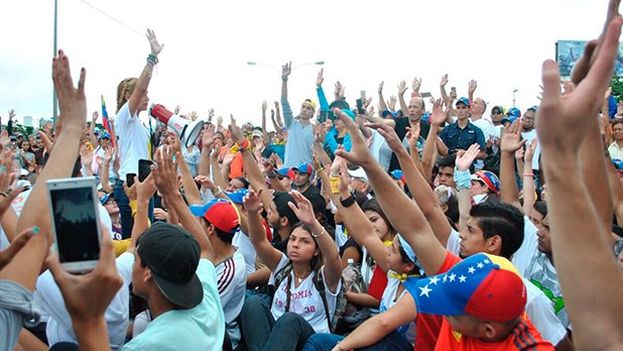
In Venezuela the opposition is aware of its strength and its leaders show their faces in demonstrations against the regime. (@liliantintori)

14ymedio bigger14ymedio, Rolando Gallardo, Quito, 10 December 2016 — On the 58th anniversary of the overthrow of Fulgencio Batista, the seizure of power by Fidel Castro and the disappearance of the national hope of a return to the constitutional values ​​of 1940, the people of Cuba, their emigration and the “historic exile” continue to ask the same rhetorical question: When will we be free?

Before the Obama administration’s rapprochement, the island’s regime raised the alarms of the possible perpetuation of the current state of affairs. Opposition groups have concentrated their intellectual efforts on delegitimizing the actions of the United States government and few have concerned themselves with analyzing the new opportunities for action that it presents. They demand that Washington return to the politics of confrontation of the last 50 years, a return to a Cold War based on ideological footholds or real threats to the stability of the United States that no longer exist. Times have changed, the world is not the same, this is a fact.

Although US President Barack Obama broke the taboo by stepping foot in Havana and shaking General Raul Castro’s hand, and despite the ongoing conversations, the situation in Cuban continues more or less the same. The defenders of the regime point to the deep popular roots of the “Revolution”; the defenders of Obama’s policies blame the opposition’s inability to articulate a plan to destabilize the regime or to win popular support; the detractors of the US administration, coincidentally the traditional opposition the Cuban regime, both on the same side but for opposite reasons, argue that rapprochement is useless. For officialdom it is a maneuver to hide mixed objectives, for the regime’s opponents it is a maneuver to strengthen the regime and betray democratic aspirations, etc.

But what are the real reasons that social unrest does not happen in Cuba? continue reading

In the current Cuban conflict four elements are involved. We must assume that there are four important figures, three national and one external. The national figures are the government and its repressive structures (“mass organization” in the official jargon), opposition groups inside and outside the country and, most importantly, the ordinary people (workers, students, housewives, technicians, doctors etc.), mostly discontented but with high levels of political apathy. The external element is the US government and its policies toward the island.

Where is the project?

The traditional, dispersed and divided opposition base their positions on the flagrant violations of human rights. The main flag of dozens of opposition groups is the establishment of democracy and free elections, a cause undoubtedly just but one that does not offer a intelligible plan to the Cuban masses who want a change in their pocketbooks and in their kitchens. The objectives of the struggle seem futile to a needy majority that depends on the ration book and the tiny wages, the lowest salaries in the Western hemisphere. The opposition discourse forgets to speak out about the pressing needs of the population. What does the ordinary Cuban want to hear? Do they want to hear about democracy? Are the interests of the opposition the same as those of the common people?

Leadership?

The opposition leadership is a burning issue. Some avoid talking about it so that they are not accused of “pandering to the regime” and end up being called “G2 agents,” that is in the pocket of State Security. New times need ethical leadership, a leadership immune to the caudillos, one that can articulate the ideas and diverse projects in the current collage of opposition factions.

We have a common rosary of ex-prisoners turned into patriotic opponents, people who love to get checks and their phones recharged, opposition caricatures who don’t act if the interests of their fiefdom or their personal opinions are not affected. A leadership that doesn’t skimp on launching insults to devalue their adversaries, in the seeking of remittances from abroad. A kind of political flip-floppers that end up smearing the work of ethically firm and committed opponents. One wonders which they benefit more, the democratic cause, or the regime’s discourse. They should aspire to a prepared leadership, trained in theory and practice. Leaders, not supervisors, are what the cause needs.

Civil disobedience?

The Gene Sharp Academy has become famous among opponents. It is common to hear the term as if it were a hidden card, a weapon per se. Civil disobedience is a process that starts from a common idea, a shared desire by the majority who attempt to act together from the first moment in the simple refusal to be a part of what they don’t agree with

The mistake is to call the masses to participate in marches and strikes when they have not first been called to abandon the repressive structures of the regime. It is joining together in civil disobedience when fear is lost and this is discovered when realizing there are many who are willing to be punished.

A simple act of civil disobedience is putting a ribbon on the door or a sticker in the window. It is not about a march like that of September 1st in Venezuela if people haven’t already identified with the opposition project.

“The suspicion syndrome”

The fear of being marked by the regime is one of the reasons for political apathy. The vast majority of Cubans talk quietly at home, criticizing the barbarity and arbitrariness of the government. People avoid talking about it more at work saying: “You don’t know who’s who.” The fear of being put on the blacklist makes people prefer to remain outside any political debate and simply repeat the regime’s propaganda or join its repressive organizations (mass organizations) “so as not to stand out.” Opportunism and amorality have become an instinct for self-preservation.

End of the charismatic government

Fidel Castro met his end. The charismatic leader, bearer of all truth, was a decrepit old man. Although some, glued to the criticism of his image and legacy, still blame him for everything as if he still ruled, the reality is that nature, the only effective opponent of the regime, has removed Fidel Castro.

Fidel’s hypnotic personality was the cornerstone of the Cuban government. The interfamily transfer of power left a vacuum that we ignore. Raul Castro, the elderly general, is a person with little facility with words, jovial among his people but lacking charisma, incoherent, a faint shadow of what was the sex-symbol image of the Commander in Chief in his younger days.

Obama’s visit unveiled a Raul Castro without arguments, disoriented, his voice shrill and disagreeable, reflecting what was left of the “historic leadership of the Revolution.” The dictatorship has lost its charisma and its essence becomes more evident.

Possibility of dialog

The Cuban opposition currently does not have the power or the popular support to force a dialog with the government. Some passionate but hardly pragmatic leaders refuse, as an exercise in bravado, to accept a possible future dialog with the regime. Dialog is desirable, it can be a way to negotiate agreements and to obtain a share of power when the conditions for it are created. But, being realists, the opposition in Cuba had done very little to obtain the elements of pressure.

Obama policy and “normalization”

“Normalization” took the opposition by surprise. Something cooking behind the scenes until we all got a whiff of it. President Obama, ending his term in office, launched an adventure toward an uncertain future. Like it or not there are now fluid diplomatic relations between both countries. The screws have been loosened on the restrictions of the embargo-blockade, a policy that has been voted against for two decades by the majority of the countries that make up the United Nations General Assembly. Keeping it was illogical and trying this new path is the only reasonable option.

The disappearance of tensions and the eventual end of the embargo will put an end to the concept of the imperialist enemy and mark the end of political ideological work. The regime is left without the excuse of considering itself the hero of the “plaza under siege.” The blame cannot eternally fall on the United States: there are no reasons for the scarcities, the corruption, the persecution of entrepreneurs, the imposed lack of connection to the internet, the lack of freedom of expression and the violations of human rights. Will the opposition adapt to the new rules of the game and abandon its tantrums?

Keys

A social explosion will not occur in Cuba as long as a separation of immediate interests between the population and the opposition persists. People must lose their fear and become aware that most Cubans want an immediate change in relations with the state. An ethical renewal of the opposition is essential, as is the meeting at an intermediate point that permits unifying the idea of change for Cuba on the basis of a viable project to undermine the foundations of a regime that has lost its charismatic leader. Articulating a project for a future Republic that does not start from antiquated rhetoric about obsolete economic projects and licenses to kill.

A social explosion will come only when the majority of the population identifies the single culprit responsible for their ills, for which the distractions and excuses must disappear. We must put an end to the idea of the “imperialist enemy.” It requires a committed opposition that takes advantage of the new conditions and doesn’t lend itself to the improbable activities of those who have settled into a way of life guaranteed by dissent.

The freedom of Cuba does not depend on the United States, it depends on our own efforts. As long as we don’t understand our own responsibility, we will not achieve the changes we aspire to.

Cuban Government Launches Ideological Offensive On Human Rights Day / 14ymedio, Zunilda Mata

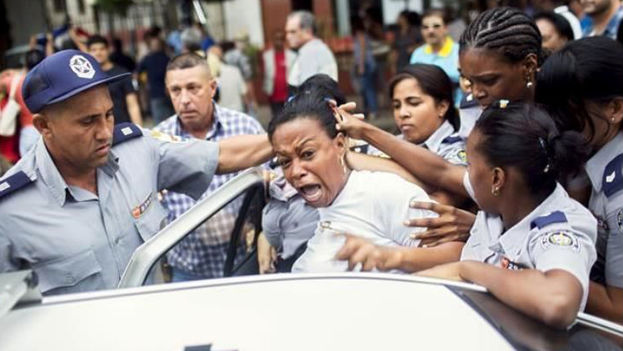
A member of the opposition movement Ladies in White is arrested during a demonstration on International Human Rights Day in December 2015. (EFE)

14ymedio bigger14ymedio, Zunilda Mata, Havana, 10 December 2016 — For several years on International Human Rights Day, the Cuban government has strengthed its ideological battle on the internet with police operations around the country. The volume of epithets posted on social networks and the official slogans published in on-line forums offer a strong contrast to the poor access to the World Wide Web experienced by people on the island.

Cuba has one of the lowest internet penetration rates of the Western hemisphere, with fewer than 5% of the population connected, but this Saturday its presence on the web will surpass that of other more connected nations. The authorities have prepared an avalanche of messages of support to spread what they call “the human rights enjoyed by Cuban youth.” continue reading

For the virtual offensive they have called on university students, members of the Young Communist Union, and teenagers in high school. The political battle on the network will be accompanied by activities and celebrations in dozens of parks and plazas throughout the country.

“I have to go, but variety is the spice of life; because I publish on Twitter they asked me to take advantage of it and connect with some friends on Facebook,” a student majoring in History at the University of Havana, who is participating in the digital offensive, told this newspaper.

The official press has called the day a “hornet’s nest” that is held under the slogan “My Cuba with rights.” The activities not only address the National Day for Human Rights, but also plan a tribute to “the chief defender of the humble, Comandante en Jefe Fidel Castro Ruz,” according to the announcement.

The activities planned for Saturday also include sports competitions, cultural shows, book sales and presentations of audiovisual materials. The sites chosen for the celebrations coincide in many cases with points where the opposition traditionally demonstrates during the Human Rights Day.

University Law Professor Luis Sola Vila spoke on the Legal segment of the morning news magazine, saying that “in our country the Universal Declaration of Human Rights went into effect with the triumph of the Revolution, undeniably.”

Sola Vila noted that Cuba is a signatory to several treaties, including those against torture, discrimination against women and racial discrimination, but omitted that the government of the island has not yet ratified the United Nations International Covenant on Civil and Political Rights and its International Covenant on Economic, Social and Cultural Rights.

Amid the intense ideological campaign on display in the official media for the occasion, conspicuously absent has been any reference to the rights of association or freedom of expression.

From the early morning hours several activists denounced police operations around their homes and warnings from State Security not to go out into the street. At dawn the headquarters of the Ladies in White in the Havana neighborhood of Lawton was surrounded by political police, according to a report from the dissident Angel Moya.

Officialdom expects to mark another ideological victory on this Human Rights Day, keeping the opposition forces under control, deploying an army of followers on the internet, and staging prepared celebrations in Cuban parks.

The Film ‘Santa and Andrés’ is Excluded From Havana Festival / 14ymedio, Luz Escobar

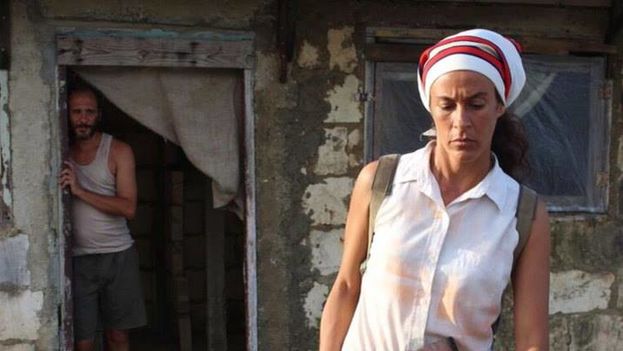
Still from the film ‘Santa and Andrew’ Carlos Lechuga. (Facebook)

14ymedio bigger14ymedio, Luz Escobar, Havana, 23 November 2016 — The film Santa and Andrés will not be screened at the 38th edition of the Havana Film Festival, to be held between 8 and 18 December. Sources from the industry guild commented to 14ymedio that the exclusion of the independent film, directed by Carlos Lechuga, could be motivated by its theme, focusing on censorship against a gay intellectual in the early eighties.

The 36th International Festival of New Latin American Cinema awarded the film the prize for an unpublished script, but it will not compete in this year’s festival. This decision came from “the highest authority,” several filmmakers told 14ymedio, and contrasts with the decision initially made by the event’s organizing committee, which gave a green light to the showing of the film. continue reading

An article in the official blog El Heraldo Cubano says that the plot of the movie “aims to highlight political persecution and attacks on the island that did not take place.” The article says that the film follows “a course of action that is not consistent with history.”

The article has circulated widely among filmmakers, and Carlos Lechuga, in a passionate response on his Facebook page, says that the author’s words are not only an attack on Santa and Andrés, but also represent “a critique and an attack on all independent cinema.”

The director, Enrique ‘Kiki’ Alvarez, has joined the defense of the film because he feels that the story of the two main characters, “who are opposites, she a revolutionary and he a censored writer, forced to be together,” ends up leading them “to a coming together and a recognition of the other that defines the humanistic will of this film.”

Lechuga continues to hope that the decision to exclude the movie from the most important film event on the island will be reversed. However, the filmmaker Miguel Coyula believes he “is still trying to have a dialogue of the deaf (…). We have to advocate for creating a space, an independent theater, where art films are shown without being dominated by the dictates of an institution.”

The official attack has ignored the vast number of awards received by Lechuga, including the Julio Alejandro Award from Spain’s General Society of Authors and Editors (SGAE). This is the second feature film by this young director, who captivated audiences with his film Molasses (2012).

Santa and Andrés premiered to a full house at the Toronto International Film Festival, and was also screened at San Sebastian, Chicago and Zurich. Its first showings were dedicated to Reinaldo Arenas, René Ariza, Nestor Almendros, Guillermo Cabrera Infante, Virgilio Piñera and José Lezama Lima.

Lechuga says that in the idea and filming of the work he was motivated by “the desire, the attempt, to hear the voice of many who were silenced or who suffered the repression of people who tried to silence them.”

The Havana Film Festival will show 440 films this year, with 36 of them competing for prizes. Among them, two Cuban productions will compete in the category of first works and three will compete for the award for best feature film.

For more than three years several Cuban filmmakers have defended, in open meetings ,the idea of a Film Law that would permit the development and operation of independent production houses.

Cuba’s Christian Liberation Movement Leader Gets a Lawyer / 14ymedio

Eduardo Cardet, national coordinator of Cuba’s Christian Liberation Movement. (Flickr)

14ymedio biggerEduardo Cardet, national coordinator of the Christian Liberation Movement (MCL) who has been under arrest since the night of 30 November, as of Thursday has found a lawyer to represent him. His relatives have denounced in several media that no lawyer wanted to take on the activist’s defense. Although the lawyer has not had access to his file, the family is optimistic and affirms that the attorney “fight for his right to bail.”

Yaimaris Vecino, the activist’s wife, told this newspaper in a phone conversation that she was able to see Cardet just after they moved him to the so-called “provisional prison” of Holguin, located on the Bayamo highway very close to the airport. continue reading

Yaimaris said that the regime opponent still has notable injuries on his face that he suffered during his arrest, and she clarified that ultimately the accusations have focused on the crime of attack, for which the prosecution would ask for a sentence of between one and three years, as stipulated in the Criminal Code.

Under the law, it is a crime when the use of “violence or intimidation against a public authority or official or its agents or assistants impede them from realizing an act appropriate to their duties.”

However, according to the testimony of numerous witnesses consulted and the family, it was the agents of authority, represented by two members of the State Security in plainclothes and two in uniform, who pounced on Eduardo Cardet when he arrived on a bicycle at his mother’s house.

“It was they who knocked him off his bike and exercised unnecessary violence to arrest him,” his wife explained. No one has officially explained why they went to arrest him at this time. “The first answer when I asked the reason for his arrest was from a State Security official, who told me everything was for his counterrevolutionary activism and they there were not going to allow any actions of this time,” his wife said.

Yaimaris Vecino explains that the attack occurred at the door of her house in front of their children, one age 11 and another 13 years old. “The only police officer who suffered something like an injury was one who injured his hand when he threw my husband against a fence with spikes to try to injure him,” she adds.

The Christian Liberation (MCL) Movement was founded in 1988 by the dissident Oswaldo Payá (who was killed in 2012); the MCL promotes a peaceful change towards democracy and seeks respect for human dignity.

Cuba’s Phone Company, The Monopoly of Inefficiency / 14ymedio, Zunilda Mata

Problems on the phone company’s Nauta internet service are exacerbated during the weeks a recharge specials are in effect. (14ymedio)

14ymedio bigger14ymedio, Zunilda Mata, Havana, 9 December 2016 – The Nauta network has failed again. This time users have been unable, for several days, to recharge their accounts on the internet, or to check or make balance transfers. The Cuban Telecommunications Company (ETECSA) suffers constant interruptions, a situation that highlights the deficiencies in its infrastructure, despite the substantial profits it earns as a monopoly.

Since its creation in 1994, ETECSA has been gobbling up all the sectors of the telecommunications market that were once managed by other companies, such as C-COM or Cubacel. Five years ago, Cuban authorities acquired all elements of that company and put an end to any foreign investment in the sector. continue reading

The closing of that stage, which was characterized by foreign investment from countries such as Mexico and Italy, was a symbolic slamming of the door in the same year that the Italian company Telecom sold its shares – 27% of the company – for 207 million dollars. With complete control of the country’s phone service, ETECSA began to dictate its operations.

Currrently, the monopoly manages all fixed and cellular phone service on the island, email communications and internet, and the distribution of recharge cards, the latter of which has improved in recent years with the licensing of private individuals to work as telecommunications agents.

Although in the last five years ETECSA has expanded from 350 to a little more that 600 base stations in the country and brought its signal to all the municipalities in the country, in web services and email ongoing problems generate constant complaints among users.

“I can only send or receive messages late at night, when there’s no one on-line,” protests Yohandri Rojas who lives in Santa Clara. The 29-year-old complains about the poor quality of the Nauta email service, which is managed from mobile phones. “It’s a disaster,” he says.

Rojas works with a friend in a small place that repairs mobile phones, and has extensive knowledge of computing and communications that he taught himself. “This is because of problems with the bandwidth on the data network,” he explained to 14ymedio. “What has happened is that ETECSA has not expanded its servers consistent with the growth in the number of users,” he emphasizes.

ETECSA refused to answer questions from this newspaper to explain the causes of the frequent crashes in service and the poor quality of its operation. “We are working on solving the problem,” an employee at the number to report problems curtly told this newspaper.

Services from email to cellphones have worsened in the past year. “They have sold more accounts than they can effectively manage,” says a telecommunications agent in the Regla district of Havana, who preferred to remain anonymous. “The service is disappointing and if another company emerges offering a different service, ETECSA is going to lose a lot of customers.”

In the middle of this year, Ministry of Communications authorities let it be known that there are 11.2 million temporary or permanent email accounts on mobile phones. Many of them are opened by tourists passing through the country, but at least half are regularly used by domestic customers.

Each megabyte downloaded or uploaded via email on Nauta mobile phone services costs one Cuban convertible peso, the daily wage of a professional. But because of the instability in connections, the same amount can cost three times as much, because interruptions cancel message transmissions over and over again.

The problems are worse during weeks when “bonus recharges” are offered, allowing the user to purchase a recharge amount on the internet with a bonus as a “gift” from the company. “During those days there is no way I can get into my Nauta email inbox,” explains Deyanira, a nurse who lives in Havana’s Cerro neighborhood.

“When they announce ‘double’ or ‘bonus’ recharges, I know I won’t be able to communicate with my family by email that week,” she explains. The young woman’s mother lives in Germany with her younger sister, and email via mobile phones is the quickest way to stay in touch. However, most of the time, “my messages remain in the outbox for hours or days, waiting for ETECSA to wake up,” she jokes.

Bandwidth problems on the cellular network affect more than just email services. Ernesto, a Valencian visiting Cuba for two weeks, complains that “the roaming service is very unstable, and sometimes there’s a signal and sometimes not.” At more than 5 euros for every megabyte sent, the tourist tried to use “Facebook and also Instagram, but with little success.”

In recent months, Cuba has signed agreements for roaming with several telephone companies in the US, most notably Verizon, Sprint and AT&T.

“If they continue to strain the network with users demanding data, but do not expand or update the infrastructure, it will collapse,” predicts Yohandri Rojas. “ETECSA is going to be like the hard currency stores that sell beer: high demand and low supply,” he scoffs.