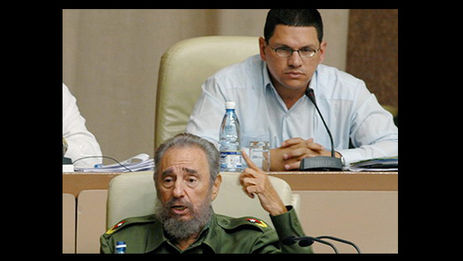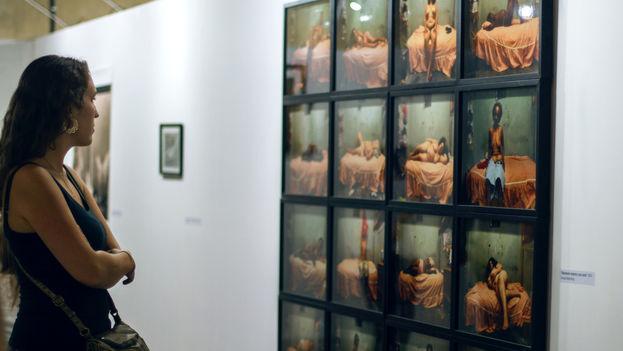

The Day of the Woman in Cuba, More Honored in the Breach / 14ymedio, Yoani Sanchez

On Women’s Day, no protest march is scheduled in Cuba, as if the life of the women in this country was a bed of roses. (Silvia Corbelle)

14ymedio bigger14ymedio, Generation Y, Yoani Sanchez, 8 March 2017 – Lying in bed, with the light off, feeling each one of her vertebrae howling. After coming home from work she spent four hours in the kitchen, bathed her invalid mother, helped the children with their homework, went shopping and prepared an administrative report. On TV the announcers offer congratulations for the Day of the Woman, but it sounds like a distant echo that does not influence her life.

On March 8, the workplaces end their days earlier, the officials intone mellow speeches and all the stands are sold out of flowers. The news is filled with images of women who cut cane, give life to babies, and carry guns on their shoulders. Nor is there any lack of politics. Officialdom takes advantage of the day to insist that only “after January 1959” have we Cuban women been recognized. continue reading

There are no protest marches, no demands expressed, as if the life of women in this country was a bed of roses

The National Symphonic Orchestra prepares a special concert, the Post Office sells postcards in bad taste, while the Cuba Workers Center – the only legal union in the country – dedicates the day to Fidel Castro and the “eternal president of the Federation of Cuban Women,” Raul Castro’s late wife Vilma Espín Guillois. There are no protest marches, no demands expressed, as if the life of women in this country was a bed of roses.

The noise of the music, the slogans and the triumphalism drown out our complaints. The day, made compulsorily festive, does not allow demands to emerge, nor talk – with bras shed – about the problems that threaten our daily lives. “Today is a day for celebration, not complaining,” many say; but tomorrow other topics will fill the agenda and there will never be “a good time” to talk.

Symptomatically, the initiative of a women’s strike under the slogan #NosotrasParamos (We Stop) does not find space here, although 45 countries have joined the protests to demand equality between men and women. The lack of independence of women’s associations and their subordination to the government prevents the idea of our taking to the streets with posters and demands.

Machismo and gender discrimination fill every space of our daily lives. In the media, a catchy children’s song tells the story of mother ant who urges her daughter to abandon her games and help her iron, sweep and scrub; but the capricious little girl prefers her dolls. In schools, teachers prepare an area of ​​pink kitchens and baby beds for the girls to play in, while they reserve trucks and play weapons for the boys. In workplaces, bosses feel the power to compliment, harass and touch their subordinates, often under the belief that “they like it.”

Power continues to maintain its old-fashioned, cheesy machismo, purportedly “chivalrous”, which veers from flattery to insult towards those in skirts

In the official discourse we are seen as decorative elements, as a necessary gender quota or simple pieces of the ideological gears. Power continues to maintain its old-fashioned, cheesy machismo, purportedly “chivalrous,” which veers from flattery to insult towards those in skirts. The woman who shares their ideology is a “beautiful flower of the Revolution,” the dissident only deserves that hard four-letter word that questions our morality.

The Cuban feminist movement is dead. This system was killed by depriving it of autonomy, extinguishing the discourse of demands and imposing the false premise that women emancipated themselves five decades ago. All a fallacy that hides the drama of millions of women condemned to double or triple working hours, subjected to sexual harassment and surviving every day with a dose of antidepressants.

The entire economic crisis that we have experienced has claimed women as its main victims. The shortages force them into the long lines to buy food and the stress, every day, of having to “invent” a meal. The accelerated emigration has separated them from their children and the layoffs at state workplaces have returned them to the house, back to the hearth.

Where are the figures for the number of women murdered or beaten by their partners? Where can harassed wife who fears the next beating take shelter?

Statistics about women professionals, deputies to the National Assembly, scientists in white coats or athletes, cannot hide the other side. The numbers of battered women, threatened by a boyfriend who has sworn to kill them if he sees them with another, those raped inside or outside of marriage or those who have had to exchange sex for promotions at work.

Where are the figures for the number of women murdered or beaten by their partners? Where can harassed wife who fears the next beating take shelter? Why not talk about femicide in the national media if each of us knows at least some case where a macho rage ended a life?

Today is not a day to celebrate, but to worry. A day of demands that have been extinguished by the music of a machismo reluctant for us to have our own voice.
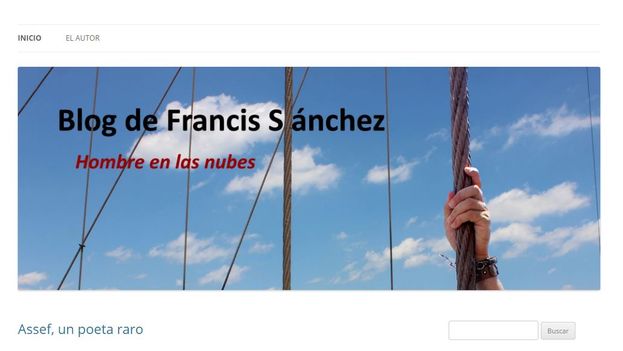
Poet Francis Sanchez Reopens His Blog After Six Years Of Digital Silence / 14ymedio

Screenshot of the blog Man in the Clouds, by Francis Sánchez. (CC)

14ymedio bigger14ymedio, Havana, 7 March 2017 – The poet and essayist Francis Sanchez has returned to the blogosphere this week after six years of not updating his personal blog. The writer from Ciego de Avila announced he would continue to publish his ideas “without censorship” on his site Man in the Clouds, now with a new web address.

“I am not the same,” says Sanchez in the first text he posted on the web after his long digital silence, a pause that attributes to the social pressures he experienced following the opening of the site in October 2010.

“After five months I was forced to stop updating it,” recalls the author. “All the bloggers, in Cuba, we were accused of being cyber-mercenaries.” This situation that caused many acquaintances to close the doors or cross “the street in search of another sidewalk” when they saw them. continue reading

In those years the official press deployed an intense campaign against the alternative blogosphere. National television dedicated a chapter to it on their Cuba’s Reasons program, where it was suggested that it was a “new strategy in the United States war” against the island.

In those years the official press deployed an intense campaign against the alternative blogosphere

In March 2011 Sanchez published the post Closed for Demolition in which he said goodbye to his readers. Now he returns to the digital space with the intention of writing about “readings, art, society, reality and imagination, human rights, and everything unpredictable that beats inside a very long etcetera”.

The creator of the magazine Inverted Tree has published three texts in his new stage as a blogger, one of them dedicated to the poet Pedro Alberto Assef, born in Ciego de Avila in 1966 and recently deceased in a hospital in El Paso, Texas. In the text he calls him an authentic writer and possessor of an “exhaustive lyrical knowledge.”

Another post reproduces a fragment dedicated to the figures of Julián del Casal and José Martí in the book of essays Sacred Companies that Sánchez wrote “in four hands” with his wife, the essayist and poet Ileana Álvarez. The volume was presented at the most recent Havana Book Fair in February.

“I can not calm anyone nor calm myself announcing what’s going to happen or what I’m going to write tomorrow. I do not really know, I do not want to. I am only attentive,” Sanchez tells his readers.

For Francis Sanchez’s blog translated into English from May 2012 and before see here: Man in the Clouds. For later entries see here.


Cuban Human Rights Group Denounces The Death Of A Political Prisoner Pending Trial / 14ymedio

Hamel Santiago Maz Hernández had been in prison for eight months pending trial. (CCDHRN)

14ymedio bigger14ymedio, Havana, 7 March 2017 — The Cuban Commission for Human Rights and National Reconciliation (CCDHRN) has denounced the death of political prisoner Hamel Santiago Maz Hernández, an activist from UNPACU, who died* on February 24 at Combinado del Este prison in Havana. The opponent had been imprisoned for eight months without trial for the alleged offense of contempt.

The CCDHRN has released its report for the month of February in which it says that “there have been thousands of cases of Cubans killed in government custody,” a situation for which the authorities bear all the “moral and legal responsibility.” continue reading

The report includes the 482 arbitrary arrests of dissidents last month, a “slightly higher figure than in January.”

The CCDHRN also documented 16 cases of physical aggression and 18 of harassment, “by the secret political police and para-police agents,” with the victims being peaceful opponents, adds the report.

The report includes the 482 arbitrary detentions of dissidents last month, a “slightly higher figure than in January”

The text clarifies that, given “the closed nature of the regime that has ruled Cuba for almost 60 years,” it is “impossible to record the thousands of violations of fundamental rights” that occur throughout the island each month.

Nevertheless, it reports that the Ladies in White and the Patriotic Union of Cuba (UNPACU) are once again the organizations most repressed. In the case of the women’s organization, they have been “subjected to humiliations and other abuses” over and over. For its part, 54 members of the UNPACU “are political prisoners, most of whom remain imprisoned without formal charges or pending trial.”

During 2016, the Cuban Commission on Human Rights and National Reconciliation (CCDHRN) documented 9,940 arbitrary detentions. This figure “places the Government of Cuba in the first place in all of Latin America,” according to the independent organization.

*Translator’s note: Cuban State Security informed his wife that he died of a heart attack.

Disappeared / 14ymedio, Reinaldo Escobar

Marino Murillo and Ramón Machado Ventura have been absent from official events for some time, in which their presence would normally be assured. (14ymedio)

14ymedio bigger14ymedio, Reinaldo Escobar, Havana, 7 March 2017 — The two personalities who represent the polar opposites of the so-called process of updating the Cuban model have disappeared. We have seen neither hide nor hair of the “captain” of economic reforms, Marino Murillo, since October of last year, and Jose Ramon Machado Ventura, considered the braking mechanism for any measure that looks like a change, has not appeared in the official media since 27 February.

Murillo did not appear in the images that filled the media during the nine days of the funeral and mourning period of former President Fidel Castro. He was not seen in the last session of the parliament fulfilling his usual role of asking for accountability on the implementation of the Party’s Guidelines. He was not on the viewing platform saluting the troops who marched in the military parade of 2 January, nor at any other significant event of the ruling party during the current year.

On the other hand, rare is the day when the second secretary of the Communist Party, Machado Ventura, does not appear visiting a chicken farm, sausage factory or a sugar mill, moments that he uses to hammer home his slogans of discipline andcontrol, demands that put him in the headlines almost daily in the official press. He is the visible face that exhorts the peasants to produce food and the workers to comply with savings measures.

Absences attract attention as well as presences. What is not said can be as revealing as what is stated

However, the most significant sign that unveils the wide range of suspicions about the whereabouts of this hardliner has been that when Raul Castro returned from his brief trip to Venezuela, the so-often repeated scene of Machado Ventura receiving him at the bottom the airplane stairs was missing. Perhaps this is the first time that images of the general president’s return to the country were not released and that the press didn’t mention who welcomed him.

The last meeting of the Council of Ministers, held on 28 February, was the first of Raul Castro’s presidential term that was not broadcast live on television, nor were photos published in the Party newspaper Granma. Both Murillo and Machado Ventura should have been visible as members of the group of highest ranking decision makers in the country.

Instead, in the official information about the meeting there was a reference to Leonardo Andolla Valdea, deputy chief of the Permanent Commission for the Implementation and Development of the Party Guidelines. He was in charge of saying, on this occasion, what would have normally been said by Murillo, also known as the “czar of the economic reforms.”

It is not serious to spread rumors, much less to invent them. In journalism only the facts must be counted, showing evidence and citing sources. However, under the opaque veil of secrecy in which the most important political and economic events unfold in Cuba, absences attract attention as much as presences. What is not said can be as revealing as what is stated.

After Trump, the Deluge / 14ymedio, Carmelo Mesa Lago

Donald J. Trump addresses the Joint Session of Congress. (EFE)

14ymedio bigger14ymedio, Carmelo Mesa Lago, Miami, 5 March 2017 — In his speech to Congress last Tuesday, Donald Trump was magically transformed into a statesman and looked “presidential” for the first time. He offered something for every member of society: new infrastructure, one million jobs, paid maternity leave, cutbacks in the high cost of medicines, special education for students in difficulties, defeat of “Islamic radicalism” and all of this, in unity, without hatred and in support of the resurgence of the nation. Was this a real transformation or just a well-rehearsed reading of a speech written for him and projected onto a screen? In any case, his key proposals did not change, only his tone: A good one-hour speech cannot erase twenty months of incessant stumbling.

Shortly after Trump announced his candidacy in June of 2015, I wrote a statement with Enrique Krauze, signed by 68 prominent Hispanic intellectuals, academics and artists, where we criticized the magnate’s ideas and predicted the disastrous effects of them. There was a prestigious academic who refused to sign the statement because he believed that the clown’s candidacy would quickly evaporate (just like what happened with Hitler). With 45 days in power, the US and the world are already suffering the devastating effects of his nonsense. continue reading

Trump is an egocentric narcissist, an arrogant know-it-all who proclaims himself the best on any subject

Trump is an egocentric narcissist, an arrogant know-it-all who proclaims himself the best on any subject (self-described as “outstanding in his performance”); thus he does not take advice and improvises creating chaos. From the beginning he said he would deport 11 million “undocumented” Mexicans. In February he decreed that people from seven Islamic countries could not enter the United States, none of which have sent terrorists to the country. This order created massive problems in airports around the world, with American residents refused entry, and measures had to be improvised to relieve the catastrophe; fortunately a district court overturned the executive order and Trump denigrated them as “so-called judges.”

Another sinister trait is his racism and xenophobia: against Mexicans and Hispanics, women (“with my power I can grab them by their genitals”), African-Americans, Muslims, Jews and gays. He dismissed as unfair (for being a “Mexican”) a judge born in the United States who approved the complaint against Trump University; he denied he was a racist and paid 25 million dollars to the scammed, to stop the spread of the scandal.

The effects of his discrimination has been horrendous: attacks on Mexicans; the murder of an Indian engineer, taken as a Muslim, to the scream of “leave my country”; the airport detention of Muhammad Ali’s son, interrogated because of his Arabic name and religion (the agents denied this); the resurrection of the white supremacist Ku Klux Klan that brazenly supported him; the proliferation of Nazi swastikas; the bomb threats against 53 synagogues and the desecration of a hundred Jewish cemeteries; the attack on a gay couple because “we live in Trump country now.”

His motto “America First” was used by American Nazis during World War Two. Reacting to the question of a Jewish journalist he exclaimed, “I am the least anti-Semitic person in the world,” and despite his abominable treatment of Latinos he insists that they adore him. Although his discourse denounced those attacks, his rhetoric of intolerance, division and hatred has incited them.

His motto “America first” was used by American Nazis during World War II

Trump is a pathological liar: Obama was not born in the United States, three million of Hilary’s votes were fraudulent, public attendance at his inauguration was the highest in the country’s history and also higher than the massive demonstration of women against his misogyny. His advisor Kellyanne Conway invented a massacre in Bowlling Green to justify the deportations. All false.

A Freudian lapse is his constant catch-phrase “believe me.”  His Orwellian construction of “alternative facts” is a remembrance of “1984,” a trinket to deny the truth. He denounces the leaks to the press by officials as a crime that has to be eradicated and insinuates that Obama has been responsible for them.

His praise of Putin as a strong leader is detestable. Advised that the Russian autocrat is an assassin, that he annexed Crimea and dreams of retaking Georgia, Trump responds with the excuse that those in the United States “are not innocent.” He asked the FBI to end its investigation into his relations with Russia, based simply on his word: “I haven’t talked to Russia for a decade.” Another scam because he talked to Putin after his inauguration and was in Moscow in 2013.

Michael Flynn, his national security advisor, resigned when it was discovered he lied about talking to the Russian ambassador in the United States; and the Attorney General Jeff Sessions did the same. If Trump really is not guilty, why is he so afraid of that investigation?

Worse yet is his authoritarianism and irritable attacks against all criticism even it it’s documented. At the beginning of the election campaign he refused to answer a question from the Mexican journalist Jorge Ramos and violently expelled him from the premises. In his first press conference as president-elect he refused to let the CNN reporter ask a question, accusing him of “fake news” (what irony!), days later accusing the New York Times of the same thing, and in the last week he referred to the “fake media” as “enemies of the American people.”

Later The NY Times, Buzzfeed News, CNN, The Los Angeles Times, Politico, BBC and The Huffington Post were excluded from a meeting with Press Secretary Sean Spicer. He also disqualified his opponents: branding the hero of the Vietnam War John McCain a “loser” for having been captured, while he himself evaded military service through some trickery, and mocked the brilliant Meryl Streep (nominated for an Oscar 20 times), saying she was Hollywood’s most “overvalued” actress.

Stubbornly, Trump has insisted many times that Mexico will pay for the wall, something firmly denied by President Peña Nieto and two former Mexican presidents

From the beginning he promised to build a “fantastic” wall on the border with Mexico that would put an end to the entry of “criminals, drug addicts and rapists,” denigrating Mexican emigrants who play a crucial economic role in the United States. The wall will cost at least $20 billion and will not stop immigration because it takes place mainly by air.

Stubbornly, Trump has insisted many times that Mexico will pay for the wall, something firmly denied by President Peña Nieto and two former Mexican presidents. Changing tactics, Trump says he will finance the wall with a 25% tax on all Mexican imports, which will trigger a similar policy in the neighboring country. In his speech to Congress he announced legislation to protect “the victims of the migrants.” Mexican Foreign Minister Luis Videgaray has been emphatic that Mexico will not admit non-Mexicans deported from other countries.

The blind Republican fury against “Obamacare” was exacerbated by Trump with his call to “repeal and replace.” Two days before his speech he said that “nobody knew how complicated health care is”; in fact he is the one who didn’t know, unlike Obama and tens of thousands of experts that Trump ignored.

There are 22 million citizens covered by the affordable health plan and there is no idea if they will remain covered and how. In his speech he tried to offer something new by ensuring that those with a prior chronic illness will have to be covered, something that is already in the law, which he doesn’t know.

One of his first actions was to overturn the Trans-Pacific Partnership, creating a vacuum that is rapidly being filled by China, which he provoked with his announcement that he would strengthen ties with Taiwan, abandoning the American policy of a single China from the time of Nixon (later he tried to undo the damage). He proposed to renegotiate or annul the North American Free Trade Agreement, which would provoke a serious crisis in Mexico, the second largest Latin American economy and the main trading partner of the US, which could destabilize the region and generate a global trade war.

His latest delusion is to increase the defense budget by $54 billion, cutting back vital programs by the same amount, such as protection of the environmental and international aid

His latest delusion is to increase the defense budget by $54 billion, cutting back vital programs by the same amount, such as protection of the environment and international aid; although he has promised not to touch social security, there is fear he will privatize it. He will also reduce taxes, benefiting the richest 1% of the population, something that is enthusiastically supported by his cabinet of billionaires.

When the tax reduction is added to the $20 billion cost of the wall and the trillion dollars in infrastructure, the budget deficit will soar. His speech to Congress did not explain how he will finance his great vision of the future, he just said that “money is pouring in.”

It is astounding that the Republican congress allows such nonsense that goes against their neoliberal beliefs such as freedom of trade, a balanced budget and reduction of public debt, as well as the risk of increasing Russian power and Chinese expansion. But doesn’t matter, they were rejoicing, standing up and applauding Trump’s speech. After him, the deluge.

___________

Editorial Note: This text has been published in the Letras Libres website and we reproduce it with the authorization of its author.

Carmelo Mesa Lago. Cuban economist. Degree in Law from University of Havana (1956). Professor Emeritus of the University of Pittsburgh.

Cuban Police Prevent Joanna Columbié From Boarding A Plane To Mexico / 14ymedio

Joanna Columbie, member of the Somos+ (We Are More) 1010 Academy. (Courtesy)

14ymedio bigger14ymedio, Havana, 6 March 2017 – Cuban police prevented activist Joanna Columbié from boarding a plane this Monday heading to Mexico. The car in which she was raveling was intercepted on the way to the airport and a State Security official warned her that she would not be allowed to travel abroad, according to what she herself told 14ymedio after being released.

Columbié had planned to participate in a discussion meeting of the Democratic Action Roundtable (MUAD) to be held in Mexico City. The meeting is scheduled for this week and four activists from various opposition groups and social projects were invited. continue reading

Manuel Cuesta Morúa, Boris González, Roberto Díaz and Eroisis González were the other participants planning to attend event in Mexico. So far this newspaper has not been able to determine if those four activists managed to board their flights or if any of them was detained inside the Havana airport.

“The meeting was to be the MUAD secretariat with other members outside the island,” says Columbié. The activist also states that the Konrad Adenauer Foundation participated in organizing the event.

“I left the house in a taxi and I was nearing Lenin Park when a police patrol car with the number 784 stopped us. They told me to go with them and they also asked me for my phone so I could not make any calls,” says the member of Somos+ (We Are More) Movement.

The official warned her to stay away from “the counterrevolution” and threatened that “from now on” her life would become “very bad.” 

In the police car was a State Security official known to Columbié from previous arrests, who calls himself Leandro. She was taken to Bacuranao Beach, to the east of the city, where the man warned her that they would have “a long conversation” and that she would not be allowed to travel to Mexico.

“I asked him what the reasons were but he simply told me that he wanted to talk,” recalls the activist. Leandro warned her that in recent months she had been “greatly elevated in her profile,” and that this could lead to her being deported to the village of Céspedes in Camagüey, where Columbié lived before residing in the capital.

The official warned her to stay away from “the counterrevolution” and threatened that “from now on” her life would become “very bad.” The man insisted that they would not let her leave the country.

“This is totally arbitrary,” says Columbié. “They have come to the point of taking completely arbitrary actions without even seeking a pretext.” The activist does not rule out taking legal action before the Military Prosecutor’s Office to denounce what happened.

During 2016, the Cuban Commission for Human Rights and National Reconciliation (CCDHRN) documented a total of 9,940 arbitrary detentions in the country. A figure that “puts the Government of Cuba in the first place in all of Latin America,” according to the report of the independent organization.

Official Fervor Towards Fidel Castro Contrasts With the Indifference of Young People / EFE-14ymedio, Lorena Canto

The cult of personality around Fidel Castro has come to take on messianic dimensions, even after his death and supposedly against his will. (EFE)

14ymedio biggerEFE (via 14ymedio), Lorena Canto, Havana, 5 March 2017 — A hundred days after his death and although Cuba has limited by law the use of his name and image, the figure of Fidel Castro is more present than ever on the island, where the fervor towards the former president is beginning to take on messianic proportions that have even come to his being compared with Jesus Christ.

Since the death of the leader of the Cuban Revolution last November 25 at age 90, there is no activity, congress or celebration in Cuba that does not include a tribute to Fidel Castro in its program, while the state media also devotes a good part of its space to him. continue reading

A good example of this situation was the recent Havana Book Fair, the most important cultural event of the year on the island. This year’s event was dedicated to Canada and its authors, but the acts and presentations of numerous titles around the figure of Fidel Castro eclipsed the invited country.

The situation contrasts with the last will of the ex-president, made into law last December by the Cuban Parliament: no monuments or public buildings or streets with his name, in addition to a rigorous regulations that shield the commercial use of his figure.

In life, the controversial commander was also opposed to the cult of personality, although paradoxically it was his personal style of exercising authority, which led some to consider him a leader and others to consider him a tyrant.

“The charismatic and messianic figure of Fidel Castro was undoubtedly one of the most popular elements of the Cuban Revolution from its beginnings in the 1950s to at least the first decade of the twenty-first century,” Jorge Duany, director of the Cuban Research Institute at Florida International told 14ymedio.

The key is whether the Cuban Revolution can survive without the physical presence of the man who so passionately embodied it.

According to Duany, “the worship of and loyalty to the commander-in-chief became one of the main ideological supports of the Revolution, although his overpowering personality also provoked intense disgust and resentment among his political adversaries.”

The state media, until now, has avoided the word death and replaced it with physical disappearance, a shift reminiscent of the way Fidel Castro used the term biological inevitability.

Paradoxically it was Fidel Castro’s personal style of exercising authority, which led some to consider him a leader and others to consider him a tyrant.

The newspaper Juventud Rebelde (Rebel Youth), official organ of the Union of Young Communists, went further on December 25, Christmas day, which marked one month since the death of the Cuban leader: “Time does not devour redeemers,” said the front page, in a veiled parallel with the figure of Jesus Christ.

“Man, we learned to know you eternal. Just like Olofi and Jesus Christ, there is not a single altar without a light for you,” says the chorus of the song composed by Raúl Torres after the death of Fidel Castro, a tune that played unendingly during the nine days of national mourning decreed in Cuba.

Another new constant is the assimilation of the former president with the Cuban independence figure José Martí, father of the country and next to whose tomb in Santiago de Cuba Fidel Castro was interred.

For the moderate opponent Manuel Cuesta Morúa, what is happening “seems to be against the will of Fidel Castro.”

The state media, until now, has avoided the word death in relation to Fidel Castro, and replaced it with physical disappearance

“It seems that in his last will he did not talk about the media, where his presence is constant. It is a gap they [the authorities of the island] have used, but I think that responds to Cuban society’s capacity to forget,” says Morua, the spokesman of the democratic initiative “Otro 18” (Another 2018), which advocates free elections next year.

In his opinion, the country’s leadership seeks to perpetuate the message of “do not forget the imprint of Fidel Castro” in a society that “has been giving a clear and key answer in that direction, very intuitive, to say that a country must not have a surname.”

Transmitting this message to new generations is a particularly complicated challenge; for an overwhelming majority of young Cubans, the bearded commander is more of a distant figure than an ideological reference point.

In a recent study of Cuban teenagers published by Juventud Rebelde, no respondent mentioned Fidel Castro among their most admired people.

“The poll seems to confirm an erosion in the figure of Fidel among the younger generations of Cubans born and raised after the Revolution, [despite] the government’s efforts to maintain his memory as the undisputed hero of post-Revolutionary Cuba,” Duany concludes.

Santa y Andres: It’s Never Too Late If The Censorship Is Old / 14ymedio, Zunilda Mata

Screenshot of the film ‘Santa y Andres’ by Cuban director Carlos Lechuga.

14ymedio bigger14ymedio, Zunilda Mata, Havana, 4 March 2017 — Miami and Havana are the same city. Those censored here, in Havana, are going to end up over there; while the residents there spend their vacations here. The movies that are not allowed in the Cuban theaters find their place in Calle Ocho in Miami. Santa y Andrés, a film directed by Carlos Lechuga and censored at the Festival of New Latin American Cinema, will be presented this Sunday at the Miami Film Festival.

The film could not premiere on the Island because the authorities were bothered by its treatment of the story of a homosexual intellectual persecuted and monitored in the decade of the eighties. Without having made the necessary mea culpa for that witch hunt, officialism refuses to accept that punishment against artists once existed. continue reading

The more orthodox argued that their script distorted the facts and was unaware that many of the mistakes had been rectified

The controversy over the exclusion of the movie was unleashed for weeks and the most orthodox argued that that script distorted the facts and didn’t note that many of the mistakes had been rectified. As if it would be useful to publish a poetry book by an author whose reputation was assassinated two decades earlier and to whom the worst adjectives were attached.

The defenders of the film point out its undeniable artistic values ​​and believe that in speaking publicly of those dark moments of the national culture the movie helps to build a better future. But even the opinions of renowned directors such as Fernando Pérez have not changed the ideas of the Party machinery of the Department of Revolutionary Guidance (DOR).

In the film, the two distant worlds that represent each of the protagonists manage to find a common thread. Perhaps the greatest annoyance felt by the censors is not the treatment of the conflicted poet, but the director’s thesis that it is possible to be reconciled amid such abysmal differences.

This possibility of the protagonists conversing and embracing in spite of the ideological gulfs that separate them, may have influenced the opposition to the movie Lettuce. In a country where political hatred is the main engine that drives power, there is no room for the reconciliation promoted by the film.

The Cuban Institute of Art and Film Industry (ICAIC) simply played its role of applying scissors to the national culture, but the order was given from above. From an entity that, fortunately, is still not able to control the movies that are shown in Miami, that other Cuban province.

The Prosecution Asks For Three Years In Prison For The Opponent Eduardo Cardet / 14ymedio

The extension of the preventive confinement of Eduardo Cardet has generated statements from international organizations like Amnesty International. (Oswaldopaya.org)

14ymedio bigger14ymedio, Havana, 3 March 2017 — This Friday, the trial against Eduardo Cardet, a doctor and the national coordinator of the Christian Liberation Movement (MCL), was concluded. The prosecution has maintained its original request for three years of deprivation of liberty for the opponent, who has been detained since November 30 and charged with “attack on authority.” The trial was held in the Municipal Court of Gibara (Holguin) and the sentence will be handed down on March 20.

The arrest occurred in a violent manner outside the activist’s home in the municipality of Velasco, where he lives and works in the Family Clinic office. He is charged with an alleged attack on a State Security officer at the time of arrest.

Cardet’s wife, Yaimaris Vecino, was able to enter the courtroom this morning, but other MCL activists had to wait outside the building. Marlenys Leyva, Cardet’s mother-in-law, told 14ymedio that only nine family members were allowed in. continue reading

A neighbor told 14ymedio that “Cardet was very calm and explained very well what happened, without contradictions.” He asserts that the opponent has the truth in his hand and that the same could not be said of the accusation. “They stumbled from beginning to end trying to impose their lies,” he explains.

According to Marlenys Leyva, the access road to the Tribunal was closed from the early hours and there was a considerable number of members of the Rapid Response Brigades around the outside of the building.

Cardet, 48, was denied bail on three occasions to await trial at his home

“The people of State Security are here, like Major Juan Carlos Espinosa.” He stated that not only was there a police presence outside the building but there was also “a large group of officers inside.”

Cardet, 48, was denied bail on three occasions to await trial at his home. Set to begin on February 20, the process was postponed to Friday without explaining the reasons to either the family or the accused.

According to Vecino, the defense lawyer, Eliécer La Rosa, called four witnesses during the trial. The lawyer indicated that those presented by the prosecution are members of the Rapid Response Brigades. For their part, MCL activists have denounced Cardet’s case as being “fabricated” by the Cuban government to get him to stop his activism.

The extension of the preventive confinement of the opponent has generated pronouncements of international organizations such as Amnesty International, which declared him a prisoner of conscience. Similarly, the Cuban Commission on Human Rights and National Reconciliation demanded his immediate release.

Cuba Seeks To Encourage Women To Enter Military Service / 14ymedio, Mario Penton

A woman soldier participates in the rehearsal of the parade for the 50th anniversary of the proclamation of the socialist character of the Revolution, in 2011 in Havana. (EFE)

14ymedio bigger14ymedio, Mario Penton, Miami, 3 March 2017 – With the opportunity to study at the university by passing the University entrance exams with the “minimum score,” the Ministry of Higher Education (MES) is offering an incentive for young women who want to enlist in Military Service, which is an obligation for men.

The announcement was made by the MES authorities during a press conference this Thursday, where they stressed that the requirements for regular entry to higher education for candidates who are not military women remain the same: “Pass exams in Math, Spanish and History with a minimum of 60 points” and compete in the provincial roster for a university seat.

“They will be offered first-rate careers and the Ministry will do everything possible to offer them the majors they request,” said a journalist at the meeting. continue reading

“An important element is that they will be given the possibility of enrolling in the regular day course,” he added.

The enrollment for the subjects that are studied in regular daytime courses will be 36,705 places for the next course.

In the case of women who choose to wear the green uniform of the Revolutionary Armed Forces, they will skip the requirement that they compete with other candidates in their provinces and may enroll in the universities simply by passing the entrance tests.

Recruits to compulsory military service in Cuba have the opportunity to study a university career through Order 18. That law privileges the recruits’ access to the university the second year after joining the FAR. In the case of women, they can start at the university the same year they enlist.

In the case of woman who choose to wear the green uniform of the Revolutionary Armed Forces, they will skip the requirement that they compete with other candidates in their provinces

After the arrival of Raúl Castro in 2006, university enrollment declined sharply, a trend that contrasted with the increase in the previous 20 years, when enrollment in the social and human sciences increased by 4,000%.

The entrance exams for higher education also underwent changes, becoming more rigorous.

Starting with Raul Castro’s reforms, enrollment in the humanities decreased by 83% while enrollment in the national sciences great by 13%.

In 2014, university enrollment decreased by 30%. In the 2014-2015 academic year there were 18,112 fewer university graduates than in the previous academic period.

According to statistics provided by the Cuban Government, 356,600 women worked in the country’s defense, public administration and social security in 2015, fewer than the 451,400 women that made up these organizations in 2014.

The Army continues to be one of the main institutions in the life of the Cuban nation. Its presence extends to the Government and controls the Business Administration Group that manages the main tourist companies of the country.

In 2016, Global Firepower placed Cuba in 79th position among the world’s major powers and one of the 10 most powerful military forces in Latin America.

Cuban Government Sees IT As “A Weapon For The Defense Of The Revolution” / 14ymedio, Marcelo Hernandez

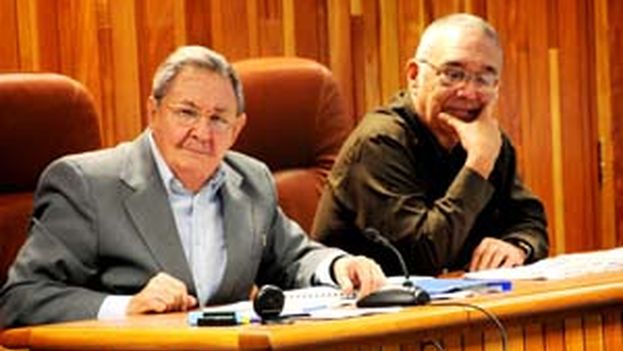
General Leonardo Andollo Valdés (R), in charge of the Commission for the Implementation and Development of the Improvement of the Economic and Social Model, with Raúl Castro (L). (Cubadebate)

14ymedio bigger14ymedio, Marcelo Hernandez, Havana, 3 March 2017 — The role of information technology as a “weapon for the defense of the Revolution” has grabbed the attention of the latest meeting of the Council of Ministers, held several weeks late this Tuesday in the Palace of the Revolution and headed by President Raul Castro.

During the meeting, policies were approved for the improvement of the system of standardization, measurement, quality and accreditation, as well as fishing and food safety. But the leading role was taken by Information and Communication Technologies, whose shortcomings were expressed by General Leonardo Andollo Valdés, who is in charge of the Commission for the Implementation and Development of Improvement of the Economic and Social Model. continue reading

The military man stressed that “different actions have been undertaken for the regulation of computerization in the country, however, a comprehensive policy is required.” He called for the creation of content aimed at “strengthening the identity and preserving the values ​​of Cuban society.”

At a time when new technologies are gaining a presence among the population, the Government is still cautious about defining protocols for computerizing activities of daily life. Doing legal paperwork on the internet, or reserving a ticket, or taking money out of an ATM, are all tasks that continue to be surrounded by complexities.

Andollo said that conditions will be created to facilitate both communication between government institutions and procedures for the population

Andollo said that conditions will be created to facilitate both communication between government institutions and procedures for the population. Citizens have insisted on the need for these improvements, since it is not comprehensible that in such a centralized state, many procedures must be pursued separately with each entity.

On the other hand, while official reluctance remains, alternative distribution networks have a wide assortment of devices, content and “tricks” – such as NanoStations, Bullets, Rockets or Routers – to take advantage of global developments in technology. On the streets of Cuba, the most sophisticated smartphones coexist with the stories of those who still haven’t been able to afford their first cellphone.

The ministers met the day before the announcement of the prices of Nauta Home, a service that provides Internet browsing from homes. After a pilot test that included 2,000 homes in Havana’s historic center, the Telecommunications Company (ETECSA) announced the fees for the service, which range from 15 to 115 Convertible Cuban pesos (CUC) for 30 hours of connection. The available speeds start at 128 kilobytes and range up to 2 megabytes.

Luxury and Excess in Socialist Cuba / 14ymedio, Marta Requeiro

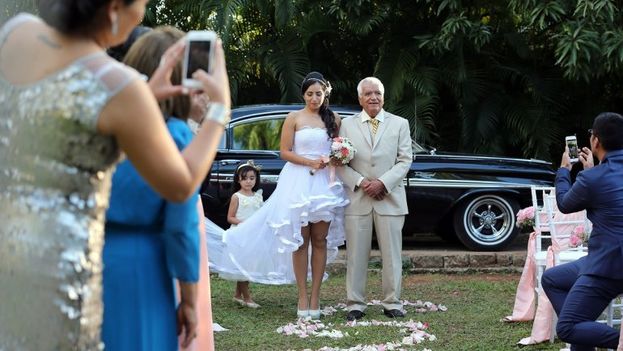
Photograph from February 13, 2017, during a wedding organized by the private company “Aires de Fiesta” in Havana. (EFE)

14ymedio bigger14ymedio, Marta Requeiro, Miami, 26 February 2017 – I don’t know how my mother managed always to know a little more about my friends and their customs, and even those of the neighbors, because her limited time did not allow her to gossip; but she continually warned me that things are not always as they appear.

That is how I ended up having a lover who was to her liking. I confess that he was attractive, but we had frequent differences when we talked about topics of daily life that ended up opening a breach in the relationship.

Contrary to what the Island’s Government always suggested, without being apparent except to the most rebellious or those with the “clinical eye,” the beginning of the abysmal separation that today exists between the two known population groups, the governing elite with all of its coterie, and the people, was immediately conceived. continue reading

I realized soon after beginning the relationship with him that there were people who projected an image of humility but, behind closed doors, had covered all the basic necessities that for common mortals – like me – were impossible. And more so, they came to be luxuries.

There was a segment of the population that accessed a life unknown to the majority of Cubans.

I later learned, thanks to that relationship, that there was a segment of the population that accessed a life unknown to the majority of Cubans. Ordinary Cubans who served once a month on the guard duty for the Committees for the Defense of the Revolution (CDR), more than anything in order not to be robbed in the night by their own neighbors and despoiled of what they had achieved with their own effort. Ordinary Cubans who marched to the Plaza Jose Marti on dates commemorating some important revolutionary event in order to sing hymns and feed their faith in the process of change (a change that still has not arrived), and who subsisted on what they would acquire through the ration booklet and who always carried the empty bag that was indispensable when leaving the house so as not to be surprised and unprepared for the arrival at the warehouse of some product among those that were distributed only sporadically and that, hopefully, would be something good.

Many families had only the ration book to count on to provide them with petty rations, which, even if they were well managed and “cultivated,” did not even allow them, at least once a day, to bring to the table a serving of decent food.

Even so, the markets and warehouses of that time were not as poorly supplied as now, and that little ration booklet meant something.

I saw for the first time live – and in full color – a domestic service team. Until then I had only seen it in foreign films.

Already by the ‘80’s the economic impoverishment, forecast only to get worse, was obvious, today inhuman for the ordinary Cuban, who is always the most affected.

As young as one was, one could tell. In most cases what was missing was enough courage to publicly say it and in a form of protest, as happens today with the internal dissidence that, in spite of the vexations that those who dare to raise a voice are subjected to, there are more who join them in order to protest their discontent.

It happened one day that a friend invited my lover to a house in Vedado that belonged to one of his cousins who would turn fifteen. My mother, knowing that I would go with him – after already having investigated his background and knowing that he was from a good family – and making him promise that we would be back early – granted me permission.

I had time to prepare my best clothes to go in accord with the occasion since he advised me several days ahead that I had to go elegant.

The day and time came and we climbed into the car of his friend who, accompanied by his girlfriend, would carry us to the party that would take place in Vedado.

We went up 23rd Street and, now well into the trip, the driver took a turn I could not say where; but there was a time when I did not exactly know our location. I was not at all familiar with that place where the car travelled.

The neighborhood that emerged before my eyes was at a glance far from my neighborhood and what was familiar to me until then. It was composed of beautiful houses with immense gardens that extended from the sidewalk to the entrances, some with tall bars of black balusters. The car kept going until it came to an immense wooden gate in a fortified wall that extended for almost the whole block.

That opulence and excess were inconceivable for what was proclaimed from the other side of the wall

We got out, and the uninhibited driver went forward to press the doorbell, which turned out to be an intercom. It was strange for me to look around and see majestic houses, well-cared for, painted, to hear silence and await a response from that artifact attached to the concrete; in my neighborhood it sufficed to yell from the sidewalk the name of the person sought for him to come out, and in the air you could always hear the mixed sound of different rhythms and someone or other calling vociferously highlighted by dogs barking in the distance.

Finally we heard a voice come from the apparatus asking “who is it” and with a simple “I,” said by the driver, the handle of the solid wooden door was magically activated so we would enter invading the immense barricade that impeded access and visibility from the streets to the dwelling.

Passing the threshold, I marveled at the beauty of the immediate area. If they spoke to me then I swear I do not remember it. I felt like and must have had the same expression as Alice in Wonderland.

Some hundred guests had already arrived, all dressed elegantly. My boyfriend, while we were there, asked me several times if I was alright. Surely my unusual quietness was making my surprise evident.

I saw for the first time live – and in full color – a domestic service team. Until then I had only seen it in foreign films. It was composed of about half a dozen women dressed in green guayabera dresses and white lace-up tennis shoes.

Golf course of one of the Melia hotels in Cuba. (EFE)

I saw there for the first time Pringles Potato Chips, and beer acquired without the well-known scavenging for the five boxes on the ration book only allocated if you were getting married or turning fifteen, and in cans. I tasted – with a grimace – the Spanish brandy Terry Malla Dorada. I felt strange before this conglomeration displaying the bourgeois behavior criticized by the Government.

The two smorgasbord tables in the middle of the immense room with a marble floor never emptied. Trays with all kinds of snacks and sandwiches were brought by the waitresses.

Outside, next to the entryway, was the bar attended by two young men with white guayaberas who asked what we wanted to drink or what we desired, including glasses for the beer.

How was there a capitalist form of existence inside Cuban territory, supposedly socialist and egalitarian?

Later the rueda de cubana dance was unleashed to the furor of the music of the Van Van hits and it reminded me how beaten up Cuba was.

I felt like leaving, I had nothing in common with the others there, nothing was familiar and known to me except my companion and the music; then I suggested that he invent an excuse and that we leave. That opulence and excess were inconceivable for what was proclaimed from the other side of the wall, although the reason was a fifteen-year-old’s party.

I asked the friend to get us out of there and take us to the nearest bus stop. He agreed after trying to persuade us, without success, and wanting to know the reason for our sudden departure.

Outside I felt relief, and I breathed comfortably. I commented on it with my fiancé, and he told me what little he knew of the mysterious family of his friend, whom he believed was from State Security or a bodyguard for someone important.

I met some people who lived in secret opulence supporting Castro-ism, which stayed in power with a public image as protector of the underdogs

How was that way of life kept in silence, how was it not criticized on television, and where did it come from and how was that luxury and excess that was not just a festive event paid for? How was there a capitalist form of existence inside Cuban territory, supposedly socialist and egalitarian?

Back then it was undercover; today we know how it is and that the behavior of the ruling leadership far from surprising us proves the existence of two social classes or poles that they themselves do not want to recognize as so disparate: The experts in training and subjugating so that the Cuban people do what they say and not what they do, and the people themselves.

We have learned about the excess expenses for recreation and tourism of one of Fidel’s sons and the carryings-on of Raul’s grandson/bodyguard.

The international press and Cuban dissidence have unveiled those two faces of those who for almost six decades have had control and power on the largest of the Antilles.

It is true, looks deceive!

I met some people who lived in secret opulence supporting Castro-ism, which stayed in power with a public image as protector of the underdogs. It’s not that I don’t like the good life but that condition is given in Cuba only to those who speak of equality without practicing it.

Opulence and abundance should belong to those who earn it, inherit it or work for it, not to those who steal it. Submission is not dignified, even less for so long a time. Let’s hope that once and for all the Cuban people open their eyes and reclaim the rights that have been denied them.

Translated by Mary Lou Keel

The Ladies In Green Can Not Sell Their Lettuce / 14ymedio, Havana

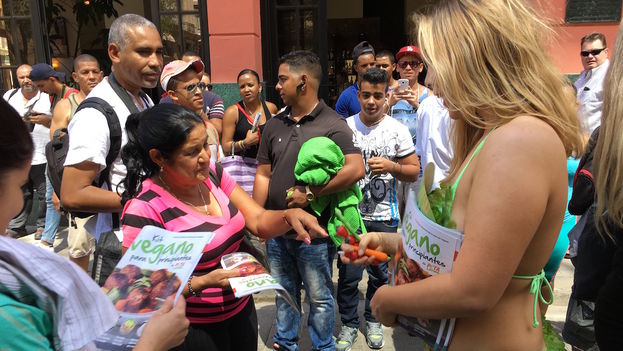
A few minutes after noon, the Lettuce Women stood at the corner of Obispo and Mercaderes streets in Old Havana. (14ymedio)

14ymedio bigger14ymedio, Luz Escobar, Havana, 2 March 2017 — A few minutes after noon, the Lettuce Women stood on the corner of Obispo and Mercaderes streets in Old Havana. They came with their unique message that promotes healthy food and a love of animals. Under the March sun, their lettuce bikinis generated more curiosity than their environmentalist discourse.

From a lime-green suitcase, activists pulled out magazines and ad sheets to promote a vegan diet. A campaign that does not stop generating confusion in Cuba, a country obsessed with meat and where the dream of many people is to eat a steak every day.

At first the activists were surrounded by more press than public, but their scanty clothing soon caused an uproar. Under the eyes of some policemen the Ladies responded to questions from journalists and those who wanted to know what it’s like to be a vegan.

Under the eyes of some policemen the Ladies in Green responded to questions from journalists and those who wanted to know what it’s like to be a vegan. (14ymedio)

The women declared that, since their arrival on the island, they have viewed the situation of the animals with “a lot of sadness,” according to Yerica Sojo, a Puerto Rican who has been doing this for more than ten years, “there are many [animals] abandoned in the street who need help.” Some national groups do “a very good job of caring for them and promoting compassion,” like the Association for the Protection of Animals and Plants.

This Friday the Ladies in Green plan to go to different schools to chat with the students.

With regards to the Cuban diet they said it “contains a lot of animals” but also “there are many fruits, vegetables and grains that can be eaten” and that one can be vegan and “keep the Cuban culture of eating rice, beans, bananas.”

Among the recipes they distributed to the public, there were some to prepare potato croquettes or mango ceviche.

Near the place where the activists engaged with the public is the San Rafael street market. This week a head of lettuces cost about 10 Cuban pesos (CUP) in the market, which is equivalent to the amount of money a retiree receives on their pension for a full day.

Eating vegetables and legumes is often a luxury that many Cubans cannot afford. (14ymedio)

Eating vegetables and legumes is often a luxury that many Cubans cannot afford.

In the final minutes of the presentation the women took out some pens shaped like fruits and vegetables from the bottom of their suitcase and tried to distribute them among those present. However, a dozen people rushed over the suitcase and grabbed all that were left.

The Lettuce Women promised to “warm up Havana” with “advice on how to save animals, be healthy and protect the environment while being vegans.” But there were more lewd looks at their bodies than interest in their message.

Panama Will Deport Almost 500 Cubans in the Coming Weeks / 14ymedio, Mario Penton


Video: Lajas Blancas Camp Where Almost 100 Cubans Are Living

14ymedio, Mario Penton, Miami, 2 March 2017 – In the next few weeks Panama will deport almost 500 Cubans who remain undocumented in the country, after being stranded by the end of the United States’ wet foot/dry foot policy in January, which had previously allowed Cubans who stepped foot on American soil to remain in the country.

According to reports to 14ymedio by sources from Panama’s National Immigration Service, the deportations could begin when the Service’s director, Javier Carrillo returns; currently he is in Havana in the fourth round of migration talks between the two countries.

“The deportations depend on the agreement between the two nations, but we can confirm that all undocumented migrants who are currently in the country will be returned to Cuba,” said the official source.

“The Memorandum of Understanding for the deportations has been signed but the details have not yet been made known,” he said.

In Panama, 383 Cubans remain in the care of Caritas Panama, 92 in Lajas Blancas and another 24 in the shelter of the National Migration Service. For the migrants who are in the shelter set up by Caritas the news was disconcerting.

“They are very worried they did not expect something like this,” says Victor Luis Berrio, permanent deacon in charge of the Catholic institution.

Last week two Cubans attempted suicide by taking sleeping pills due to the uncertainty of their fate, they said

“At the moment we are making every possible effort to avoid the massive deportation of these Cubans,” he adds.

According to Berrío, his organization has sent a letter to the president of the nation explaining that all the humanitarian work of the Government could be jeopardized if they proceed with the deportation.

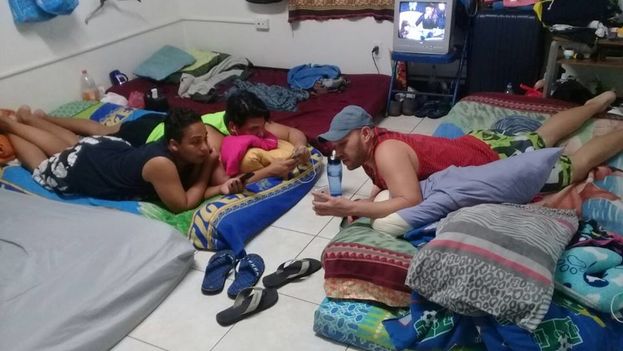
Hundreds of Cubans stranded by the end of the United States’ wet foot/dry foot policy in January. (Courtesy image)

According to Deacon Barrios, who follows the message of Pope Francis to shelter refugees, “the authorities’ intention has always been deportation.” He thinks, however, that it will not come to pass, “without a fight.”

“We are going to open our doors so that Cubans in Lajas Blancas can come to Caritas and we will continue to protect these defenseless people,” says the deacon.

“The decision of Caritas is to defend all the migrants that are in its care,” he says.

Last week two Cubans attempted suicide by taking sleeping pills due to the uncertainty of their fate, they said. They were in a Cuban migrant camp in the village of Lajas Blanca, near the western Panama border. Many crossed the Darien Gap jungle to get there.


Otto Rivero’s March 2nd / 14ymedio, Zunilda Mata

Otto Rivero seated behind Fidel Castro (EFE)

14ymedio bigger14ymedio, Zunilda Mata, Havana, 2 March 2017 — Otto Rivero directed the most powerful entity in Cuba at the beginning of this century, the Battle of Ideas, but was ousted by Raúl Castro a few months after the latter assumed the presidency. Now, the former youth leader has emerged from his “pajama plan” – as such forced retirements are referred to in Cuba – to be a producer for the Covarrubias National Theater, a few yards from the Plaza of the Revolution.

Reserved and with psychological scars from his purging, Rivero navigates behind the scenes of the well-known theater. Those who do not remember his glory days cannot even imagine that the silent employee who coordinates the events was once one of the most powerful men on the island. continue reading

Behind his discreet appearance hides the man who controlled the immense resources of a “supra-ministry” with omnipotent powers, arising from the campaign for the return of the child rafter Elian Gonzalez to Cuba. A supra-ministry with the capacity to oversee gas stations, distribute air conditioners or call forth the shock troops in repudiation rallies against dissidents.

On March 2nd, but eight years ago, a brief note published in the official press gave accounts of its end

On the second day of March, but eight years ago, a brief note published in the official press gave notice of his end. The Council of State had decided to “free compañero Otto Rivero Torres of his responsibilities as vice president of the Council of Ministers.” A phrase which, for connoisseurs of the official grammar, confirmed his fall into disgrace.

Rivero’s exclusion from the “family photo” had been foreshadowed since Fidel Castro was sidelined by health problems in mid-2006. The former secretary general of the Young Communists Union (UJC) had been part of the entourage of the “Comandante’s men” and his dismissal was only a matter of time.

In the purges carried out by Raul Castro against the team loyal to his brother, others who fell included vice president Carlos Lage and Foreign Minister Felipe Perez Roque. But unlike in their cases, Rivero’s ousting was not the subject of an acidic public diatribe; no column by the former president in the Party newspaper accusing him of addiction to “the honey of power.”

Close witnesses report that after his dismissal, Rivero went through a real ordeal. He was detained in the cells of the dreaded Villa Marista, State Security’s headquarters in Havana. He was accused of having allowed and participated in an enormous embezzlement that sucked funds out of the Battle of Ideas. The losses totaled millions in an era when Venezuelan oil allowed every kind of excess.

Police investigators blamed his lack of control over the entity and his having allowed its resources to be squandered on luxuries, foreign travel and gifts. Embezzled products circulated in the informal market: white, red and blue shirts; refrigerators made in China; and air conditioners.

“He was interrogated endlessly and his head could not resist,” a close family source says. “When he returned home he was a zombie, he could not even speak”

“He was interrogated endlessly and his head couldn’t resist,” a close family source told 14ymedio. “When he returned home he was a zombie, he couldn’t even speak.” His mental state deteriorated to the point that he attempted suicide, but “that didn’t go well,” the relative commented.

The former vice president’s family fell into a precarious economic state. The car and chauffeur were taken away as was the supply of luxury foods. As a punishment, the authorities sent Rivero to work at the Frederick Engels printers among the ink and printing presses. But he spent weeks before showing up for work the first time, where he became a mute automaton keeping his head down.

Rivero does not give statements or respond to questions about his past. All attempts to make him talk about the subject crash into the wall of his silence. But a nervous tic in his hands appears in response to the sound of certain names. His co-workers describe him as someone “affected” who has been “under psychiatric treatment.”

Of the confidence with which he wove slogans from the dais, nothing remains. “He is very careful and avoids being seen,” a singer-songwriter who has organized several events at Covarrubias Theater tells this newspaper. “He has changed a lot physically and most of the people who pass by him do not recognize him,” says the artist, who prefers anonymity.

Before the crash, his trajectory had been meteoric. At the age of 38, he was appointed Vice-President of the Council of Ministers after leading the UJC for seven years. With a degree in Economics and a seat in the National Assembly of People’s Power, the young man ascended the power structure at full speed to stand at the right hand of the Commander-in-Chief.

At the 7th UJC Congress of the, Fidel Castro defined Rivero and his team as “an avant-garde army, an elite troop of the Revolution.” Four years later, he had become a pariah

At the 7th UJC Congress, Fidel Castro defined Rivero and his team as “an avant-garde army, an elite troop of the Revolution” for being at the forefront of the Battle of Ideas. Four years after those words, the brand-new official had become a pariah.

To accommodate the Battle of Ideas, he began to refurbish a luxurious mansion on the central corner of 23 and B in Havana’s Vedado district. Here the promising leader would spend his glory days. The arrival of Raúl Castro stopped that dream and now the property hosts the Comptroller General of the Republic. A cruel irony.

Otto Rivero’s biography has also been removed from EcuRed, a Wikipedia substitute made to measure by the ruling party. For many Cubans, that youth leader no longer exists or has been forgotten. But very close to the Council of State he was once a part of, a gray employee ruminates his fate of banishment in the dim light of a theatrical hall.