Chinese Company Huawei Dominates Cuban Cellphone Market

Chinese brands have been expanding on the Island in recent times, ahead of the previous leading brand, Samsung. (14ymedio)

14ymedio bigger14ymedio, Marcelo Hernandez, Havana, 23 March 2017 — The mobile telephone market is changing at a speed that leaves little time to get used to new models. In Cuba, this dynamism is mostly seen in the informal networks, where the Chinese brand dominates because of its low prices and the preference it receives from the government.

Since 2008, when Raúl Castro’s government authorized Cubans to have a mobile phone contract, the number of customers with mobile lines has skyrocketed. At the end of 2016, the Telecommunications Company of Cuba (ETECSA) had more than 4 million subscribers to its cellphone service.

However, the sale of the handsets in the state network fails to satisfy users, who complain of outdated models and high prices. To alleviate this situation, the black market is greatly supported by those who want to update their telephone technology. continue reading

ETECSA’s offices sell Huawei Y3 and Huawei Y520 for 80 and 85 CUC respectively; low-end terminals with limited features

ETECSA’s offices sell Huawei Y3s and Huawei Y520s for 80 and 85 Cuban convertible pesos (CUC) respectively. Catalogued as low-end terminals with limited features, these devices are an option for those who can’t afford more complex models such as Huawei P7, which the company sells for a whopping 472 CUC (roughly the same in dollars — about two years’ average salary in Cuba).

“I use it to connect to wifi and make videocalls with IMO,” Havier Morales, a technology student who owns a Y520 told 14ymedio. The young man emphasizes that the front facing camera, which is the one that is most used to talk with this application, is not very good quality, “but for the rest it’s an all-terrain phone.”

In the ETECSA office located in the Miramar Trade Center complex, an employee who preferred to remain anonymous offered more details. “We sell a lot of these models to teenagers who can’t afford a more expensive device and also to people who want to use it to connect to the internet,” she says.

The employee acknowledges that “the competition is tough, because street prices for mobile devices have dropped a lot,” and informal sellers frequently offer their merchandise outside the office. “They sell phones with cases, extra batteries and high-capacity micro-SD cards, so they have more attractive offerings than we do.”

Huawei holds 17.2% of the Chinese market and is now the leading mobile producer in that country. Outside its borders, for example in Spain, where in 2016 the Chinese company provided 21% of the smartphones sold in that country, the company has been very successful.

In late 2015, the company founded by Ren Zhengfei, who worked as an engineer in the Chinese Army, signed an agreement with the Cuban state monopoly to market smartphones on the island

In late 2015, the company founded by Ren Zhengfei, who worked as an engineer in the Chinese Army, signed an agreement with the Cuban state monopoly to market smartphones on the island and to improve voice and data services. The agreement includes the purchase of “parts, pieces and technical training,” according to a report at the time from the Cuban News Agency.

In 2000, Huawei obtained a contract to install the national fiber optic network. The Chinese company’s equipment is also used in wifi hotspots and in the newly opened Nauta Home service that provides internet access from homes.

The presence of Huawei on the island goes back more than fifteen years, according to Javier Villariño Ordoñez, sales director for the Chinese firm. In its relationship with state entities, it emphasizes “negotiating on the basis of mutual protection,” the businessman told the national press.

Official media has widely covered the company’s presence, while they have ironed out the scandal that enveloped the firm for some months because of a security hole in its code that sent client information to China. The problem was detected in other very popular brands in Cuba, such as ZTE and BLU.

The Washington-based human rights organization Freedom House has followed a number of allegations about the close ties between Huawei and state power in China and warns that security and human rights issues have been linked to the business.

In an open letter from Miami addressed to ETECSA, the Foundation for Human Rights in Cuba stated its disagreement with the agreements between Havana and Huawei, a firm that “has a long history of supporting closed societies by improving the ability of your government to censor the Internet. ”

In the middle of last year it was learned that US authorities were investigating Huawei for its business with Cuba, Iran, North Korea, Sudan and Syria

In the middle of last year, it was learned that US authorities were investigating Huawei for its business in Cuba, Iran, North Korea, Sudan and Syria. Its Chinese competitor, the telecommunications company ZTE had already been sanctioned for the same reason and fined 1.2 billion dollars.

However, the brand continues its expansion in the Cuban market. “Before we sold more Samsung but now a lot of customers prefer BLU or Huawei,” Rosa Ileana, an informal seller who sells smartphones from Panama and the United States, told 14ymedio. “Three out of four phones I sell are Chinese brands,” she says.

Her most frequent clients are “young people in high school,” but she also says that recently her products have been sold to “many older people who want to video-chat with relatives abroad,” from the wifi zones on the island.

The preferences are “a question of prices” but also because “as more people get a Huawei others also want to have one,” explains the seller. “A lot of it is word of mouth, if a device is recommended to you because of a long-lasting battery, stability and durability, then it’s more likely you’ll reach into your pocket and buy it.”
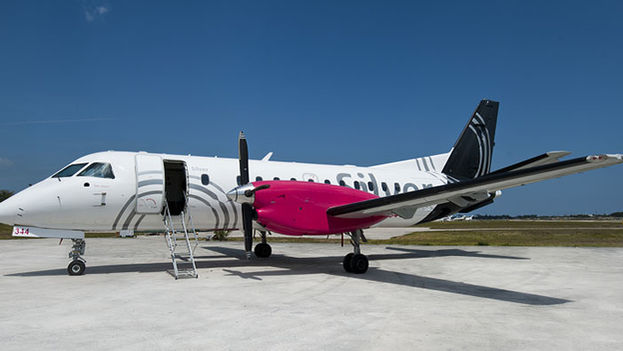

Bubble Bursts for Flights Between Cuba and the United States

Silver Airways has been forced to reduce its weekly flights to six cities in Cuba. (Silverairways.com)

14ymedio bigger14ymedio, Zunilda Mata, Havana, 17 March 2017 — A year ago the headlines left no doubt: Cuba was Americans’ new destination and that country’s airlines fought for their piece of pie of flights to the island. After the initial enthusiasm, several of these companies have cut back on the frequency of their trips and others have seen a reduction in passengers.

In March 2016 the most important airlines in the United States requested permission from the Department of Transportation to include the island in its commercial destinations. Among them are big ones like American Airlines and Delta Air Lines, as well as United Continental Airlines, Southwest, JetBlue, Spirit Airlines, Alaska Air Group and Silver Airways. continue reading

Expectations grew and climaxed when JetBlue’s 387 flight arrived in Cuba on August 31, 2016 from Fort Lauderdale airport in southeastern Florida. The plane arrived in Santa Clara in just over an hour, completing the first commercial flight between the two countries in more than half a century.

Everything was all positive predictions at the time, and the Cuban ambassador to the United States, José Ramón Cabañas, cut the inaugural tape of the flight with JetBlue CEO Robin Hayes. In all, the routes of all the airlines reached 110 flights daily, 20 of them to Havana, the most popular destination.

For some airlines this is a test of persistence rather than speed. “Patience is the word for now,” said Gary Kelly, chief executive of Southwest Airlines

Earlier this year, American Airlines sounded the alarm when it cut its daily service by 25% and decided to use smaller planes. At the end of last year the company was operating two daily flights from Miami to Havana, Varadero and Santa Clara and daily service to Camagüey and Cienfuegos, but many of the aircraft flew with more than half of the seats empty.

Americans are still banned from traveling to the island as tourists but can travel within 12 other categories. The most used are cultural and educational exchanges. In January 2017, Cuba received 43,200 visitors from Cuba, a growth of 125% compared to the same period last year, according to Cubadebate.

However, the numbers of travelers have not grown as expected. The causes range from the slow economic changes implemented by Raúl Castro, up to the arrival of Donald Trump and the fears that have been generated before a possible reversal in diplomatic normalization between the two countries.

The low number of customers also points to Cuban-Americans’ caution in visiting the island. “With the immigration changes implemented by the Trump administration, many rumors have surfaced that exiles could have problems if they travel,” Idania Consuegra, a middle-aged Cuban living in Miami for two decades, told 14ymedio.

Frontier has announced that it will operate its last daily flight from Miami to Havana on June 4

Idania had plans to visit her family in the spring, but preferred to “cancel everything until further notice, because you do not know what will happen in this country.”

For some airlines this is a test of persistance rather than speed. “Patience is the word for now,” said Gary Kelly, chief executive of Southwest Airlines. The executive clarifies that the company had no expectations about its six daily flights to Havana and two other cities since this route had not be served for 50 years.

Silver Airways was forced to cut its weekly flights to six cities in Cuba, according to Bloomberg. The inability to sell tickets to the island through major online travel agencies such as Expedia and Priceline are some of the causes of these cuts according to company managers.

Frontier, a low-cost carrier based in Denver, Colorado, has announced that it will operate its last daily flight from Miami to Havana on June 4.

The cruise ships stay afloat

On the other hand, the president of the Norwegian Cruise company, Frank del Río, is elated due to the high sales levels of the cruises that include Cuba in its itinerary. During the Seatrade Cruise conference this week in Fort Lauderdale, the manager said he believes the island “is going to be a home run” for his company.

The declarations come a few days after the company’s first cruise arrived at the port of Havana with 1,250 passengers on March 9 on its inaugural trip to Cuba.

For the first time in its history Cuba received 4 million tourists last year

Norwegian plans to make nine more trips from the US during this year with two other of the company’s brands also participating: Oceania Cruises and Regent Seven Seas Cruises.

The reception of the imposing ship was the occasion for the president of the Enterprise Cuba Travel Group of the Ministry of Tourism of the island, Jose Manuel Bisbé, to predict an increase in the number of trips of this kind.

According to the official, during 2016 88,000 cruise trip passengers visited the island and in the first two months of 2017 the number is 55,000. Visitors have arrived on the twelve cruise lines that have agreements with the country.

For the first time in its history Cuba received 4 million tourists last year, a record that represented a growth of 14.5%. For this year it is expected that the numbers will exceed 4.2 million visitors.

Lower On-Line Prices for Brazilian Meat While Cuban Government is Silent

Supermarket Treew, one of the most popular sites for shopping on the net, maintains offers for Brazilian beef. (Screencapture)

14ymedio bigger14ymedio, Zunilda Mata, Havana, 24 March 2017 – Cuba has reacted very oddly to the scandal of adulterated meat from Brazil, the island’s main provider of beef products: silence on the part of the authorities, lower prices on some on-line shopping sites, and very little public concern about possible health risks.

At the corner of Monte and Cienfuegos several customers milled around this Thursday, waiting for La Havana Butcher Shop to lower the prices on its display. “My daughter told me they were going to lower prices,” Carmen, a 78-year-old pensioner waiting on the sidewalk, told this newspaper,

Carmen’s daughter lives in Murcia, Spain and has kept abreast of all the news about the adulteration of products by the Brazilian companies JBS and BRF, the two most important in the country, which came to light through an investigation by the Federal Police. continue reading

The Cuban press has been sparing in details about “Operation Weak Meat,” but the issue has generated hopes among Cubans of a possible fall in prices of these foods, in high demand on the nation’s tables.

The digital sites that sell on the island have taken the first step and this week some of them have dropped prices on beef. “Meats imported from Brazil. With great discounts and better quality,” announced Supermarket Treew, one of the most popular internet sales sites.

The services of the company, based in Toronto, began in 1998 and are widely used by emigrants living abroad to supply their families with food, cleaning supplies and appliances; they place and pay for their orders on line and the products are delivered in Cuba. Now online products like roasts, ground beef, hamburgers and steak are showing price reductions ranging from 5% to 15%.

However, Cuba’s Ministry of Internal Commerce has not applied similar discounts in the network of domestic stores nor withdrawn these products from the shelves.

The Ministry of Internal Commerce has not applied similar discounts in the network of national stores or withdrawn products from the sale

The Department of Attention to the Population of that state entity confirmed to this newspaper, by telephone, that “no particular measure has been taken with regards to that subject. We have not ordered the suspension of the sale of meat from Brazil nor lowered prices, although each store can do so autonomously.”

The point of sale of frozen products located at Neptuno and Angeles streets continued displaying the usual prices: 10.90 CUC per one kilogram of beef, half of the monthly salary of a professional.

“I have the store’s phone number and I have called every day to know if they have put anything on sale, but nothing,” says Ignacio Luaces, an entrepreneur who runs errands for a private restaurant. “We are hoping that the goods will go on sale, but so far, no,” he told 14ymedio.

Others are concerned about the potential health implications. “Every day on TV there are lots of announcements about mosquitoes and the dangers of the diseases they transmit, but they have not said anything about it,” protests Liudmila, a medical student who plans to specialize in gastroenterology.

“Food poisoning is very dangerous and most people who buy beef for domestic consumption do it for children or the elderly,” she says. “I think it’s time for the Ministry of Public Health to make a public announcement telling people not to eat that meat.”

Legal Process Opens Against ‘14ymedio’ Reporter in Camagüey

The reporter Sol García Basulto has denounced the escalation of repression against her, which started in December 2015. (14ymedio)

14ymedio bigger14ymedio, Havana, 23 March 2017 – This Wednesday the gates have begun to close around independent journalist Sol Garcia Basulto, who has been charged with the crime of “usurpation of legal capacity.” (In other words, “practicing journalism without a license.”) The correspondent for this newspaper in Camaguey is facing a sentence of between three months and a year of deprivation of liberty.

The accusation against Garcia Basulto coincides with that made against the regional vice-president of the Inter-American Press Association in Cuba, Henry Constantin. Both reporters are a part of the editorial team of the independent magazine La Hora de Cuba (Cuba’s Hour), which is distributed in a digital format.

The young reporter was warned by the police about her work interviewing and gathering information in public spaces. A task that she engages in, according to the officials, to “misrepresent information and write against the government.” continue reading

If the process takes its course, the journalist could be tried under Article 149 of the Penal Code which punishes those who “perform independent acts of a profession for which they are not properly qualified.”

The police did not mention the names of the possible complainants, but warned Garcia Basulto that she was not “empowered” to undertake work as a reporter. The young woman is being investigated and cannot leave the country. Any travel outside her home province must be communicated ahead of time to the police.

Last November, State Security prevented the 14ymedio correspondent from leaving her house in the days after the death for former president Fidel Castro, while the funeral procession carried his ashes to Santiago de Cuba.

At that time, the young woman denounced the escalating repression against her, which started on 4 December 2015 when she tried to take some photos and collect opinions in front of Camaguey Provincial Court where the trial was being held for the murder of the musician Pedro Armando Junco, known as Mandy.

The Inter American Press Association warned this week about García Basulto possibly being charged with the same crime for which its vice president is being prosecuted. The entity considers that such accusations are contrary to international provisions that support “the right to seek, receive, disseminate information and express opinions.”

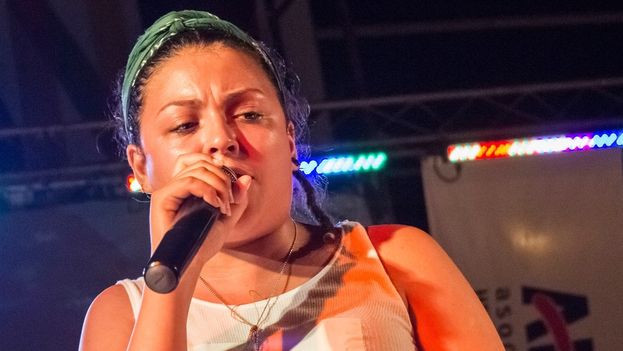
Censored at the Camaguey Festival, Rapper ‘Rapshela’ Denounces “Fear of Liberty” / 14ymedio, Sol Garcia Basulto

Cuban rapper Rashel Cervantes, “Rapshela,” could not appear at the Trakean2 Festival because of not receiving authorization to reside abroad (Facebook)

14ymedio bigger14ymedio, Sol Garcia Basulto, Camaguey, 22 March 2017 – Hip Hop has become that redoubt of rebellion that other musical genres, like rock and roll, used to embody. The Trakean2 Fesitval, which ended Monday in Camaguey, gave voice to performers who sing as if they were shooting truths at the public, but censorship against Cuban rapper Rashel Cervantes – known as Rapshela – who lives in Spain, overshadowed the event.

Also missing were rappers who sing their lyrics in marginal neighborhoods where the genre enjoys the greatest vitality. But that is what was decided by the Brothers Saiz Association, who organized the ninth edition of the event with 40 participating rappers, including MCs (Masters of Ceremony), breakdancers and graffiti artists. Cockfights, the improvised verbal confrontations between musicians, were the moments most appreciated by the public.

Rapshela could not appear before the public in spite of having travelled to the Island for the occasion. Problems with her cultural visa and reproof by the organizers prevented it. continue reading

After spending her own money for the plane ticket from Barcelona, where she lives, Rapshela ran into the cancellation of the presumed institutional promise to pay for her travel from Havana to Camaguey. She managed to arrive nevertheless, but the obstacles had not ended: as a resident abroad she did not receive authorization to appear in time.

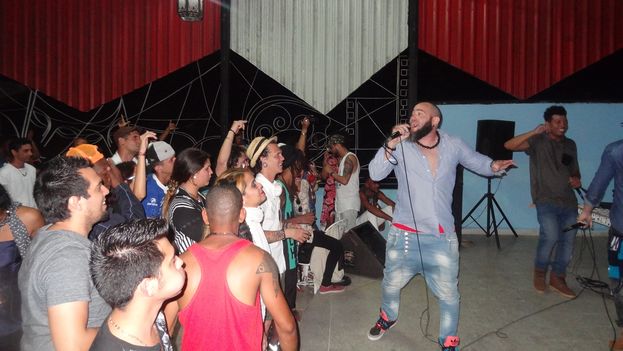
Festival Trakean2, which ended Monday in Camaguey, gave voice to rap, hip hop and other urban genre singers. (14ymedio)

“As soon as I arrived I went to the AHS, and the organizer [Eliecer Velazquez] told me that I could not sing because I was living abroad,” she tells this daily. Nor was the artist included in the lodging and food options that other guests enjoyed. A situation that she regrets “after four months of speaking” with the event promoters.

In a gesture of solidarity, Los Compinches, a group from Pinar del Rio, invited Rapshela to accompany them to the stage. But when the artist began to sing, the Festival organizers ordered the microphone sound lowered. A little later the spectacle came to an end.

The event generated an intense debate when other musicians and the public clamored for her to be permitted to sing, but the organizers proved inflexible. Although they declined to give their version of what happened, Eliecer Velazquez justified himself to the artist, arguing that it was the first time that he had organized a festival, and he did not know “that there was so much paperwork to do.” The promoter explained to the singer that she sought the cultural visa too late and that is why they did not grant it.

Among the attendees, many considered it absurd that a Cuban had to wait for a cultural visa to appear in the city where she was born, so they saw what happened as censorship masked in bureaucratic delays.

The organization also had disagreements with some lyrics by the group Los Compinches, in which marijuana consumption is promoted and Cuba’s economic situation is criticized.

Before the microphones went mute, the spectators had shown great enthusiasm and repeated choruses like Don’t step on the herb, smoke it. A second song increased nervousness of the authorities when the singer explained that the video clip that accompanied the lyrics had been censored.

Joaquin Corbillon Perez, member of the group, does not explain what they did wrong although he argues that the Brothers Saiz Association is not responsible for the situation. “The guilty ones are much higher and are the ones who prohibit it,” he said.

The AHS director from Pinar del Rio, Denis Perez Acanda, also a member of Los Compinches, defended the lyrics of his song and characterized as an “act of repression” the fact that the organizers did not let Rapshela sing.

For Rapshela the problems that she suffered transcend the music scene. “The Cuban people are censored,” she says. In her opinion “rap is a weapon for expression” and “a window to liberty, but here they are scared of liberty.”

The organizer of the Havana female rap festival and manager of the Somos Mucho Más (We Are Much More) project, Yamay Mejias Hernandez, known as La Fina (The Fine One), showed her solidarity with Rapshela because “she is Cuban, Camagueyan, and has never performed in her land. What she wanted was to introduce herself and for her people to hear her.”

Mejias Hernandez, also a feminist activist, told 14ymedio about the festival’s other problems. “It needs a little more organization, maybe more coordination in the places where they hold the concerts at night.” She thinks that Cristo Park, a site intended to offer concerts, did not meet the requirements for nighttime performances.

“There have to be more theoretical events like discussions, meetings, book readings,” adds Mejias Hernandez. “They need more female presence because at this event only two female rappers appeared.” The singer asserts that throughout the Island there are many females who are connected to the genre.

Translated by Mary Lou Keel

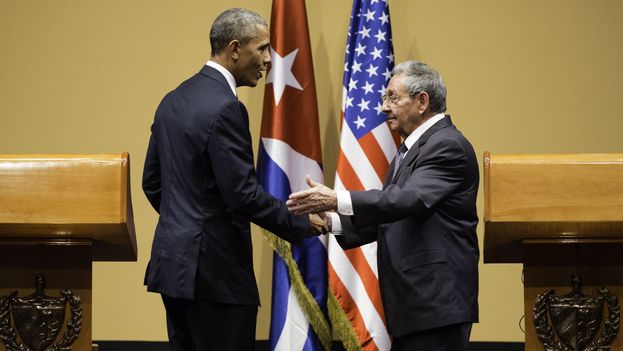
Raul Castro Squandered His Last Chance / 14ymedio, Yoani Sanchez

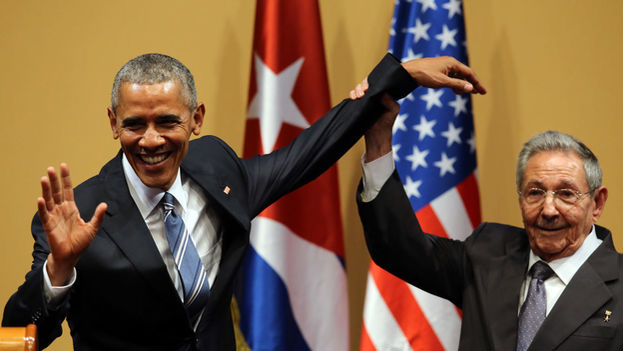
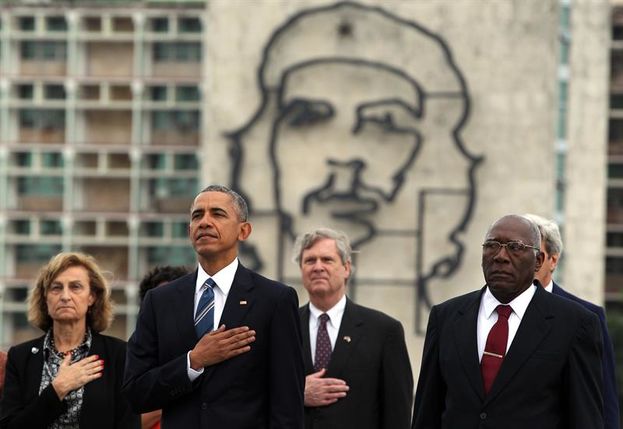
US President Barack Obama and his Cuban counterpart, Raul Castro, shook hands a year ago in Havana. (White House)

14ymedio bigger14ymedio, Generation Y, Yoani Sanchez, Havana, 22 March 2017 — A year ago Cuba had a once in a lifetime opportunity. US President Barack Obama came to the island willing to turn the page on political confrontation. The gesture transcended the diplomatic situation, but Raul Castro – fearful of losing control – responded by putting the brakes on economic reforms and raising the levels of ideological discourse and repression.

Nations are not presented with opportunities every year, nor even every century. The decision to entrench itself and not to undertake political flexibilizations has been the Plaza of the Revolution’s most egotistical measure of recent times. Failure to know how to take advantage of the end of public belligerence with our neighbor to the north will bring this country lasting and unpredictable consequences. continue reading

These effects will not be suffered by the so-called “historic generation” – those at the forefront of the 1950s Revolution – now diminished by the rigors of biology and desertions. Rather than the generals in olive-green, the ones who will pay the price will be those who are still sleeping in their cradles or spinning their tops in the streets of the island. They don’t know it, but in the last twelve months a short-sighted octogenarian tricked them out of a share of their future.

The greatest waste has been not exploiting the international moment, the excitement about foreign investments, and the expectations everywhere in Cuba of taking the first steps towards democratic change without violence or chaos. It was not the job of the White House to encourage or provoke such transformations, but its good mood was a propitious setting for them to be less traumatic.

Instead, the white rose Obama extended to Castro in his historic speech in Havana’s Gran Teatro has faded, beset by hesitations and fears. Now, it is our job to explain to these Cubans of tomorrow why we were at a turning point in our history and we threw it away.

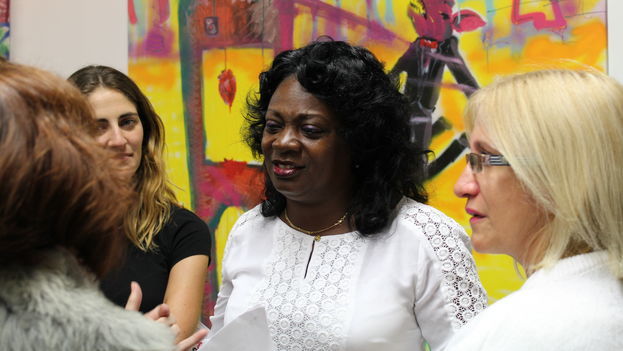
The Government Prohibits Berta Soler From Leaving Cuba / 14ymedio

The leader of the Ladies in White, Berta Soler, says that the government will not allow her to leave Cuba because of leaflets distributed in a protest. (14ymedio)

14ymedio bigger14ymedio, Havana, 21 March 2017 – This Tuesday, the Cuban government prevented Berta Soler, leader of the Ladies in White movement, from traveling outside the country because of an unpaid fine for for an alleged infraction “against public adornment.” Meanwhile, the authorities accuse her of having thrown “papers in the street,” which the regime opponent clarified to 14ymedio were “leaflets.”

Soler took advantage of the action to denounce the disappearance, this Tuesday, of her husband, the activist Angel Moya. “We consider that he is ‘disappeared’ because when he left the house he was being followed,” she detailed. “Today I am calling him and his phone is shut off or outside the coverage area.” continue reading

“This morning I was supposed to travel to the United States, first to Miami and then to California,” said Soler. However, after passing through the immigration booth and security controls at Jose Marti International Airport in Havana, she was intercepted by an immigration official who asked her to accompany him to an office.

The official told Soler that they would not let her board the plane because she had not paid a fine for “throwing papers into the street.” According to Decree 272, whoever “throws into the public street waste such as papers, wrappings, food waste, packaging and the like,” will have a fine of 50 pesos and must “pick them up immediately.”

“Here, the person who owes the Cuban people freedom is Raul Castro,” Soler replied to the accusation. She claims that it was sheets with political slogans. “The fine is from last September, after that I went to Panama and the United States, so I don’t understand this now,” the dissident complains.

The activist was planning to meet in California with David Kaye, United Nations rapporteur for freedom of expression. Instead of Soler, the activist Leticia Ramos will attend the meeting

Last year, when the Aguilera Police Station informed Soler about the fine, she signed a document informing her of the contravention with an ironic “Down you-know-who,” and threw it in the agents’ faces, telling them: “I do not accept any inappropriate fines.”

Subsequently, Soler was informed that the unpaid fine could be doubled, and it was suggested that the police could exchange each Cuba peso (approximately 4 cents US) of the fine for one day in jail or instead not let her travel on Tuesday.

The activist was planning to meet in California with David Kaye, United Nations rapporteur for freedom of expression. Instead of Soler, Lady in White Leticia Ramos will attend the meeting.

“In the report we list all those fines that they assign to us inappropriately,” reflects Soler. “They are illegal and violate the Republic’s penal code,” a situation that is complemented by “the harassment, the threat and violence that is unleashed against our families, against our children and our husbands to try to get us to stop our activism.”

This month marks a year since the Lady in White was prevented from attending mass at Santa Rita parish, and also blocked from attending the Sunday marches on 5th Avenue, a traditional route that goes back to the origins of the movement after the repressive wave of 2003, known as the Black Spring.

Doubtful Meat From Brazil Continues To Be Sold In Cuba / 14ymedio, Zunilda Mata

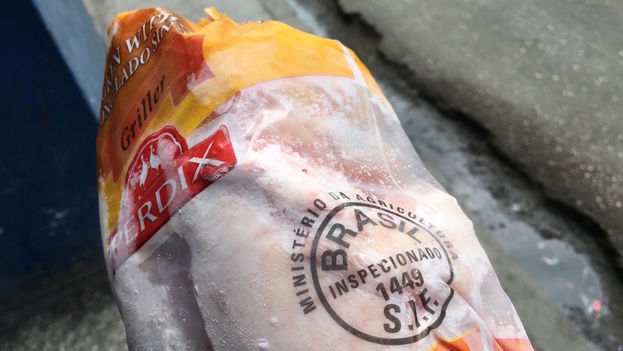
Brazilian frozen chicken that was sold this Monday in the markets of Havana. (14ymedio)

14ymedio bigger14ymedio, Zunilda Mata, Havana, 21 March 2017 — Cubans know a lot about adulterations. For decades they have grappled with the “diversion of resources” [i.e. stealing] from state stores and the practice of state employees acquiring products elsewhere at low prices, bringing them into the stores and selling them at high prices and keeping the profit for themselves. Hence the scandal of the altered meat that involves two Brazilian companies has hardly surprised anyone on the Island.

This Monday Brazilian meat products continued to be sold in Cuba’s retail network, where the frozen chicken of the brands Frangosul and Perdix, from the companies JBS and BRF respectively, continue to be on sale. According to an investigation by the Federal Police of Brazil, both these companies adulterated these products. continue reading

In the case of chicken, the authorities have warned that it is more of an economic fraud, consisting of adding water to the product to increase the weight, without any risks to health.

In the case of chicken, the authorities have warned that it is more of an economic fraud, consisting of adding water to the product to increase the weight, without any risks to health

The results of what was called “Carne Fraca” (“weak meat” in Portuguese), confirmed the suspicions of those who warned that something “doesn’t smell right” in the world’s largest exporter of these products. Each year Brazil exports beef worth roughly 5.5 billion dollars and chicken worth roughly 6.5 billion. This business represents 7.2% of Brazil’s Gross Domestic Product.

So far, no Cuban store or market has withdrawn the Brazilian frozen food products. On the digital sites that offer a wide range of foods that emigrants abroad can order for their families on the island, Brazilian beef and chicken remain on sale.

The official media spread the news of the scandal, focusing on the possible repercussions for President Michel Temer’s government. The Ministry of Public Health did not discuss the issue when asked by 14ymedio.

Cuba imports more than 80% of the food it consumes. For 2017, the bill for these purchases is expected to exceed $1.75 billion, $82 million more than the estimate for the previous year.

Each year, more than 120,000 tonnes of chicken meat are bought in the international market, most of it hindquarters, also called “dark parts.” Alberto Ramírez, president of the Cuban Society of Poultry Producers (SOCPA), recently confirmed to the official press that “[domestic] meat production is practically zero.”

Each year more than 120,000 tonnes of chicken meat are bought in the international market, most of it hindquarters

In 2014, several representatives of the Ministry of Agriculture visited Brazil to inspect the facilities of the dairy and beef plant managed by JBS in Mato Grosso do Sul, with a view to importing its products to the Island. Another 25 facilities approved for trade with Cuba are located in the states of Tocantins, Rondonia, Rio de Janeiro, Rio Grande do Sul, Goiás, Mato Grosso and Sao Paulo

The United States and Brazil are the countries supplying the greatest amount of frozen products to the Cuban market. Faced with the lack of supply and the lack of variety, chicken has become one of the most common foods at the table of Cubans. Only the wealthy can afford beef.

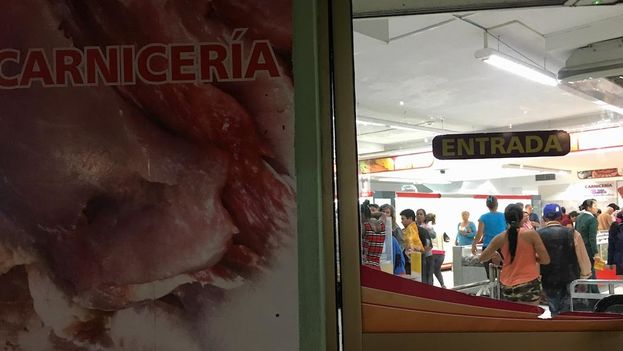
“I came to buy a piece of top round steak,” said a retired woman at the butcher’s in Plaza de Carlos III on Monday. She said, “it is a luxury that I can only allow myself from time to time.” The meat on offer in that market comes from Brazil, according to an employee who preferred anonymity, but who, so far, had received “no order to stop selling it.”

On display in the meat case are several packages with prime ground beef, stew meat, top round and tip steak. No merchandise specifies where it comes from, but local workers confirm that it has been bought from Brazil. The customers look longingly at the display; meat remains a forbidden delicacy for many, even if it is wrapped up in investigations and fraud.

“Here we work with Brazilian meat,” explains one of the waiters at the restaurant next to the Riviera cinema, formerly El Carmelo, on 23rd Street. In their menu they offer sirloin, fillet mignon, fried beef tender and ropa vieja (shredded beef in sauce), this last a very traditional dish that is in high demand among tourists.

Butcher shop in the Plaza de Carlos III in Havana. (14ymedio)

The select El Palco market, whose main customers are diplomats and foreigners living in Havana, is also “especially stocked with Brazilian meat,” points out one of the local cashiers.

Some 27 people have been arrested in Brazil, and Federal Police Commissioner Mauricio Moscardi warned of a corruption network inside the government that allowed adulterated meat to be legalized. That chain of infractions involved officials of the Brazilian Democratic Movement Party, to which President Temer belongs.

The main Brazilian meat producers added chemicals to meats that were “rotten” or unfit for human consumption. An extensive network of bribe payments purchased approval from the Ministry of Agriculture.

“They used acids and other chemicals, in some cases carcinogenic, to disguise the physical characteristics of the rotten product and its smell,” Moscardi explained. They treated the meat with vitamin C to give it a more “appetizing” color, along with levels of preservatives well above those allowed by health authorities.

Representatives of both companies have denied allegations by police authorities, but the alarm has spread in the international market and the companies’ stock prices have tumbled sharply.

“BFR ensures the high quality and safety of its products and guarantees that there is no risk for its consumers,” said one of the largest food companies in the world with more than 30 brands in its portfolio, Sadia, Perdigão, Qualy, Paty, Dánica, Bocatti or Confidence.

Cuban customers who are learning about the news coming from Brazil are beginning to connect the dots. “The chicken no longer came with the quality of before and had a lot of ice”

The Chilean Ministry of Agriculture announced, a few hours ago, that it would accept no more imports from the Brazilian beef market. Minister Carlos Furche explained that the measure is temporary “until the Brazilian authorities know exactly what facilities are being investigated, and of those facilities which have exported to the world and Chile,” he said.

The Chinese authorities have responded unceremoniously. The Government banned all such imports and prevented meat already shipped from being unloaded in its ports. Last year the Asian country imported 1.6 billion dollars from Brazilian meatpackers.

Europe has slowed shipments from JBS and BRF. This week the European Commissioner for Health Affairs, Vytenis Andriukaitis, will travel to Brasilia and the agenda revolves around the food scandal.

Cuban customers who are learning about the news coming from Brazil are beginning to connect the dots. “The chicken no longer came with the quality of before and had a lot of ice,” complains Luisa Cordoves, a housewife in Central Havana who says that “right now it’s better to buy the chicken boxes that come from United States, because the product tastes better. ”

She believes that the scandal will not dissuade domestic consumers from acquiring these products. “People have many needs and there is no choice: you take it or leave it.”

Unlucky Palm Trees / 14ymedio Marcelo Hernandez

The section that goes from the Park of the Fraternity to near Neptune Street was decked out with the national tree. (14ymedio)

14ymedio bigger14ymedio, Marcelo Hernandez, 17 March 2017 — As part of the restoration work of the National Capitol, seven palms were planted at the beginning of last year on the Paseo del Prado median facing the famous Havana building. The section that goes from Fraternity Park to near Neptune Street was then decked out with the national tree, but this lasted for only a short time.

The planting took place during the days before the visit of the American president Barack Obama, in which the city lived a dizzying swirl of construction and beautification. The Department of Forestry of the Ministry of Agriculture chose the trees that would be transplanted and experts in the matter offered advice for their rapid acclimatization. continue reading

With precision, the construction workers made wide planting areas surrounded by paving stones while the nearest neighbors debated whether or not to have these plants that, although they are not native to the Cuban archipelago, are consecrated in the left pavilion of the coat of arms of the Republic.

Within a year of their planting, the palms were dying one by one. They were planted in the appropriate soil and neighbors say they were watered frequently despite the city’s water shortage, but they did not survive the transplanting.

The palms have been dying one by one. (14ymedio)

Those who claim to know certain intimacies of nature ensure that before relocating a palm tree to a new site it is necessary to mark on its trunk a sign that shows which side faces the sun. The tree should be placed in the same direction. Failure to do so, results in the plume of leaves looking “disheveled” at the first light of dawn.

No one can assure that this requirement was met. Like other facts that become a “state secret,” no public official has felt it necessary to offer an explanation for the mass death. At the same time another transplanted tree died, the young ceiba that was replanted a year ago in the Plaza de Armas of Old Havana and that honors the foundation of the city.

A Year After Obama’s Visit, Cubans Feel Disillusioned With His Legacy / 14ymedio, Luz Escobar

On March 20, 2016, Barack Obama began a historic visit to the Island that raised hopes and questions. (EFE)

14ymedio bigger14ymedio, Luz Escobar, 19 March 2017 – It rained when the presidential plane touched down on the tarmac at Havana’s Airport. On 20 March 2016, Barack Obama began a historic visit to the island that awakened hopes and sparked questions. One year after that visit, Cubans are taking stock of what happened and, in particular, what did not happen.

The tenant of the White House evoked waves of enthusiasm during his tour of Havana’s streets. His official agenda included talking with young entrepreneurs, he appeared on a comedy TV show, he visited a private restaurant, and he met with representatives from civil society. They were intense days during which popular illusions reached historic records.

However, Obama’s decision to eliminate the wet foot/dry foot policy before the end of his term in January, caused that sympathy to plummet. Now, inquiring about his legacy on Cuban streets leads to answers mostly filled with criticism, resentment or a sense of betrayal. continue reading

“I lost my life,” Luis Pedroso, a soundman by profession, tells 14ymedio, He sold all his property to pay for an illegal trip to the United States. He left Cuba for the Dominican Republic, and then crossed Mexico and arrived at the border in Nuevo Laredo, on 12 January when the immigration policy that benefitted Cubans was no longer in force.

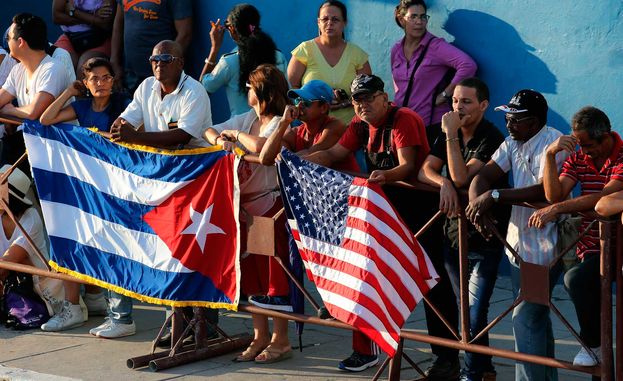
Cubans crowded the streets hoping to see Obama and his family. (EFE)

“What did he do that for?” asks Pedroso, about the act of the Democrat. “We Cubans gave him our hearts and he betrayed us,” he says. The man sleeps on the couch of his sister’s house waiting to “make money again to leave.” He thinks “Trump is less sympathetic,” but perhaps, “will get more loyal.”

The months following the presidential visit, the emigration of Cubans to the United States continued its growing trend. More than 50,000 Cubans entered US territory during fiscal year 2016, according to the Office of Field Operations of the Customs and Border Protection Service.

Norma works as a saleswoman in a private coffee shop in Havana’s Chinatown. She recalls that in the days when Obama was on the island, “people were going crazy all over to try to see him.” She was among the hundreds of people who crowded along the Paseo del Prado when word spread that The Beast (Obama’s armored car) would pass by with the presidential family.

The woman was especially hopeful about the economic benefits that could come from the trip. “It seemed that everything would be fixed and that we self-employed workers would be able to import and bring products from over there,” she reflects. But, “everything is stuck,” is continues.

The entrepreneur would like to bring an “ice cream machine” from the United States, and “ask for a loan or find an investor who wants to put money into a small business.” However, the customs restrictions imposed on the Cuban side make commercial imports difficult, and there is no easy way to send supplies to the island from the United States.

Nor have expectations in the countryside been met. Luis Garcia, a farmer dedicated to planting rice outside Cienfuegos believes that “everything has been greatly delayed.” The flexibilities implemented by Obama from the beginning of the diplomatic thaw were mainly directed toward the private and agricultural sectors, but “the benefits haven’t appeared,” said the farmer.

Obama in the Plaza of the Revolution in Havana. (EFE)

The Cienfueguero continues to plow the land with an old yoke of oxen and recalls that “there was much talk about the arrival of “resources, tractors and seeds, but everything remains the same.” Nevertheless he believes that “Obama has been the best president of the United States with regards to us, a man of integrity,” he says.

The activists, who talked with Obama on that occasion and behind closed doors, are also taking stock after twelve months.

For Dagoberto Valdés, director of the independent magazine Convivencia (Coexistence), the main result of the trip was “to show that ‘the enemy’ used as a weapon in the Cuban government’s narrative was willing to offer a white rose,” as Obama demonstrated in his speech at Havana’s Gran Teatro.

The speech, broadcast live, is considered by many as “the best part of the visit,” says Valdez, who recognizes that “a year later, unfortunately, the situation in Cuba is worsening.” He cites an increase in repression, the attacks on the United States in the official discourse, which continues to be one of “trenches and confrontation.”

The opponent Manuel Cuesta Morúa was also at that table at the US Embassy in Havana. He points out that after the arrival of the Democrat there was an emphasis on “an awareness that our problems are our problems, not problems caused by the United States.” Obama helped to defuse the “historic tension” between “democracy and nationalism.”

Obama’s trip ended with a visit to a baseball game. (EFE)

On the other hand, the regime opponent Martha Beatriz who was traveling during the historic visit, sums up the impact of Obama’s trip as “none.” While “he left everyone filled with hopes,” on the contrary, “what he did was to put a final end to the wet foot/dry foot policy.”

The former prisoner of the Black Spring believes that the visit “is not something that is remembered gratefully right now.” When it happened, “everyone was very happy and filled with hopes, but a year later it’s completely different,” she emphasized.

The columnist Miriam Celaya believes that beyond “being in favor or against” Obama’s actions toward the island “there is one thing that is undeniable, and that is that he marked the Cuban policy of the last fifty years like no other American president.”

Celaya believes that the Democrat “ended the exceptionality” of the Cuban issue “by taking away the government’s foreign enemy.” A situation that has the Plaza of the Revolution “forced to render accounts. Ending the wet foot/dry foot policy,” also contributed to ending “the emigration preference for Cubans in the United States.”

“Any policy towards Cuba framed by US politicians, as long as this system lasts, will have as an obligatory reference this parting of the waters achieved by Obama,” the independent journalist says.

Celaya believes that the population developed “tremendous expectations that are now completely deflated. Many see Obama as the beloved and the hated,” an attitude that puts “the solutions in the United States, as if they have to come from outside,” she says.

The leader of the Patriotic Union of Cuba (UNPACU), Jose Daniel Ferrer, believes that Obama “did everything possible to help the people out of the deep crisis in which Castroism has plunged us,” but “the regime closed all the doors”.

The outgoing president urged Raúl Castro “to open up to his people, to allow the people to recover the spaces” but instead, the authorities remain “in their old position of controlling everything and doing nothing that endangers the total control they have over society. ”

“What’s up, Cuba?” Obama tweeted when his plane was about to land in Cuba. Today, listening to that question generates more concerns than certainties.

Ecuadorian Presidential Candidate Says Cuban Medical Missions “Are Slavery” and Vows to End Them / 14ymedio


Apologies to our readers that this video is not subtitled. Before the shouts of “bravo” Lasso says, that the free healthcare system in Ecuador provided by the government should be in the hands of Ecuadorian doctors. His other statements are reported in the article.

14ymedio bigger14ymedio (with information from Diana Ramos), Quito, 17 March 2017 – Guillermo Lasso, a candidate for president of Ecuador, is against the Cuban medical missions in his country and promised to end them, should he triumph in the upcoming run-off election.

“We must end this slavery of one government negotiating with another that pays poverty-level wages for the services” provided by professionals. He also stressed that Cuban professionals “displace” Ecuadorians in their own country.

“In my government there will be no policy that persecutes any professional sector in Ecuador,” he said on Tuesday, during a visit to Luis Vernaza Hospital in Guayaquil, the candidate’s hometown.

On February 10, Movimiento X Cuba, a civil society group composed of Cuban health professionals based in Ecuador, asked the future president to end the Cuban medical presence there.

“We advocate that Cuban doctors be free and able to decide their own future, their country of residence, and have the freedom necessary to exercise such a dignified profession,” the movement said in a statement.

Some 600 Cuban doctors are working in Ecuador and the Ecuadorian government pays 2,700 dollars a month for each one. From this, the Cuban Ministry of Public Health pays individual doctors barely 800 dollars, with the rest going into the coffers of the state. Profits from this leasing out of medical and other professionals is one of the Cuban government’s largest source of revenue.

Acure, an association of pro-Castro Cubans in Ecuador, spoke out against the “malicious and provocative statement of Movimiento X Cuba” and insisted that doctors from the island have provided medical care “to more than four and a half million Ecuadorian patients,” emphasizing the provision of eye operations and kidney transplants.

“Cuba has trained, free of charge, more than 6,000 Ecuadorian specialists in its universities,” Acure said.

Dr. Daniel Medina, president of Movimiento X Cuba, who defines himself as an opponent of the Cuban government, asked for protection for “all migrants who seek freedom and flee totalitarian regimes like those in Cuba and Venezuela.”

New Skate Park Opens in Havana, 14ymedio, Marcelo Hernandez

Skating and skateboarding has gained followers in Cuba in recent years and also the attention of filmmakers, musicians and supportive friends. (14ymedio)

14ymedio bigger14ymedio, Marcelo Hernandez, Havana, 16 March 2017 – Manolito spends his afternoons chasing buses to grab onto as he rides down the street on his skateboard, or rehearsing new stunts. The young man left school a couple of years ago and every day he spends fewer hours in the house in La Timba where he lived with his mother, his grandmother and his three brothers. Now, a few yards from where he lives, there is a new skate park.

An immense site, closed to the public for decades, was opened for skateboarding on Paseo Street and 31st, very close to the Plaza of the Revolution. With the opening of the new facility they no longer have to watch jealously as other boys do tricks on their boards. News of the opening of the new park spread rapidly among fans of the sport, who have always had to try to find their own place to skate, despite the prejudices.

This urban sport has gained followers in Cuba in recent years and also the attention of filmmakers, musicians and supportive friends. For years, the organizations Cuba Skate, based in Washington DC, has been sending materials to the island for these restless boys, including boards and spare skates. The lack of material is just one of the problems they face. So far the main “squeaky wheel” is that the urban sport lacks places where it can be practiced, leaving them only the plazas and other public spaces where they are definitely not welcomed by other users of the space.

Cuba Skate from Cuba Skate on Vimeo.

Total Uncertainty Among Families Of Cuban ‘Rafters’ Recently Arrived In The United States / 14ymedio, Mario Penton

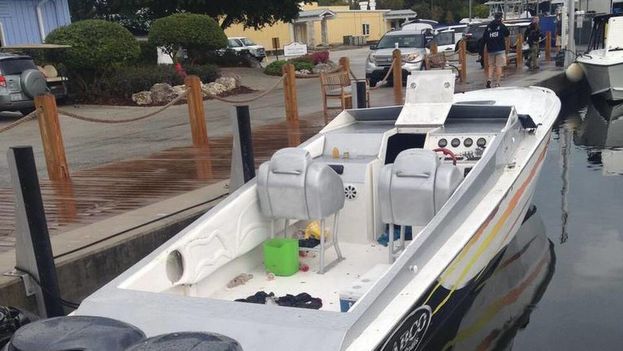
The speedboat in which the Cubans traveled. (Miami Herald)

14ymedio bigger14ymedio, Mario Penton, Miami, 16 March 2017 — A call from Cuba finally let Yandry Perez relax. His aunt had alerted him through an interrupted phone call from the north of Villa Clara, that for two days the whereabouts of his mother and his two younger brothers had been unknown. Organized in absolute secrecy to facilitate their flight, fifty Cubans escaped last weekend in speedboats to Florida, even though they knew they were no longer welcome there.

“For days we have been waiting for news, in complete uncertainty,” says Perez, who two years ago crossed seven international borders to seek refuge under the wet foot/dry foot policy, cancelled in the last days of President Obama’s term. continue reading

“When we heard the news that they had caught two boats with Cubans, we breathed a sign of relief,” he adds.

Last Sunday, a 40-foot speedboat was intercepted by an operations team from the US Customs and Border Protection. It had more than 30 migrants on board

His mother, Marlenes Romero Leon, 47, along with his brothers Yusdiel and Kevin, 20 and 11 respectively, boarded the speedboat as a last option to join the rest of the family that was in the south Florida, in a reunification process that was initiated some years earlier but was frustrated when Romero was denied a visa to travel to the Unites States to reunite with the father of her children.

“On television I was able to see one of my brothers, so I know they are being detained,” says Perez, who only wants to know where his family is so he can hire an attorney to take the case.

“We believe that can ask for political asylum. On more they one occasion they arrested my mother [in Cuba]. They didn’t even let her get to beach so she couldn’t escape Cuba,” he adds.

“My brother is a child, at least they should let us take care of him,” he says.

Last Sunday, a 40-foot speedboat was intercepted by an operations team from US Customs and Border Protection. There were more than 30 migrants on board, five of them ran off into crocodile filled mangrove swamps to escape the authorities but they were caught.

A few hours earlier a small boat with seven Cubans on board was intercepted at Blackpoint Park and Marina, south of Miami-Dade. Another boat with 21 migrants was detained in the vicinity of Cayo Largo.

“We can not give any information about the case or those involved because it corresponds to an open investigation,” an official with the United States Immigration and Customs Enforcement (ICE) said.

Authorities are investigating the boat operators who transported the Cubans from the island. If it is proved that they are human traffickers they could face severely punished charges

Authorities are investigating the boat operators who transported the Cubans from the island. If it is proved that they are human traffickers they could face severely punished charges in the United States.

Since the press announced the arrival of the Cuban migrants, Julio Infante has not stopped seeking the whereabouts of his father-in-law, who allegedly traveled on one of those boats.

“I’ve gone to several places but they always tell me that they cannot give out information. We’re desperate because we do not even know if he’s alive,” he says.

The missing man is Wilber Hechavarría, 46, who left Cuba on Monday. The relatives were supposed to call to his daughter, Yoandra, who was waiting for the news.

“I wanted to be with her and leave Cuba. She always wanted to leave the country because people there have to steal to eat,” says Infante.

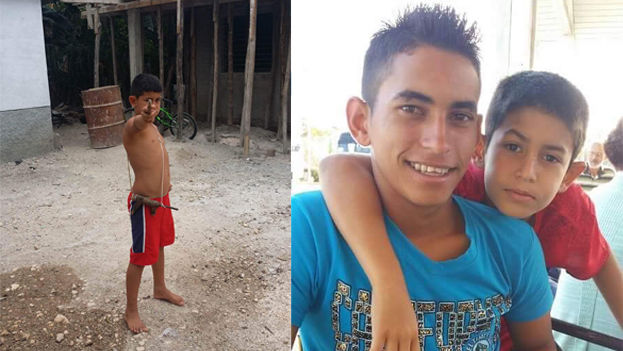
Brothers Kevin, 11, and Yusdiel, 20,, are among the fifty or so Cuban ‘rafters’ detained. (Courtesy)

“My wife came from Guatemala a year ago crossing borders. She arrived pregnant, we already have a family and we wanted her dad to be with us too,” he adds.

Although the migrants knew of the ending of the wet foot/dry foot policy, they ventured to cross the Florida Straits, confident that they would find some way to legalize their situation later in the United States.

For Infante, it’s all the same that the policy that facilitated the entry of Cubans to the United States is over.

“In the end, I would look for some way to legalize or be undocumented, but that will always be better than staying in Cuba,” he says.

When a rafter or any undocumented Cuban migrant arrives in the United States, he is obliged to appear before the authorities for processing

Immigration attorney Wilfredo Allen comments that when Cuban rafters arrive in US territory and do not surrender to immigration authorities, not only will they not be eligible for the Cuban Adjustment Act after staying in the country for a year, but they will not be able to obtain legal status even by marrying residents or citizens.

“When a rafter or any undocumented Cuban migrant arrives in the United States, he is obliged to appear before the authorities for processing. The migrant can apply for political asylum if he is persecuted and fears to return to Cuba,” says Allen.

“If your case is credible you have the right to fight for asylum before a judge and, if granted, you could then adjust your situation through the Cuban Adjustment Act.

“If migrants who illegally entered the United States do not present themselves to the authorities, they remain undocumented and it is very difficult for them to legalize their status later. They are subject to immediate deportation,” he adds.

Police Accuse Journalist Henry Constantin Of “Usurpation Of Legal Capacity”

Cuban activist Henry Constantin. (Twitter)

14ymedio, Havana, 17 March 2017 – Journalist Henry Constantin, director of La Hora de Cuba (Cuba Hour) magazine and regional vice president of the Inter American Press Association (IAPA), was formally charged Friday with the crime of “usurpation of legal capacity,” he told 14ymedio.

Constantin received a subpoena for the third Police Station in the city of Camagüey where First Lieutenant Pacheco Seagnamillo informed him that he was accused of conducting interviews on the public right-of-way in which he “misrepresented reality.”

The police did not mention the names of potential complainants, but emphasized that he was not “empowered” to perform a reporter’s job. continue reading

The journalist could be prosecuted for violating Article 149 of the Penal Code which punishes whomever “performs acts of a profession for the exercise of which he is not properly qualified.” The sentence contemplates the “deprivation of liberty from three months to a year or a fine of 100 to 300 shares* or both.” The official told him that the independent journalist Sol García Basulto, correspondent of this newspaper, will also be prosecuted for the same crime.

In the next 60 days, Constantin will be subject to a precautionary measure yet to be detailed but at the moment he cannot leave the city. The reporter will not be able to attend an exhibition in Los Angeles, about the current situation of journalists on the island, nor the subsequent meeting of the IAPA in Guatemala.

Constantín was named last December as IAPA’s regional vice president for Cuba and pledged to spread “the reality of journalism” on the island. The organization has issued several press releases condemning the harassment and arrests of those who have been victims of attacks in recent weeks. It has urged the Cuban government to guarantee freedom of the press and expression throughout the country.

*Translator’s note: Cuban law sets fines based on “shares”; the value of a share is set separately and in this way can be changed, over time, without having to amend all of the laws that reference fines as a penalty.

Cuba Will Pay For 500 Former FARC Guerillas To Study Medicine / 14ymedio

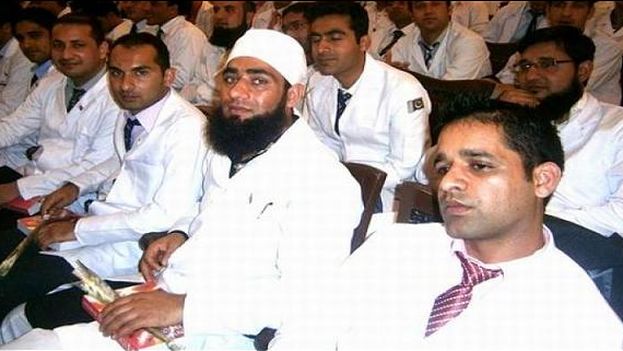
Graduation of Pakistani doctors in Cuba in 2014. (Screen Capture)

14ymedio bigger14ymedio, Havana, 16 March 2017 — The Cuban Government will offer to Colombia one thousand scholarships to study medicine on the Island, of which 500 will go to former FARC guerrillas and another 500 to civilians without ties with the Revolutionary Armed Forces of Colombia.

The proposal was presented by the Cuban ambassador in Colombia, José Luis Ponce Caballero, to Iván Márquez and to the Commission for implementation, monitoring, verification, and resolution of differences of the Final Peace Agreement (CSVR). It is a contribution to the peace process and to the post-conflict phase.

The 1,000 grants will be distributed over five years and the first course will begin this coming September. Each year 100 grants will be awarded to the Government and 100 to the FARC for its management.

“The embassy of the Republic of Cuba will deliver to the Government of Colombia and the FARC a document detailing the offer, which is being prepared by the Cuban authorities,” Ponce said.

Iván Márquez, a former FARC guerrilla and leader of the peace process on the part of the guerrillas, thanked the Cuban government for the gesture. “To Army General Raúl Castro, our gratitude for filling Colombia with his love and solidarity He supports peace and offers us doctors,” he said.

The total price for a foreigner without a scholarship who wants to study medicine on the island is about $85,000 for six years of study.

Translator’s note: Foreigners studying medicine in Cuba attend the Latin American School of Medicine, which was established specifically to educate foreigners separately from Cubans.