A second convoy made up of activists from Italy, Switzerland, Mexico and the USA is received in Havana with a welcoming ceremony
 14ymedio, Havana, April 25, 2026 — Cuba’s state press continues to enthusiastically celebrate the arrival of meager international donations as gestures of “solidarity” in the face of the crisis gripping the island. These handouts of so-called “international support” are hailed as if they could compensate for a deficit that the model has been grappling with for over half a century: the inability to generate genuine economic autonomy.
On April 22, Cuba received a second European convoy of “solidarity aid,” 28 days after the Nuestra América convoy, which was received with so much propaganda surrounding it that it leads one to wonder if more resources were allocated to its promotion than to effective aid for the Cuban population.
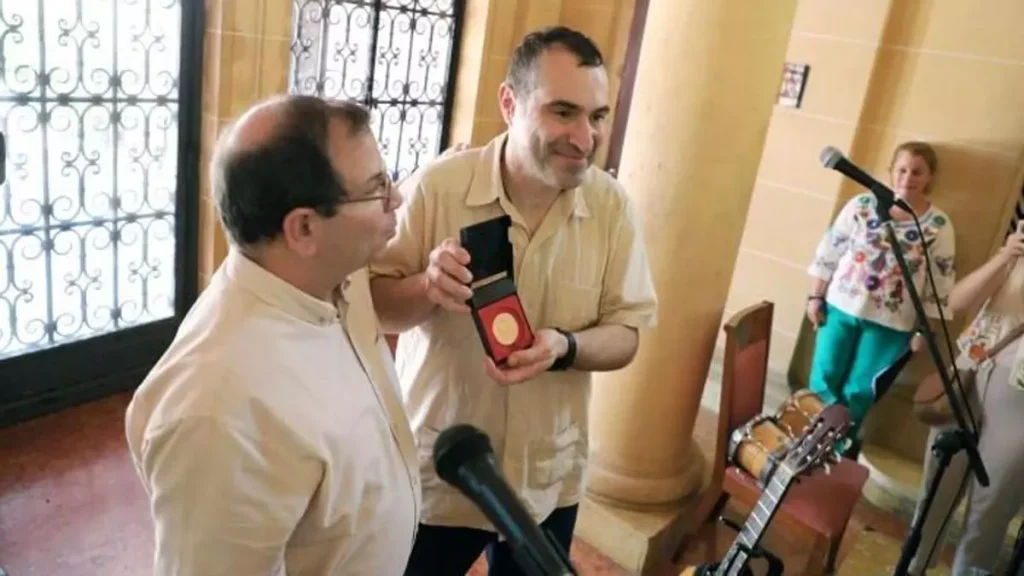
This second convoy, called Primero de Mayo [May Day] and organized by the Agency for Cultural and Economic Exchange with Cuba, led by the Italian activist and businessman Michele Curto – also president of the joint venture BioCubaCafé SA – was received with a welcoming ceremony at the headquarters of the Cuban Institute of Friendship with the Peoples (Icap) in Havana.
“You give Cubans a grain of sand and they give you back the beach,” said Michele Curto himself at the event when he was presented, in gratitude, with the commemorative seal of the 65th Anniversary of ICAP.
The handouts of so-called “international aid” are celebrated as if they could make up for a deficit that the model has been grappling with for over half a century.
Fernando González Llort, president of ICAP, acknowledged that the donation’s “symbolic value is of paramount importance.” At the same ceremony, Deputy Minister of Public Health Julio Guerra Izquierdo said, regarding last month’s shipment: “Although it doesn’t cover all of Cuba’s healthcare needs, it’s an immense relief.”
According to the EFE news agency, the new convoy—comprised of activists from Italy, Switzerland, Mexico, and the United States—brought to Cuba “donations of food, medical supplies, and educational materials.” The news report published in the official state newspaper Granma provides no details about the specific contents of the aid, other than the phrase “50 boxes of supplies for the Public Health system, among other things.”
This Saturday, Cubadebate also reported that Russia delivered to the Cuban government a humanitarian shipment prepared by the government of St. Petersburg “consisting of a batch of medicines destined for hospitals and clinics on the island.”
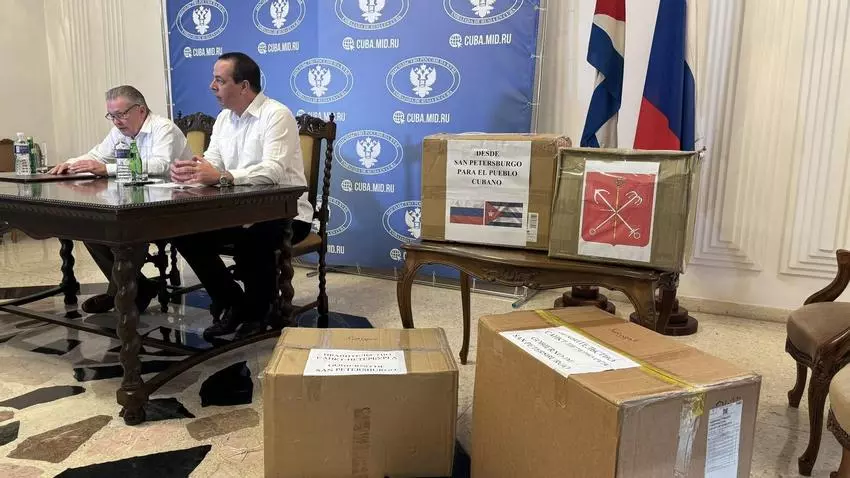
The article omits specifying what types of medications were included, their quantity, or how they will be distributed within Cuba’s dilapidated healthcare system, but it does show images of the few cardboard boxes containing the donation. The article emphasizes the political and symbolic gesture of the modest aid provided by St. Petersburg.
The handover ceremony was held at the Russian Embassy in Cuba. Ambassador Viktor Koronelli, personally presenting the donation to Cuban Minister of Public Health José Ángel Portal Miranda, emphasized that “this is not simply an act of humanitarian aid, but a clear demonstration of the deep and historic bonds of friendship that unite our peoples.”
Koronelli also insisted that the current health crisis in Cuba is “a consequence of the economic, commercial and financial blockade imposed by the US” and reiterated Russia’s opposition “to any form” of external pressure on Cuba.
Yesterday, Friday, the media also celebrated China’s donation to Cuban sports “as part of the close ties of friendship between the People’s Republic of China and the Republic of Cuba.” Another official ceremony was held at the Higher School for the Training of High-Performance Athletes (Esfaar) to receive the donation.
The accumulation of these “gestures of solidarity” normalizes the dependence on external donations that do not even truly alleviate the essential sectors of the Island
“It is a gesture that goes beyond the sports equipment and items we received today: it is a manifestation of solidarity and trust between two sister nations,” said Gisleydi Sosa, director of international relations at the National Institute of Sports (Inder), at the ceremony.
Once again, the specific details of the shipment take a back seat to the narrative of international cooperation: “Cuba is not alone.”
The Cuban regime is a constant recipient of international aid, where each shipment is publicly applauded as a significant relief, and yet the population continues to suffer the same shortages.
Decades ago, the official media triumphantly celebrated the “overfulfillment” of meager national production plans, but now what is celebrated is the receipt of handouts. The accumulation of these “gestures of solidarity” normalizes dependence on external donations that don’t even truly alleviate the needs of the island’s essential sectors.
If previously the propaganda celebrated production goals, today it celebrates the arrival of foreign aid
After more than half a century of centralization, the Cuban economy has functioned solely on external subsidies, unable to finance its imports with its own exports. Thus, from its inception, it depended on massive Soviet subsidies—which between 1960 and 1990 reached tens of billions of dollars—and in the 21st century, it has been sustained by Venezuelan oil.
The collapse of each of these “sponsors” – the USSR in 1991; Venezuela since January 3rd – has led to profound crises that end up being paid for by the Cuban population, forced into “resistance” and “resilience” by vertical order of the State, showing that the problem is not “cyclical” but structural.
Current donations from Russia, China, and sectors of the international left do not represent a solution. They are limited-scope stopgap measures that do not correct the structural dysfunction of the Cuban economy or the lack of genuine productive autonomy. While propaganda previously celebrated production goals, today it celebrates the arrival of foreign aid.
______________________
COLLABORATE WITH OUR WORK: The 14ymedio team is committed to practicing serious journalism that reflects Cuba’s reality in all its depth. Thank you for joining us on this long journey. We invite you to continue supporting us by becoming a member of 14ymedio now. Together we can continue transforming journalism in Cuba.