“At this rate, five Cubans with pots and pans could very well open the Strait of Hormuz.”
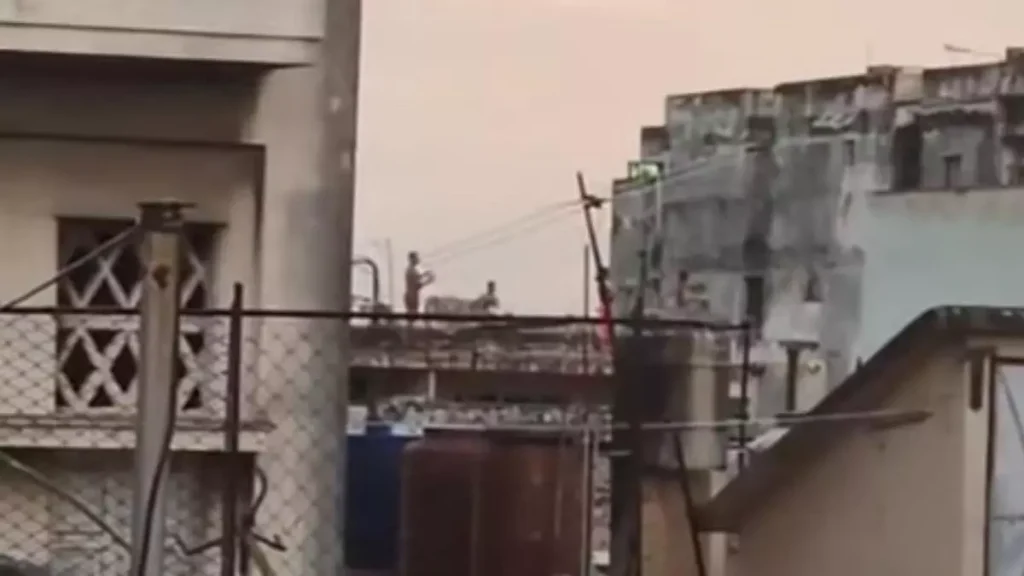
 14ymedio, Havana, April 9, 2026 — Protests against the prolonged power outages, involving banging pots and pans, are no longer confined to nighttime. This Wednesday, the pot-banging protests took place again in several neighborhoods of the capital, with the difference that some of them occurred in broad daylight.
A resident of Santos Suárez, in the Diez de Octubre municipality, recounts on Facebook with a touch of humor: “Five blocks from here, around 3:00 pm, following the number 1 concert in B-flat for pot and pan, performed by the neighbors in that area, the police arrived and immediately the lights came back on!” As has happened on other occasions, the authorities have responded to the pot-banging protests by restoring electricity, always temporarily.
“Did the fuel appear only for that little bit of neighborhood?” the same woman asks, adding ironically, “At this rate, five Cubans with pots and pans could very well open the Strait of Hormuz.”
Videos circulating on social media show residents banging pots and pans during the day in that neighborhood, but also in Central Havana and others, where blackouts have lasted up to 30 hours.
We want food, we want light, we want water
Other testimonies gathered by Martí Noticias confirm the pot-banging protests that could indeed be heard in various neighborhoods of Diez de Octubre in the afternoon, accompanied by slogans such as: “We want food, we want electricity, we want water.” The same news outlet quotes a resident as saying: “We’ve been without electricity for a day and a half. It’s madness, we can’t sleep.”
During the night, similar demonstrations were also reported in other parts of the capital. In the Bahia neighborhood, videos circulating online show that, in addition to the banging of pots and pans, church bells were ringing as a form of protest against the more than 24-hour power outage.
In the Zamora neighborhood of the Marianao municipality, after three consecutive days of power outages lasting more than 12 hours, residents also banged pots and pans in protest. According to published accounts, electricity was restored almost 20 minutes after the protest began.
Repressive forces were deployed, including trucks with black berets, plainclothes police officers, and around five patrol cars.
On Tuesday night, pot-banging protests were also reported in Guantánamo, in the Caribe and Norte neighborhoods. The intensity of the protest prompted a police presence, which the independent legal organization Cubalex warned of as a “risk of repression, arbitrary arrests, and other human rights violations,” following arrests reported in the context of daily demonstrations that began on March 6.
“Repressive forces were deployed, including trucks with black berets, plainclothes police officers and around five patrol cars,” Cubalex reports in its publication, accompanied by videos documenting the demonstration and the police presence.
According to a report by Martí Noticias, authorities restored electricity to quell the protest. But the service only lasted for an hour. Then the blackout resumed, accompanied by an internet outage that lasted until the following morning.
The pot-banging protest in Guantánamo took place about five blocks from the provincial headquarters of the Communist Party of Cuba (PCC). The PCC’s first secretary in the province and officials from the Ministry of the Interior were present. This deployment reflects fears that the protests could take on a political dimension.
Although no arrests were reported during these latest protests, it has been noted that arrests often occur days later.
The demonstrations, sparked by shortages of basic services, have taken on a political character, with slogans blaming the state administration for the crisis. Several have featured chants of “Freedom!” and “Down with communism!” along with insults directed at Cuban President Miguel Díaz-Canel.
Although no arrests were reported during these latest protests, it has been noted that arrests often occur days later, as happened after the March 13 demonstrations in Morón, with more than 16 people subsequently arrested, including minors, such as the case of teenager Jonathan David Muir.
The lack of electricity makes it impossible to pump water, preserve food, and sleep in the spring heat on the island. Mosquitoes and the weather exacerbate the discomfort, making it increasingly difficult to lead a basic daily life amidst the energy crisis.
The National Electric System (SEN) has been severely affected recently by the breakdown this Monday of the Antonio Guiteras thermoelectric plant – the largest generating plant in the country – and the failure that caused the disconnection of unit 1 of the Che Guevara plant, in Villa Clara, already restored by this time.
The National Electric System (SEN) continues to fail to meet basic demand due to the accumulated wear and tear on its plants and a lack of maintenance.
Today’s report from the Cuban Electric Union (UNE) indicates that Unit 2 of the Felton thermoelectric plant is offline due to a breakdown, while Unit 5 at Mariel, Units 5 and 6 at Renté, and Unit 5 at Nuevitas remain out of service for maintenance. This results in a projected deficit of 1,775 MW during today’s peak hours, compared to a national demand of 3,020 MW.
Despite the recent arrival of the Anatoly Kolodkin tanker to the island with 100,000 tons of Russian crude oil, the National Electric System (SEN) still cannot meet basic demand due to the accumulated wear and tear on its plants and a lack of maintenance. The fuel shortage, exacerbated by the sanctions and tariffs imposed on Cuba by the United States, further worsens the country’s energy crisis.
______________________
COLLABORATE WITH OUR WORK: The 14ymedio team is committed to practicing serious journalism that reflects Cuba’s reality in all its depth. Thank you for joining us on this long journey. We invite you to continue supporting us by becoming a member of 14ymedio now. Together we can continue transforming journalism in Cuba.