Who is the leader taking over in Venezuela? Why does she both reassure and worry Cuba?
 14ymedio, Havana, 4 January 2025 — Following the capture of Nicolás Maduro, power in Venezuela has not been left hanging. As is often the case in highly centralized regimes, the transition was expected. Delcy Eloína Rodríguez Gómez, until now the executive vice president, assumed the role of “interim president” in a move that can be summarized as “the king is dead… the queen is crowned.” For the Cuban audience, it is worth examining who is this woman who is now managing the forced transition from Chavismo and why her name is not at all unfamiliar in Havana.
Delcy Rodríguez was born in Caracas in 1969 into a family deeply rooted in leftist activism. She is the daughter of Jorge Rodríguez, a historic leader of the Socialist League, who died in police custody in the 1970s, and the sister of Jorge Rodríguez, one of the most influential political operatives of Chavismo. A lawyer by training, Rodríguez built her career not on charisma or popularity, but on ideological loyalty, party discipline, and systematic confrontation with the West—virtues highly valued in both Caracas and Havana.
Her ascent was steady. As Foreign Minister from 2014 to 2018, she became one of the most aggressive voices of Chavismo in international forums, especially before the OAS and the UN. Her rhetoric, sharp and militant, earned her personal sanctions from the United States and the European Union, but also solidified her position as a trusted figure within Maduro’s inner circle. Since 2018, she has held the Executive Vice Presidency, a position from which she has controlled key areas such as the economy, oil, foreign relations, and, no less important, communication with strategic allies.
Delcy Rodríguez has not only visited the island on multiple occasions, but has also become one of the principle managers of the Caracas-Havana axis.
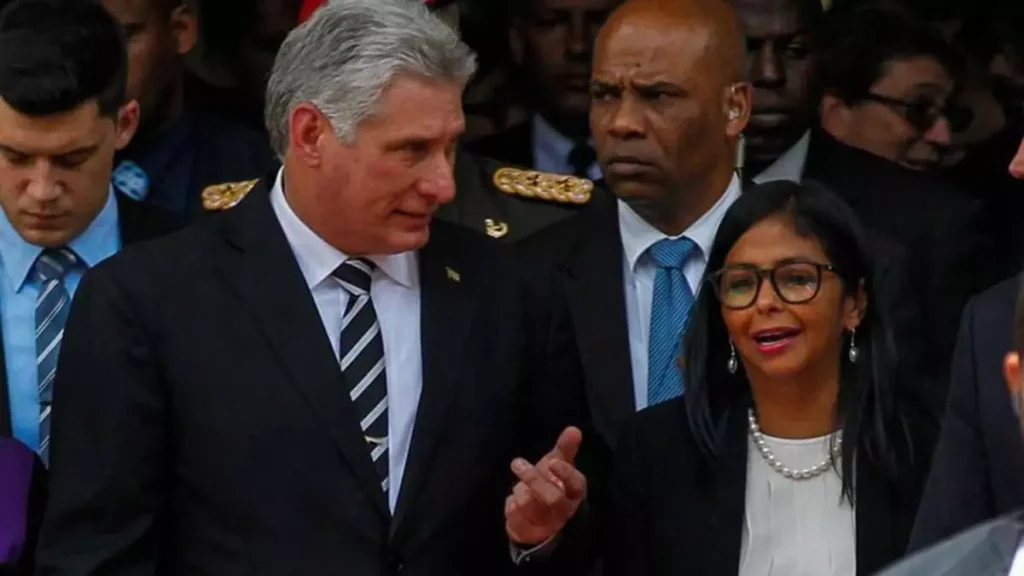
Among these allies, Cuba occupies a central place. Delcy Rodríguez has not only visited the island on numerous occasions, but has also become one of the principle managers in the Caracas-Havana axis in recent years. She has met repeatedly with Miguel Díaz-Canel, held meetings with delegations from the Communist Party of Cuba, and participated in negotiations related to energy supplies and bilateral cooperation. For the Cuban government, Rodríguez represents a guarantee of continuity: a leader trained in the same political language, with the same distrust of pluralism, and a profound understanding of the value of repression as a tool for stability.
This alignment became clear after the 11 July 2021 protests in Cuba, when Delcy Rodríguez publicly expressed her support for Díaz-Canel and justified the repression against the demonstrators. At that time, she did not appeal to nuance or call for dialogue, but rather embraced without reservation the official Cuban narrative of a “soft coup attempt” and “foreign interference.” This stance placed her, unambiguously, in the same political and moral camp as the ruling Castro regime.
In Venezuela, her figure evokes mixed reactions. For the opposition, Delcy Rodríguez is neither a moderate nor a pragmatic technocrat, but rather one of the architects of the Chavista system of control, involved in decisions that have deepened the country’s economic and social crisis. She has been singled out for her role in opaque financial operations, in managing international sanctions, and in forging alliances with actors such as Russia, Iran, and Turkey. For the most hardline sectors of Chavismo, however, she embodies the continuity of the Bolivarian project.
Her prominence after Maduro’s fall might therefore imply neither an opening nor a rupture, but rather a closing of ranks. Cuban Foreign Minister Bruno Rodríguez Parrilla quickly understood this, expressing his immediate support for the Venezuelan government and Delcy Rodríguez on Saturday, denouncing what he called a US aggression. The message was clear: Havana is counting on her as a guarantor of its interests in Caracas.
However, President Donald Trump has made it clear that Washington will lead the Venezuelan transition and manage the country’s oil sector, a tutelage whose compatibility with the nationalist and anti-imperialist rhetoric that Rodríguez has maintained thus far remains uncertain. The US president asserted that his Secretary of State, Marco Rubio, had a “long conversation” with the then-vice president. According to the Republican, the Chavista leader expressed her willingness to cooperate with the United States.
Only in the coming hours will it be known whether the lawyer chooses to facilitate the dismantling of the regime and US administration’s control over the oil sector, or maintains her confrontational rhetoric against the White House. Havana is closely monitoring every nuance in her words, every gesture of rapprochement or rejection that Rodríguez makes toward Trump, and any statement that strengthens or weakens the alliance with Cuba.
In contrast, Marco Rubio has made it clear that he doesn’t care about words, but about actions: Washington will work with the current Venezuelan government if it makes the “right decisions” and will evaluate those who currently hold power in the country “by what they do,” not by what they say.
This could be the guarantee that, despite the blow suffered with Maduro’s capture, Chavismo does not dissolve, but rather reorganizes itself, and does so under figures reliable to the Cuban apparatus.
For the Castro regime, Delcy Rodríguez’s appointment represents more than just an institutional change. It could be the guarantee that, despite the blow dealt by Maduro’s capture, Chavismo will not dissolve, but rather reorganize itself, and do so under figures trusted by the Cuban apparatus, with assurances of economic support and the continuation of official missions that keep thousands of Cubans in the Venezuela. It is no coincidence that Rodríguez has been one of the main advocates for maintaining oil cooperation with the island, even during Venezuela’s most severe economic hardships.
From a Cuban perspective, the question isn’t just who is Delcy Rodríguez, but who will she be from now on. Everything indicates that she could behave as a crisis manager, not a reformer; a facilitator of Maduro’s downfall, not of a genuine democratic transition. Her track record shows a leader prepared to negotiate through hardline tactics, not concessions. But in a context like Chavismo, where opportunism and dissimulation have been rewarded for decades, no one knows her true colors.
For Havana, Delcy Rodríguez was until yesterday a known ally, but now she is becoming the great unknown that must be resolved as quickly as possible.
___________
COLLABORATE WITH OUR WORK: The 14ymedio team is committed to practicing serious journalism that reflects Cuba’s reality in all its depth. Thank you for joining us on this long journey. We invite you to continue supporting us by becoming a member of 14ymedio now. Together we can continue transforming journalism in Cuba.