In July, Prisoners Defenders recorded the imprisonment of 25 new political prisoners.
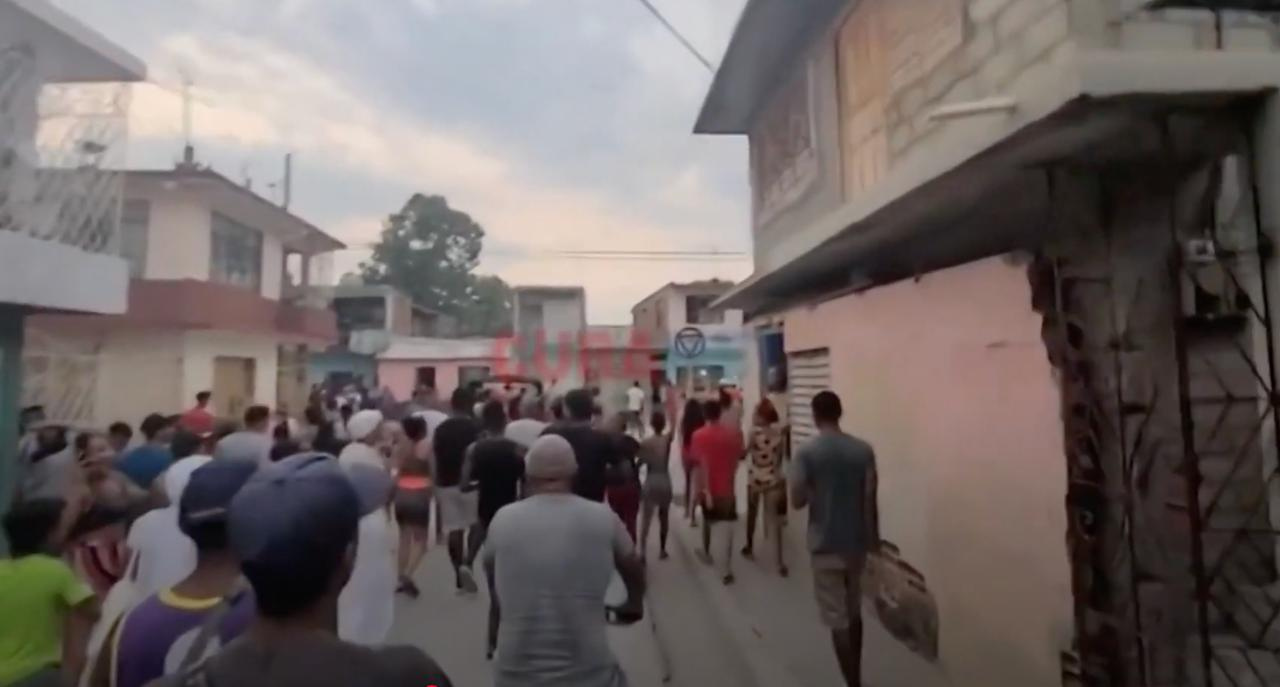
 14ymedio, Havana, 7 August 2025 — More than a year after the March 2024 protests in Granma Province, Prisoners Defenders (PD) has confirmed the arrest of at least 17 protesters on that date. While the details of the arrests remained unknown until now, the organization clarified in a July report on political prisoners, that the silence was because the fear of the regime’s repression on the part of “those affected” and their families often limited the investigation.
On June 20, after being held without trial for more than a year, the report notes, 16 of the detainees received their prosecutorial requests, a process that was carried out “without any judicial protection,” it adds. The penalties sought for the group range from one to seven years in prison.
Among those arrested in Granma is Juan Carlos Verdó Zamora, who was only 18 years old at the time of his arrest. He remains in prison today and is the only member of the group for whom the Prosecutor’s Office has not filed a petition. Two other members of his family were imprisoned during the same demonstration, in which residents demanded an end to the blackouts and shortages.
Prisoners Defenders also reported that, as of the end of July, 1,176 political prisoners remained in Cuban prisons. Of these, 124 were women, many of them mothers, and 33 were minors, some convicted of “sedition,” one of the most punishable offenses under the Penal Code.
Prisoners Defenders also reported that, as of the end of July, 1,176 political prisoners remained in Cuban prisons.
Last month alone, 25 new political prisoners were registered, although seven people were also removed from the list: six due to serving their sentences and one due to death. Political prisoner Yan Carlos González died on July 7 after a prolonged hunger strike in protest of his sentence.
González had been incarcerated for over a year in Santa Clara’s La Pendiente prison, accused of setting fire to a sugarcane field. The 44-year-old prisoner faced up to 20 years in prison at the request of the prosecutor’s office.
The organization also included in its records the revocation of parole for five political prisoners who benefited from the agreement between Havana and the Vatican. Just a week after Pope Francis’ death in April, José Daniel Ferrer and Félix Navarro were returned to prison for allegedly failing to comply with these conditions.
In early June, Donaida Pérez Paseiro, a Yoruba priestess living in Placetas, had her prison sentence revoked. The political prisoner had been sentenced to eight years in prison for “public disorder,” “disobedience,” “contempt,” and “assault,” also in the context of ’11J’, as the Island-wide protests in July of 2021 are called. In her case, the court also alleged a “breach of duty, primarily in the workplace, and failure to appear when summoned by the Execution Judge.”
The first case of revocation, however, was that of Jaime Alcide Firdó, released in January and returned to prison in early April, allegedly for refusing to become a State Security informant. The 25-year-old political prisoner is serving a seven-year sentence for alleged sedition after taking part in the June 11 protests in La Güinera, Havana.
Finally, a few days ago, the regime returned to prison political prisoner Marlon Brando Díaz Oliva, who was convicted for 11J, for allegedly violating his house arrest.
An alarming fact also highlighted by the report is that 474 political prisoners suffer from serious illnesses.
Prisoners Defenders also dedicated part of its report to female political prisoners: 45 of them, it said, remain imprisoned in inhumane conditions, without medical care, under extreme heat, and subjected to constant threats; while another 79 are serving sentences under house arrest. Some face sentences of up to 15 years.
Another alarming fact highlighted in the report is that 474 political prisoners suffer from serious illnesses, and 40 have mental disorders without receiving adequate medical treatment. The organization asserts that lack of nutrition, mistreatment, and isolation exacerbates their situations.
Another report from the Cuban Observatory of Human Rights (OCDH) states that July was the most repressive month so far this year, with at least 357 such actions by the regime. The record includes cases of harassment, threats, police summons, and surveillance of activists and dissidents, especially in Havana, Matanzas, Villa Clara, and Granma.
The abuses, according to the OCDH, intensified around key dates such as July 4th and the fourth anniversary of 11J, with the aim of preventing activists and relatives of political prisoners from participating.
____________
COLLABORATE WITH OUR WORK: The 14ymedio team is committed to practicing serious journalism that reflects Cuba’s reality in all its depth. Thank you for joining us on this long journey. We invite you to continue supporting us by becoming a member of 14ymedio now. Together we can continue transforming journalism in Cuba.