
Self-employed…That Damn Breed / 14ymedio, Miriam Celaya

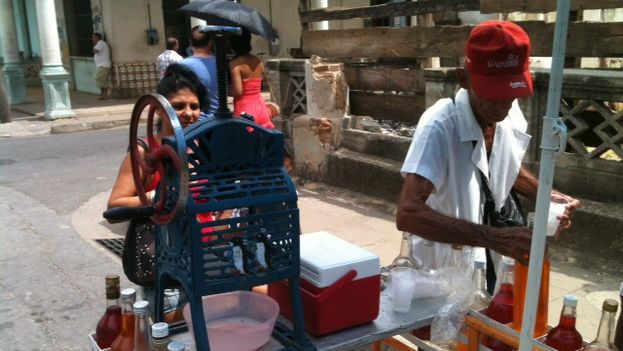
Traditional business of a self-employed. Slushy making with an ice-grating machine in Pinar del Río. (Juan Carlos Fernández/14ymedio)

14ymedio bigger14ymedio, Miriam Celaya, Havana, 2 May 2015 — Few sectors have been so viciously beaten in Cuba as the one grouped under the generic name of “entrepreneurs”, or, according to the informal term, “cuentapropistas” (“self-employed”).

The backgrounds of the self-employed have their roots in small business, family business owners and street vendors that swarmed throughout the Island until their extermination by the revolutionary guillotine called The Revolutionary Offensive of 1968. However, this is a breed that will sprout from the ashes, at any opportunity, a quality that is, at one and the same time, the secret of its survival and its curse because if there is anything that totalitarian power distrusts it is individuals with aspirations of independent entrepreneurship, especially if they have demonstrated their ability to thrive outside the “protection” of the flock.

Thus, at the smallest fissure in the system’s monolithic structure there would follow a fast flourishing trade with glimpses of prosperity for the most daring children of that wicked caste, whose autonomy allowed them to distance themselves somewhat from the political-ideological commitments hanging over the rest of society, and the respective official raids would then follow. continue reading

Perhaps the most famous purifications were the so-called Operación Pitirres en el Alambre (Operation Kingbirds on a Wire) and Operación Adoquín (Operation Cobblestone), which hurled all the fury of Castro I against the peasants of the “free market” and the artisans of the Cathedral Plaza respectively.

The egregious one had decided that those emancipated individuals were becoming too rich, maybe almost as rich as the leaders of the Communist Party. It was necessary to root out evil and demonize the nouveau riche, who were immediately re-christened “flower pots,” imprisoned, dispossessed, prosecuted, and convicted, as a general warning. At the same time, commercial activities of the self-employed were suppressed until the 1990’s, when the crisis stemming from the soviet collapse and the ensuing famine among the Cuban population left the government no choice but to allow their activities once again.

By the mid to late 1990’s foreign investment and capital inflows began, giving a respite to the Castro regime and, at the end of the decade, the almost providential appearance of Hugo Chávez on the stage breathed new life into the regime. It then immediately “froze” the issuing of new licenses for the self-employed sector, while raising taxes on those who already had licenses plus the pressures of inspectors contributed to the contraction of the sector.

Currently, the government has created new support and control mechanisms to keep a short leash on the “private ones”

Currently, with the sector’s most recent revival by the hand of so-called Raulista reforms, the government has created new mechanisms of support and control to keep a short leash on the “private ones.” A large body of inspectors – a whole army of corrupt officials – and a “union of the self-employed” allow for monitoring, keeping individual incomes at low levels while retaining the ability to mobilize on the side of the political discourse. Innate entrepreneurs and the government remain antagonists that tolerate but mutually rebuff one another.

One witness among thousands

Sandra lives in a small town in Matanzas and became self-employed 21 years ago. She is a survivor of that outpost of proto-entrepreneurial Cubans who, in the worst years of the 1990’s, decided to take a risk in tackling the economic crisis under the government’s “opening” for the self-employed. It was then that Sandra was licensed as a seller of handicrafts and other trifles. She was very young then, but she had a nose for business and she was also good with people, so she found a niche in the marketing world, sought and found her own suppliers and soon mastered all the intricacies of the trade, including contacts that alerted her about police and inspection operations within a time frame sufficient to hide far from her selling space anything she was not licensed to offer for sale.

Despite all the alarms, a short while after, she was able to start a small pizza business, baking them in an an old electric oven at a time when any kind of food offered for sale was sure to be a hit. To tell the truth, Sandra sold whatever she found, from clothing, make-up or video equipment to frozen yogurt or plaster ornaments. She found out that she was much better off working by and for herself than continuing at her job as secretary at a government office at an obsolete typewriter, typing information that nobody would read, only to get 148 Cuban pesos a month, while a mere bar of bath soap manufactured in Cuba cost 50 Cuban pesos.

It was much better to work by and for herself than to continue at her job as a government secretary for 148 Cuban pesos a month.

Today Sandra is a veteran self-employed, owns her own home and has forged ahead with her two daughters. However, though she now only sells custom jewelry, just as she is licensed to do, she still feels like she walks the tightrope, and assures us that she cannot make ends meet.

“There is a war against us (the self-employed). Our taxes go up for whatever reason and it is hard to see the benefits. In country towns, like mine, things are even worse. I have to travel to Havana to buy merchandise and bring it home, risking being detained by police, taken to the station and having to justify everything with paperwork. If you don’t have the papers or contacts to come to your aid, they will seize everything. Imagine that! If I bought my merchandise at the government stores, how much would I have to sell it for at home to not only clear a small profit, but just to break even? And to top it all off, the Government invents more legal mechanisms every day to get more money out of you.”

Indeed, in recent years they have increased our taxes briskly. If when she started out Sandra paid the almost symbolic amount of 40 pesos in tax for the sale of small handicrafts, the current monthly tax is 349 pesos per license, plus 10% of sales (which the authorities estimate at over 1,000 pesos a week, implying a tax of 400 pesos each month), plus 60 pesos for social security. Add to that 300 pesos for rent for the site where she conducts her business and she ends up paying 1,109 pesos a month. In addition, there is the annual tax return on sales which must be paid promptly to the National Tax Administration Office (ONAT) each January, which amounts to paying twice for the same sales: monthly and annually.

In recent years the sector taxes have multiplied rapidly

And this is not the only reason why Sandra and many others feel cheated. At the beginning of the so-called “Raulista” reforms, the speech by the General-President stated that the self-employed were honest workers who paid taxes to the government while generating jobs, therefore they deserved all the respect and the rights of any worker. Among those rights, he said, we should recognize their working years to guarantee them a decent retirement.

Sandra was one of the ones who got excited about this news: she already had 20 years under her belt as a self-employed individual paying her taxes under established law. However, she was told at the ONAT that the measure was not retroactive, so if she wished to count those previous years, she should contribute 60 pesos per month for social security for each of the 18 years she had worked before the official law, however, at the ONAT they explained that this measure was not retroactive, so, if she wanted to have those previous years counted she should contribute 60 pesos per month in social security for each one of the 18 years she had worked before the official change, which, translated into hard numbers, would mean paying 12,960 pesos within three calendar months because “we haven’t established any other way to pay.”

Sandra resigned herself to watching the retirement promise go up in smoke: “If I had almost 13 thousand pesos, I would immediately hand it over to my son-in-law to help him build the raft for all of us to get the hell out of here. No matter how I struggle to better my life, I end up screwed.”

“If I had almost 13 thousand pesos, I would immediately hand it over to my son-in-law to help him build the raft for all of us to get the hell out of here”

This year we have seen yet another way to squeeze the self-employed, under the guise of “sub respondents.” This is a note slipped under the crack of the door of the self-employed when the “computer system” decides that the amount declared is less annual income than has actually been received. This document bears the printed amount that “the system” considers correct, and states the exact debt due to the fiscal authorities. If not paid by the established date, the license will be suspended.

However, there is no control mechanism to establish how much each self-employed person has sold in each case, but the estimated amount in question is not subject to appeal. None of the defendants –all the self-employed in Sandra’s hometown – knows by whom or on what parameters those “sub-declarations” are based. She, for instance, has been taxed an extra 1,600 pesos over and above what she has already paid.

“Some of us went to ask that they clarify this for us, because it had never taken place before, but at the ONAT they tell us that they know nothing, that this is established by ‘the system’. I told them that it’s clear that ‘the system’ is the one that’s not working, we can be sure of that! But, how can we change it?

And while Sandra is not one to give up, she confesses that she already feels tired of such an uneven war. She, who has a technological degree in economics, says that the self-employed worker can’t even count on the legal backing of a signed contract. “When you request a license, they hand you a card and that’s it. You don’t sign anything, they don’t tell you any more than what you should pay in taxes and nobody has an obligation towards you, though you do have the obligation to pay on time all the taxes they impose for an amount they determine, though the government does not invest one cent or risk anything. It’s unfair and abusive. And now they also want to force you to pay union dues, and to march and shout slogans!”

Sandra is convinced that this responds to a government strategy to prevent the self-employed sector from growing and consolidating. That is why there are so many obstacles and so much harassment. “We, the self-employed, are just as repressed as the opposition,” she jokes. And she is not far from the truth in this.

“I told them that it’s clear that ‘the system’ is the one that’s not working, we can be sure of that! But, how can we change it?”

On the other hand, neither she nor her fellow associates have legal options, so many are giving up their licenses and choosing between getting jobs as an employee of a more prosperous self-employed person – perhaps one of those who run restaurants or rent rooms to foreign tourists – entering the illegal market (from which many came), or more radically, emigrating however they can and taking their chances far away from the guarantee of poverty they have in Cuba.

“For now, I will not give up my license after 21 years of struggle. I will simply keep up the façade selling the custom jewelry and will have to conduct other business under the table to catch up. If ‘these people’ will not let me breathe while I’m working, I will have to prosper by being inventive. Because if I’m killing myself working, it is logical I should see some profit. It’s not worth it to be legal: they force you to violate laws. But for now, I am seriously thinking that I should leave with my daughters and my son-in-law. There’s not much left for us here.”

Now, when the winds will once again favor foreign investments, Cuban entrepreneurs continue being excluded from all benefits and try to survive the new cycle of simulated suppression they are suffering. Sandra sums up the situation with an illustrative phrase: “When they hand you a license it’s as if you are picking up a machine gun. From that moment on, you will be living in a permanent war: the war of the government against us.”

But Sandra is wrong about this last part, because the government’s war is against all Cubans.

Translated by Norma Whiting
Anticipated News of Another May Day / 14ymedio, Reinaldo Escobar

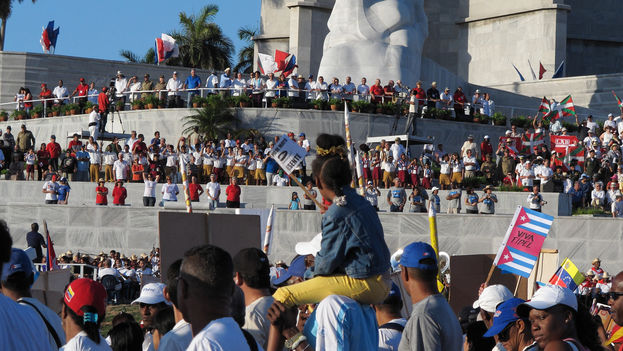
Celebration of May 1st in Cuba. (FLICKR/CC)

14ymedio bigger14ymedio, Reinaldo Escobar, Havana, 30 April 2015 — Like all ritual ceremony, the parade for International Workers Day involves previous preparation and specific purposes. Along with 26th of July events and the Triumph of the Revolution’s anniversaries, May 1st has always stood out as the celebration that mobilizes the most people in Cuba.

In some of these parades around a million participants have been recorded. Depending on the directions coming from the top of the hierarchy, they are sometimes organized under neutral mottos, such as “To defend the homeland”; in others the motto can be more specific, such as “Against the imperialist embargo” or, like last year’s motto, “For the return of the Five Heroes.” The 2015 parade’s main motto is “United for the construction of socialism” and official chroniclers claim that it will be massive, compact, strong, unforgettable and other similar adjectives. continue reading

In the capital, starting at midnight on the night of April 30, the main avenues surrounding the Plaza of the Revolution will be blocked to traffic along with a parking ban. If rain does not play us a trick, from early morning on May 1 the march will deploy in 18 groups which will begin gathering at previously planned staging points. At the front, there will be 50,000 public health workers, headed by members of the Medical Brigade that confronted the Ebola epidemic of in Africa.

The selection of this group to represent the vanguard of the vanguard has different connotations. Perhaps the most significant is related to the new winds blowing in the relations between Cuba and the United States as of December 17. Sheathed in their protective suits, physicians and Cuban nurses worked side by side with American specialists and many times carried out their work under the direction of and with the resources of the United States.

This time the State Security will have to be attentive to any extremist who shows up with insults against Obama or extemporaneous fundamentalisms

They’ll need an eagle eye to detect any anti-imperialist messages in the placards held high. This time the State Security operation, which traditionally deploys close to the platform to detect any provocations “from the enemy,” will have to be attentive to any extremist who shows up with insults against Obama or extemporaneous fundamentalisms.

Like every year, visitors from half the world will gather to contemplate the magnificent spectacle. More than 1,800 representatives of nearly 200 organizations from 68 countries have already confirmed their participation. Of these, 285 are American. The majority are trade union members, but groups of solidarity and social movements will also be present. Many of them will also be present on Saturday, May 2, at a scheduled meeting on international solidarity to chart the new course that they will need to focus on, now that there are no longer imprisoned heroes, that Cuba will no longer be on the list of countries who collaborate with terrorism, and that the embargo seems to have its days numbered.

Workers, soldiers, students, athletes will wave their flags so that the present continues to resemble the past

The pattern of the parade, the model to follow, is directed from the Plaza of the Revolution in Havana. Each province organizes its own events, but with little room for improvisation. So in each provincial square the parade will start with public health workers in a number that will total around 300,000 across the country, including those who work in the Antivector Brigades (brigades that fight for the elimination of the Aedes Aegiptis mosquito responsible for Dengue Fever), known as “the grays,” reinforced with the presence of young recruits from the Military Service, which in the ranks of the Youth Labor Army are devoted to detecting and eliminating sources of mosquitoes and who receive a white Public Health logo T-shirt that they wear in proletarian march.

The choreographers in charge of this colossal dance have determined that the last marching group at the parade will be the young people. Workers, soldiers, students, athletes, intoxicated by hormones and adrenaline, will wave their flags and march singing or dancing. With the same ecstasy in which some cultures victims went to the altar of sacrifice, they will be swearing eternal loyalty to elderly leaders, they will be ratifying their commitment to socialism and to the Cuban Communist Party Guidelines, and they will be offering up their future so that the present continues to resemble the past.

Shortly afterwards an army of sweepers will eliminate the trash.

Translated by Alberto

The Cuban population is aging faster than expected / 14ymedio, Orlando Palma

Two elderly women talking. (14YMEDIO)

14ymedio bigger14ymedio, Orlando Palma, Havana, 28 April 2015 — In a park in Central Havana the Grandparents’ Circle meets every week for physical exercises that help to prolong a healthy life. A few yards away, the line to buy rationed bread is also filled with gray-haired people more than six decades old.

The aging of the population is moving at a more accelerated pace than foreseen by the plans developed to deal with the consequences. This issue will be addressed at the 7th International Longevity Seminar to be held at the Palace of Conventions in Havana from Monday until Thursday.

The Cuban speakers at this event will present their proposals for how the healthcare system can meet the challenges of offering high quality care to adults age 65 and older who represented 18.3% of the population in the 2013 census and could exceed 25% in 2025. The situation is aggravated if we consider that the active working population won’t exceed 60% in the same year, according to studies by the National Bureau of Statistics. continue reading

In an interview with the newspaper Granma, Dr. Alberto Fernández Seco, head of the Department of the Elderly, Social Assistance and Mental Health in the Ministry of Public Health, said it has increased both geriatric services in the country as well as the number of residents in this specialty. “That is a great strength. However, the greatest challenge that we all have, not only in the healthcare sector, is the issue of care.”

In this concept of care aimed at seniors, we need to concentrate material and human resources, and improve infrastructure. Seemingly minor details, like the size of the text in public notices, the streetlighting schedule to allow pedestrians to pass along the main streets, the presence of chairs in the waiting rooms of institutions, in addition to other more visible and urgent aspects such as the poor condition of sidewalks or lack of information on the issues that matter most to older people.

The training of caregivers for the elderly is a true specialty in the modern world. We must learn to communicate with this sector, which at times becomes very sensitive to the codes of respect and understanding evidenced by the younger generations. To the extent that the number of elderly people increases, there will be a greater use of wheelchairs, walkers, special beds and mattresses, as well as the consumption of vitamins, medications and other supplies.

The desire to live 120 years or more, which was proclaimed in Cuba with the intensity with which the political slogans are launched, is a noble goal that is only viable and sustainable if it is based on a solid economic base. Most experts agree that to ensure a better old age Cubans will have to provide incentives for births and increases in the productive population. At the same time, we must provide opportunities for young people so they will not seek a better life abroad.

In the next 35 years Cuba could become one of the most aged nations in the world, which would not be exclusively the consequence of increased life expectancy, but also of the fact that fewer children will be born and more young people will emigrate.

New requirements for language schools prioritize workers / 14ymedio, Orlando Palma

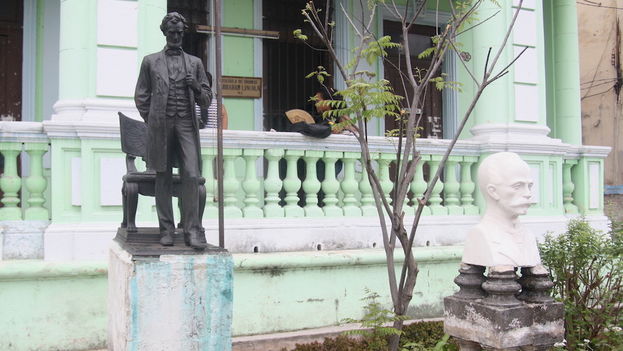
Sculpture of Abraham Lincoln at the most popular language school in Havana. (14ymedio)

14ymedio bigger14ymedio, Orlando Palma, Havana, 29 April 2015 – The high demand for foreign language instruction in Cuba in recent years has forced the Ministry of Education to augment the requirements for access to language schools. Resolution Number 75 of 2015, recently published in the Official Gazette, regulates entry to these schools to people over 17, prioritizes workers, and limits students to studying one language at a time.

The regulation establishes that students who want access to this variety of adult education must have completed at least the ninth grade in high school. Only through special exceptions will the schools admit “housewives, retirees, other students in senior high schools or universities, or those not working for the social-economic interests of the locality and for the creation of an emerging workforce, requiring language school training.” continue reading

To the new restrictions is added, however, the flexibility to open language classrooms in workplaces. With previous authorization, there may also be specialized training courses for people who will be serving on missions of cooperation in foreign countries.

An official from the Ministry of Education who preferred to remain anonymous said that among the motives for making the entry requirements stricter is that a large percentage of the students “end up emigrating and taking with them the knowledge that has been given to them at a very low cost or, in most cases, for free.” He explained, “We need to bring language learning to people who are going to use it in the local economy.”

None of these measures directly affect private sector instruction in foreign languages, although they could benefit from a greater influx of students who no longer meet the requirements to enroll in state schools.

Making a Living From Trash / 14ymedio, Victor Ariel Gonzalez

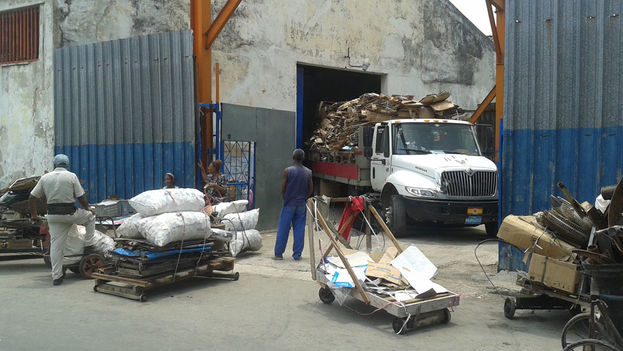
Collection point (14ymedio)

14ymedio bigger14ymedio, Victor Ariel Gonzalez, Havana, 1 May 2015 – They appear silently, without anyone taking notice, a little after dawn.  They will not hide again until nightfall, when they return home or camp out in some corner of the city to count their profits.  They used to be called “divers,” not without a certain disdain; now, the activity is gaining organization as well as workers.  Without the collectors of raw materials, Havana would be an even dirtier city.

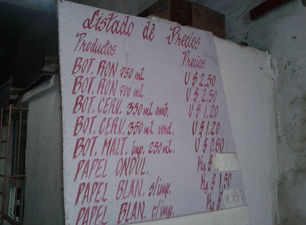
Jesus is one of them.  Dragging a mountain of cardboard pieces on his cart, he goes to a buying house with the merchandise acquired today.  For each kilo they pay one peso and 20 cents, but sometimes he gets other material – pieces of aluminum or bronze – and they pay him more.  “It all depends on knowing how to search,” he says.

At Benjumeda and Retiro Streets in Central Havana is one of the warehouses where the collectors go to patiently wait their turn in line.  Each one carries the merchandise however he can, whether in a street sweeper cart or a trailer hitched to a car, a luxury, this latter one, uncommon in the business.  In Cuba, gathering rubbish is a job like any other, because it barely provides enough for survival. continue reading

Around the recycling industry there has been created a whole network of private workers who play various roles.  The “buying houses” can be individuals, like the one at Belascoain and Santo Tomas Streets, next to another state collection warehouse.  The difference between the two may be, for example, that in the private ones they also buy the imported beer bottles that no other site accepts.

With the unveiling of the private sector came the legalization of this kind of job.  The trash collectors must pay around 30 pesos a month for their license, in addition to social security.  Their tax system does not include the obligation to present a sworn statement, explains Jesus while he waits for another truck.  The one that was there has just left completely full.

But there are also workers who operate without authorization, as an extra job.  They see trash in the street, pick it up and discreetly put it in a little bag.  “Are you going to throw that out, sir?”  they ask when a neighbor approaches the containers at the corner of his house with a box of empty bottles.

The illegals must always be careful about the police, but the legal ones also are harassed sometimes, above all if their presence coincides with an important event in the city and it is not “proper” for them to be in the streets, wandering and ragged, because they “mar” the environment.

The official media estimate that 430,000 tons of trash is recycled each year, which means a savings of 212 million dollars for the national economy.  Sixty-four percent of the collection – which includes a first cleaning, sorting and transporting of material to the collection point – is achieved thanks to the army of individuals who roam the streets.  They see an empty can, they pick up an empty can.

Prices for trash (14ymedio)

Those in line at Benjumeda think that figure falls short, and they accuse the State of barely employing a few trucks and waiting, while they bring everything.  “We must really account for 80 to 90% of the total gathered,” estimates the driver of a Fiat who pulls a small trailer loaded with pieces of stainless steel and who clarifies that he does not regularly devote himself to recycling.

“In the Carlos III [shopping center] they do it, but I don’t know anywhere else like this,” says a young man referring to the small raw materials warehouse located next to the crowded store.  Some more warehouses exist, but not many.  Big Havana stores have one or another hidden space dedicated to accumulating the boxes, now empty and disassembled, awaiting transport.

“Those in charge of doing it don’t pick up the trash on time,” according to a recent television report.  The official report said that “in most cases there is no control over the contracts, there is a lack of stringent performance among the involved parties, there is slowness to approve cancellations of resources and equipment, and they do not fulfill delivery plans.”

“Big enterprises have to deal with their own rubbish and finance the process with their own resources,” the report specified.  Thus, the private sector demonstrates a management capacity superior to that of the State, working on a smaller scale.

The deficiencies, therefore, exist at an institutional level.  In Cuba the infrastructure for the treatment of trash is insufficient.  Dumps are lacking – those that exist still do not use any system for sorting wastes – and transportation is scarce.  Also, there is a lack of industrial interest and of exportation of re-useable material.

All these conditions mean that there is not an effective collection system, and trash accumulates on the corners.  Fires are frequent, and the micro-dumps constitute a serious sanitation problem, which is aggravated in the poorer neighborhoods, where service is even worse than in the downtown and tourists areas.

Although these problems have been recognized by the authorities, no measure has been announced to address trash collection via a coherent state policy.

Meanwhile, it is possible to see gatherers working at dawn, after each important event that attracts the public and generates a lot of trash.  Without a contract, without security for the dangerous circumstances or other conditions of their work.  That is how it works, the silent army that lives from the trash of others.

Translated by MLK

They Didn’t Let the Rain “Rain on the Parade” / 14ymedio, Eliecer Avila

American students marching in Havana's May Day parade (Luz Escobar/14ymedio)
American students marching in Havana’s May Day parade (Luz Escobar/14ymedio)

14ymedio bigger14ymedio, Eliecer Avila, Havana, 1 May 2015 – Right now in the City of Havana, especially in the neighborhoods, families and individuals with fewer economic possibilities are living through hard times. Downpours, normal enough in many capitals in the world, take on a different character here.

A few days ago many were clamoring for a few drops of water to ameliorate the unbearable heat. But when you live with the danger of the roof falling in on you, desires are confused and you end up preferring to sweat.

I know exactly what it means to sleep with fear. I spent my childhood, teenage years, and early adulthood sleeping in a bed-hammock with my grandmother and my first cousin. At the least downpour, the power went out and with the boards creaking, the house moved as if dancing with the wind. continue reading

Mima went down on her knees on the ground and began to pray, which made Carlitos and me more nervous. The gaps in the thatched roof let all the water through and we had to seek out each drip with a candle and put pots, jugs, cups and whatever receptacle we had to protect the little display cabinet, the Caribe television and the mattress.

The worst of it was that not only water fell from the roof. Scorpions, spiders, cockroaches and ants, feeling threatened by the thunder and rain, slipped out of the walls, rushed under the doors or fell on our chests as we were trying to get back to sleep.

At five in the morning, after a sleepless night, Mima would try to light some damp coconut shells to brew coffee over a wood fire, whose ashes we used on our toothbrushes many times instead of toothpaste, which was a luxury at one time…

How many grandmothers watch over their sleeping grandchildren while it rains, trying to hold up the walls with their faith

Under these conditions, Mima raised us two grandsons, having also raised as good people our parents, working like a mule, although ill, for 110 Cuban pesos (roughly US$5.50) a month. No one is going to convince me today that my grandmother is not a true heroine.

Today she continues to live under these conditions, after a lifetime devoted to family, work and the Revolution. After a year of efforts at every level at the Ministry of Agriculture to approve the paperwork that would allow us to start building a small room on the ground where she has been living for more than 60 years, through her own efforts, we carried on without authorization. And they say that delay…

I think of my grandmother when I hear the news of building collapses in Havana. How many like her will watch over their sleeping grandchildren while trying to hold up the walls with their faith.

While floods ravage Havana, those directly responsible for the misery that prevents so many families from repairing their houses; the creators of a system that slowly demolishes every trace of beauty, comfort and dignity, it doesn’t even occur to them to appear on TV lamenting the loss of three Cuban lives that are added to so many others. On the contrary, with their harangues, and the excitement of the celebration, they show their lack of respect for the pain of the families who are mourning today.

Those directly responsible for the misery don’t even think of even appearing on television to lament the loss of three Cuban lives

The official press barely mentions the names of the deceased, as if they were potatoes, at the end of the newscast. In all honesty, they dedicate more broadcast time to potatoes.

Nothing can tarnish the brilliance of the parade, one old woman more or less. What matters is that the world sees Cubans making fools of themselves disguised as a victory that breaks all the Guinness Records for the absurd.

The State announced that it was calling into service more than 3,200 buses for the parade, including 78 damaged by the rains that were repaired in one day for the occasion. It seems that not a single journalist in Cuban has investigated the costs of these events and of how much progress could be made in repairing homes and building infrastructure with those resources.

Surely those interested in organizing the May Day celebrations don’t have to worry about their families, their homes, or many other things missing from our national daily life that have already been forgotten as the decades pass.

I just hope that this time, the General didn’t ask for the earth to tremble.

A Math Test Shielded Against Fraud / 14ymedio, Zunilda Mata

Students waiting to access the admission examination in mathematics at Havana’s José Miguel Pérez High School. (14ymedio)

14ymedio bigger14ymedio, Zunida Mata, Havana 28 april 2015 — “This is more protected than Plaza of the revolution,” a teenager joked this Monday just before sitting down for the math test for college admission. Yesterday, dozens of schools across the country held the difficult test to enter higher education. The rigor of the evaluation content has increased this year, after a string of cases of fraud that marred last year’s test.

The National Committee of Admission and Job Placement of the Ministry of Higher Education made a prior call for “discipline, punctuality and rigor” in order to carry out the process of University admission. This time, control measures have also been reinforced to deliver and protect the sheets containing the admission exams. “The chain of custody has been guaranteed,” a teacher boasted this Monday outside Old Havana High School as she answered the questions of curious parents who gathered at the site in the early hours of the morning. continue reading

Rigor has not only been expressed in greater control measures for the distribution of the exams but also in the difficulty of the tests. “They made it a difficult test,” complained a young man at the exit; for him the “math problems were complicated and the equation questions had some kind of trick.” In conversation with 14ymedio, several students expressed their suspicions that the complexity of the examination was intended to serve as a “warning” so that last year’s irregularities wouldn’t happen again.

The Municipal People’s Court of Marianao imposed, last November, heavy penalties for those responsible for leaking tests in the process of higher education admission for the academic year 2014-2015 in the province of Havana. A similar event happened at the Faculty of Medicine of Santiago de Cuba, where second year Anatomy and Statistics tests were leaked along with the fourth year English test and the well-known state test that all sixth year students must cope with.

Teachers and methodologists involved in the scandal were sentenced to from 18 months up to 8 years in prison. During the police investigation, it came out that several of these teachers trained groups of students, without legal authorization, based on the leaked test questions. The figure of the tutor – a teacher privately contracted by families, outside of the schools – has become famous in Cuba to prop up the deterioration of teaching quality in the schools themselves. 

The figure of the tutor – a teacher privately contracted by families, outside of the schools – has become famous in Cuba to prop up the deterioration of teaching quality in the schools themselves.

The events led to a new math test held on May 6, 2014, to the modification of the Spanish and history tests and to the “extraordinary repeat test for these three subjects,” as Granma newspaper explained at that time. Repeating the state test and the indefinite invalidation of the diplomas of the medical students involved in the leaking also occurred in Santiago de Cuba.

In order to avoid the repetition of such incidents in yesterday’s math exam, examination sheets were distributed to officials and managers during the weekend in sealed envelopes, requiring a signature to open them. “This year we have managed to avoid that teachers have prior access to questions; only school principals and heads of Departments are allowed to handle the exams”, assured a methodologist from the Playa municipality.

The official press echoed the words of René Sánchez, President of the National Committee on Admission and Work Placement of the Ministry of Higher Education, for whom the current round of testing is characterized by “transparency” and “purity.” As the official explained, we should now add that there is no access “to the fraudulent” in the slogan “The University is for Revolutionaries.”

This year, the majority of university openings correspond to medical, pedagogical, technical and agricultural majors. High School graduates compete for a total of 57,375 spaces in daytime course options and the so-called “encounter courses” – that is courses where students attend classes. Although there are more places than students for the examinations, much of what is offered is not of interest to young people. The pedagogical and agricultural careers are considered among the worst and students foresee them as a road to sacrifice with low wages and little social recognition.

In a few days, once the results of the tests are published, students may request a requalification process of a review of their scores.

The Spanish examination for University admission will be held on 30 April, and on May 4 that of Cuban history. In the meantime, the repeats for all these tests will take place between June 18 to 24.

Translated by Alberto

Book Fair Falls Short of Expectations / 14ymedio, Yosmany Mayeya Labrada

Zuleica Romay, President of the Cuban Institute of the book, writing a message against gender-based violence. (Y. MAYEYA)

14ymedio bigger14ymedio, Yosmany Mayeya Labrada, Santiago de Cuba, 28 April 2015 — The 24th edition of the Santiago of Cuba Book Fair did not meet official forecasts, nor was it up to the celebrations for the 500th anniversary of the foundation of the city. In the event, which closed its doors last Sunday after five days of activity, 85,000 books were sold. Between 250,000 and 300,000 people attended the reading fair, despite the high prices and the narrow range of titles on offer.

The authorities of the Cuban Book Institute (ICL), however, defined the fair as a success. “We are succeeding in having each event resemble the territory where it occurs, with the provinces leaving their cultural imprint on the fair and writers feeling more at ease to interact with their readers,” said Zuleica Romay, president of the organization. continue reading

Ramon Alvarez Cortés, President of the Organizing Committee of the fair, also spoke of an “excellent, successful and wonderful” event. His opinion, however, contrasts with that of readers such as Moraima Lescay, resident in the municipality of Palma Soriano, who complained of not being able to buy the textbooks she was looking for because they ran out in the first two days of the fair. To this Santiago resident, children’s texts were at “unaffordable prices” relative to wages.

Among the youngest, there were more positive reviews. Javier Méndez, a young man from the María Rafael de Mendive high school, for example, said he was “satisfied” with this event and considers it as “the best edition in the relation to the past”. According to the young man, this time “there was more variety in the books” and he could even buy at an affordable price the three volumes of “One thousand and one nights,” in an adaptation of Oriente Publishers.

Some participants regretted that children’s texts were “at unaffordable prices” relative to wages.

Ideology and politics monopolized much of the presentations. During the last days, they launched books like Palomas Blancas (White Pigeons) by Ramón Labañino and Enigmas y otras conversaciones (Enigmas and Other Conversations) by Antonio Guerrero, two of the five spies who returned to Cuba in December of last year after being imprisoned in the U.S.

Another title put forward at the fair was Estados Unidos: El precio del poder (The United States: The Price of Power), written by the son of the Cuban President, Alejandro Castro Espín. However, the public better valued the texts of the national award winners Leonardo Acosta and Dr. Olga Portuondo Zúñiga, to whom this fair was dedicated.

Portuondo Zúñiga said she was surprised by the number of people at the provincial events, from Pinar del Rio to Santiago de Cuba, and said that she will continue writing “for a growing audience.”

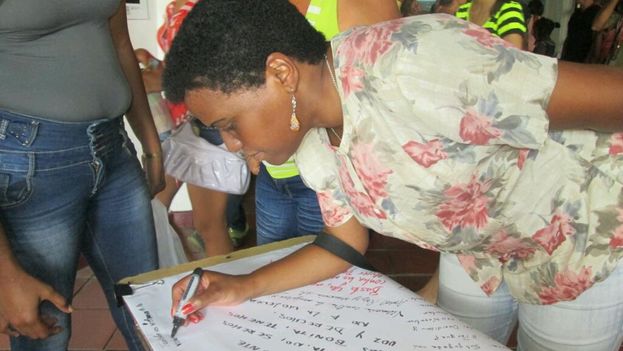
On Sunday, the last day of the Book Fair, there was a clear denunciation of gender violence. On the so-called Orange day, various initiatives, organized with the support of specialists from the United Nations, warned about the physical, sexual and psychological harm or physical suffering caused by acts of aggression against females.

The presence of Zuleica Romay contributed to the visualization of a problem affecting Cuban society, although there is little room for it in the media.

Ideology and politics monopolized much of the presentations

More than one hundred people wrote and signed messages rejecting violence against women. Romay, for example, explained that a victim of violence is also someone who grows up in it and then reproduces the violent behavior: “Let us give love to our children so that they can give love when they are older,” he added.

A professor of psychology at a university in the eastern part of the country, who attended the meeting, said that Santiago de Cuba is one of the provinces with the most cases of this kind of violence and that in the last two years about ten women have been killed for this reason.

The fair featured, for the first time, an exhibition area dedicated to the United Nations. From the 22nd to the 26th of April, readers had access to several publications of this organization and its regional specialists. Between the texts and multimedia which were presented, some also reflected on the situation of the city after the passage of Hurricane Sandy and the long process of recovery that they have been undergoing.

Translated by Alberto

Lowering the price of milk does not satisfy buyers / 14ymedio, Rosa Lopez

There is more rum than milk in Cuba (14ymedio)

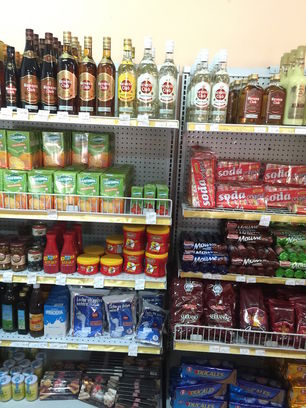
14ymedio bigger14ymedio, Rosa Lopez, Havana, 28 April 2015 – In Cuba it is cheaper to buy a liter of rum than a kilo of powdered milk. Ever since convertible currency stores appeared in the nineties, people have been demanding price reductions for basic products. In its Monday edition, the Communist Party newspaper Granma announced a price reduction for powdered milk, but the measure has not been met with the satisfaction the authorities expected.

The new measure reduces the price of kilo of powdered milk by 15% in the hard currency stores. Now a kilo (2.2 pounds) costs 5.50 or 5.75 convertible pesos (CUCs), and a half kilo cost 2.90 or 2.80, depending on the quality of the container. The reduction, which went into effect on April 24, ranges from 0.45 to 0.85 CUC per packet, and is derived from “updating import costs,” according to sources at the Ministry of Finance and Prices. continue reading

The price adjustment benefits only the small sector of Cubans who can afford to pay the equivalent of what the average worker earns in four days for this product. Everyone else has to abstain from drinking milk or resort to the black market, where it is sold for a little less than half the official price.

In the store attached to a gas station located at the corner of Boyeros and Ayestaran Streets, several customers browsed on the Monday of the publicized price reduction, which so far has not set off any buying frenzy. The parishioners were wary and disappointed by how small the price reduction was for this basic food.

“What they have done is to return to almost the same price they had before the last year’s huge price increase”

Caridad Rojas has twin three-year-olds and the milk quota assigned to them in the ration market isn’t enough. After reading the note in Granma, she went to the closest store to buy milk at the new prices. “The truth is, what they have done is return to almost the same price from before last year’s huge price increase.”

The unpopularity of the measure adopted in 2014 could be one of the reasons the authorities decided to lower the price of the product. “They greatly reduced sales with the increase in prices, so in the end the State ended up losing money,” said an employee at the Carlos III commercial center, one of the largest supermarkets in Havana.

Meanwhile, milk continues to be distributed in the usual way to children under seven and to patients prescribed special diets at subsidized prices in the ration market. The rest of the buyers will confront the prices of the “hard currency” stores, where they can also pay in national pesos at an exchange rate of 1 CUC to 25 CUP (Cuban pesos, or “moneda nacional” – national money).

New Stoves and State Policies / 14ymedio, Victor Ariel Gonzalez

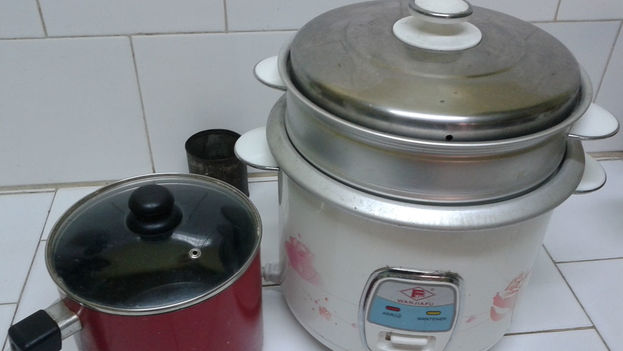
Saucepan and rice cooker in Cuban kitchen

14ymedio bigger14ymedio, Victor Ariel Gonzalez, Havana, 24 April 2015 – She didn’t have any luck. Like many, Estrella is one of those Cubans who faces the difficult task of feeding her children today without being very sure of what she will feed them tomorrow. Even still, hers is a family that is not classified as being in need of social assistance; thus, they will not receive any help from the State to buy the new induction stovetops that will go on sale “in a few days.”

This week it was announced that very soon everything will be ready to start the sale of this new kitchen equipment along with other items – a lidded pot, frying pan, pitcher and coffee pot – to the nearly 80,000 nuclear families who receive government assistance. The official media assures that, “the conditions have already been created in the stores of the special program network, belonging to the Ministry of Domestic Trade.” continue reading

The conditions include 257 “adequately equipped” workshops to repair the equipment, which carry a three-month commercial warranty. It has also been made easier for the vendors to pass “a training course” to connect the equipment and test it.

The plan has been designed to reduce energy consumption in the residential sector; induction stoves are up to 75% more efficient than resistance stoves, according to the concerned authorities, and, they add, they are easy to use, provide comfort and are more durable.

Behind this decision is none other than the Council of Ministers, whose policy has been responsible for other “bold moves” such as the unrationed sale of liquefied gas in various parts of the country “as an experiment.” Also, since 2014, and thanks to the “Food Cooking Program,” it is possible to buy home appliances through bank loans. In effect, the question of cooking in Cuba is a matter of State.

Estrella was one of those who bought her rice cooker on credit. Of the 7,800 who applied since the beginning, 7,355 have been approved and 5,828 delivered – at a cost of 15 million pesos* – among which we find hers.

In effect, cooking in Cuba is a matter of State

However, it wasn’t totally easy. First, because this pharmacy employee doesn’t earn enough wages for the bank to have confidence she can make on-time payments for her rice cooker. As in capitalism, lending to individuals in Socialist Cuba involves a risk analysis that weighs an individual’s ability to repay the debt.

Secondly, because she wouldn’t have been able to afford it without the help of some family members. But Estrella needed the pot, even though she would have to sell more medicines under the table than usual.

The issue of subsidies granted by Social Assistance is a delicate one. The form of payment with respect to the appliances that will soon be sold has not been completely defined, except that the acquisition of the stoves could be fully or partially charged to the State.

The Ministry of Labor and Social Security (MTSS) has declared the Provincial Administration Council is “the collective body that approves the sale of these stoves and decides which method of payment will be applied” in each case. To accomplish this they will work on standards for “socioeconomic assessment.”

Yusimí Campos, an official with MTSS, informed the national media that, among the families not benefitting there are also those “who cook their food with other services such as manufactured gas, liquefied gas or (…) those who live in remote areas and who have no electricity service.”

Estrella, who has piped gas in her Central Havana apartment, will have to wait a while to acquire a modern stove. Meanwhile, she has to finish paying the bank for her Chinese made Haier refrigerator. The last thing Estrella wants is another debt. And with regards to food, “something will come up,” she says, while showing a small reserve of eggs and rice that keeps her calm, at least for now.

*Translator’s note: Roughly running the math on these numbers gives the price for a rice cooker as somewhere between $80 and $100+ dollars. This is for an appliance that sells in the U.S. (looking at the one in the photo) for plus-or-minus $20. In other words, the government “loans” Cubans as much as six months wages, so that they can purchase one rice cooker.

Linksys negotiates the sale of wireless routers in Cuba / 14ymedio

You cannot get a wireless router at state owned stores (14ymedio)

14ymedio bigger14ymedio, 24 April 2015 – Linksys, the American company that makes routers for home networks and small businesses, announced on Thursday that it is negotiating with the United States Department of State and other authorities to receive the necessary directions that would allow it to distribute wireless routers in Cuba. Its intention, as affirmed by the company through its vice president of product management, Mike Chen, is to help overcome financial and technological obstacles that currently prevent expanding Internet access in the country.

“Now that we are celebrating this milestone, we must also remember that our work is not finished. Along with the launch of the #LinkYourWorld company, we have set out the objective, together with our business partners, to better connect the Cuban people to one another and with the rest of the world,” said Chet Pipkin, the CEO of the company. “This is our opportunity to promote the development and growth of Cuba. We believe that recent political changes make this effort more viable, and we look forward to working with our partners in the industry and with government officials to achieve this important goal.” continue reading

The company plans to take the lead in connecting Cuba, taking the LinkYourWorld campaign worldwide. The worldwide promotion will contribute to educating people about the value and significance of internet access in daily life at home, at work or on the go. Linksys plans to introduce programs and interactive content on its website and its pages on social networks, as well as in stores and value added resellers.

The announcement was made in a press conference celebrating the hundreds of millions of routers sold around the world, a milestone achieved by the California Company that took its first steps in 1999.

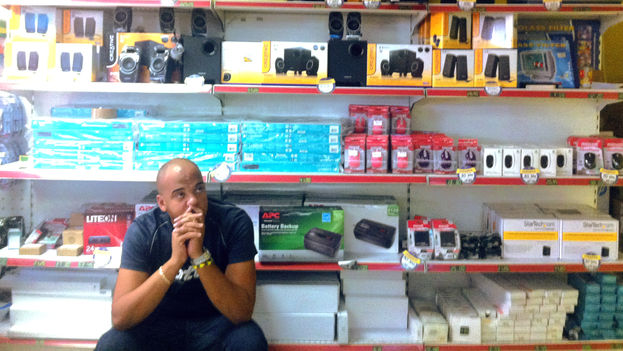
In Cuba the only way to get a wireless router is in the black market. The price is around 100 CUC (convertible pesos, roughly US$110).

Translated by Alberto

Corruption and its Three Enormous Harms / 14ymedio, Carlos Alberto Montaner

Protest against corruption in Spain (Flickr/CC)
Protest against corruption in Spain: “They don’t govern, they steal!” (Flickr/CC)

14ymedio bigger14ymedio, Carlos Alberto Montaner, 25 April 2015 – Mexico and corruption are two words that always go hand in glove, or as the Columbians mischievously say, “grab each other’s peepees.”

Corruption in Venezuela is greater, and that of Argentina is not far behind, according to Transparency International, but to judge by what is happening in Chile, Brazil and Cuba, it seems to be a bad Latin American epidemic.  The continent, with few exceptions, is a pigsty.

In any case, the Mexican government wants to end corruption. It was about time. Is that possible? When did it start? They tell you, laughing, as soon as you set foot in the country.

The Spanish conquistadors tortured Cuauhtemoc, the Aztec chieftain, to make him reveal where he hid the gold: continue reading

“Tell me, you damned Indian, where the gold is,” screamed the torturer, through the interpreter, while he burned the hands and feet of the warrior prince.

“I’ve told you forty times that it is buried 50 steps from the pyramid, under the palm tree,” screamed Cuauhtemoc, writhing in pain.

“He says he does not know, and that if he did know, he would never tell you,” translated the interpreter, secretly rubbing his hands together.

It all started there. Right at the beginning. The confusion between public and private is in Latin America’s DNA and in that of three quarters of the planet. They gave Hernan Cortez a tribute of 20,000 Indians as a reward for the conquest of Mexico. Then they took them away, and the fierce captain ended up in Europe, poor and angry, unable to forget the scorching odor of burned flesh.

Some cynics and pragmatists – sometimes they are the same – maintain that corruption is a form of wealth redistribution and income growth, designed to stabilize society through a web of interests and complicities.

I do not believe it. The harms that unpunished corruption causes are usually devastating. Let’s look at just three from an infinitely greater list.

First, it rots the essential premise of the Rule of Law, making a lie of the principle that everyone is subject to the authority of the law. If the politician or the civil servant steals with impunity, or receives bribes for granting favors, why is the common citizen going to pay taxes?  What stops him from lying or cheating?

The law establishes that it is a crime to sell cocaine and also to seize public property.  Why not sell cocaine if others embezzle the national treasury with impunity?  Why not rob a bank?  What moral difference is there between stealing from everyone or stealing from a business or an individual person?

Second, it distorts and inflates the whole economic process.  The market economy is based on free competition.  It presumes that goods and services compete on price and quality.  It is the end buyer who decides which businesses succeed or fail.  When a politician or an official favors one business in exchange for a commission, this unholy operation forces the consumer to select an inferior and more expensive option, given that the cost of corruption is added to the prices.

Moreover, corruption eliminates incentives to innovate and improve the quality of the offer, while it notably reduces productivity, which is the foundation for growth.  Why be more productive and lower prices if we have a captive market?  Why design a new and better car if the customer is obliged to buy the usual one?  Sometimes the businesses themselves distort the market by agreeing among themselves to raise prices.  This is another serious form of corruption.

Third, it destroys the ideal meritocratic structure to which all healthy societies should aspire.  It weakens the passion to study and curbs the entrepreneurial impulse. In corrupt societies personal connections prevail.  “He who has godparents gets baptized.”  That is the general order.  Ties are more important than effort to compete in an open and free market.  What sense does it make to burn the midnight oil studying when, in order to enrich yourself, it suffices to pass an envelope under the table of a corrupt official?  Why sweat and toil in the effort to create a successful business if to achieve economic success a combination of personal relations and lack of scruples suffices?

There is no doubt: corruption kills the political and economic system and moral values.  Ask the Spaniards who today walk that dark and uncertain road. Of course corruption is a tendency present in our species. That is known, but it is not a good excuse. Either we fight it and defeat it or it devours us. It is that simple.

Translated by MLK

European Parliament Members call for EU mediation to release Cuban artists from prison / 14ymedio

The vice president of the Liberals and Democrats for Europe Party in the European Parliament, Pavel Telicka. (European Democratic Party)

14ymedio bigger14ymedio, Havana, 24 April 2015 — The vice presidents of the Alliance of Liberals and Democrats for Europe Party of the European Parliament, Fernando Maura and Pavel Telicka, have asked the High Representative of the European Union for Foreign Affairs and Security Policy, Frederica Mogherini, to intervene with the Havana Government for the release from prison of Angel Santiesteban and Danilo Maldonado. In a letter to Mogherini, signed by some thirty Eurodeputies, they also call for an end to the “prolonged confinement” of Tania Bruguera.

In a letter released this Friday, the Eurodeputies ask Mogherini to mediate for the withdrawal of the charges for “counterrevolutionary activities” against the regime opponent Antonio Rodiles and his partner Ailer Gonzalez. continue reading

Maura and Telicka argue that “any step in the advancement of international diplomacy must be accompanied by a demand for a radical change in Cuban policies that restrict freedom of expression and imprison dissidents,” and they demand that respect for human rights “prevails” in relations between the European Union and Cuba.

The graffiti artist Danilo Maldonado, known as El Sexto , has been in prison since last December on charges of contempt and he continues to wait for trial. He was arrested while trying to stage a performance with two pigs stamped with the names “Fidel” and “Raul.”

The writer Ángel Santiesteban is serving a sentence of five years for an alleged crime of violation of domicile. However, activists and independent lawyers have denounced the many irregularities that were brought to bear during his trial.

Bruguera is currently unable to leave Cuba, because she is being legally prosecuted for the events arising from her attempt to organize a performance this last December. Since then, the artist has denounced “a constant psychological war.”

Demographic Enigma / 14ymedio, Reinaldo Escobar

The projected number of young Cubans in 2015 seems to have been mistaken. (14ymedio)

14ymedio bigger14ymedio, Reinaldo Escobar, Havana, 23 April 2015 — The National Electoral Commission recently informed us that 63,441 young people had turned 16 since the previous elections in 2012, which gave them the right to vote on Sunday. However, demographic estimates made in 2006 by the government projected that by 2015, the country would have 275,389 young people aged 17 to 18 years. Where are the 211,948 missing young people?

According to the calculations of the Center for Population Studies, in 2015 Cuba has 138,866 18-year-olds, and 136,523 17-year-olds, totaling 275,389 young people in this age group. That Projected population for Cuba for the period between 2007 and 2015 was published nine years ago. continue reading

Logically, this includes not only those who turned 16 before the municipal elections on 19 April 2015, but also those who were born in 1998 and 1997 who turned, or will turn 17 or 18 in any month in 2015, because none of them had reached age 16 in September 2012 when the last elections were held.

Similarly we also have to add those who were born after September 1996, but who were not old enough to vote in the last election. If we just consider those born in 1997 and 1998, who had not previously been able to exercise the right to vote, the figure of those eligible to vote should be around 275,385 mentioned above. Missing, or having disappeared from the lists, are nothing more nor less than 211,948 young people.

Is it a colossal miscalculation on the part of the National Bureau of Statistics? Perhaps the electoral authorities, who work in coordination with the Identity Card offices, didn’t find these guys, or put them in the wrong account? Or is this number of missing made up of those who have left the country or are in prison?

Most likely we will never know what has happened to these “lost” youth.

Yoani Sanchez: “I am not expecting that Obama is going to demand our rights” / 14ymedio

14ymedio bigger(EFE) Santiago de Chile, 22 April 2015 – Yoani Sanchez said on Wednesday that the normalization of relations between Cuba and the United States gives new hope to the inhabitants of the Island, but stressed that Cubans themselves must exert pressure to demand their rights.

“I am not expecting [US president, Barack] Obama, from the White House, is going to demand our rights, it is up to us,” said the regime opponent and journalist at a press conference in Santiago de Cuba, where she had arrived for a three-day visit.

On the normalization of relations between the two countries, the blogger felt that the United States has made several concessions so far, but the Government of president Raul Castro has been hiding his cards. continue reading

“The issue of human rights and freedoms, such as of the press, has been knocking on a closed door, but we don’t know if the Cuban government is going to cede anything,” she said.

Beyond the scope of the negotiations, Sanchez said that it is a beneficial process because it gives hope and externalizes the “conflict between the Cuban people and the Cuban government,” which, in her opinion, is the real conflict on the island.

“I would like for this process of negotiation to also bring acceptance on the part of the Cuban government of a multiparty system, of the legal existence of independent media, and a commitment not to violate human rights,” the journalist said. She predicted, however, that the regime will cling forcefully to the “absolute control” that it exercises.

On being asked for the reasons of the rapprochement between Cuba and the United States, the regime opponent said that Venezuela’s economic and social crisis is a “determining” factor, due to the economic assistance it provides to the Castro regime.

Sanchez also welcomed the announcement of the trip Pope Francis plans to make to Cuba this coming September, before visiting the United States, and expressed her desire for the Pope to promote “the end of political imprisonment.”