Cuban Customers: Collateral Damage In The Tourism Boom / 14ymedio, Luz Escobar

Cuban hotels have opted to exclude Cuban tourists from ‘all inclusive’ resort deals, because they eat and drink too much. (Emmanuel Huybrechts)

14ymedio bigger14ymedio, Luz Escobar, Havana, 16 February 2017 – In the photo the couple smiles with one glass of beer in hand, all they were able to obtain after waiting in a long line at a Varadero resort. Nine years after the government allowed Cubans to enter hotels in Cuba (a right previously denied them in what was commonly called ‘tourist apartheid’), local customers continue to be discriminated against relative to foreign tourists in the midst of the current boom in tourism.

Eugenia and Guillermo, retirees from the transport sector, are trying to make up for lost time after decades of being unable to enjoy the tourist facilities of their own country. With the remittances sent by their son who emigrated and the profits on a house that they sold a few months ago, they decided to enjoy the natural beauties of the Island and its multiple hotels. continue reading

Nevertheless, the so-called smokestack-free industry is experiencing tense times caused by the increase in the number of foreign visitors. At the end of last year, the country reported a record of more than 4 million tourists, good news for the national coffers but which does not, however, represent a better situation for local customers.

“The all-inclusive was actually rationed. The initial times when you could eat and drink whatever you wanted are now just a memory”

Cuba has more than 65,000 hotel rooms and some 17,000 private houses that provide lodging. The tourist boom of recent years tests that infrastructure and the complaints accumulate, especially with regards to the facilities managed by the state or by joint ventures.

Eugenia and Guillermo were among the first customers to purchase an all-inclusive package back in 2008 to spend a weekend in a four-star hotel near the city of Holguin. They recall the experience as excellent. “It was like living a dream and enjoying what, before, only foreigners could have,” recalls Guillermo.

However, with the passage of time that initial joy was transformed into discomfort. “The prices have gone up and the quality of the facilities has decreased a lot,” comments the retiree. At the end of last year they booked four nights in Pasacaballo, a hotel in Cienfuegos from which they say they left “horrified.”

“The all-inclusive was actually rationed,” says the wife. “The initial times when you could eat and drink whatever you wanted are now just a memory.” Despite having paid for an “open bar,” the Cuban guests found themselves with their food and drink rationed.

For the retirees, that regulation of consumption reminded them of “the ration market bodegas,” they say. “We wanted to escape reality, to disconnect a few days but it turns out that we found ourselves in the same situation we wanted to escape,” Guillermo points out.

In the Pasacaballo restaurant “the main courses are limited,” he clarifies. You can only choose one meat, fish or chicken course. On arrival, each guest received a card that allowed them to consume a maximum of 64 beverages, including two liters of rum for the four nights of their stay.

Not even the Royalton Cayo Santa Maria, with five stars, is immune from these types of restrictions. “We had to supervise the domestic guests better because they were cleaning out the hotel”

The situation is repeated in other accommodations around the Island. Not even the Royalton Cayo Santa Maria, with five stars, is immune from these types of restrictions. “We had to supervise the domestic guests better because they were cleaning out the hotel,” a maid told 14ymedio, on condition of anonymity.

Managed by the Gaviota Tourism Group, a business arm of the Cuban military, special controls are placed on the accommodations of guests from Cuba. “We have lost huge amounts of towels, cups, glasses and cutlery,” complains the employee. She blames “the Cubans who come and do not understand how things work in a hotel, they think this is a boarding school in the countryside.”

“They want to eat at breakfast what they don’t consume in two months at home, so there are many excesses,” she says. “While a Canadian will breakfast on an omelet, a Cuban wants to put a hunk of cheese in their pocket, take twenty servings of bread for their room and carry off all the jam they can find.”

Maria del Pilar Macías, Director General of Quality and Operations of the Ministry of Tourism, told the official press at the end of last year that the fundamental challenge was to achieve a competitive service “without disregarding international standards” based on “quality and innovation.”

In 2014, the influx of domestic tourists to hotels reached 1.2 million guests, an increase of 23% compared to the previous year. On that occasion, the locals spent 147.3 million CUCs in those facilities, according to a report published by the National Office of Statistics and Information of Cuba (ONEI).

The Communist Party has urged in its guidelines “to expand and push the development of national tourism by creating offers that make it possible to take advantage of the infrastructure created in hotels and other recreational and historical tourist attractions.”

Eugenia and Guillermo prefer hotels with managers from another country. “They are much more attentive and do not seem to differentiate in the treatment of national tourists.” In those run by the state and under the control Gaviota the situation is different. “If you’re a national, they leave you with the word in their mouths or with half-service while they run off to look after a foreigner.”

The reason for that difference in the treatment lies in tipping. Although most are all-inclusive accommodations, foreign guests “always leave something,” comments the maid at the Royalton Cayo Santa Maria. Also, according to the employee, “there have been many incidents with Cuban clients who mistreat workers.”

An employee of Cubanacán who manages a tourism bureau at the Hotel Vedado denied that there has been an increase in rates. “We are in high season and prices are rising every year”

Varadero is the main beach resort on the island and Cubans have become the second largest group of guests in the resort, behind the Canadians. “Cuba’s customer today not only goes to standard hotels but also goes to the chain’s highest quality hotels,” said Narciso Sotolongo, deputy sales director of Meliá Hotels International in Cuba.

The Hotel Group Islazul gets the worst comments among islanders. “I dropped something on the floor and when I looked under the bed I was surprised at the amount of dirt,” Guillermo says. The curtains were old, there was no minibar in the room and for several days there was no water in the sink or shower. The manager never showed up for explanations, despite repeated customer complaints.

For the retired couple, the most difficult thing is to accept the price increases. “So before we paid between 70 and 85 Cuban convertible pesos (about the same value in $US) per night with all inclusive; now we can’t find it for less than 120 or 140 CUC,” the woman complains. An employee of Cubanacán who manages a tourism bureau at the Hotel Vedado denied that there has been an increase in rates.

“We are in the high season and prices are rising every year,” she explains to 14ymedio. “Now what is happening is that there is much more demand and the cheaper offers are sold abroad, through the internet and with a credit card.” But Eugenia and Guillermo have never connected to the great world-wide-web and only know about cash.
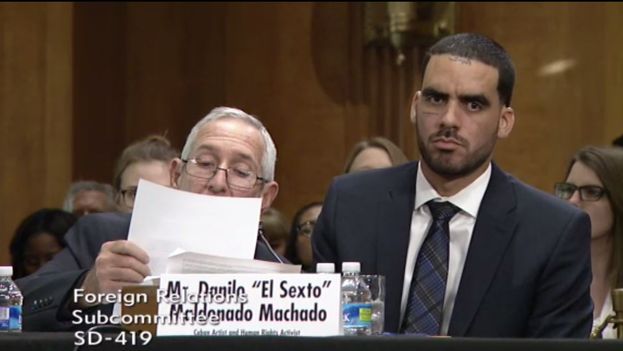

‘El Sexto’ Appears Before US Senate to Speak of Human Rights / 14ymedio, Mario Penton

Danilo Maldonado, El Sixto, appears before a commission of the United States Senate. (14ymedio)

The video of Maldenado’s remarks is here. His prepared remarks begin at 01:18:00, and can be read here in English. He then answers questions at 2:18:31.

14ymedio, Mario Penton, Miami, 16 February 2017 — Danilo Maldonado, El Sexto, a well-known Cuban graffiti artist and human rights activist, appeared before the United States Senate Subcommittee on Western Hemisphere, Transnational Crime, Civilian Security, Democracy, Human Rights, and Global Women’s Issues on Thursday, and called for solidarity with the cause of democracy in Cuba.

“First, we request solidarity for the cause of democracy in Cuba, given that we have suffered a regime that does not allow democratic elections for almost 60 years. The world should give us solidarity and should ask Raul Castro for a plebiscite and democratic elections in Cuba,” said Maldonado in his informal remarks before Marco Rubio, a Cuban-American senator who presided over the panel. continue reading

The artist asked the people and the government of the United States to put pressure on Castro to release the “thousands of political prisoners” in Cuban prisons.

According to El Sexto, 85% of the Cuban prison population would be considered innocent if they had been tried under the laws of democratic countries.

Senator Bob Menendez, also of Cuban origin, asked Maldonado if the US government should put human rights and free elections before further deepening relations with Havana, and El Sexto responded “definitely.”

“If there is someone who does not respect human rights and is complicit in murder, how is it possible that they do not have to appear before a court?” asked Maldonado.

“It does not matter how they can help me, but how they help 11 million Cubans who are constantly trying to escape,” he said.

The artist asked the people and government of the United States to put pressure on Castro to release the “thousands of political prisoners” in Cuban prisons

The artist described the violations of human rights on the island and emphasized the lack of freedoms for artistic creation.

“In Cuba, freedom of speech by artists is prohibited by Article 39 of the Constitution. According to this, “artistic creation is free provided that its contents is not contrary to the Revolution.” This means that the work of artists such as myself and my colleagues Gorki Águila and Tania Brugera, who is critical of the dictatory regime of the Castro brothers, is illegal in Cuba,” he said.

The Cuban Constitution states that “artistic creation is free provided that its content is not contrary to the Revolution.”

The graffiti artist recalled that in 2014 he was imprisoned for ten months for attempting a performance art piece in Havana’s Central Park inspired by the novel George Orwell’s Animal Farm.

“During that time I was tortured physically and psychologically by the dictatorship to the point that I declared myself on hunger strike and even considered the possibility of letting myself die in prison as a result,” he said.

“Until today I have not been served any notice of pending criminal charges nor have I been summoned for any type of trial.”

El Sexto explained that he was imprisoned four times because of the lack of freedoms, the last of which occurred after the death of former Cuban President Fidel Castro last November, when he painted graffiti on an exterior wall of the Habana Libre Hotel. The artist was detained for two months in the Combinado del Este prison on the outskirts of the Cuban capital.

With regards to his graffiti and the call he made through social networks to celebrate the death of Castro, he explained that he did so following the example of Vaclav Havel, the former president of the Czech Republic who had a leading role in the Velvet Revolution that ended with The communist government in 1989.

In the police unit I asked the officer: Do you know me? Have I done something to you? If I have not committed any crime, why do you beat me for my way of thinking?”

“Havel advised all those who, like him, had to live under communist totalitarianism, to Live In Truth. To stop pretending that the reality imposed by the regime by force is genuine,” he added.

El Sexto told the congressmen that once arrested he was beaten and tortured psychologically.

“When in the unit I asked: Do you know me? Have I done something to you? If I have not committed any crime, why do you beat me for my way of thinking?”

According to the artist’s testimony, the officer replied: “the laws support us.”

El Sexto accused the Castro brothers of being “murderers.” He cited as examples the victims of the 13 de Marzo Tugboat massacre, the thousands of executions, and the deaths of Laura Pollán and Oswaldo Payá.

“The Castro have supported guerrillas and dictatorial regimes in different parts of the world,” he said and accused the Cuban government of supporting the dictatorial system of the Chavista regime in Venezuela.

“All Cubans are hostage of the Castro brothers’ regime and the life of all Cubans, particularly artists, opponents, and dissidents, are under permanent danger at the hands of the repressive dictatorship. Once again we need the solidarity of the United States and the support of all people of the world,” he said.

The Student Who Did Not Want To ‘Ride With Fidel’ / 14ymedio, Reinaldo Excobar

David Mauri Cardoso was expelled from the university during a test that did not evaluate his academic knowledge. (Alejandro Tur / Cubanet)

14ymedio bigger14ymedio, Reinaldo Escobar, Havana, 16 February 2017 — David Mauri Cardoso, a 24-year-old from Cienfuegos, dreamt of being lawyer but could not successfully pass a test of dishonesty. In appearance it was a test of Spanish, but what was being evaluated was his capacity to fake it.

Along with 30 other young people, who had not been admitted to higher education through the standard entrance exams, David was part of an experiment where workers were enrolled in the first year of Law School at the Carlos Rafael Rodriguez University in Cienfuegos and then assessed on their knowledge of Math, History and Spanish.

The exams were conducted in January and David was one of twenty students who had made it to the end of the previous stage. He finished high school in 2011, and after several failed attempts to enter the university, this seemed to be his last chance. continue reading

His “incorrectness” is described in the Teaching Regulation of Higher Education, where it specifies “it is a very serious error to say or do anything against the Revolutionary Process.”

Everything seemed to be fine until the first week of February, when they summoned him to a Disciplinary Council. His “incorrectness” is described in the Teaching Regulation of Higher Education, where it specifies “it is a very serious error to say or do anything against the Revolutionary Process.” The punishment established for this behavior is expulsion from the higher education system in any program throughout the country. On Friday, 10 February, the resolution imposing this punishment was signed.

What, in fact, did David do?

The Spanish test consisted of writing an interpretation of a fragment of the lyrics from the song “Riding with Fidel,” which flooded the airwaves after the death of the former Cuban president at the end of November 2016.

David tells 14ymedio how he reacted when he read Question No. 5, which inquired about what he had felt when he honored the ashes of the historic leader of the Revolution. “I realized I was not in a position to fully respond, because that wasn’t the case for me. The question was based on an erroneous supposition, because I had not participated in the acts of homage to Fidel Castro, nor did I personally honor him in a spiritual way.”

Before the exam, he had prepared himself to identify a simile or a metaphor and felt capable of parsing a text to indicate subordinate or juxtaposed sentences and to call out with precision grammatical mistakes in any verb. But, he said, “To adjust to what they were asking me I responded with total honestly about what this person had meant to me. I was respectful because no one has the right to insult others. I gave my opinion in the framework of good manners.”

David recorded in his own handwriting the misery, the destruction of the foundations of society and the injustices. He dared to use the term “authoritarian” to define the established system in his country and at some point, without his pulse trembling, he wrote the word “dictatorship.”

“In short, I only offered my personal opinion, which is exactly what they asked of me,” he says with the simplicity of one who does not believe he has performed a historic act.

The person in charge of grading the exam must have felt very troubled in the face of such a demonstration of sincerity. David chose not to name names, his Christian ethics precludes it. Nor did he mention the identity of a Spanish-language methodologist at the provincial level who is, at the end of the day, the person who assumed the responsibility of lodging a complaint.

Here, the young student makes a legal argument. “This exam, more than a private text, was a confidential document. Something between the professor and the student that did not have to be sent on under any circumstance.”

In the sacred intimacy of the classroom, he offered his opinion, which was what was asked of him. Without his consent, his responses were “elevated” and analyzed under extra-academic rules

And therein lies the key, because David did not make statements to foreign television, nor did he publish an opinion piece in the independent press, nor did he go out into the street with a poster, all of which would have been his right.

In the sacred intimacy of the classroom, he offered his opinion, which was what was asked of him. Without his consent, his responses were “elevated” and analyzed under extra-academic rules.

Not a single one of David’s classmates was consulted on this sanction because according to the regulation that ordinarily requires a process that does just that, it only applies to “regular” students in the day course.

Now everything is “comments in the hallway” and no one will come to his defense.

David says he does not intend to appeal, although he explains: “I have not resigned formally because I still have time, but I lost interest because, when I think of appealing to the Minister of Higher Education, I wonder who this official answers to and it makes me feel like not even starting the process.”

To the question of what he intends to do with his life now, David jokingly replies: “What I was doing: inventing,” that is figuring out some way to get by, “like all young people do in Cuba.”

Havana’s Archbishop Asked Cuban Government “To Sit Down And Talk To The Opposition,” Says Berta Soler / 14ymedio

The Archbishop of Havana, Juan de la Caridad García Rodríguez. (EFE)

14ymedio bigger14ymedio, Havana, 16 February 2017 — Berta Soler, after meeting this Wednesday with Archbishop of Havana Juan de la Caridad Garcia Rodriguez, said that he has offered his full support to the Ladies in White and that the prelate told her he had asked the Government to sit down and talk to the opposition.

“We ask the Catholic Church to speak out, because whoever is silent supports [the government], and he said to me: ‘No Berta, silence is not always support. We have asked the Cuban Government to sit down and talk to the opposition, but what we say is one thing and what they do is another,” Soler told 14ymedio. continue reading

Soler, the leader of the Ladies in White, and Maria Cristina Labrada, a member of the organization, met with Juan de la Caridad Rodriguez early Wednesday morning and the Archbishop told them that that during the trip from their Lawton headquarters they were “monitored by a large operation made up of the National [Revolutionary] Police and State Security.”

According to Soler’s account, at the meeting the Archbishop was “very receptive” to the movement’s complaints, and they explained to the prelate how they are systematically prevented from reaching the church to attend mass and are victims of abuse such as thefts and fines for “violating the security cordon of the Communist Party of Cuba” when they leave their homes.

“We were able to give him some names and surnames of those who have told us that we could never go to mass at any church,” she added.

María Cristina Labrada and Berta Soler received from the hands of the Archbishop “a family Bible with a dedication for each of us,” and they gave him “a CD and two reports with evidence of repression” suffered by the women’s movement and their families. Both left the door open for a future second meeting.

Juan de la Caridad García Rodríguez was named Archbishop of Havana in April of last year after Pope Francis accepted the resignation of Jaime Ortega and Alamino who retired, as established by the Code of Canon Law, after having reached the age of 75.

A few weeks after taking office, Garcia Rodríguez generated a bitter controversy in declaring that he did not want Cuba to “have capitalism or anything like that, but that socialism should progress” to go “forward in a just and balanced society and one of brotherhood.”


Birthrate Is Not Just a Matter of Resources / 14ymedio, Marcelo Hernandez

Mothers who return to work after 18 weeks of maternity leave will receive, in addition to 100% of their salary, an extra provision of 60% of their pay. (Priscila Mora)

14ymedio bigger14ymedio, Marcelo Hernandez, Havana, 15 February 2017 — Concerned about low birthrates, this month the Government has launched a campaign focused on fertility and a package of measures to stimulate births of two or more children per woman.

Since 1978 fertility rates have declined throughout the Island, dropping below population replacement levels. By 2050, the country will rank 9th in the world for elderly population. The aging demographics will exacerbate the lack of economically active people.

The new regulations to stimulate birth, made widely known by the paper Gaceta Oficial (Offical Gazzette), are composed of two decrees and four resolutions. These measures include the paid participation of family members in the childrearing process. continue reading

“Now my mother will be able to stay home with my daughter while I go to work,” says Sahily Cuevas, mother of a four-month-old baby and an employee of a Cooperative of Credits and Services in the municipality of Güira, Artemisa.

The discount of 50% on subsidized childcare rates for parents of two or more children can help “the poorest families,” especially in rural areas.

The grandmother, employed in the State Gastronomic Network, will receive 60% of her salary as a social benefit, a benefit that up until February was only available to the father of the child. It is true, however, that this payment is equivalent to $11, the price of three packs of disposable diapers.

The majority of women surveyed point to lack of resources as the main cause for postponement or interruption of a pregnancy. In the period between 2006-2013, birth rates rose from 1.39 children per woman to 1.71, but that figure should reach a minimum of 2.1 to get out of the red zone.

“I would not dare have a second child,” exclaims Tahimí, 27, resident of Aguada de Pasajeros. “The list of necessities to have a baby is so long that the extra money will be like a drop in the ocean, it will serve very little use.”

The women believes that the 50% discount on subsidized childcare rates for parents of two or more children can help “the poorest families,” especially in rural areas. With the third child the family will become exempt from payment, a benefit extending to couples that have multiple deliveries at once.

Returning to work after giving birth has also received new stimuli. Mothers who return to work after 18 weeks of maternity leave will receive, in addition to 100% of their salary, an extra provision of 60% of their pay, from three months to one year after giving birth.

The private sector, with more than half a million employees in the country, has also received a reduction in monthly taxes for self-employed workers with two or more children under 17 years old. But the labor demands in private businesses leave little room for women to take a more extended family leave.

“I would not leave from here because they would replace me and this is my family’s livelihood,” comments an employee of La Mimosa, a restaurant in Chinatown in Havana. “There is a lot of competition and getting pregnant is the same as being left out,” adds the employee, who chose to remain anonymous.

Maipú, 21, has had four abortions. The first two with the technique of menstrual regulation performed on an outpatient basis that does not require anesthesia. For the last two she entered an operating room where they used the technique of scraping, known as curettage. The young woman refuses to have children at the moment.

“I live with my parents and my grandparents, as well as my two brothers,” she says to 14ymedio. Housing problems are the main cause for postponing motherhood, but she also has her eyes set on emigrating. 

The director of the Center of Population and Development studies believes that “social processes like female emancipation” also influence in the decision to push back maternity.

In recent years, without publicly announcing it, the Ministry of Public Health has restricted abortions. “Now the requirements to receive an abortion are stricter,” says a nurse of the Obstetrical Gynecological Hospital, Ramón González Coro. The employee believes that “it is difficult to complete all the paperwork in time for a menstrual regulation technique or an abortion.”

However, the informal market has also flourished in that field. Maipú paid 50 CUC for her last abortion. “I did not have much time because I was already at 12 weeks,” she recounts. She spent the equivalent of a doctor’s monthly salary. There was no record of her procedure on her medical record.

The director of the Center of Population and Development Studies, Juan Carlos Alfonso, has tempered the weight of the economic crisis and immigration in the rejection of pregnancies maintained by Cuban women. For the specialist, “social processes like female emancipation “also influence in the decision to push back maternity.

A 2009 fertility survey by the National Bureau of Statistics (ONEI) found that 21% of women aged 15-54 had experienced at least one pregnancy that ended in intentional abortions. Eighty percent of the population reported having used contraception.

“Obtaining one visa is not the same as obtaining two,” affirms Maipú in a pragmatic tone. However, she acknowledges that she has always wanted to “be a mother and have many children running around the house.”

Translated by Chavely Garcia.


Extortions, Kidnappings And Limbo: Daily Life Of Cubans Stranded In Mexico / 14ymedio, Mario Penton


14ymedio bigger14ymedio, Mario Penton, Miami, 14 February 2017 — Hundreds of Cubans were stranded in Mexico after the Obama administration ended the wet-foot/dry-foot policy that favored Cuban’s immigration to the United States, but for the 90 who are detained at the 21st Century Migrant Station in Tapachula, and for their relatives in the United States, the American dream has become a nightmare of extortion and disappearances. A hope against all hope.

“For weeks a person has been calling us to ask for money if we want to see our families again,” says the mother of one of those stranded who asked not to be identified to protect her son. continue reading

The woman, who lives in Miami, recounts how within half an hour of receiving a call from her son from the Migration Station the phone started to ring from different numbers in Mexico.

The voice on the other side of the device identified himself as “lawyer Padilla.” She said, “He tried to learn the names of our family members and told us he could help get them out of there for a sum of money.”

To Yuniel, stranded in southern Mexico, those responsible for these calls are the agents themselves from Mexico’s National Institute of Migration (INM).

“We all know that the migration officials have some way of knowing the numbers of the people we call in the United States. Somehow, they figure out the numbers and then take advantage of that to extort the families,” he says

The telephones set up for international calls at the Migration Station are public, but at least three relatives of different migrants consulted by this newspaper affirmed that they had received calls in which people calling themselves officials asked them for money for the freedom of the Cubans.

“We are afraid for their fate, they are in the hands of mafiosos. Last week three Cubans ‘disappeared’ from the same prison. As of today, we haven’t heard anything from them,” says the mother of a Cuban migrant.

An IMF official confirmed to 14ymedio that there are currently 90 Cubans at the 2st Century Migration Station. Of these, 59 asked for protection before a judge and 23 asked for refuge from the Mexican authorities. The remaining eight are awaiting the decision of the Cuban embassy in that country. If Havana recognizes their citizenship, under migratory agreements between the two countries they must be deported back to Cuba.

With regards to the absence, since last Wednesday, of three Cubans (Armando Daniel Tejeda, Daniel Benet Báez and Yosvany Leyva Velázquez) the official said that it was an escape, which is why they are not considered missing. So far the relatives of the Cubans do not know the whereabouts of these migrants.

With regards to the accusations against the INM officials, the representative of the Mexican government made it clear that “they are lies.” According to her, the immigration agents do not even have guns or clubs.

“They (the Cubans) are very desperate. We aren’t trying to justify ourselves, but we believe that is the cause. ”

 “Two of them had sought refuge and one was waiting for the legal process. Both of them escaped and the corresponding authorities were given notice.”

It was the migrants themselves in the 21st Century center who discovered that three Cubans were missing and, given the silence of the authorities, they began a protest that was brutally repressed, according to those stranded. The police and the Mexican army participated in putting down the revolt.

“They were beaten, their blankets and mattresses were taken away, forcing them to sleep in cement bunks. They are being watched and held as if they were criminals,” the migrant’s mother told the newspaper.

“My son may disappear, just as those have disappeared,” she adds.

Last week a group of eleven Cubans was kidnapped by a criminal gang and later released under conditions not made clear in Reynosa, northern Mexico.

Corruption prevails in Tapachula, according to the testimony of Yuniel, one of the stranded, who has been waiting for more than a month for a safe conduct to continue to the north of Mexico.

“Receiving money from abroad is impossible without mediations,” explains the migrant. If you do not have the corresponding visa, the transfers made by Western Union carry a charge from locals who are awarded a commission of 5% for the transaction.

The hope that Trump will reinstate the wet-foot/dry-foot policy or declare an amnesty for stranded Cubans is increasingly remote, according to Yuniel, even though that the number of Cubans arriving in Mexico from Central America “has taken a nosedive.”

“All that’s left for me is to surrender to the authorities and ask for political asylum. I have nothing to lose because I have lost everything,” he says.

Some relatives in the United States who have contracted legal services in Tapachula to avoid the repatriation of the stranded complain of the slowness of the processes and even of scams.

“The attorney José Roberto Escobar Ross allegedly filed an protection petition for our relatives not to be repatriated to Cuba, and demanded the payment of $120. To this day, they are still being detained,” says the girlfriend in Miami of one of those held in Tapachula, Karla Ramírez.

Escobar, via telephone, explained that he has in his hands the 59 protection orders for Cubans and that he is doing his best to get them released as soon as possible.

“The judge gave Migration three days to solve the case of the Cubans but until now we see no response, they haven’t even been released,” he said.

The INM official made clear that there will be no releases until the legal proceeding has been held and a judge determines the fate of the Cubans.

“It is not the fault of the INM that they are detained. By law, these people cannot be released until the trial is held.” It costs Mexico to for these people to be there, to feed them, to care for them and so on.”

In the case of Cubans who asked for refuge, the National Commission for Refugee Assistance is responsible for analyzing their cases.

For Ramírez, the girlfriend of one of the detainees, this is a maneuver: “They are trying to delay their release as much as possible so that they have no choice but to return to Cuba or they run out of money. It’s a hell for us Cubans.”

World’s Harley-Lovers Gather in Varadero / 14ymedio, Regina Coyula

Participants wear vests that identify the owner’s name and country, in addition to the countries where they have been with their motorcycles. (14ymedio)

14ymedio bigger14ymedio, Regina Coyula, Havana, 14 February 2017 – This last weekend colorful festivities marked the 6th National Harley Davidson Meeting in Varadero in Cuba’s Matanzas province. Lovers of these powerful and visually attractive motorcycles attracted the curiosity of many tourists who were surprised by the peculiarity of the event.

Sponsored by the Cuban section of the Latin American Motorcycle Association (LAMA), the meeting was also attended by owners of other makes such as Indian, Triumph, Honda and Yamaha. Members have formed a strong community that helps in case of traffic accidents, or simply meets to talk and share their passion for motorcycles. continue reading

Numerous Harley-lovers from different parts of the world also met in Varadero to support their Cuban counterparts. Identifiable by their names and the flags of their country of origin on their vests, it was easy to distinguish members from Canada, France, Italy, Mexico, the USA, Germany and Croatia, who often were able to understand each other only through the passion that unites them.

One of the most exciting activities was the visit to Cheita in the city of Matanzas, to the home of a 107-year-old Harley enthusiast who had the strength to briefly peer out his door and enjoy seeing the street filled with motorcycles and the curious who came to see what all the commotion was about.

The attendees enjoyed the different competitions, such as one that tested the ability to ride most slowly without putting one’s feet on the ground, or another that tested riding through a serpentine course without touching the obstacles.

Others, more entertaining, involved a co-pilot, such as one biting a hotdog hanging from the bike in movement, or another called “straw in the bottle” which had to be accomplished without stopping or putting one’s feet down. There were also prizes for the bike that came from farthest away, the best repaired bike, or the most personalized chopper.

In all the competitions it was notable that the oldest motorcycle, a 1936 Flathead model, ran through its paces on Cuba’s roads, and in the hands of its experienced owner won several skills tests, including those for slow riding and stability.

Saturday did not come to an end without the usual concert open to the public with the popular David Blanco. The artist, also a Harley aficionado, satisfied his followers with a thrilling three-hour concert, very in tune with the spirit of the meeting, where he presented everything from classics of international rock to an arrangement of the emblematic Yo Soy El Punto Cubano.

On Sunday at noon, the motorcycle brigade departed from the park where the event was held to a point near the Varadero Marina. Once there, the official photo of this year’s meeting was taken.

In this edition an increase in the number of participants was perceptible, although neither the event nor the association have the appropriate tools of dissemination, beyond their official web pages. A proper promotion could help to promote this exceptional annual meeting in Cuba, on whose roads circulate true objects of desire for any collector in the world.

Lack Of Packaging And Containers Reinforces Ingenuity Of Cuba’s Recyclers / EFE, 14ymedio

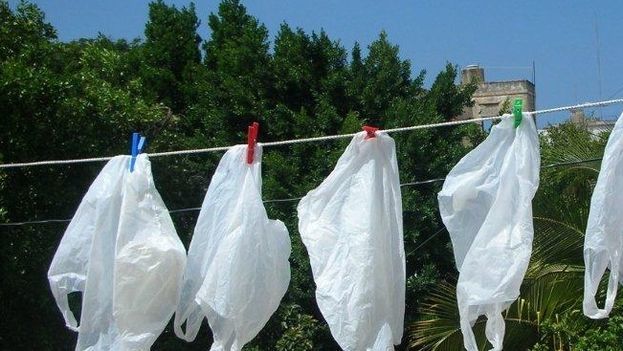
Plastic bags drying on a clothesline after being washed for reuse. (CC)

14ymedio biggerEFE (Via 14ymedio), Havana, 9 February 2017 — In Cuba, take-away pizza is eaten on piece of paper, people go to the market with their own bags, and rum bottles are reincarnated as sauce containers. It is not that the country has an admirable environmental awareness, but that there is a perpetual lack of packaging and containers that sharpens the island ingenuity.

By necessity, recycling has become a daily habit for Cubans, who never forget to grab a jaba (bag) when they leave home, and even wash and dry them to reuse until they are nothing but shreds.

“A Cuban is composed of head, trunk, limbs and jabita,” quipped a comedian in a celebrated monologue that became popular in the Caribbean country two decades ago. continue reading

This pressing demand explains the success of PACGRAF at the International Fair celebrated this week in Havana “with the aim of generating new business opportunities and working with the main buyers and distributors for the production of packaging in Cuba,” according to its organizers.

Nearly 50 companies from eleven countries have attended the event to try to promote a sector that the Vice Minister of Industries, José Álvarez, considered during his inauguration as “strategic to guaranteeing economic development and especially boosting the pharmaceutical, agro-food and tourism industries.”

The lack of packaging and containers is another face of Cuba’s daily shortages, attributable to several factors depending on who is asking: the official response is the United States trade embargo on the island is responsible, while ordinary citizens blame the state apparatus for its lack of foresight.

The Cuban government has invested more than 40 million dollars in packaging, paper and cardboard, in the last three years, said the director of Packaging and Containers of the Ministry of Industry, Juana Iris Herrera, who anticipated a new investment to produce more carbdoard boxes.

Some packaging and containers are so complicated to get through normal channels that they have become coveted objects of desire. Among them, the large cardboard boxes used in international moves, which in Cuba have the value of a war trophy.

Another example is the square pizza boxes. Some fortunate private restaurants have found alternative “supply” routes and even have them customized – and many charge for them at about 50 cents a box – but in other places the calculations fail and they are suddenly without packaging.

“If there are no boxes, if they want pizza to take away, they have to bring a plate,” explains the waitress of a private pizzeria in the Havana neighborhood of Miramar.

Cans that drinks come in are cut in half to serve as containers for flans and other delicacies sold in street stalls, and in the farm markets rum bottles have a second life as containers for honey or spicy sauces.

“Cubans are sick of (addicted to) the bags,” says Ruben Valladares, a freelancer who has been working for the last five years at the PACGRAF fair.

The company, which like so many entrepreneurs started as a precarious and “rustic” home-based business, today supplies several state-owned companies, numerous private businesses and even has become a peculiar exponent of the thaw with the US through an alliance with Commonwealth Packaging Company, a firm from the neighboring country that wanted to bet on Cuba.

“The first packaging, a new relationship” is the slogan of this joint venture.

Another company present at the fair is the Spanish Siepla, which sells machines with technology to make plastic containers such as bottles, decanters and jars.

“The needs of the country are immense, there is a lot of demand,” says the sales manager of the firm, Josep Puig.

Bottles for soap, deodorant containers or containers for jam and honey are some of the products that can be made with these machines, a plethora of containers that will have a long life in Cuba, the country where nothing is thrown out.

Fire Heavily Damages Shop In Havana’s Chinatown / 14ymedio, Yosmany Mayeta Labrada

Fire in Chinatown. (14ymedio)

14ymedio bigger14ymedio, Yosmany Mayeta Labrada, Havana, 13 February 2017 – A Sunday fire heavily damaged the Panamerican Rayo Fair shop, in Havana’s Chinatown. The premises, located a few yards from the central corner of Zanja and Dragones, caught fire about one in the afternoon and it took the fire brigade more than three hours to smother the flames. The fire was put out without loss of human life or injuries.

The fire spread rapidly, consuming seven departments within the store, among those home appliances, perfumes, furs, clothing, basketry, boutique and cafeteria. continue reading

Yudith Gonzalez, a worker in the store, attributes the fire to “a short circuit in a power outlet on one of the wooden walls.” In statements to 14ymedio, the clerk regretted that when the first flames were noticed and the store evacuated she did not take her personal belongings or salvage merchandise.

A resident of 116 Rayo Street, who explained that “smoke covered the whole area,” watched from his balcony as the “shop windows exploded sending pieces out into the street.”

Given the high residential density of this area of Central Havana and the commercial character of Chinatown, the firefighters had to cordon off the perimeter and convince numerous onlookers to keep their distance. After three and a half hours’ work, the fire was put out.

Several high-ranking officials from the Ministry of the Interior and directors of the Cimex Corporation, to which the shopping center belongs, came to the area. The experts began to investigate the precise causes of the fire.

From nearby buildings, numerous neighbors decided to film the flames with their cellphones, a practice increasingly common among Cubans. The closeness of the building to the Fe del Valle Park wifi connection zone, meant that many of the images were uploaded to social networks within hours.

A young man who was recording nearby commented to this paper that he saw the smoke from La Cabaña Fort, where he had been visiting the Book Fair. “I came to see what happened because I was afraid something had happened to my house,” said the young man, who lives in a poorly maintained building on San Nicolas Street, a few yards from fire.

After putting out the flames, the firefighters began to evacuate the area and fill the street with items ranging from burned up washing machines to other home appliances blackened by the smoke. At dusk Zanja Avenue was reopened although access to that stretch of Rayo Street remains blocked.

Private Taxi Drivers Close Ranks Against Fixed Prices Charged By The State / 14ymedio, Marcelo Hernandez

Transportation crisis in Havana is aggravated by the “semi-strike” of private taxis. (14ymedio)

14ymedio biggerMarcelo Hernandez, Havana, 12 February 2017 – “Take me, I’ll pay you double,” implores a woman to a taxi driver on the main route of Prado y Neptuno. The car is empty, but the driver does not stop to those hailing his taxi, even while showing money in their hands. Imposed fixed prices on private transport have unleashed a silent battle on the streets of Havana.

Since last Wednesday capital authorities have applied a new scale of fixed rates on the routes of private taxis, a decision that reinforced an end to the law of supply and demand, which regulated the private transport since its authorization in the mid 1990s. Last year the authorities decreed set fares, but the drivers found a way to get around them and the state came back with a second round of controls last week. continue reading

Private transport drivers reacted by eliminating intermediate stops or by opting to pick up only passengers going the full route. Despite not relying on an independent union, they have closed ranks and reduced the number of clients they transport in order to pressure local authorities to take a step back.

Since last Wednesday capital authorities have applied fixed rates on the routes of private taxis.

“It has not been necessary for drivers to agree on taking these measure because we all know that accepting this means worse measures to come,” assures Leo Ramírez, one of the private taxis whose route runs between downtown and the neighborhood La Víbora. Driver of a 1957 Chevrolet, this man says the government is “waging war” on them.

Like most of his colleagues who transport passengers within the city, for the past three days Ramírez only accepts riders going the full route. “Most of the time I ride around with no passengers and I have lost a lot of money,” he says to 14ymedio. He claims, “if the measure is not reversed I will turn in my license.”

At the end of 2016, Cuba had more than 535,000 private or non-state workers, the largest figure recorded since 2010, according to data from the Ministry of Work and Social Security (MTSS). Of these, about 54,350 work in the transport of cargo and passengers and are popularly know as boteros (boatmen).

The situation has put the mobility of Havana in check, a city with over 2 million people and a public transport system facing a deficit of vehicles.

In July 2016, the Council of Provincial Administration published Agreement 185, setting maximum fares for the routes of the popular almendrones*, or private taxis. At that time, established rates were for the most important routes, but the drivers resorted to breaking the trips into segments and charging per segment.

Tatiana Viera, vice-president of the Council, explained on national television that behind that decision was “a series of violations that occurred between the months of September and October.” Consequently, “in order to continue to protect the public,” they decided on the new “measures for shorter trips.”

The official explains that private taxis transport workers, students and even “teachers, who with their salary and hard work cannot afford transportation at those prices.” Viera pointed out that “it is our state and moral duty to continue protecting these customers,” even though she classified the almendrones as “complementary transport.”

The situation has put the mobility of Havana in check, a city with over 2 million people and a public transport system facing a deficit of vehicles.

“The problem is not prices, but wages,” says Yampier, a taxi driver on the route from the area of the Capitol to the municipality of Marianao. According to this self-employed driver, “our cars are always full, which means there are people who can afford our prices.” However, he considers that presently, they are all affected by the new measures.

A retiree who tried to take a taxi this Saturday to Santiago de la Vegas from El Curita park, showed more optimism. “There was no one who could pay those prices, which makes me glad the State intervened,” she commented to 14ymedio. She went outside with the newspaper stating the new rates to “show (the drivers) if they tried to take advantage of her.”

The sanctions for those who do not conform to the new rates range from a fine to the confiscation of the vehicle. “Our inspectors are already on the streets” dressed in “blue jackets,” warns Viera and adds, “They are accompanied by the National Revolutionary Police (PNR).”

The sanctions for those who do not conform to the new rates range from a fine to the confiscation of the vehicle.

Carlos Manuel, known as the Mule, is self-employed in construction and lives in the Martí neighborhood. Every day he takes at least two private taxis to get to the house where he is building a bathroom and a kitchen. “When I heard the news I felt happy because I was going to pay half of what I was paying last Thursday,” he commented to this newspaper.

However, as the days pass, the Mule explains that these new measures have actually “affected me a lot.” Now, “I have to go to where the route starts to hop on a taxi,” he retells. So, “I pay more because I have to go on a longer route now.”

This construction worker is also concerned that “this type of decision by the State will trickle down into other professions.” In his case, he is afraid that “one day they might announce fixed rates for the placement of a square meter of tiles or the installation of sanitary fixtures,” a situation which he would be “deeply affected” by.

*Translator’s note: “Almendrones” means “almonds” – from the shape of the classic American cars often used to provide this service.

Translated by Chavely Garcia.

“Those Who Do Not Help the Victims of Castro-ism Are Complicit in the Oppression,” says Rocio Monasterio / 14ymedio, Mario Penton

Video not subtitled: Rocio Monasterio talks about her dreams for Cuba in Miami

14ymedio, Mario J. Penton, Miami, 11 February 2017 – Rocio Monasterio, a Cuban living in Spain who became popular after starring in a televised debate at the end of November in which she confronted Castro supporters about the legacy of former Cuban President Fidel Castro, gave a talk Friday in Miami about her ideological platform and her aspirations for Cuba’s future.

This 43-year old Cuban with parents from Cienfuegos and a member of the (conservative) Vox Party in Spain defends the family and liberty as supreme values. She is a passionate speaker who strongly criticizes the Cuban government and condemns those politicians disposed to dialogue with Havana.

“Cuba raised a big wall in 1959. Since then night fell on the country, the search for liberty was interrupted. Unfortunately, 60 years later, Cubans are still in the shadows and we don’t see a light that illuminates our homeland. All those who live in Cuba are imprisoned,” she said before emphasizing, “When we see a brother imprisoned we have to do everything possible to help him.” continue reading

An architect by profession, Monasterio decided to go into politics as a result of the loss of values that, in her judgement, Spanish society has experienced. She joined Vox as a way of giving voice to hundreds of Spaniards who do not agree with the relaxation of policies by the Popular Party, currently in power, an organization to which she delivered her vote every year but about which she is singularly critical.

“It is extraordinary that a Hispanic Cuban can speak to Cuban Americans in Miami. We are united by the Hispanic phenomenon,” she said.

About those who opt for investment in Cuba in order to foster an emerging middle class that in the future will be able to demand political changes, Monasterio asserts that those politicians and businessmen are “soothing their conscience for collaborating with the regime.”

“It is being shown that investment in Cuba is nothing more than supporting Castro-ism,” she adds.

As an alternative to totalitarianism, Monasterio proposes Hispanic values.

“We have inherited from Spain the Christian values that are society’s foundation: equality, defense of freedom, right to life, belief in the individual and in his individual responsibility, also the family as a fundamental value of society. All this is this based in freedom,” she said.

One point that she emphasized was the relationship between the European Union, above all Spain, and the Cuban Government. For the Hispanic Cuban, the credibility of the institutions and the parties that negotiate with Raul Castro are in jeopardy.

“In the collective imagination of Spain, Cuba is the most beloved. The relationship of both countries is that of brotherhood,” said Monasterio. Nevertheless, she characterized as “a great betrayal” the normalization of relations without a single word about human rights violations on the Island.

“Those today who do not help the victims of Castro-ism are accomplices in the oppression and contribute to the perpetuation of night in Cuba, a night that has already lasted too many years,” she added.

The architect conceives her battle as not only against communism but against all kinds of totalitarianism, which according to her is being exported from Cuba to Spain and Latin American countries like Venezuela, Nicaragua and Ecuador.

“Totalitarianism is not only the lack of freedom, but also the elimination of the individual. All contrary to our values,” she says.

She also admitted that she fights hard against gender politics and is radically opposed to homosexual marriage:

“I don’t meddle in civil unions between people who have another view of sexuality, but that is not matrimony. Matrimony is between a man and a woman,” she says.

For Monasterio, gender ideology is “another big dictatorship of our time.” She condemns Spanish education in this sense.

“We are subjected, once again, to determined ideologues who come from big institutions. Gender ideology is contrary to the family and our values,” she said.

To oppose the proposed education in gender ideology values, Monasterio’s party proposed a platform for freedoms that defends the right of parents to educate their children according to their values.

About her dispute with “the defenders of the indefensible, that is, Castro-ism, Monasterio reminded that the Castro brothers came to Cuban government promising equality,” but what they have done is to equalize everyone “in misery and oppression.”

“A Castro military elite controls Cubans and makes them ignore freedom.”

According to Monasterio, the Cuban diaspora confronts three big responsibilities: the obligation to denounce what Castro-ism means before those who truly do not know what it is; to be effective in the use of a new discourse and new tools for telling and transmitting the values of our culture; and to create a new iconography. “We have to pass to the next generations the commitment to fight for the freedom of our land.”

Translated by Mary Lou Keel

Faith Arrives to the Rhythm of Reggaeton / 14ymedio, Luz Escobar

Members of La Union: Left to right: Osmel (Mr Jacke), Misael (Dj Misa), Ramiro (Pucio) and Randoll (El Escogido). (14ymedio)

14ymedio biggerLuz Escobar, Havana, 11 February 2017 – Sexists, hard and streetsmart, such are the lyrics of most reggaeton songs that are heard everywhere. Topics that speak about jealousy and rivalries, but that can also convey very different messages. Under the name La Unión (the Union), a group of young artists spread the Christian faith to the rhythm of this urban genre so popular in Cuba.

The group, founded in 2013, promotes their songs and videos through the Weekly Packet in the folder titled “Christian section.” A musical work that stands out in the Cuban panorama by combining two elements that seem opposed: religion and reggaeton.

Willing to break down those prejudices, Ramiro (Pucio), Osmel (Mr. Jacke), Randoll (El Escogido), and Misael (DJ Misa), compose and sing for a new generation of listeners born with this millennium. A generation accustomed to choosing a la carte the audiovisual materials they consume and who are very familiar with flash drives, Zapya and smart phones. continue reading

In times of vertigo in the exchange of content, the members of the Union release their songs under the label Kingdom Records, a handcrafted studio installed in the house of DJ Misa, in the Alamar neighborhood. In that zone of ugly buildings and good musicians, rap and hip-hop reigned in earlier decades.

In public performances of the Union, women dancing with lewd movements, twerking style, are not seen and the group members do not wear heavy gold chains around their necks. Even so the places where they perform are packed and fans sing along to the lyrics, which praise values such as solidarity and friendship.

In public performances of La Union, women dancing with lewd movements, twerking style, are not seen and the group members do not wear heavy gold chains around their necks.

In a conversation with 14ymedio during a promotional tour around La India, in Old Havana, the director of the group, DJ Misa, said that from the beginning they wanted to “take the message of Jesus to the Island’s youngest listeners” and they thought it “perfect” to use urban music “as a strategy” because “that is what is mostly heard in the streets.”

Currently, the DJ Misa is immersed in a whirlwind of preparations for a concert the group will perform on February 17 in the central venue Riviera. The launching of a new video clip also fills him with pride, although reaching the point they have now arrived at has not come easily.

The beginnings of the Union were not exempt from “some obstacles,” comments DJ Misa, because few people dared to “mix Christian music with reggaeton.” However, they found acceptance within the island’s millennials and the pastor of the Methodist Church of Alamar, Daniel Marín, who supported them unconditionally.

A recent survey of young Cubans found that their idols range from soccer players, like Cristiano Ronaldo and Lionel Messi, to reggaeton singers, like Yomil, El Chacal and el Príncipe, who are overwhelmingly popular among those under 30 years old.

In this context, Christian musicians count on an audience interested in rhythms representing reality. But it is also an audience accustomed to the ruggedness of many reggaeton songs, which praise sexism, promiscuity and frivolity. These are the themes heard in bars, cafeterias, and taxis and even during morning assemblies in Cuban schools.

Christian musicians count on an audience interested in rhythms representing reality. But it is also an audience accustomed to the ruggedness of many reggaeton songs, which praise sexism, promiscuity and frivolity.

DJ Misa explains the support they have also received from other pastors. He says it is because many young people “who are in church but no longer very interested and about to leave,” after listening to their music return with more joy. Although he laments that due to lack of resources they can only do two or three concerts a year.

Both performances and video clips are self produced and financed, says the artist, who complains “there are still no companies that promote Christian music.” Nevertheless, they have managed to perform various concerts and in August of last year filled the venue Avenida.

The young man’s production ability was self-taught, and he counts on spreading his music through social networks, such as Facebook and YouTube.

He does not discard that the Union will be televised and is thinking about presenting his next music video, Jesus Fanatic, at next year’s Lucas Awards. DJ Misa is convinced that his audiovisuals “have the same quality as the ones presented” and show a “very professional appearance.”

As they reach the small screen, these young musicians are achieving a special place in the national urban music, a place where the heavy terrain of reggaeton manages to gain spirituality and compromise.

Translated by Chavely Garcia


Measuring Hopelessness / 14ymedio, Yoani Sanchez

Those who believe that the closing of a one door to emigration will act like the snap of the fingers to awaken a society whose civic conscience is hypnotized are mistaken (Archive photo)

14ymedio biggerEl Pais/14ymedio, Yoani Sanchez,12 February 2017 — Statistics are deceiving. They only reflect measurable values, tangible realities. International agencies cram us with numbers that measure development, life expectancy or educational attainment, but seldom succeed in grading dissatisfaction, fear, and discouragement. Frequently in their reports they describe a Latin America and its inhabitants encased in a fog of digits.

This year the region will have weak growth of 1.3%, according to forecasts by the Economic Commission for Latin America and the Caribbean (ECLAC). A data point that barely manages to transmit the scope of lives that will be ruined by the region’s sluggish progress. Unfinished projects and a long string of social dramas will be accentuated in many of these countries in the coming months. The breeding ground from which populism springs.

However, the major drama remains the lack of horizons for millions of people on this side of the planet continue reading

A Haitian who risks crossing the jungle of Panama’s Darien Gap to reach the United States is driven not only by the miserable conditions of life in her country, the destruction left by natural phenomena or the repeated epidemics that cost thousands of lives. The most powerful engine that moves her is hopelessness, the conviction that in her own country she will never have new opportunities.

Seeing no end to violence pushes other Central Americans to escape their countries. In several of these nations gangs have become an enthroned evil, corruption has corroded the internal scaffolding of institutions and politicians go from one scandal to the next. Discouragement then prompts a response quite different from that generated by indignation. While the latter may push people to rebel, the former pushes them to escape.

Meanwhile, on this Caribbean island, millions of human beings ruminate over their own disappointment. For decades Cubans fled because of political persecution, economic problems and weariness. Until 12 January 2017, that generalized choking sensation had a relief valve called the wet-foot/dry-foot policy, but President Barack Obama closed it a few days before finishing his second term.

The most staunch critics of that migratory privilege say that it encouraged desertions and illegal exits. Some people also criticized its unjust character in that it benefitted and offered entitlements to people who were not escaping war, genocide or a natural disaster. They forget, among these arguments, that discouragement also deserves to be taken into account and computed in any formula that tries to decipher the massive flight that affects a nation.

A similar error has been committed by agencies such as the FAO, UNHCR or ECLAC, all of which specialize in measuring parameters such as the number of daily calories ingested, the effect of climate change on human displacements, or the percentage decrease in a nation’s GDP. Their reports and statements never evaluate the energy that accumulates under frustration, the weight of disappointment or the impotence reflected in every migration.

When more than three generations of individuals have lived under a political and economic system that does not evolve or progress, there is a conviction among them that this situation is eternal and immutable. They no longer see any horizon and the idea that nothing can be done to change the status quo becomes rooted in their minds. By now, many of those born in Cuba after January 1959 have grown up with the conviction that everything had already been done by others who preceded them.

That explains why a young man who had recently slept under a roof in Havana, who had access to a limited but adequate amount of food through the rationed market and who spent his long free hours on a park bench, launched himself into the sea on a raft, at the mercy of the winds and sharks. The lack of prospects is also behind the large number of migrants from the island, in recent years, who have ended up in the hands of human traffickers in Colombia, Panama or Mexico.

Washington not only cut an escape path, but the White House’s decision ended up deepening the depression that comes from the chronic absence of dreams that characterizes our country. The Cuban Adjustment Act, enacted in 1966, is still in effect for those who can prove they are politically persecuted, but the most widespread feeling among potential migrants is that they have lost a last chance to reach a future.

However, this undermining of illusion has little chance of being transformed into rebellion. The theory of the social pressure cooker and the idea that Obama closed the escape valve so that the fire of internal austerity and repression will make it explode is a nice metaphor; but it misses several key ingredients, among them the resignation that overcomes individuals subjected to realities that appear unchangeable.

The belief that nothing can be done and nothing will change continues to be the principle stimulus, in these areas, to lift one’s anchor and depart for any other corner of the planet. The pot will not explode with a sea of people in the streets bringing down Raul Castro’s government while singing hymns on that dreamed of “D-Day” that so many are tired of waiting for.

Those who believe that the closing of a one door to emigration will act like the snap of the fingers to awaken a society whose civic conscience is hypnotized are mistaken. The cancellation of this policy of benefits in the United States is not enough to create citizens here at home.

A new bureaucratic barrier is a small thing to those who believe that they have reached their own glass ceiling and that in their homeland they have nothing left to do. This quiet conviction will never appear in tables, bar charts or schemes with which specialists will explain the causes of exodus and displacement. But ignorance of it means the specialists will never understand such a prolonged escape.

Far from the reports and statistics that everyone wants to explain, hopelessness will take Cuban migrants to other places, re-orient their route to new destinations. In distant latitudes, communities will flourish that will dine on their usual dish of rice and beans and continue to say the word “chico” before many of their phrases. They will be the ones who will let drop small tear when they see on a map that long and narrow land where they had their roots, but in which they could never bear fruit.


Editorial Note: This text was published this Sunday, February 12 in the newspaper El País.

Cubans In Ecuador Ask Ecuador’s Next President To End The Medical Missions / 14ymedio, Diana Ramos and Mario Penton

Cubans working in a medical mission to Ecuador. (américatevé.com)

14ymedio bigger14ymedio, Diana Ramos and Mario Penton, Quito/Miami, 10 February 2017 — A group of Cubans in Ecuador united in the Movement X Cuba (MXC) requested in an open letter to the next present of Ecuador, the end of the medical missions of the Cuban government in the Andean nation.

Doctor and president of the association, Duniel Medina, signed the letter that expresses “concern” over the opinions of some of the presidential candidates that the organization considers “xenophobic and poorly focused,” especially with regards to the presence of Cuban citizens in the country. continue reading

“We believe it is important to release this communication due to the kinds of statements the candidates are making. Many of them believe that Cubans come here to take Ecuadorian jobs and they think we are all employees of the Cuban government,” says Medina in statements made to 14ymedio.

The president of the association signed the letter that expresses “concern” over the opinions of some of the presidential candidates that the organization considers “xenophobic and poorly focused”

Movement for Cuba defines itself as a peaceful organization that seeks change in Cuba. During its short months of existence has created 3 different cells inside of Cuba. It is fundamentally composed of Cubans who migrated to Ecuador but who maintain a close relationship with their country of origin.

The group of Cubans also stays updated on the situation of their undocumented colleagues in Ecuador and has assisted in several ways the hundreds of migrants who asked for an airlift that would allow them to travel safely to Mexico to continue their journey to the United States.

“We are making a call for attention so that they can differentiate between the Cuban doctors and health professionals who live in Ecuador and share the same fate as the Ecuadorian people,” the note adds.

The MXC, representing Cuban doctors and health professionals who migrated from Cuba to Ecuador, is expressing its desire to put an end to the medical agreements signed by President Correa and the Cuban Government “that undermine the employment opportunities of Ecuadorian and foreign citizens who live in Ecuador.”

Some candidates for presidency of the Republic have emphasized the need to eliminate contracts with Cuba and give priority to Ecuadorian doctors.

Cynthia Viteri, one of the candidates, has called for the “recovery” of jobs in public health by Ecuadorians, as has Guillermo Lasso, who in an interview with the newspaper El Universo indicated that the health sector’s priority is “more non-Cuban Ecuadorian doctors.”

The agreement of cooperation with Cuba stipulates that the salary of Cuban professionals is of 2,700 dollars, of which only 800 dollars ends up in the hands of the professionals themselves while the rest stays with the Cuban government.

The Movement condemns this practice: “We advocate that Cuban doctors be free and can decide their future, their country of residence and have the freedom necessary to exercise such a worthy profession.”

“We advocate that Cuban doctors be free and can decide their future, their country of residence and have the freedom necessary to exercise such a worthy profession.”

Hundreds of Cuban doctors took advantage of the free visa that Ecuador provided between 2008 and 2015 to emigrate to that country. Through a relatively easy process, health professionals achieved the accreditation of their qualifications and were integrated into the national health system.

According to official data, in 2015 almost 800 foreign doctors were in Ecuador, the great majority of Cuban nationality.

After the migratory crisis triggered by the thousands of Cubans who were stranded in Central America in 2015, Ecuador reinstated the visa requirement for citizens of the island. It is estimated that Ecuador hosts the third or fourth largest group of Cubans abroad, with a population of over 40,000 Cubans.

Ecuador is immersed in its electoral campaign. On February 19 the country will elect a new president and decide whether to continue with the program of the current president Rafael Correa or to distance itself from the left.

A Day Without Private Taxis / 14ymedio, Marcelo Hernandez

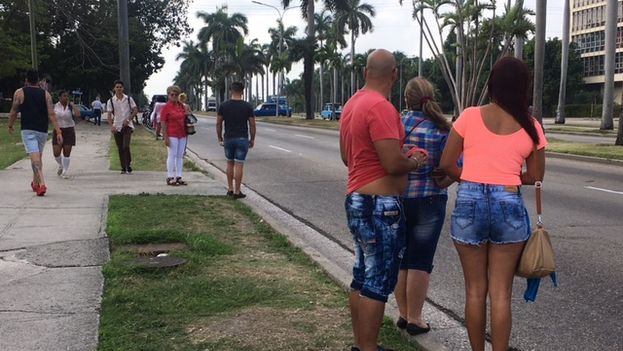
Customers wait on Rancho Boyeros Avenue for a taxi to take them to Vedado or Centro Habana. (14ymedio)

14ymedio bigger14ymedio, Marcelo Hernandez, Havana, 10 February 2017 — Without posters, lists of demands or protest demonstrations, Havana’s private taxi drivers are responding to the recently imposed fare caps. The authorities made a bold move, adjusting their previous fare caps – which the drivers got around by breaking their journeys into pieces and charging separately for each piece – to specifically apply the price controls to newly defined portions of a single trip. In response, the self-employed taxi drivers have offered a Friday from hell for Havanans trying to travel around the city.

At the edge of the sidewalk, desperately waving their arms, were hundreds of people this morning along the routes of the “almendrones” – as these shared taxis are called, in reference to the “almond-shape” of the old American cars called into service to run them. But the drivers rarely stopped on the grounds that they would only make “direct trips” between the first and last points of the journey. In this way they avoid fragmenting the payments and lowering the costs of the travel, in accordance with the new regulations.

Lacking a union to represent their demands, the drivers are trying to force the government to withdraw the pricing measure, by ensuring congestion in urban transportation. For its part, the government knows that a good share of the city’s residents need these shared taxis to get to their workplaces or schools. Without them, the country will be paralyzed.

As of yesterday, a silent pulse is developing in the streets, where right now the worst affected are the passengers.