Rosa’s Little Shoes

It is rare to find a Cuban who doesn’t know some poem by José Martí, at least some snippet of those simple verses we learn by heart in elementary school. From the time we’re little, in the morning assemblies at school, in Spanish classes, at all the political rallies we attend, we hear over and over the lyrical verses of our national hero. The over exposure to him leads to the point where many associate him with the current state of things, and in the very poor areas, where the electricity often fails and food is in short supply, they have even vandalized his busts.

But back to the Apostle’s poetry, especially the most famous of them, with its childlike tone, full of ribbons, flowers and images, which has the title “Rose’s little shoes.” Any child under ten could rattle off its sweetened octosyllables and narrate the story told in its verses. But could also recite some of the many parodies that have been written, especially those of a political nature that make a mockery of the system. Marti is the most parodied of our authors, which is not a mark against him, but rather proof of the familiarity people feel with his work.

Among the many jokes we draw from the work of this universal Havanan, is one taken from “Rose’s little shoes,” where the protagonist — named Pilar — meets a poor little sick girl at the seashore. Without consulting her mother, the rich girl takes off her shoes and gives them to the little needy one. She completes her generous gesture with a phrase, “Here, take mine, I have more at home.”

That brief line, written almost 150 years ago, is now an infinite source of jokes, wisecracks and imitations. It is used to indicate the social differences that are becoming more obvious and traumatic in a society where the official discourse continues to talk about equality. The most profound of the jokes among the students, obliged to wear school uniforms, has do to with their ability to rate the buying power of each person by looking at their feet. Although one of the slogans most repeated by the Cuban government is that there are no children walking barefoot through the streets of this Island, the big question is where do parents get the money so that their children aren’t walking with their heels on the asphalt. It’s enough to walk past store windows and look at the high prices of leather, to realize that a salary alone — the fruit from working for the State — won’t be enough.

The drama of shoes for children becomes more poignant when school is about to start and the markets are crowded. It is not unusual then to hear the parody of Jose Marti’s poem everywhere, especially when the first day of class hundreds of eyes will look over what is shown below the pants and skirts. The cost of a pair of shoes, the cheapest, is equivalent to the average monthly wage of any worker.

We must choose between surviving for thirty days or providing our children a pair of sneakers, sandals or boots. Luckily people are not satisfied and almost everyone does something illegal to send their children to school smug and comfortable. There are also generous family or friends who donate clothing and shoes, already used, to others who need them most. Those who have no clandestine business, “divert resources from the state” or appeal to the family that lives across the Straits of Florida. Ironically, it is the exiles who end up making the official propaganda come true. The high-sounding phrases of the political billboards are based on the thousands of dollars each year that enter the country through remittances.

But the parody of Marti’s poem does not attack those who have better shoes thanks to inventiveness or a relative, but others, those who have gotten them through privilege. “Take them, take mine, I have more at home,” comes the sarcastic whisper of the son of a colonel or of a trusted diplomat posted abroad. And so the caricature of Pilar and her generosity is evoked again and again when someone brags about owning something that ordinary Cubans can barely dream of.

For example, the teenage grandson of some general, driving his own car, will hear the cute verse tossed at him when he boasts of his four wheels and their gleaming tires. It is also a way of saying: we are watching, we know that everything you are flaunting came to you by way of ideological loyalty. Sometimes it’s enough to say, “Yes, I know, you have more at home,” for the braggart to feel unmasked and the conceited to comprehend the ephemeral nature of the crumbs that come from power. Because history has these ironies, this way of making fun of everything and everyone. The nineteenth century lyricism — by the grace of necessity and humor — converts verbal material into scorn, sweet revenge on those who have less. And at some point far away, Marti’s taciturn face, believing that his Pilar with her straw hat and ribbons will be remembered as an example of kindness, not used as a spear against the false discourse of egalitarianism.

31 May 2012

From Cuba Libre in El Pais

El Chupi Chupi and the Dilemma of Limits / Yoani Sánchez

I disagree with what you say,
I totally disagree with it,
but I would defend with my life your right to say it.
Voltaire

Yoani Sanchez, Generation Y, 22 November 2011 — I press the headset until it almost touches my eardrums, but still the music in the collective taxi is pounding in my head. It’s the third time today I’m forced to hear the same song, a lascivious reggaeton capable of making those of us riding in that 1950s Ford blush. The most popular song has won the fanaticism of some, the repulsion of others and even a strong critique by the minister of culture, Abel Prieto, on national television. It would seem that no one can remain unmoved, tranquil, while listening to that “Dame un chupi chupi, que yo lo disfruti, abre la bocuti, trágatelo tuti*.” Either you wiggle your hips or you cover your ears, there’s no middle ground.

The El Chupi Chupi video has been nominated for a Lucas Prize, but a few days ago it was categorized as “horrible” by the president of the Cuban Music Institute himself. The many fans of the composer Osmani Garcia and his controversial lyrics don’t know if he will remain in the competition and the media has almost stopped airing the song. Hundreds of people have already sent in their votes — via text messages — in favor of giving the popularity award to this reggaeton artist. They hope to dance to his creation during the gala this coming Sunday at the Karl Marx theater. But a television presenter declared — half joking half serious — that “there will be no ‘honey nor caramels’ at the event this weekend… because they’re bad for your teeth,” in a clear reference to the likelihood of presenting the controversial rhythm with its direct sexual allusions.

If all of the television, newspapers and radio in Cuba were not the private property of the one political party, there would also be space for these kinds of productions, even though many don’t like them. The current problem is that if national television broadcast it, it would be as if it had the endorsement of the Cuban Communist Party (PCC) itself, as if the entire political discourse would have to recognize that its “New Man” is more interested in amusing and lewd tunes than in the anthems of the working man and songs about utopia. I am confident that some day there will be stations devoid of ideology, that in adult programming they will present topics far beyond melodic preferences or the blushing point that everyone accepts. Controversy will arise, of course, and generate debate, but no public official will be able to erase it with the stroke of a pen, because musical tastes don’t change through censorship. If they doubt it, let them climb into a collective taxi in Havana right now.

Translator’s note: Roughly: “Give me a suck, which I enjoy, open that little mouth, and swallow it all.”

Since the Appreciation / Yoani Sánchez

Yoani Sanchez, Havana, 23 March 2011 — Had I hired an ad agency and a nimble publisher to disseminate the work of the alternative bloggers, I probably would not have accomplished such wide awareness of our existence, within Cuba, as that achieved thanks to the “Cyberwar” program shown Monday on official television. The tangible result is that my phone hasn’t stopped ringing and I’m hoarse from talking to so many people who have come to show me their solidarity. My sunglasses — as big as owl’s eyes — are no longer enough camouflage for me to pass unnoticed in my city. Every few yards someone approaches me on the street to offer words of encouragement and even big hugs, the kind that take my breath away.

What’s happening on this island such that those of us “stoned” by official insults have become so attractive? What happened to the time when aggravating State media represented years and years of ostracism and vilification? When did the spontaneous anger against those slandered, the sincere punch in the face for the stigmatized, fade away? I swear I was not prepared for this. I imagined that 24 hours after this pack of lies, told in emulation of Big Brother, everyone would pull away, stare fixedly at the cobwebs on the wall whenever I passed by. The result, however, has been so different: a complicit wink, a pat on the shoulder, the pride of neighbors who are surprised because a certain quiet and frail little woman who lives on the fourteenth floor is apparently enemy number one — at least this week — until the next to be stoned appears.

And I’m not the only one. Almost all the bloggers whose names and images appeared on the “Interior Ministry Soap Opera” are experiencing similar situations. Vendors at the farmers market who hand them a piece of fruit in passing, drivers of collective taxis who say, “You don’t pay today, sir, it’s on the house.” If the scriptwriters of that courtroom TV show had calculated such a response at the grass roots level, I think they would have refrained from putting our faces on television. But it’s already too late. The word “blog” is now irrevocably linked with our faces, glued to our skin, associated with our actions, tied to popular concerns, and synonymous with that prohibited zone of reality that is becoming more and more magnetic, more and more admired.

23 March 2011

Here is the TV show Yoani refers to, in 2 videos with English subtitles:
Cyberwar in Cuba’s Reasons

The Instant Creation of Emerging Teachers

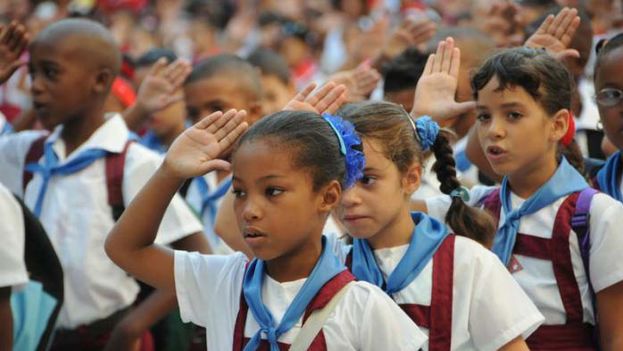
Cuban schoolchildren repeating slogans at the morning assembly.

Yoani Sanchez, Generation Y, 11 February 2010 — It was a sober meeting attended by several representatives from the municipal Ministry of Education. A murmur passed among the parents, seated on the same plastic chairs used by their children in the morning. The date was approaching for the announcement of who would continue their studies at the senior secondary school; it appeared that at this meeting they would tell us the number of pre-university or technical school slots assigned to our school site. Thus, the news at the end about “comprehensive general teachers” took us by surprise, because we had come to believe that their existence would be extended until our great-grandchildren reached puberty.

Educating adolescents – through accelerated courses – to teach classes ranging from grammar to mathematics, turned out to be a categorical failure. Not because of the element of youth, which is always welcome in any profession, but because of the speed of their instruction in teaching and the lack of interest many of them had in such a noble endeavor.

Faced with the exodus of education professionals to other sectors with more attractive earnings, the emerging teachers program was developed; with it the already ailing quality of Cuban education fell through the floor. The children came home saying that in 1895 Cuba had lived through “a civil war” and that geometric figures had something called “voldes” which we parents understood to mean “edges.” I particularly remember one of these instant educators who confessed to his students on the first day of class that they should, “Study hard so you don’t end up like me, someone who ended up being a teacher because I didn’t take good notes.”

On top of that the tele-classes arrived, to fill a very high percentage of the school hours from the coldness of a screen that cannot interact. The idea was to make up for the lack of training of those standing in front of the students with these lessons transmitted by television. The tele-teacher substituted in many schools for the flesh-and-blood version, while teacher salaries increased symbolically, but never exceeded the equivalent of 30 dollars a month. Teaching became, even more than being a priest, a sacrifice.

Thus, standing in front of the blackboard were people who had not mastered spelling or the history of their own country. There were young people who signed a pledge to become teachers, but who already regretted it after one week of work. The incidents and educational deformations that this procedure brought with it are written in the hidden book of failure of revolutionary plans and ridiculous production goals that are never met, with the difference that in this case we are not talking about tons of sugar or bushels of beans, but about the education of our children.

I breathe a sigh of relief that this long experiment in emergent education has ended. However, I do not envision the day in which all those people with preparation to teach leave the wheel of their taxis, come out from behind the bar, or exchange the tedium of working at home to return to the classroom. At least I could feel more relaxed if, in place of a television screen, Teo could receive all his classes from a corporeal teacher with a mastery of the content. I think that in this case we will have to wait for the great-grandchildren.

Adios to Schools in the Countryside / Yoani Sanchez

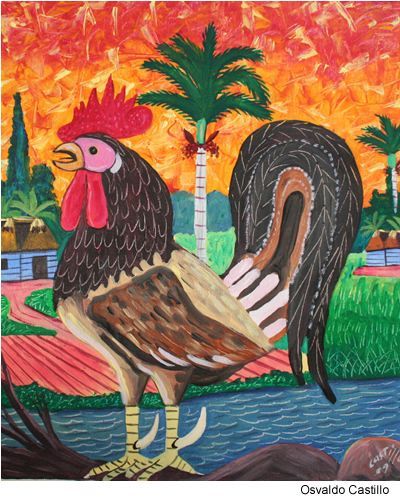
gallo

Yoani Sanchez, Havana, 24 July 2009 — The idea of combining study with work in high schools looked very good on paper. It had the air of an immortal future in the office where they turned it into a ministerial order. But reality, stubborn as always, had its own interpretation of the schools in the countryside. The “clay” meant to be formed in the love of the furrow, was made up of adolescents far away—for the first time—from parental control, who found housing conditions and food very different from their expectations.

I, who should have been the “new man” and who barely could have become a “good man,” was trained in one of these schools in the Havanan municipality of Alquizar. I was fourteen and left with a corneal infection, a liver deficiency and the toughness that is acquired when one has seen too much. When matriculating, I still believed the stories of work-study; at leaving, I knew that many of my fellow students had had to exchange sex for good grades or show superior performance in agricultural production. The small lettuce plants I weeded every afternoon had their counterpart in a dormitory where the priorities were bullying, lack of respect for privacy and the harsh law of survival of the fittest.

It was precisely one of those afternoons, after three days without water and with the repetitive menu of rice and cabbage, that I swore to myself that my children would never go to a high school in the countryside. I did this with the unsentimental adolescent realism that, in those years, calms us and leaves us knowing the impossibility of fulfilling certain promises. So I accustomed myself to the idea of having to pack bags of food for my son Teo when he was away at school, of hearing that they stole his shoes, they threatened him in the shower or that one of the bigger ones took his food. All these images, that I had lived, returned when I thought about the boarding schools.

Fortunately, the experiment seems to be ending. The lack of productivity, the spread of diseases, the damage to ethical values and the low academic standards have discredited this method of education. After years of financial losses, with the students consuming more than they manage to extract from the land, our authorities have become convinced that the best place for a young person is at the side of his parents. They have announced the coming end of the schools but without the public apologies to those of us who were guinea pigs for an experiment that failed; to those of us who left our dreams and our health in the high schools in the countryside.