
Breaking: The Russians are coming back to Cuba, this time as tourists and with hard currency. And these last few days there has also been a fleet of enormous Russian ships, bristling with weaponry and radar, at anchor in Havana’s port. The intentions of both governments are clear. Castro II wants to ask for a lot and to pay little. Dimitri Medvedev wants to re-position Russia at the center of world power.
They’re as tall as palm trees. They walk slowly and scrutinise the buildings in the old part of Havana. It’s a group of five Russian tourists. Three men and two fashionably dressed young women. They’re blond and have green or blue eyes. If you didn’t know about the embargo on Americans travelling to Cuba, you could easily mistake them for bored and slightly lost Yankees.
Near the Plaza de Armas, in their faltering English, they ask a balding mulatto guy holding a guitar where they can get something inexpensive to eat. “Fast food”, says the Russian girl. “Oh, there’s no McDonald’s here. The most similar thing you’ll find is the ‘Di Tu,’ which sells chicken, about two blocks from here”, the mulatto guy replies, in Russian, to the amazement of the tourists who want to know where he learned it.
“In the 70s I studied at Oleg Popov’s famous Clown School in Moscow”. “Oh, so you’re a clown?” asks a Russian wearing a Chelsea football shirt. “Yes, a clown who earns his living by singing nowadays,” he replies, while picking out on his guitar the tune to “Midnight in Moscow.”
The ex-clown manages to extract 10 convertible pesos from the Russian’s wallet for the song. His name is Manuel Oritz and he’s 53 years old. For the last 15 years, he’s been on the soup circuit (the term used on the island for serenading tourists while they eat) around Old Havana’s cobbled streets. “I was lucky with them. On the whole, they’re stingy, the Russians, and they don’t like hearing the old Russian songs, nor being called Tavarish.” [Translator: Tavarish is the Russian word for comrade, and was the only acceptable form of address in the days of the USSR.] Ortiz confirms that he did indeed study as a clown in the former USSR. With this new wave of Russian tourists, the extensive and well supplied informal market place, home to jineteras, personal guides, musicians, rum and tobacco sellers, drivers, and guest house keepers, is dusting off the old basic Russian manuals so as to be able to break the ice with the new visitors.
Joel Romero is 32, slightly overweight, and has the look of an intellectual about him. He works as a private guide for tourists. Keeping an eye out in both directions in case a tourist comes along, and smoking a menthol cigarette, he offers the following profile of the Russian visitors: “They still like rum and Cuban tobacco in excessive quantities, just like the old Soviets did. They go after mixed race girls, and young bisexuals, for their orgies. Unlike Western Europeans, they don’t like the old style Cuban music. They prefer rap groups, like Orisha, or Isaac Delgado’s salsa. They do sometimes leave tips, but they’re not big tippers, not like Cuban-Americans or Canadians.”
Héctor Gómez is 48 and works for the Gran Caribe hotel chain. He estimates that the number of Russians who have visited the island this year is about 10 thousand. And the new Russian invasion extends beyond tourism. Russian-made Maz buses are operating the Metrobus company’s PC, P9, P6 and P10 lines, some of the routes around the city’s main roads where the use of large capacity buses has managed somewhat to alleviate the capital’s difficult transport situation.
Besides buses, the Cuban government is also studying the possibility of establishing joint ventures with Russia in the petro-chemical and biotechnology sectors. Where they’re keeping mum is on the question of the military. We know that the islands’ armed forces are equipped with out-dated Russian technology: it’s a miracle it keeps going and then only thanks to the numerous adaptations carried out by Cuban military workshops. Nothing was said last November about this during Dmitiri Medvedev’s visit as Russian leader.
One thing which is being updated is civil aviation with new Russian Ilyushin 96 and Tupolev 204 airplanes. Even in religious matters Cuba and Russia are busy. Those who control our destinies have never looked favourably on the Catholic church.
The latter awaits an official response in order to be able to dedicate more space to pastoral work and to the work of the church in educational and social spheres.
Meanwhile, however, a Russian orthodox church has been consecrated in historic Havana; this is a religious doctrine which has few followers in this country. Raúl Castro’s new foreign policy aims to get Russia back as an ally, alongside Venezuela and China, so as to re-float the country’s precarious economy. The Russian answer has been Yes.
It remains to be seen what cards the young Russian president is keeping up his sleeve. Analysts suggest that Cuba has a debt of 20,800 million rubles to the former USSR. Neither Putin, the current Prime Minister, nor Medvedev, is a fool. They know that the island’s ability to pay for their products is non-existent. Cuba isn’t a good place to do business.
So, the reasons for this rapprochement with Cuba must be of a political nature. The joint military exercises with Venezuela, plus the war with Georgia, both point to Russia looking to regain a pole position among those countries which play a decisive role on our planet.
It remains to be seen whether the current government of Castro II is more interested in a dialog with the president of the United States, Barack Obama, or with being a chess piece in Russian’s foreign policy. once before, 46 years ago, marriage with Russia could have meant the end of the world with the missile crisis. And in exchange for an oil pipeline and Russian oats, the Russians got permission to establish on our soil military bases like the Study Center Number 11, and the Lourdes Farm of Electronic Espionage. Apart from that, Russia made little mark on Cuban society. Thousands of marriages, and names like Mijaíl, Iván, Tania or Tatiana.
The shape of Cuba’s future foreign policy is in the hands of Raúl Castro and his team, and theirs alone. It’s simple. Do we side with Obama and his view of the world or with Russia’s twisted imperial ambitions.
The visit of the Russian fleet to Havana, and the political flirting with Moscow, create more doubts than hope. Let’s wait and see.
Iván García December 2008
Translated by RSP


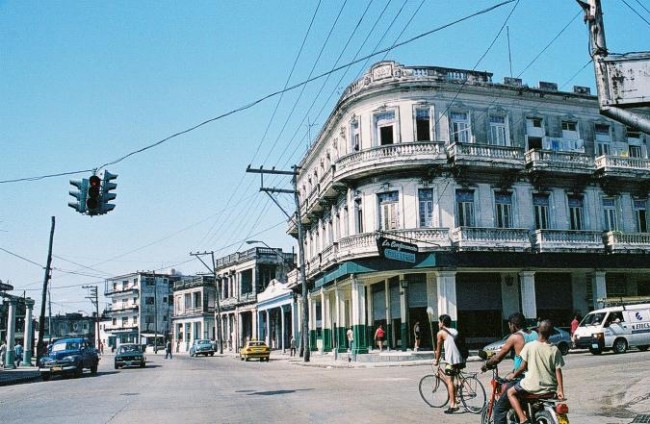 In the bureaucratic and political jargon of my country it’s called Vibora People’s Council. It’s my neighborhood. A piece of geography, extending from Avenida de Acosta to Santa Catalina, and from the Causeway on 10th of October – once called Jesus del Monte, which the poet Eliseo Diego Rodriguez immortalized – to Mayia Rodriguez.