Economist Pedro Monreal estimates a GDP contraction of up to 31% this year, three times more than the ECLAC forecast.14:15
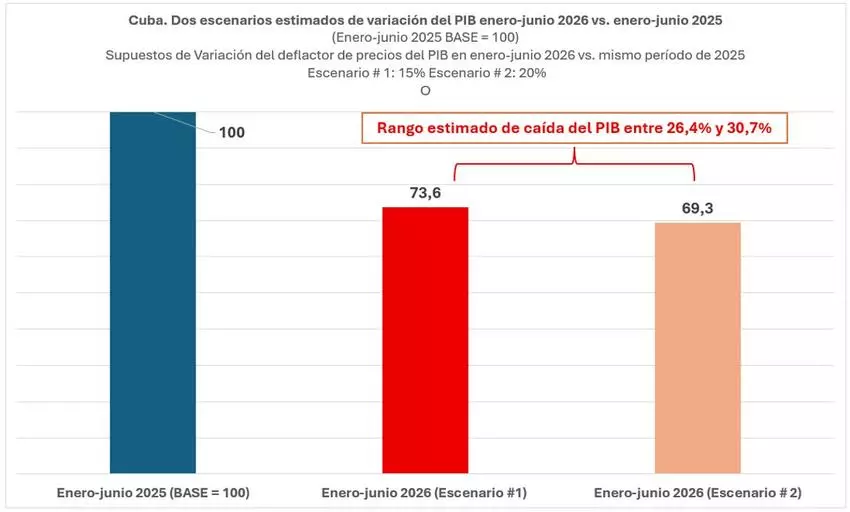
 The drop in gross domestic product could be double that of 1993, considered the worst year of the Special Period. This calculation comes from Pedro Monreal, a Cuban economist residing in Spain, and is based on data regarding State Production of Goods and Services for the first half of 2026, published this Tuesday by the National Office of Statistics and Information. Projecting the provided figures, the expert estimates that GDP could fall this year between 26% – in the best-case scenario – and 31% in the worst.
Monreal describes the situation as a “recession that is no longer within the realm of the forecasts.” The figures are double the 14.9% drop in GDP that occurred in 1993 and triple the ECLAC estimate of 10.3% for this year.
To calculate this, the economist used the value—published in national currency—of the production of goods and services by the state sector, which totaled 495.353 billion pesos—20.6397 billion dollars at the official exchange rate of 24 pesos per dollar—13.4% less than last year. In the first half of 2025, the figure was 571.760 billion pesos—23.8233 billion dollars—but inflation changes the picture.
Monreal estimates two possible deflators to complete the calculation based on the same period in 2025. If prices had risen by 15%, GDP would have plummeted by 26.4%, while if inflation were 20%, the figure would climb to 30.7%.
The expert believes these figures could set the tone for the rest of the year, as there are no signs of improvement. Although the picture of the Cuban economy is incomplete due to the lack of information from the private sector—which is playing an increasingly important role in the country—the state sector, which has concentrated the majority of national activity for decades, continues to dictate the trend.
Monreal had already warned a year ago, and on more than one occasion, that Cuban economic data showed it was reaching a point worse than in the 1990s, when the fall of the Soviet Union and the resulting end of subsidies left the Cuban state vulnerable. However, the deterioration has taken a giant leap forward since the kidnapping of Nicolás Maduro in Venezuela and the US sanctions, as the economist points out.
“The Cuban economy was already suffering from a structural crisis with internal distortions—low productivity, a distorted investment pattern, fiscal imbalances, a precarious electrical grid, and incomplete and failed reforms—but the short-term worsening is mainly explained by the tightening of US sanctions in 2026,” the specialist summarizes.
In his view, the oil blockade has cut off “access to the fuels that sustained electricity generation, transportation, and food distribution; the broad group of entities ‘designated’ on the sanctions lists, and secondary pressures have driven out hotels, airlines, and payment channels.” Against this backdrop, tourism, fuel, and foreign exchange, which had already entered negative territory in 2019, have collapsed, leading to a humanitarian crisis that is worse than that of the 1990s, “particularly in terms of vital services, inequality, and hopelessness.”
“Although the exact GDP figure for the first half of the year is not yet statistically confirmed, the contraction is already translating into hunger, blackouts, health collapse and exodus, a deterioration that the 2026 US sanctions did not create on their own, but did trigger by multiplying the internal failures of a structurally fragile economy,” he says.
______________________
COLLABORATE WITH OUR WORK: The 14ymedio team is committed to practicing serious journalism that reflects Cuba’s reality in all its depth. Thank you for joining us on this long journey. We invite you to continue supporting us by becoming a member of 14ymedio now. Together we can continue transforming journalism in Cuba.