
Jesus Hernandez-Guero Or The Art Of Provoking

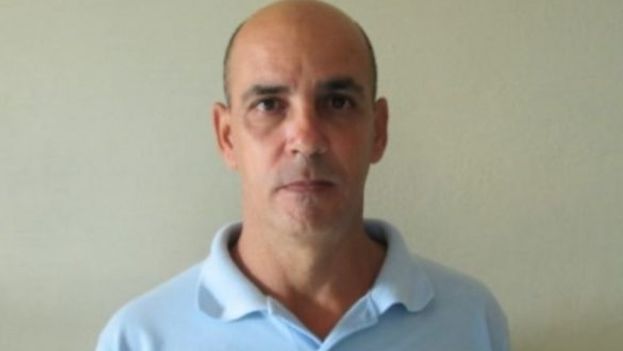
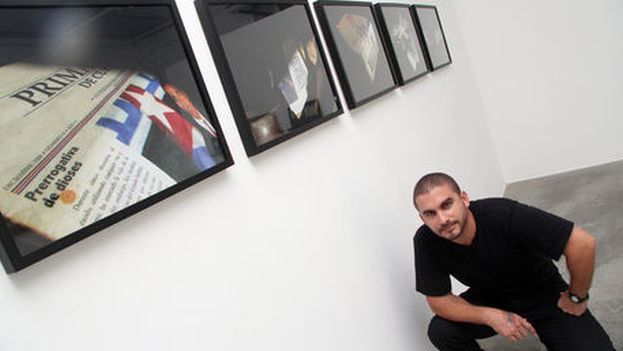
The Cuban artist, Jesús Hernández-Güero. (Courtesy)

14ymedio bigger14ymedio, Yoani Sanchez, Havana, 30 May 2017 — If something is clear in the work of Jesus Hernández- Güero is that he is not a complacent artist. His transgressive look is insolent and unrelated to any political militancy, religious creed or commercial convenience. The artist raises sparks everywhere: in Cuba where he was born and in Venezuela where he now resides.

In 2008, Hernández-Güero decided that his graduation thesis at Cuba’s Instituto Superior de Arte (ISA) would be a book entitled La Tercera Pata, with texts by journalists and writers censored. He collected writings by the poet Rafael Alcides, the former prisoner of the Black Spring Oscar Espinoza Chepe, and the narrator Orlando Luis Pardo Lazo, among others. continue reading

That effort led him to knock on many doors and more than a few saw him as a provocateur. He wanted to show the national journalistic tradition that includes figures like Félix Varela and José Martí, a tradition that was broken when independent publications “were closed and then prohibited” and all that was left “in circulation were those belonging to the State.”

The ISA leadership did not like this character of inclusiveness. Hernández-Güero recalls that a month before the discussion of his thesis the dean summoned him along with his tutor, critic and curator Mailyn Machado, to inform him that the project had not been approved. He had only two options: to take the state test or to present a compendium of his artistic work.
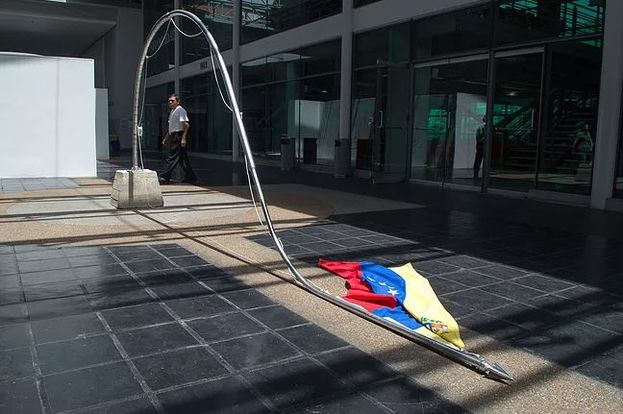
”At Fault,” a work by the Cuban artist Jesus Hernández-Güero. (Courtesy)

He opted for the second choice and happened on the book project. On the day of the presentation, a convenient power outage occurred at ISA and his thesis “never had a real conclusion” even though he finished with the maximum of qualifications.

Hernández-Güero, born in 1983, is aware that much of his research and his artistic production “has a critical sense and a high socio-political content, which makes official institutions or those who lead them uncomfortable.”

The artist established residence in Venezuela and he travels frequently to Cuba, where he recently participated in a show at the Chaplin Cinema under the title Contamination, a part of the Festival of Young Filmmakers.

However, his stay outside Cuba has not freed him from censorship because he seeks to “annoy, disturb the viewer, not only with the art, but in the face of reality that is lived and thought.” Something that he knows “is often not welcome institutionally.”

Three years ago, his work At Fault, with a 23-foot bent over flagpole and the Venezuelan flag “hoisted” on the ground, was displayed in Ciudad Banesco during the FIA ​​Youth Fair in Caracas. The piece was installed before the opening and organizers covered the flag with a black bag. The result resembled a covered corpse.

The piece caused so much turmoil in the social networks that finally they removed the flag and left only the bent over flagpole. “From that moment the work changed,” clarifies the artist and now the display of the work includes some of the tweets published during the process and “documentation of how they dismantled [the fabric].”

The whole media phenomenon and the condemnation was integrated into the work. Because the censorship, in the words of the artist, “is a boomerang that tries to hit who it is thrown at, but usually ends up hitting the thrower.”
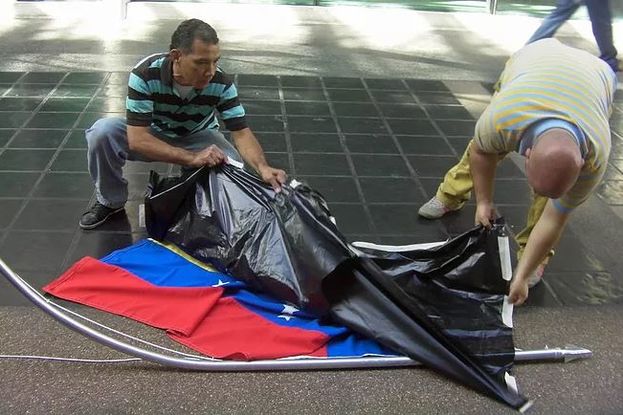
The piece caused so much turmoil in the social networks that finally they removed the flag and left only the bent over flagpole. (Courtesy)

He has had to deal with similar situations on several occasions and believes that censorship is an inseparable companion “when the work has as its research subject the great social taboos such as politics, power, religion, sexuality, pornography, among others.”

Hernandez-Güero’s work constantly questions power. Not only political power, but also “the symbolic power of visual images and conventions that are deposited in the social imaginary as indestructible, immovable or untouchable truths,” he explains.

In these circumstances he is always exposed to reprimands or warnings that end up “completing the work or expanding it to another plane,” often one unsuspected by the artist himself.
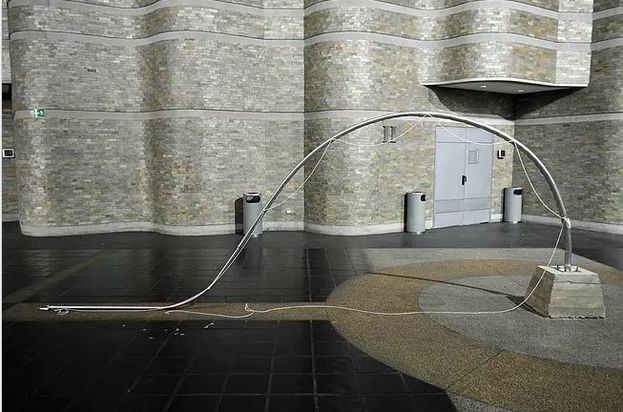
For Jesús Hernández-Güero, censorship is an inseparable companion. (Courtesy)

The most recent of his works takes the name Historical Coincidences and mixes, in the same image, portraits of great personalities who have assumed similar postures and attitudes before the camera, regardless of time, place or context.

Most are premeditated appearances, but in other cases it is an instant captured without any pose. His intention is to “demystify these figures” and to question “the perception of them in the historical and social imaginary.” The elaboration is simple: superimpose one face on another, which gives way to new faces and “other possible expressions, but unrecognizable, unknown by all.”

They are works with a great political content and, at the end of last year, five of the pieces of that series received prizes in the October Young Salon, at the Valencia Museum of Art.

Hernandez-Guerero does not prefer one medium over another. As for the new technologies, he believes that knowing them previously offers more possibilities to “know their potential.” Because the greater an artist’s arsenal, the more possibilities he will have to “navigate within the creation.”
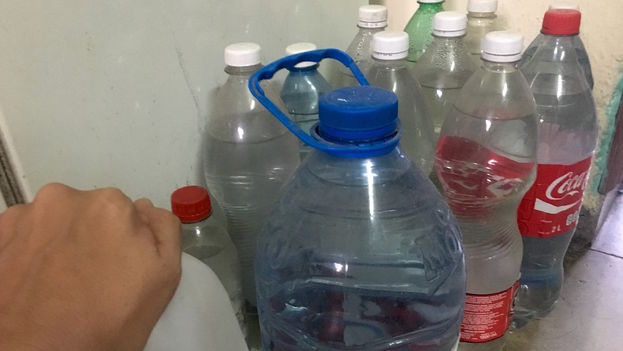
Breakdown Affects Almost a Kilometer of One Havana’s Main Water Conduits

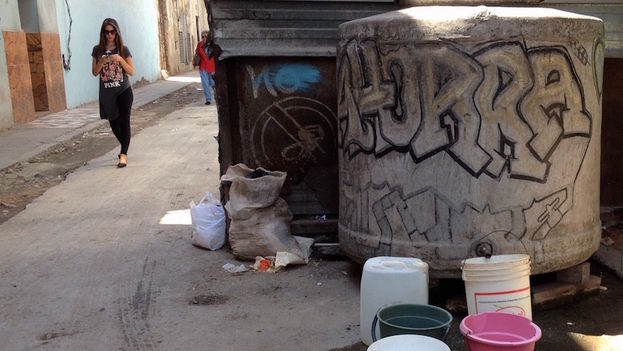
Residents of the affected areas keep all available containers full of water while they are able in preparation for the looming arrival of the worst part of the shortage

14ymedio bigger14ymedio, Havana, 29 May 2017 — Four days after the rupture of Havana’s main water conduit, authorities are trying to alleviate the shortage by servicing some parts of the city with tanker trucks. As of this Sunday, according to a director for Water Resources, they had made 1,315 trips with 117 water trucks that are now “guaranteeing” the supply. The greatest effects are felt in the municipalities of Plaza de la Revolucion, Cerro, 10 de Octubre, Habana Vieja, Centro Habana and in some areas near Boyeros.

The rupture has caused the loss of 3,000 liters of water per second from the network, as officials from the area confirmed on the news Sunday. Although they are confident that the situation can be partially overcome with “new distribution plans,” the failure is very complicated because it affects almost a kilometer of the southern catchment area’s conduit. It is not expected that the problem will be resolved before next Thursday. continue reading

Brigades under the direction of Havana’s provincial Water Resources have worked “continuously,” they assert, in order to remedy the malfunction, but it is necessary to replace a total of 400 meters that are obstructed, which complicates even more the work that they are carrying out.

One of the area’s managers asserted that they are trying to restore the prior conduit and that they have already put in place “a kilometer of 900-millimeter pipe and four welding machines that are soldering “full time.”

Engineer Javier Toledo, Provincial Delegate for Water Resources, said that they can say that “on Thursday morning” it is “very possible” that the first supply lines may be opened. Thus they will be able “to slowly begin to re-establish service.”

With the first two lines’ entry into service, a greater water level may be counted on to reach the People’s Council areas which continue to experience supply problems, as the expert explained.

Toldeo thought that, as far as distribution, “the most difficult moment” has been overcome and “the cycles, services and delivery of services to the people” are now balancing out. Also, he asserted that “every day” they are determining “place by place” the best way of distributing water in order to guarantee that it arrives “equitably” and that there is no area that does not receive it “by networks” or tanker trucks.

Water Resources daily decides and projects the capital’s water supply service’s cycles. The strategy is designed after evaluating “current conditions” and based on calls from users.

The capital’s most important hotels are located in several of the affected municipalities, like Habana Vieja and Plaza de la Revolucion, in the midst of a busy tourist season. These establishments, along with schools and hospitals, are being prioritized for supply by tanker trucks.

Cuba is experiencing its most intense drought of the last century, a situation that has been aggravated by the few rains that the wet season has so far contributed. On the other hand, due to the failures and leaks, the country is losing more than half the water it pumps.

Translated by Mary Lou Keel

Marta’s List

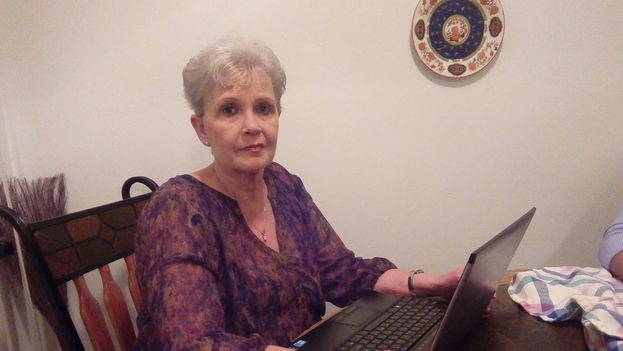
Marta Cortizas compiles daily news, opinion and reports to email them to Cuba. (14ymedio)

14ymedio bigger14ymedio, Miriam Celaya, Havana, 23 May 2017 — Her grey hair and blue eyes suggest a picture of a grandmother out of a children’s story, but Marta Cortizas is actually a native of Havana who, after emigrating to the United States, found a way to be useful to her countrymen. From her apartment in Kendall (Florida), she compiles daily news, editorial columns and reports to e-mail them to Cuba, a service known as Marta’s List.

Mailings began almost seven years ago, and today they are received by more than 50 subscribers. Its targeted recipients are independent journalists, opposition activists, members of the civil society, or simply friends.

Since childhood, Marta was in the habit of reading, and when she began working as a typist at the Casa de las Américas Library in July 1967, she was amazed at the institution’s catalogues and archives. The latter is considered the “trigger” for her passion for information. continue reading

Inside the walls of La Casa, as those who frequent the library refer to it, she met Virgilio Piñera, Anton Arrufat, José Triana and Luis Agüero, who often visited the reading room. There, she met Mario Benedetti, Roque Dalton, Antonio Benitez-Rojo, Inverna Codina, Fayad Jamis and Manuel Galich, and she has fond memories of the “beloved poet Raúl Hernández Novás.”

Mailings of news and other information began nearly seven years ago and there are currently over 50 subscribers

This soft spoken woman, with proven tenacity against discouragement, came to work as secretary for poet and essayist Roberto Fernández Retamar. “I loved my job with a passion and was respected by my peers without belonging to political organizations. In fact, I never belonged to any,” she clarifies.

Marta devoted the years after stopping her work at the library to caring for her mother, but neither retirement nor domestic life turned off the vigor of her freethinking. In her seclusion at home, she read tirelessly. These readings often included books censored by the authorities, some writings that deepened her critical stance against the official doctrine of the Castro regime.

Earlier this century, her husband, Eugenio Leal, joined other opposition members, journalists, activists and organizations and he shared his involvement with Marta. Both participated in the 2004 founding of the magazine Consenso, the first independent digital publication in Cuba.

“I started to serve as secretary and member of the editorial board”, recalls Marta. “It was a wonderful experience that offered me another reality, opening a door to freedom of expression in Cuba.”

In October 2005, Eugene and Martha suffered a spectacular act of repudiation in front of their own home. “It angered the authorities that we had created Consenso which was headquartered in our home.”

First they were threatened by State Security, and days after “they launched a massive repudiation rally which led to a 24-hour guard in the lower floors of our building, by repressive agents, members of the Committees for the Defense of the Revolution and Communist Party militants.”

The siege lasted for nine days. Its goal was to prevent visitors and terrorize neighbors. Marta laments “from that moment on, we were plunged into total and absolute ostracism in our neighborhood.”

“Some prisoners of the Black Spring who were supported in opening their personal blogs have a special place in my memory”

This event marked a turning point in Marta’s life. “I realized that anyone or anything can lose their personal dignity and their basic rights as a human being.”

If the rally intimidated the neighbors, it had the opposite effect on Marta. In fact, she continued to work for Consenso and later for the magazine Contodos, until February 2007, when the last issue was published. By then, the first independent blogs were about to make their appearance.

“The alternative blogosphere had the virtue of establishing close links between a large number of civic activists, independent journalists and members of the opposition, previously unconnected,” she explains. “In the most intense months of 2008 and 2009 several campaigns were promoted denouncing rights violations against opposition activists and ordinary citizens, and demanding freedom for political prisoners.”

“Some prisoners of the Black Spring who were supported in opening their personal blogs have a special place in my memory.” They dictated their writings by phone from prison, and Marta transcribed many of those articles that were later published on the internet.

When her mother died, her daughter – who had emigrated years before – invited her to visit Miami, but the Immigration and Naturalization Department denied her permission to leave for three years. “Although I had a Spanish passport, they would not allow me to travel. I denounced what they were doing and they finally allowed me to leave the country in October 2010. “Deciding to emigrate has been the most difficult decision in my life,” she confesses.

In the United States she found “the freedom I so much longed for, the power to vote democratically, the possibility of setting goals and being able to achieve them, the satisfaction of seeing my daughter and granddaughters evolve.” She is happy and grateful to the country that welcomed her, but insists that Cuba is forever in her heart.

Marta stops at this point in the story and quotes Guillermo Cabrera Infante: “Nostalgia is the memory of the soul.” As a result of this yearning and with the desire to contribute through technological possibilities, Cortizas saw new horizons. “I started copying articles, especially Cuban topics and some world events, which I sent, along with notes to my friends.”

Every day she tries to find the most important articles to e-mail. She also gets specific requests from Cuba.

Almost without realizing it, she learned how to edit the articles, deleting pictures and reducing fonts to minimize memory when sending them. The information and the number of subscribers thus begun to grow.

Every day she tries to find the most important articles to e-mail. She also gets specific requests from Cuba. “I try to accommodate everyone.  That makes me feel refreshed and useful,” she states.

“Some days I even spend over four hours compiling information, and I try to do this seven days a week.  The greatest satisfaction is to get messages of concern for me at times when, for different reasons, I am unable to send the information. She does not get any kind of material compensation for this work, and pays for repairs to the frequent malfunctions of her laptop out of “her own pocket.”

She does not think that the opening of Wi-Fi zones with internet access in various locations in the country has reduced the demand for news. “As long as the government keeps a gag on free information controlling, through its machinations, access to different webs, this work will be useful,” she affirms.

“I will rejoice the when it will not be necessary for me to continue this work. Then, I will find another way to be useful.”

Translated by Norma Whiting

The Kremlin is Back

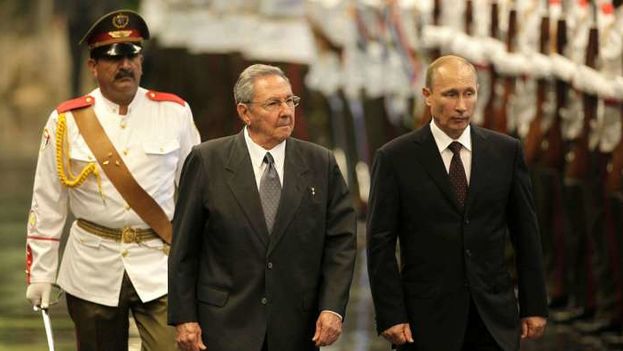
Russian President Vladimir Putin is received at the Palace of the Revolution by Raul Castro. (EFE Archive)

14ymedio bigger14ymedio, Yoani Sanchez, Havana, 28 May 2017 — After decades of intense contact, the Russians left few footprints in Cuba. Some young people with the names Vladimir or Natacha, or the nesting matrioshka dolls decorating a few rooms, are the last vestiges of that relationship. However, in recent years the links between Havana and Moscow have gained strength. The Kremlin is back.

Russia has long been disembarking in Latin America into the hands of those same governments that in international forums demand a greater respect for sovereignty and “the free choice of the people.” Its populist leaders, in part to annoy the United States, make alliances with Vladimir Putin under the premise that “the enemy of my enemy is my friend.”

That type of partnership allowed Venezuela’s Miraflores Palace to be equipped with 5,000 shoulder-launched surface-to-air missiles (MANPADS), according to a document recently published by Reuters. The arsenal began to be accumulated in the time of the late President Hugo Chavez, but is more dangerous now amid the political instability that is leading Nicholas Maduro to falter. continue reading

In Central America, Nicaragua functions as the gateway for the voracious superpower. Daniel Ortega has about 50 combat tanks sent by Moscow and his territory serves as a site for Russian military advisers. The corrupt system of the Sandinistas creates a favorable scenario for the former KGB official’s desire for expansion.

Russia has just lifted Raul Castro out of the quagmire after Caracas cut oil shipments

However, Havana remains Russia’s main ally on this side of the world. The suspicion that arose between the two countries, after the dismemberment of the Soviet Union and the coming to power of Boris Yeltsin, has been dissipating. With Putin in command, something of the USSR has been reborn and diplomatic ties are tightening again.

In the neighborhood of Miramar, west of the Cuban capital, the Russian embassy seems to have become more prominent in the last five years. Shaped like a sword plunged into the city’s heart, the building is jokingly called “the control tower,” from where the stern stepmother scrutinizes everything that occurs in her former and yearned-for domain.

Russia has just lifted Raul Castro out of the quagmire after Caracas cut oil shipments. In the years of the idyll with Chávez, Cuba received about 100,000 barrels a day of Venezuelan crude, but in recent months that amount has been reduced by more than 40%. The government was forced to cut fuel delivery to state-owned vehicles and restrict the sale of premium or specialty gasoline.

The Russian oil company Rosneft has come to Raul Castro’s aid and pledged to provide the island with 250,000 tonnes of oil and diesel, some 2 million barrels. The rescue operation leaves a trail of doubts about how the Plaza of the Revolution will pay Moscow, amid the country’s lack of liquidity and the recession.

Shaped like a sword plunged into the city’s heart, the Russian embassy is jokingly called “the control tower”

Added to the alarming signs is the fact that in recent days the son of the Cuban president, Colonel Alejandro Castro Espín, met with the Secretary of the Russian Security Council, Nikolai Pátrushev, to address the cooperation between both nations in the area of computer security. In 2014, in Moscow, the dauphin signed a memorandum of cooperation in the area of ​​intelligence.

The reunion between the old allies has been sealed with a symbolic gesture. Russia is taking care of the repair of the dome of the Capitol of Havana, which it will cover with natural stone, new bronze plates, and gold leaf that will shine under the tropical sun. A defiant message addressed directly to Washington, the city where the near twin of the imposing Cuban building stands.

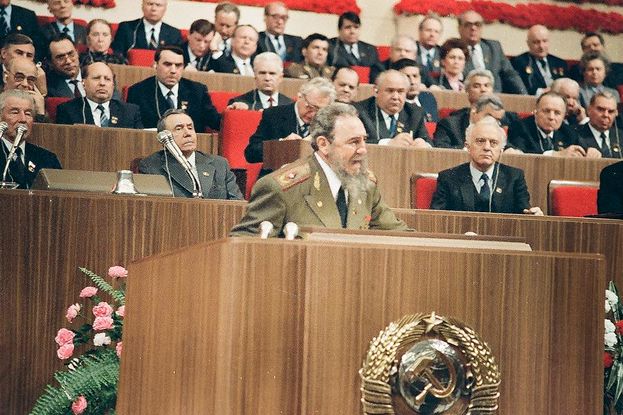
Fidel Castro delivering a speech in Moscow(Archive)

As the Russian advance unfolds in various parts of Latin America, Donald Trump looks the other way. Enveloped in the scandal of possible Putin interference in the elections that favored his arrival in the White House, the tycoon is more interested in the Middle East or in erecting a border wall with Mexico than in approaching that region more distant from the Rio Grande.

As the Russian advance unfolds in various parts of Latin America, Donald Trump looks the other way

His indifference is evident not only in his words. The US president has just proposed substantial budget cuts to the assistance provided to all of the continent, a posture that contrasts with the ground won by the Kremlin in the economic and military sphere, propping up authoritarian and decadent regimes. The Cold War is reborn in Latin America.

But this time Moscow has returned without that mask with which it hid its geopolitical longings adorned with phrases such as “support to the proletarians of the world” or “disinterested development aid to the poorest nations.”

Now it displays a cruder and more direct diplomacy. It is not willing to subsidize but intends to buy. It no longer hides under an ideological cloak, but exhibits that crude pragmatism that oozes the capitalism that the Communists ended up adopting.

If once it lost positions and had to take refuge — inside its own pride — to lick its wounds, now Russia wants to step up the pace and regain lost ground in Latin America. It knows it has allies in the region willing to skip all ethical and patriotic considerations to help it confront the United States. And it knows it must hurry, because many of these compadres are becoming more unpresentable every day.

Its cronies on this side need a Moscow that provides them with armaments and watches their backs in international organizations. They see it as a burly bear ready to show it teeth to Washington as often as needed. In exchange, they grant it positions in their nations, intelligence information and the calculated fidelity of those who expect much in return. They dream of making Russia “great again.”

______________

Editorial Note: The original text in Spanish was published this Saturday May 27 in the Spanish newspaper El País.

More Than 400,000 Havanans Affected by Break in Water Supply

The neighbors line up their buckets and other containers waiting for water to be delivered by truck in Havana. (14ymedio)

14ymedio biggerSite manager’s note: a 28 May update has raised the number number to 852,000.

14ymedio, 27 May 2017 — More than 400,000 people have been affected by a break in the main water supply conduit in the Southern Basin of Havana. The structure collapsed Thursday night after a repair and while an attempt was being made to restore the pumping of water, according to an announcement from the Havana Water Company.

A report on TV’s Havana Channel detailed that the failure caused a “total disruption” of the water supply for the Havana municipalities of Plaza of the Revolution Cerro, 10 October, Old Havana, Central Havana and some areas near Boyeros. continue reading

Engineer Javier Toledo, the Provincial Delegate for Hydraulic Resources, told local television that in the afternoon of Friday a team was “in the specific place where the external rupture occurred.” The specialist said that the works are in “an advanced stage” and should be concluded between “eight and nine o’clock at night” on Friday.

Toledo acknowledged that “a more exhaustive diagnosis has been made” of the affected area and it has confirmed that “the damage is of a magnitude a little greater” than expected. He added that the brigade doing the work found “affected locations” in several areas.

The engineer also noted that after the “immediate solution” is applied, new breaks could be expected.

A more exhaustive diagnosis confirmed that “the damage is of a magnitude a little greater” than expected

An on-site technical evaluation anticipates the possibility that a “larger pipe section” could be involved which could lead to the replacement of the structure. He said that would take “a little more time” but that “the alternatives to supply the city center by another system” are already designed.

The specialist clarified that this “alternative” would not be a total solution and would result in “partial affects” that might show themselves in limited hours or limited service.

In the Plaza of the Revolution municipality the consequences of the break are being felt. On Friday night, just like local residents, guests at the hotel on the corner of Conill and Boyeros had no water supply in their rooms.

According to official data, more than 50% of pumped water is lost due to deteriation of the network. Every year more than one billion cubic meters of water leaks out, an amount that is the equivalent of the Zaza dam, the nation’s largest.

The Future Is Built With Cement … But There Isn’t Any

A house under construction in Cuba

14ymedio bigger14ymedio, Reinaldo Escobar, Havana, 26 May 2017 — The cranes show off their slender anatomy in some areas of Havana where several luxury hotels are being built. Apart from this landscape of progress, private construction and repairs face technological problems and shortages. This week it has been cement’s turn.

“This is the third time I have come and I am leaving with an empty wheelbarrow,” a customer on the hunt for construction materials complained Thursday in the Havana’s La Timba neighborhood. The employee standing behind the counter confirmed that “they are sending less than before and every day more people come to try to buy it.” continue reading

To send, to arrive and to supply are the verbs used to refer to the state distribution of any product, be it eggs, milk powder, or tiles to cover a roof. There is an enormous supply chain responsible for distributing construction materials, in a country where 39% of the housing stock is in “regular or poor” condition.

Since the beginning of the year, gray cement has become the biggest headache for those involved in construction, a situation that has worsened in recent weeks.

Several employees of stores specializing in construction materials that offer their goods in convertible pesos say that in 2017 they have not received cement

Several employees in the stores in the capital specializing in construction materials and that sell their goods in convertible pesos, told 14ymedio that since the beginning of 2017 they have not received cement.

The government has chosen to place the product in the network that sells in Cuban pesos, the so-called national currency, in the face of previous criticisms of excessive prices in the foreign exchange network. However, a network of corruption, diversion of resources and re-sales makes it almost impossible to get one of those sacks with the precious gray powder.

The government has turned over the sale of cement to the open markets in national currency, but the shortage continues for those who repair or build houses. (14ymedio)

The national cement industry has not yet recovered from the blow that resulted from the fall of Europe’s socialist camp and the withdrawal of the Soviet Union’s subsidies to Cuba. At present, six factories on the island managed to produce slightly more than 1.4 million tonnes of gray cement last year, a figure well below the 5.2 million achieved in the same period in neighboring Dominican Republic, a country with a comparable population (about 11 million inhabitants), according to a report from the Producers Association.

The government has assigned the Construction Materials Business Group (GEICON) to produce cement in each of its variants, in addition to other building materials such as aggregates, blocks, and flooring elements, along with asbestos, fibroasphalt and roofing tiles.

The sales and marketing director of the group, Rubén Gómez Medina, recently explained on national television that despite the sector’s recovery over the last five years, it still cannot meet demand.

“Since we started, the prices of aggregates have changed from one day to the next and no one can tolerate that.”

The situation becomes complex for self-employed masons, and also for those who are part of a non-agricultural cooperative. “As there is no wholesale market, when we are contracted to do a job we have to place responsibility for the materials on the customer,” says Carlos Núñez, who two years ago obtained a license for that occupation.

The entrepreneur remembers that at first they calculated a budget that included everything, the plans, the materials and the labor. “Since we started, the prices of aggregates have changed from one day to the next and no one can tolerate that.”

A bag of gray cement last year cost just over 6 CUC in an official store. In the open markets the same bag is sold in national currency at the equivalent of 7 CUC. The lack of supply has meant that in the underground market, where it is also scarce, the price doubles and in some areas reaches as high as 18 CUC.

Cement, along with pork or cooking oil, is one of those goods that set the pace of the everyday economy. Its disappearance or shortage is a direct blow to the population’s quality of life.

Of the more than 23,000 homes that were built during 2015, less than half were erected by the state. The rest were built by the private sector.

Now, for many, the only option is to buy gray cement on the black market, or to sleep outside one of the open markets all night to see if there’s an early delivery.

On the outskirts of Fe del Valle Park, mixed among the dozens of people who connect to the Internet in this popular Wi-Fi zone, resellers abound. The site has a reputation for being a place where you can find everything, “even 12 gauge electric cables for electrical installations,” a young man nicknamed El Chino proclaims without modesty.

So as not to be confused with a police informant or an inspector, the buyer should pronounce the question in the most roundabout way. “How’s the cement coming along, pal?” El Chino arches his eyebrows and with a precise professional air answers, ” P350, which is for mounting plates, goes out of here at between 10 and 12 CUC a bag and P250, for plastering, goes for 9.”

He pauses, as if he is sorry for what he is about to confess and adds, “But right now there isn’t any.”

Several cooperatives say that part of the production in the western area has been sent to the province of Guantánamo for the repair of houses damaged by Hurricane Matthew

At the Ministry of Construction (MICONS) the officials questioned do not clarify the reasons for the shortage, although several cooperative members engaged in construction assert that part of the production of the western zone has been sent to Guantánamo province to repair the houses damaged by Hurricane Matthew.

A MICONS employee, who preferred anonymity, does not agree with that explanation and insists that “since a group of measures to promote construction by self-effort was implemented, there was a building explosion that was not foreseen in the production plans for the materials… Important hotels are being built and the supply to those places can’t be allowed to fail, so it has been prioritized,” he adds.

The most recent version of the Foreign Investment Opportunities Portfolio describes the objective of the authorities to “promote the construction of infrastructure and industrial maintenance, mainly for the nickel, oil and cement industries.” But so far potential investors are wary of putting their money in ventures on the Island.

“What has happened is that the cement industry is bottoming out and can not withstand the pressure of the high demand,” an engineer with 30 years of experience in the sector, who prefers to be called Osvaldo – not his real name – to avoid reprisals for his statements, tells this newspaper.

“It’s a chain of inefficiencies that ends up breaking down at the weakest link: the customer”

In 2016 the country’s factories have had serious problems due to the lack of maintenance but transportation has also burdened the results. “We depend on the Cuban Railways to transfer part of the material used in cement manufacture,” Osvaldo said. “It’s a chain of inefficiencies that ends up breaking down at the weakest link: the customer.”

“No new equipment or parts are coming into the country. In many factories, the furnace engines, the mechanical couplings and the mills are badly damaged,” he adds.

“This industry is the engine of prosperity, because it is the one that allows houses to be built, people to have more amenities and there is progress,” Osvaldo proudly says. “But if we do not invest a good amount of money we will continue as we are, between improvisations and defaults.”

To illustrate his comment, the engineer shows the side wall of a newly built house that is still waiting to be plastered. “It’s because I haven’t been able to find the cement anywhere,” justifies the owner.

In The Bank or Under the Mattress? Where Do Cubans Keep Their Money?

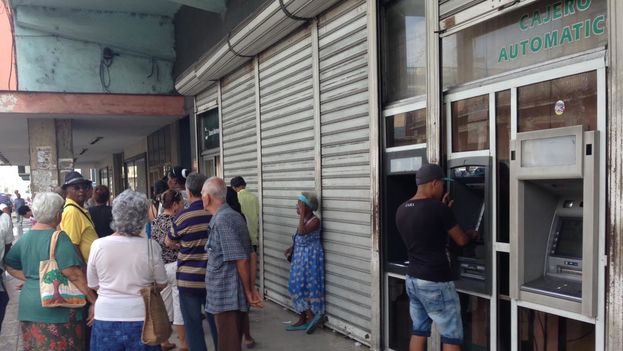
A man tries to get money at an ATM just outside a Metropolitan Bank in Havana. (14ymedio)

14ymedio bigger14ymedio, Zunilda Mata, Havana, 25 May 2017 — Finding a little bottle filled with coins that her father hid in the patio was something that happened to Eneida when she was young; now she’s a retired and says that financially she’s “escachada, without a single peso in the bank.” Her family inherited an old mansion in the center of Santa Clara, and also the determination not to put their savings in the hands of the state.

Each month, the pensioner goes to the nearest ATM, takes out the amount of her retirement, equivalent to about $12, and stores it inside an old coffee can. “I prefer to have it close because in most stores there are problems paying with a magnetic card.” continue reading

The Santa Claran also fears the authorities because, in her opinion, “you never know when they will confiscate something.”

Eneida has bad memories. Her father owned a bodega that was nationalized during the 1968 Revolutionary Offensive, and before that the small business owner had lost some of his savings with the paper currency swap decreed by the government in 1961. “He kept in the house what little they didn’t take from him,” recalls his daughter.

“He kept in the house what little the state didn’t take from him,” recalls his daughter

Since then more than half a century has passed, but many citizens are still wary of putting their money in government-run institutions.

The banking system is made up of nine banks, 14 non-bank national financial institutions, nine representative offices of foreign financial institutions and one in the process of registration. For Eneida all these entities are “the same dog but with a different collar.”

In Havana, the Metropolitan Bank seeks to attract more customers at all costs, but to the mistrust of banks is added the poor service at its branches. The long lines outside the offices and the few economic incentives to keep the money in their safes discourage savers.

The interest rates approved by the Central Bank determine that a fixed-term deposit of 72 months accumulates 7% of its amount. However, the dual currency system makes that figure ridiculous.

“I saved a third of my salary for five years to pay for my daughter’s fifteenth birthday party,” says Teobaldo, a 47-year-old from Las Tunas who transports goods from private markets to paladares and cafes. “I put it in the bank and I had no problem, but I had the illusion that the money would grow more.”

Theobald came to have the equivalent of 1,800 CUC with which he paid for the drink and the food of the party, as well as the cake and the cars to make a tour of the city and the photos of the honoree. “I had to ask my brother to send me more money from the United States for clothes, flowers and the hiring of musicians,” he adds.

It is not the mistrust of young people that guides them to not having bank accounts, but the economic precariousness of the day-to-day

As soon as his daughter’s birthday came, the small entrepreneur took all of his savings from the bank. “I did not want to set off the alarms,” he explains. In 1993, the government launched an offensive known as Operation Potted Plant aimed at confiscating products and imprisoning those who possessed “illicit money.”

The crusade became a hunt against the new rich. “If you had a nice house, air-conditioning and a well-painted façade, they would come down on you,” says Teobaldo. The Operation prosecuted two brothers  for “illicit enrichment.” One of them raised pigs and the other sold gold jewelry. After several years in prison they ended up emigrating.

Younger people see it differently. It is not mistrust that guides them to not have bank accounts, but the economic precariousness of the day-to-day. “Save money?” a young student at the University of Pedagogical Sciences who works during non-school hours as a messenger to distribute the Weekly Packet, asks with disbelief.

“Having savings is a thing for the rich,” he says. Most of their his live on what the parents give them or earn their own living, “but there is not enough to save,” he says.

Martha Beatriz Roque: “The Cuban Opposition Has Not Found The Right Path”

Cuban opposition activist Martha Beatriz Roque attended a celebration for the anniversary of independence at the CANF headquarters in Miami. (14ymedio)

14ymedio bigger14ymedio, Mario Penton, Miami, 25 May 2017 — On the verge of being operated on in Miami for a traumatic cataract caused by a punch from a Cuban State Security agent during one of the many acts of repudiation against her, the dissident and former political prisoner Martha Beatriz Roque was forceful in evaluating the trajectory of the opposition on the island, which in her judgment, “has not found the right way to reach the people.”

“We have to engage with the people and in that interaction we have to transmit to them the reality of the regime, ideas that the people understand,” Roque told 14ymedio last Monday at the headquarters of the Cuban American National Foundation (CANF), where she attended a celebration of the 115th anniversary of Cuban independence. continue reading

Roque was the only woman of the group of 74 dissidents who were arrested, tried and condemned to long sentences for crimes against the security of the state in 2003, an event known as the Black Spring that shocked international public opinion. That was her second conviction; in 1997 she was tried for writing the document “The Nation Belongs to Everyone” when she was part of the Working Group of the Internal Dissidence.

“Often the opponents go out into the street and shout ‘Down with Fidel, down with Raul, long live human rights,’ but people don’t even know what their rights are”

“Often the opponents go out into the street and shout ‘Down with Fidel, down with Raul, long live human rights,’ but people don’t know what human rights are, often they don’t even know what their rights are,” she added.

The opponent recalled how the demonstrators sent by the government itself often shout, “Down with human rights!”

“We have to reach the people through things that interest them. The Cuban opposition hasn’t found a strategy that links to the people and their problems,” she said.

The government opponent believes that the people have not been allowed to talk about their rights for a long time, so it is useless to try to explain hypothetical proposals for reforms in the Constitution.

In her opinion, among the serious problems that Cuba is experiencing is the absence of a future.

“Cubans have no future, so they want to emigrate because they know that Cuba has no future. We must try to make people understand the importance of building that future,” she added.

On the Venezuelan situation and its repercussions on the island, Roque believes that Raúl Castro’s government “fears” the consequences that could come with the end of Chavismo, to which is now added the increasingly clear position of the American president, Donald Trump, on the policy towards Cuba.

“I think things are going to change a lot in Cuba if they change in Venezuela,” she said. She also said that the path found by the Venezuelan opposition was very difficult for Cuban dissident groups, because the conditions are very different.

“I think things are going to change a lot in Cuba if they change in Venezuela”

Roque believes that the absence of concrete actions against the Raul Castro government by the Trump administration “gave the regime a lot of strength to continue repressing the opposition” and in particular to groups “that annoy them a lot.”

The 72-year-old woman does not believe that significant changes should be expected from Raul Castro’s promise to step down as president of the Council of State in 2018.

“Castro does not leave power, he continues to lead the Party and in Cuba the Communist Party is who has power, which means that he’s not going to leave power at all,” she added, adding that the advent of new figures such as current vice president Miguel Diaz-Canel will not mean a change in the system.

“Diaz-Canel is a puppet who just opens his mouth when they tell him to say what they want him to say,” she added.

Despite the grim picture, the dissident says that there is “slow movement” within the opposition in Cuba and that this year will see the first fruits of “the long struggle of the exile and opposition to bring freedom to the island.”

Cuba Seeks To Use Tourism Boom To Boost Other Economic Areas

Tourism is one of the main sources of income for the Cuban economy. (EFE)

14ymedio bigger14ymedio, Havana, 20 May 2017 — Cuba seeks to take advantage of the recent rise of tourism, one of the locomotives of the island’s economy, to boost other areas and local services, in which the tourism sector invested more than 310 million Cuban convertible pesos in 2016.

This figure represents approximately 64% of the operating expenses incurred by state tourism companies, compared to 160 million CUC spent on the import of food and other products from abroad, some 26% of total expenditures, according to an article in the newspaper Juventud Rebelde.

Last year Cuba bought cutlery, crockery, linens, office supplies, cleaning supplies, disposable products and furniture, as well as preserved fruits and vegetables, sausages, dairy products, jams and beers, given that domestic supplies could not meet the demand. continue reading

To confront the boom of foreign visitors to the island, which this year is expected to surpass the 4 million tourists received in 2016, the country plans to build 224 new hotel facilities by 2030

During a forum of the fourth National Business Fair, happening in Havana and ongoing until Thursday, leaders of Cuban Light Industry said they had already made “a group of micro-investments to expand capacities” and offerings for the tourism sector.

The general director of the National Company of Select Fruits, Juan Carlos Rodríguez, stated that by 2017 some 60 local companies will guarantee 128 agricultural products and anticipated that they will engage in more efficient agrotechnical practices to produce prioritized and high demand crops such as fruits and vegetables.

To confront the boom of foreign visitors to the island, which this year is expected to surpass the 4 million tourists received in 2016, the country plans to build 224 new hotel facilities by 2030, said María del Pilar Macías, director general of the Ministry of Tourism (MINTUR).

The goal is to build 103,000 new rooms by that year, she explained.

In addition, MINTUR plans to refurnish and build more than 20 nautical and marine clubs, an equal number of real estate properties to house foreigners, and the same number of golf courses with almost a dozen associated hotels, some of them already underway with companies from Germany, China and Spain.

State Security Offensive Against ICLEP Citizen Journalists

Raúl Velázquez, ICLEP’s executive director in Cuba, was released without charge after 72 hours detention. (ICLEP)

14ymedio bigger14ymedio, Havana, 23 May 2017 — Raúl Velázquez, executive director of the Cuban Institute for Freedom of Expression and the Press (ICLEP) was released last Friday after being held for 72 hours in the second unit of the People’s Revolutionary Police (PNR) in Santiago de Cuba, as confirmed Monday by the agency through a press release.

The journalist had been arrested on Tuesday 16 May when he was sleeping at the home of the #Otro18 (Another 2018) activist María Mercedez Benítez. According to the Institute, Velázquez had his cell phone confiscated and was photographed from various angles by the State Security before they opened a “criminal file for the alleged crimes of subversion, propaganda of illegal print materials and counterrevolutionary plans.” continue reading

The ICLEP claims that the arrest of its executive director was not the only one that took place against people engaged in information dissemination, since it coincided with the arrest of four other citizen journalists.

In Colón, Matanzas province, Alberto Corzo, an independent reporter and administrative, monitoring and evaluation director of ICLEP, was threatened with imprisonment for his information work, and was detained for approximately three hours during which time he was reminded that he was under indictment for the alleged offense of contempt against a police collaborator.

In the first 20 days of this month, the political police have committed 13 repressive acts against citizen journalists working on ICLEP media

A day later, on Wednesday 17 May in Pinar del Rio, the citizen journalist Ivis Yanet Borrego was summoned and interrogated for three hours “in a disrespectful and rude way,” according to the institute. Borrego is the director of the publication Panorama Pinareño.

“Officials banned the journalist from continuing to work for ICLEP and assured her that they would retaliate against all the journalists until they ‘disappeared’ from the face of the earth,” the statement said.

On Thursday, 18 May, two additional Pinar del Rio citizen journalists, Ernesto Morales Estrada and Calixto E. Miranda Landeiro, were threatened with imprisonment if they continued to collaborate with ICLEP.

According to the organization, in the first 20 days of this month, the political police have committed 13 repressive acts against citizen journalists working with ICLEP media.

Vending Machines for Alcoholic Beverages

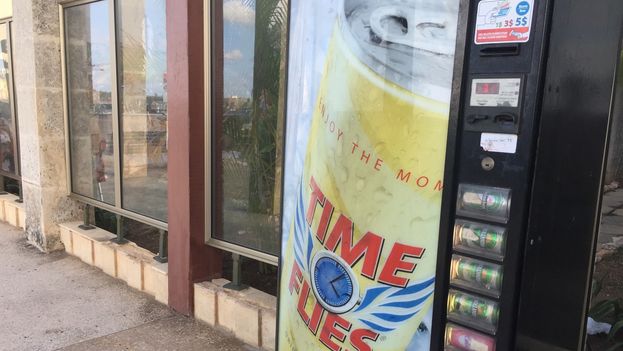
Several of these machines are located in downtown streets of Havana, accessible to anyone regardless of age. (14ymedio)

14ymedio bigger14ymedio, Marcelo Hernandez, Havana, 23 May 2017 — The campaigns against the consumption of alcohol have met an enemy. This is not an outspoken advocate of Mojitos or Cuba Libres, but of the vending machines that dispense national and imported beers simply at the introduction of a few coins. Several of these devices are located in the central streets of Havana, accessible to anyone regardless of age.

“Go get me a Heineken from the machine next door,” a father said to his little son from the doorway of a tenement on the Malecon. A few feet away, without controls or supervision, stands the automaton that catches kids’ attention because it “spits cold cans,” said one of them. No employee of the nearby restaurant, La Abadía, seems to pay attention to who uses the service.

A recent survey found that 36% of Cuban youth drink alcohol and 12% drink and smoke. Among them an alarming number begin to consume tobacco and alcohol between the ages of 11 and 13.

A common practice among parents is to encourage their sons, still minors, to have a sip of rum because “it’s a men’s thing.” For many adolescents virility is measured in the amount of “lines” of alcohol they can consume. A trend that these vending machines, without any controls, will facilitate even more.

Across the pond, in Spain, the sale of beer through the use of vending machines has been banned since 2010, according to a law enacted that same year that limits the access of alcoholic beverages to minors.

Cuba Loses More Than Half of the Food Harvested, Reports a Spanish NGO

In Cuba, losses during harvest and after collection represent 30% of total production, plus an additional 27% during distribution. (EFE)

14ymedio bigger14ymedio, Havana, 23 May 2017 — Agriculture in Cuba is among the lowest performing in Latin America according to an evaluation published by the non-governmental organization Mundubat, based in the Basque Country (Spain). On the island, losses during harvest and after collection represent 30% of total production, while during the distribution stages they reach an additional 27%.

The report includes an evaluation carried out jointly between Mundubat and Veterinarians Without Borders (VSF). Both organizations are part of a cooperation agreement with Cuba, started in 2014 and funded mainly by the Spanish Agency for International Cooperation for Development. continue reading

Mundubat and VSF have been working on the island since 1993 in projects that promote food sovereignty and gender equality. The entities work in collaboration with official organizations, including the National Association of Small Farmers, the Cuban Association of Agricultural and Forestry Technicians, and the Cuban Association of Animal Production.

The report sees as a positive sign that “the cooperative sector already has 80% of the land and produces more than 90% of the food produced in the country,” but notes that domestic production “only covers 20% of the population’s needs.”

The biggest problems detected in food production on the island have their origin in the “weakness of the cooperative institutional framework in which agricultural production is organized,” the report said.

“Domestic food production only covers 20% of the populations’ needs”

The cooperatives lack an “internal evaluation of the efficiency and ecological sustainability of the models of production,” demonstrate a “lack of knowledge of the regulatory frameworks,” suffer deficiencies in their facilities, and have “little involvement from their members,” says Mundubat.

The island suffers from “degraded soils with low levels of organic matter, and high incidence of pests and diseases,” along with “high salinity, soil compaction and overgrazing.” Invasive weeds and contamination from manure aggravate the picture.

“The scarce investment in technology” limits “production even more.” Mundubat describes the final products offered for consumption as being of “low quality.” A situation that points to “poor processing in the early stages of harvest,” “deterioration of storage systems” and “lack of experience in adding value to primary products.”

The different productive units “do not meet the [island’s] internal demands” and the food supply is characterized by “the low and unstable availability of food throughout the year” and fluctuating prices.

The report warns that women have “a low presence” in positions and structures of management in the agricultural sector and “endure the sexual division of labor.” While “rights holders and producers are men,” women occupy “agricultural labor posts” in agribusiness processing chains and in retail distribution.

“The sector’s returns are stagnant or have decreased slightly,” warns the report, which predicts that to the extent that agriculture “does not increase its yields and exploit its productive potential, the economy will have to assume significant expenditures to supply its domestic demand,” that is, for purchasing food from abroad.

Cuba Fails To Eradicate Smoking In Schools

More than half of Cuban families are exposed to environmental tobacco smoke: including 55% of children, 51% of pregnant women and 60% of teens. (14ymedio)

14ymedio bigger14ymedio, Havana, 23 May 2017 — Images of students who smoke during recess or between breaks in class, and teachers who light up their cigarettes in the classroom are common in Cuban schools. In spite of the frequent anti-tobacco campaigns promoted by the media, in recent years Cubans have begun smoking at ever earlier ages.

The head of the Independent Department of School Health in the Ministry of Education, Yanira Gómez Delgado, expressed to the newspaper Juventud Rebelde her concern about exposure to tobacco smoke in schools and noted that the regulation requires that “no person who works in schools can smoke there.”

“It is not enough to avoid students suffering the effects of being passive smokers, but it is also necessary to promote anti-smoking with the example of their own behavior, and to distance themselves from a gateway drug, which cigarettes are considered to be,” warns Gómez Delgado. continue reading

The country does not yet have a tobacco prevention and control law that more strictly penalizes those who smoke in social spaces, and although in 2005 the authorities banned smoking in closed public places, the measure is barely complied with.

The country does not yet have a tobacco prevention and control law that more strictly penalizes those who smoke in social spaces

More than half of Cuban families are exposed to environmental tobacco smoke: 55% of children, 51% of pregnant women and 60% of adolescents, said Dr. Elba Lorenzo, head of the National Tobacco Program. The specialist believes that the island is one of the countries with the “greatest prevalence of the problem” worldwide.

Lorenzo is committed to “creating smoke-free spaces in society” as “the only effective and recognized means of protecting children, adolescents and young people” from the harmful effects of smoking.

In mid-2015, the Ministry of Public Health reported that 36 people on the island die of tobacco-related illnesses every day. Dr. Patricia Varona, of the Society of Hygiene and Epidemiology of Cuba, told the official press that smoking is the non-genetic disease that most affects Cubans’ life expectancy.

Cuba occupies fourth place among Latin America countries in the prevalence of smokers, behind only Chile, Bolivia and Uruguay. There are 2,198,133 smokers on the island, including 1,431,441 men and 766,691 women, representing 23% of the population. Some 10% of them smoke more than 20 cigarettes a day.

Economic Crime, the Pitfall in the Path

14ymedio bigger14ymedio, Generation Y, Yoani Sanchez, 22 May 2017 — The saleswoman described her merchandise in a murmur: loggerhead turtle steaks, beef and shrimp. The man salivated, but replied that he could not buy any of those products, the most persecuted in the informal market. Every opponent knows that the authorities would want to try him for an “economic crime,” and perhaps that saleswoman was just the bait.

The techniques used by an authoritarian government to control citizens can be as varied as the fertile imagination of the repressors. Some are designed in air-conditioned offices using studied methodologies, while others arise on the fly, from seemingly fortuitous situations.

Are the economic constraints that we live under a calculated scenario to keep Cubans locked in a cycle of survival? Do so many prohibitions seek to leave us civically paralyzed, feeling ourselves guilty and with one foot in a prison cell? continue reading

Beyond the conspiracy theories, officialdom has managed the informal market as trap for the nonconforming, a framework for gathering information about the deep Cuba, an element of blackmail against its citizens and a lure to hunt down political opponents.

Although it is a practice that has been engaged in for many years, in recent months there has been an increasing tendency to accuse activists of alleged economic infractions

The Plaza of the Revolution has turned its bad economic management into another way of keeping society in its fist. It knows that families will do everything possible to put food on the table and will turn to the underground networks to buy everything from their children’s shoes to the dollars that at the official currency exchanges are taxed at 10%.

In many cases it is just about waiting, like the spider who knows that sooner or later the little insect will fall into its sticky threads. State Security only has to wait for a dissident to buy coffee “under the table” or to dare to have the bathroom retiled by an unlicensed tile setter.

Although it is a practice that has been engaged in for many years, in recent months there has been an increased tendency to accuse activists of alleged economic infractions. They are charged with crimes that ordinary Cubans commit every day under the patronizing eyes of the police and with the complicity of officials or state administrators. However, in the case of an opponent, the law has the capacity to be narrower, more rigid and more strictly observed.

In all international forums, Raúl Castro’s government boasts of not having political prisoners and it supports this argument by severely, but politically selectively, criminalizing such trivial matters as keeping four sacks of cement or a few gallons of fuel at home, without being able to show the papers that prove they were purchased in state stores.

Journalist Henry Constantin is accused of “usurpation of legal capacity” for working as a reporter in an independent publication, but dozens of ex-military are appointed managers of tourist facilities without ever having studied hotel management or business management. None of them have been reprimanded for serving in a position for which they are not formally qualified.

The lesson is that no matter what degree of economic illegality you commit, keep your mouth shut and don’t criticize the government

Karina Gálvez, a member of the Coexistence Studies Center, is being prosecuted for alleged “tax evasion” during the purchase of her home. However, before the new tax imposed on real estate transactions came into force, thousands of Cubans thronged the notaries to complete their paperwork under the previous tax laws, far removed from the real estate market rates. Not one was sanctioned.

Eliécer Ávila, leader of the Somos+ Movement, had his home broken into in a police raid and is charged with the offense of “illicit economic activity.” His “crime”: possessing a laptop, rewritable discs and several disposable razors. Unlike those thriving artists who import the latest iMac from the market or “Daddy’s kids” – children of the regime’s leaders – who have a satellite dish to watch Miami television, the activist committed the offense of saying he wants to help change his country.

The lesson is that no matter what degree of economic illegality you commit, keep your mouth shut and don’t criticize the government. It is not the same to buy beef in the informal market when you pretend ideological fealty to the regime, than it is to do the same when you belong to an opposition movement.

The black bag can become a wall, a noose, a hidden trap for those who do not applaud.

Cuba’s Fake Transport Co-ops

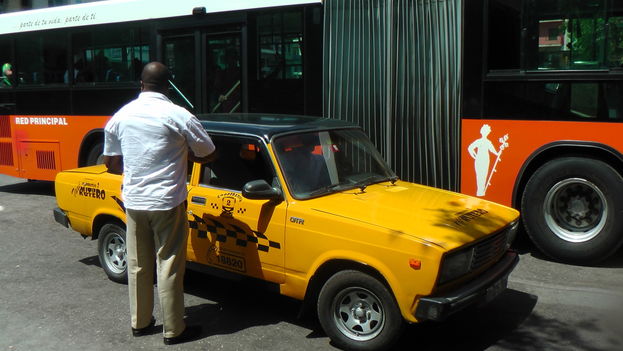
One of the new ‘Rutero” taxis, with an articulated city bus in the background. (14ymedio)

14ymedio bigger14ymedio, Pedro Campos, Miami, 18 May 2017 — In an effort to persuade Cubans and the international left that “Cuba is building socialism,” while seeking to convince the world that Castroism is abandoning State Totalitarianism and also trying to counteract the relative independence achieved by the so-called boteros, or boatmen, as independent taxi drivers are known, the state’s effort to “update the economic model” includes the introduction of what they are calling Taxi Rutero, offering rides at 5 Cuban pesos per trip.

They are not cooperatives, in their strict sense, because they do not arise from the spontaneous idea of ​​workers pooling their capital and resources to organize production collectively and distribute profits. Rather, they are state-owned leasing companies, called cooperatives, that hire vehicles to the drivers who are given some advantages, such as low gasoline or oil prices, and who are paid daily but must hand over everything they collect. More or less what they have been doing with the urban buses in the capital lately. continue reading

Now, faced with the state’s inability to deal with the boteros, it decides to invent “taxi cooperatives” which are nothing more than a version of the bus cooperatives, featuring cars

Now, the state is confronting its inability to deal with the boteros who, faced with inflation generated by bureaucratic policies and their problems getting fuel, decided to raise prices and launched a kind of strike when the state imposed a price cap. So, instead of negotiating with them and finding solutions that solve the problem for the good of everyone, the state decides to invent “taxi cooperatives” which are nothing more than a version of the bus cooperatives, featuring cars.

The system is more or less the same. In state cars, with state gasoline and state spare parts, a car is rented to a strike-breaker – the new scabs – for one thousand Cuban pesos a day, and then they are paid 800 Cuban pesos a month; an almost unbelievable arrangement that could only have been invented by the “state cooperatives.”

The cutting edge of the new “cooperatives” is clearly directed against the boteros, setting a price of 15 pesos for a ride that the private drivers charge 20 to 25 Cuban pesos for.

This is not a solution to the transportation problem, this is an attempt to crush the boteros, because Cuba’s intolerant state system does not know how to and has no interest in negotiating with people, with the workers, it only knows how to impose.

Something similar has been done with service “cooperatives,” such as cafes, shoe repairers, household appliance repairers and others, in old unsustainable state entities. In practice, they have leased the premises and equipment, without ever being offered the property and with the subsequent activities subjected to countless state controls. It’s a lie. There is nothing “cooperative” about it.

It has already become common for the Castro’s Stalinist and antisocialist state to label their para-state inventions cooperatives.

These misrepresentations come from the early years. Then, under the personal leadership of Fidel Castro, the sugar cane cooperatives were created, without giving them the land. The system of sugarcane cooperatives showed signs of increasing independence, controlling their own finances, creating the village shops, and forcing the Sugar Industry Ministry to pay for the cane they cut, plus they had their own militias and bought the machinery they needed with their own money.

Later, when it became clear that the agricultural farms were not working with wage labor, they invented the Basic Units of Cooperative Production

When Carlos Rafael Rodríguez was appointed president of National Institute for Agrarian Reform (INRA) in February 1962, he dissolved the sugarcane cooperatives in the middle of that year’s harvest, to create “farms for the people,” and thus to convert those in the cooperatives into wage laborers. He handed over their lands to Che’s Sugar Ministry (MINAZ), and thereby destroyed the monetary-mercantile relationship between agriculture and the sugar industry.

Later, when it became clear that the agricultural farms were not working with wage labor, they invented the Basic Units of Cooperative Production, UBPC, cooperatives in name only because the workers continued to receive salaries from the State. These salaries were linked only to meeting the “Productive Plans,” not to the actual market results, and the plans were developed by the state with the requirement that they deliver the production the plans “committed” them to, to a collection system where the prices were set by the buyer (i.e. the state). A complete farce.

Sometimes we give the socialists the benefit of the doubt. Has this arbitrary management of the concept of cooperativism led us to the point where its manipulators have no idea what a cooperative is? Do they do it to try to fool the uneducated politicians who abound everywhere? Or is it part of a plan to discredit the original socialist idea of ​​Karl Marx’s self-managing cooperativism?

Whatever the answer is, it is, at the very least, detestable.