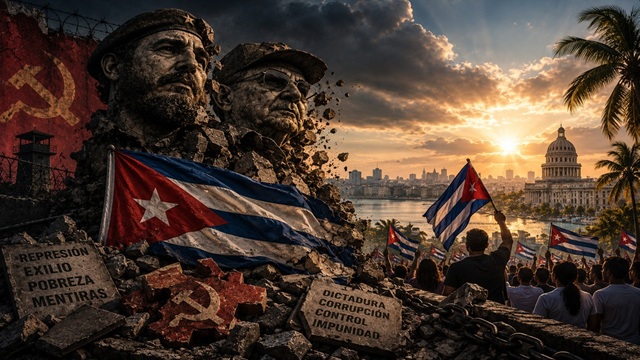
Julio M. Shiling, Miami, 4 September 2026 / Dictator Raúl Castro is ninety-five. Rumors of his impending death—or of his already having died—circulate with the grim inevitability that attends any long-lived tyrant. Whether the reports prove premature or not, the underlying truth remains: the last foundational brother of Cuba’s bloody ruling duo is nearing the end of his biological tenure. That fact is not incidental. It is a political inflection point.
Castro-Communism was never merely another Marxist-Leninist regime. It fused the totalitarian apparatus of the party-state with a sultanist structure of highly centralized, personalistic power. Fidel Castro supplied the charismatic ideology and the revolutionary myth. Raúl supplied the institutional muscle and the dynastic continuity. The death of the older dictator Fidel in 2016 produced a foundational rupture. The surviving brother absorbed the remaining personalist authority and kept the system intact. With Raúl’s own exit, that personalist core is finally exhausted. What remains is the apparatus itself—still operational, still predatory, still staffed at its highest levels by the family and its retainers.
The evidence of sultanism is not subtle. Alejandro Castro Espín, Raúl’s son, long known as el tuerto, has headed the counterintelligence apparatus. Raúl Guillermo Rodríguez Castro, the grandson called el cangrejo, has directed the grandfather’s personal security and affairs. Cousins and other relatives occupy commanding positions across the military, the security services, and the economic fiefdoms that constitute the regime’s kleptocratic backbone. This is not the impersonal bureaucracy of classical Leninism. It is a family enterprise wrapped in Marxist- Leninist language and enforced by a totalitarian security state. The nomenclature “Castro- Communism” is therefore precise: it names both the ideology and the dynastic mechanism that has sustained it for sixty-seven years.
The death of any tyrant is cause for celebration. The moral ledger is unambiguous. Fidel and Raúl Castro presided over a system that murdered, imprisoned, exiled hundreds of thousands of Cubans and basically, destroyed a country. The Castro dictatorship exported violence and subversion across Latin America, Africa, and beyond. It treated American citizens and others as disposable instruments of geopolitical theater. That they escaped formal justice is a tragedy measured in unmarked graves, broken families, and decades of silenced testimony. Their physical disappearance does not erase the crimes. It merely removes the last living founders from the stage.
Yet the system they built outlives them. Castro-Communism is not a personality cult that collapses with its cult figures. It is a structured order of party control, military dominance, economic monopoly, and systematic repression. The death of Raúl Castro will accelerate the disintegration of the personalist cement that held the structure together, but it will not automatically dissolve the structure. Those who continue to staff and benefit from it—party officials, generals, security chiefs, and the extended family network—have every incentive to preserve the arrangements that guarantee their power and their plunder. Continuity is their project.
Justice, therefore, requires more than the natural death of a cruel old man. It requires the deliberate death of the system. Cuba must be de-Castro-Communized. The communist- kleptocratic monstrosity that has ruled the island for nearly seven decades must be comprehensively dismantled. That project is not vengeance. It is the necessary precursor to any genuine democratic opening. An ambitious process of transitional justice must examine the full record: the political prisons, the extrajudicial killings, the forced exile of an entire generation, the economic sabotage of the nation, and the international crimes committed in the name of “internationalism.” The bloody legacy of the Castro brothers must be documented, publicized, and adjudicated so that it cannot be sanitized by successors who will otherwise claim reform while retaining the essential levers of control.
The alternative is familiar and depressing. A managed succession, cosmetic liberalization, selective repression, and the continued extraction of wealth by the same networks under new labels. History offers too many examples of totalitarian regimes that outlived their founders only to reproduce the same pathologies under different faces. Castro-Communism has already demonstrated its capacity for adaptation without surrender of power. Only the systematic dismantling of its institutions, the exposure of its crimes, and the removal from authority of those who sustained it can prevent that outcome.
Raúl Castro’s death, when it comes, will be a contribution to the regime’s disintegration. It will not be the victory itself. Victory and true liberation will arrive only with the death of Castro- Communism in its entirety—the ideology, the security apparatus, the dynastic privileges, and the culture of impunity that has defined Cuban public life since 1959. Until that larger death is achieved, the Cuban people remain subject to a system designed to outlast any single man, however long he lived and however many he destroyed.
© The CubanAmerican Voice. All rights reserved.