
Felton, Cuba’s Largest Power Plant, Closes Again Due to a Breakdown

The Felton thermoelectric power plant’s Unit 1 stopped working on Thursday and they plan to reconnect it this Sunday. (Ahora!)

14ymedio bigger14ymedio, Havana, 30 July 2022 — The Felton thermoelectric power plant, located in Mayarí (Holguín), once again becomes a stressor for the Cuban government. This Thursday, a breakdown in the boiler of unit 1 caused its exit from the National Electrical System, while unit 2 remains disabled due to the large fire suffered at the beginning of July.

The energy colossus is again unusable, with the consequent balance of scheduled blackouts, without the officials who came to inspect the Felton plant agreeing on the date of a possible solution.

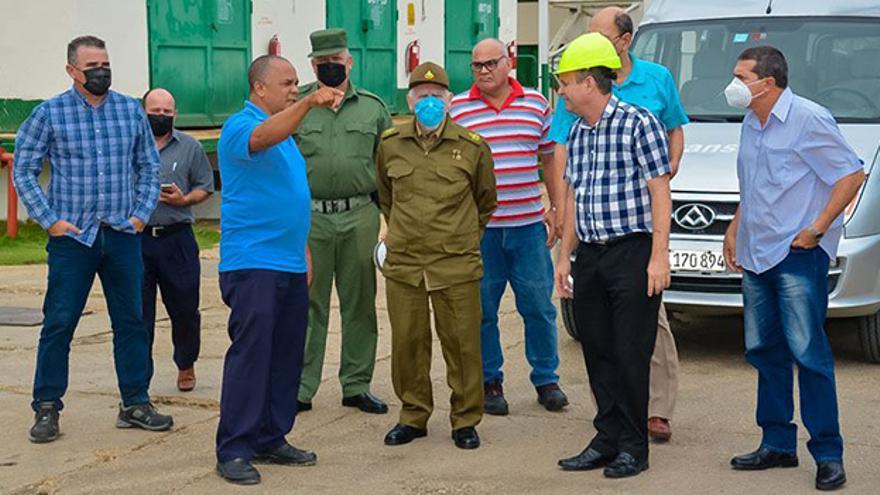
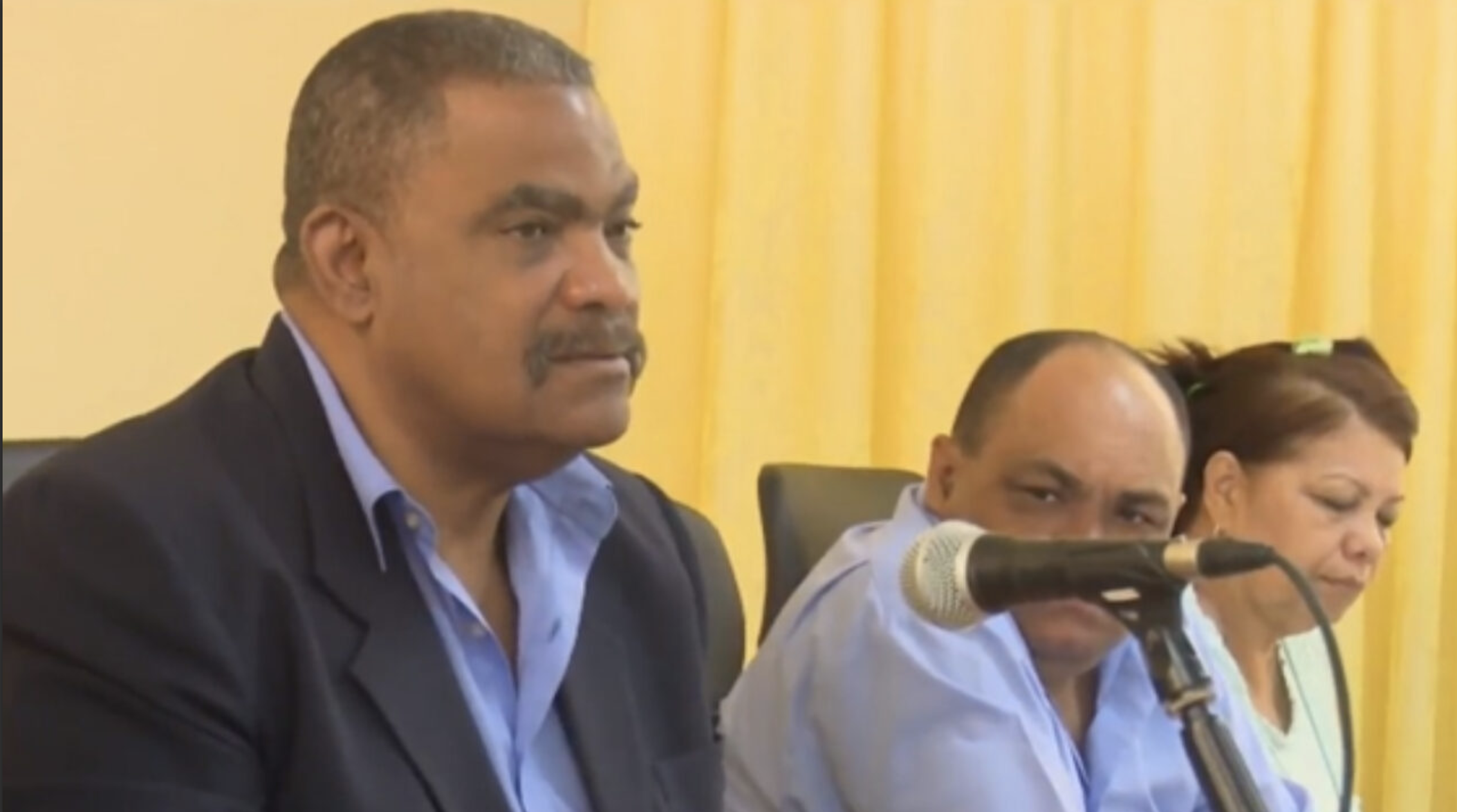
This Friday, the nonagenarian commander, Ramiro Valdés, and the Minister of Energy and Mines, Liván Arronte, along with the local governments, went to the plant to “confirm the causes of the breakdown in unit number 1” and know “the projections to put unit 2 into operation,” according to the provincial newspaper Ahora!

Valdés, who refuses to recognize the critical state of the plant, recommended “convening the best specialists in the country, mainly infrastructure builders, and having them full time in that function.”

He revealed the government’s annoyance with the delay in repairs and new incidents, which not only affect the population but also the administrative capacities of the State: “The nation invests one million dollars every three days in fuel to supply the generators that work before the exit of the thermoelectric plant,” he explained. continue reading

However, the head of Energy and Mines doesn’t share the urgency of Ramiro Valdés. Arronte assures that, since the fire of unit 2, “all the necessary companies” have been projecting repair schedules. So “we must not rush to give a time of completion.”

The minister admitted that, as for the unit destroyed by the fire, “virtually the entire boiler has to be dismantled; it’s a job that we have never done before.” To the difficulty of repairs is added the slow process of achieving the necessary “safety conditions,” since “the boiler was in a state of risk” that could lead to collapse.

According to Arronte, Felton already has 22 years of operation in its current state, which makes it necessary to do “a residual life study” of its machines. He added that numerous calculations and analyses are missing, in addition to a contact with the manufacturer of the boiler, to consider the total functionality of the thermoelectric plant.

Both Valdés and Arronte avoided detailing the recent breakdown of unit 1. However, the technical director of the thermoelectric plant, Euclides Rodríguez Mejías, explained to the local official press that “there was a leak near the upper thermal chamber, which is in the cooling process,” although, according to the operator, the causes of the breakage are not yet known.

“We predict that in the evening of this Friday or early hours of Saturday, that area can be accessed, because it’s a very warm area, with little air circulation, so you have to wait for it to cool down to make a diagnosis and then start the relevant work,” said Rodríguez Mejías.

Felton workers expect unit 1 to become operational this Sunday, while on Monday the dismantling of the boiler will begin, a “task that does not allow for errors,” due to the “damages that this gigantic structure already has.”

Slowness and precariousness at work characterize the repair process of Cuban thermoelectric plants, which aggravates the balance of blackouts already suffered by the population of the island. In the face of the crisis, local governments are implementing new programs to cut off electricity.

The governor of Havana, Reinaldo García Zapata, reported that new four-hour power outages are scheduled from 10:00 am to 2:00 pm, every three days. The cuts will be made to “save fuel” and thus guarantee “fewer blackouts in the rest of the provinces, where during these months the population has assumed that burden as a result of the generation deficit and fuel shortage, exacerbated by the intensified blockade,” García said.

There will be no blackouts, according to the official, in the circuits linked to continuous production, water pumping and public health. García added that in the state workplaces “the waste” of electricity is evident, which has led to disciplinary measures. He also admitted that these measures will not be enough if they aren’t linked to a pattern of economic development that the country doesn’t yet have.

Breakdowns, lack of parts, old machines and historically awkward management of the energy sector further heat up the summer in Cuba. Night protests, increasingly frequent, are the only way to channel the despair of citizens, who are also overwhelmed by the lack of food and growing police repression.

Translated by Regina Anavy

____________

COLLABORATE WITH OUR WORK: The 14ymedio team is committed to practicing serious journalism that reflects Cuba’s reality in all its depth. Thank you for joining us on this long journey. We invite you to continue supporting us by becoming a member of 14ymedio now. Together we can continue transforming journalism in Cuba.
Cuban Diplomats and Opponents in Front of the Castro House Museum in Galicia

Plaque installed on the door of the house before it was a museum. (Láncara House)

14ymedio bigger14ymedio, Madrid, 27 July 2022 — The birthplace of Ángel Castro Argiz, father of Fidel and Raúl Castro, will be inaugurated this Thursday in Láncara, in the Spanish province of Lugo, as an interpretation center for Galician migration. The museum, which will be officially called Casa Láncara, has delayed its opening for two years, due to the pandemic.

Marcelino Medina González, Cuban ambassador to Spain, will be received at the town hall before attending the event, convened just 30 years after Fidel Castro’s visit to Láncara to see the humble home where his father was born. Other descendants of Castro Argiz will be at the event, in addition to the Cuban consul in Galicia, Yahima Martínez Millán, according to the Spanish radio station Cope.

This Wednesday, Marcelino Medina González was received at the headquarters of the Confederation of Employers of Lugo, whose general secretary, Jaime López, spoke to the radio station about the “internationalization” strategy of the employers’ organization and how important it is to have a good relationship with the Island for the commercial expansion of their companies.

The Casa Láncara project arose from the transfer of the house by the family to the Asociación Amistad y Solidaridad Láncara-Cuba in 2018. The signing was apparently complex, because the heirs wanted to disassociate the project from the authorities to avoid eventual changes of government from posing problems.

The only condition, apparently, was that the original house be replicated. In November 2018, the Castros gave their approval to the project, by the architect from Sarria (neighboring town) José Ángel López, who in turn presented it to the Association and Mariela Castro during a trip to Cuba.

On the part of Spain, the City Council of Láncara, the Provincial Council of Lugo, the Confederation of Entrepreneurs and the Urbas construction group have participated, while from Cuba the Cuban Institute of Friendship with the Peoples (Icap) and the Office of the Historian of the Havana city. continue reading

The museum revolves around four axes: Galician emigration to America; Ángel Castro Argiz; the visits of the Castro Ruz family to Láncara; and their role in the history of Cuba. Inside there are three rooms: the entrance, which was formerly the kitchen-dining room, with characteristic furniture from the early 20th century; the alpendre (shed), where an audiovisual room has been installed; and the old stables, which serve as an exhibition area, including Cuban objects related to immigration and photographs.

In 2020, when the inauguration was suspended, the video and photographs of the exhibition area had already been made and it was expected that personal objects from the Castro family home in Birán would arrive from the Island, as well as five palm trees that were going to be planted in the exterior and that must be adapted to the climate of the Galician interior.

The house was not, at the time, the object of great interest to Fidel Castro who, after visiting it in July 1992, together with the then president of the Galician government, Manuel Fraga, said he had found that it was one of the poorest in the area. The former Cuban president was then named Láncara’s adoptive son and showed his pride in the fact that the house was not “a palace, but a very humble shack.”

Years later, in 2005, his brother Raúl also visited it.

The father of the Castros emigrated to Cuba, then a land of opportunity, shortly after returning to Spain after having served as a soldier in the Spanish troops during the War of Independence in 1895. At that time, he had to barely survive cutting cane, but he ended up owning a farm in Birán and becoming a rich landowner thanks to sugar.

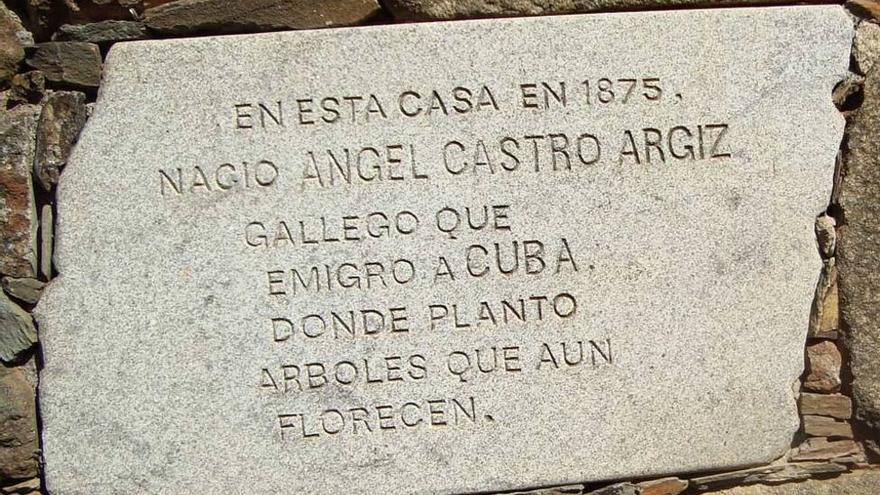
The house is preceded by a plaque that reads: “In this house in 1875 Ángel Castro Argiz was born, a Galician who emigrated to Cuba, where he planted trees that still flourish.”

Two Cuban activists, Enriquez Nodarse and Avana de la Torre, arrived at its doors on July 19, announcing an “anti-communist” tour through Galicia. Both were photographed at the entrance of the Casa Láncara with the Cuban flag and a poster with the faces of the Cuban political prisoners.

This Tuesday, the Cubans approached the monument to José Martí installed in the Eugenio Granell park, on the outskirts of the Galician capital, Santiago de Compostela. De La Torre was recording a video to demand the freedom of political prisoners when the Cuban consul Yahima Martínez Millán appeared and tried to prevent the filming by covering the phone camera, at which point a dispute began when the activist accused the diplomat of assaulting her and warned she would call the police.

____________

COLLABORATE WITH OUR WORK: The 14ymedio team is committed to practicing serious journalism that reflects Cuba’s reality in all its depth. Thank you for joining us on this long journey. We invite you to continue supporting us by becoming a member of 14ymedio now. Together we can continue transforming journalism in Cuba.
Cuba’s New Laws, a Strategy for the Debacle / Dimas Castellano

Dimas Castellanos, 1 July 2021 —  To improve the image of Cuban laws — outdated with respect to the international legal system — the Supreme People’s Court (TSP) submitted four preliminary drafts to the National Assembly of People’s Power for approval: Law on the Courts of Justice, Code of Proceedings, Law on Administrative Procedure and Law on Criminal Procedure. According to the president of the TSP, Rubén Remigio Ferro, it is “the most innovative proposal and the one that most intensely impacts the rights and guarantees of citizens vis-à-vis the Administration.”

In the following lines I present three factors that call into question the statement of the president of the TSP: 1- The subordination of the judiciary, 2- The international covenants ,and 3- The reason for the preliminary draft laws

Subordination of the judiciary power 

Constitutionalism, the foundation of governance, emerged in history as a necessity to establish limits to power. In Cuba, although it debuted at the beginning of the 19th century, it took shape in the Constitution of the Republic in Arms (Guáimaro (1869), which adopted the type of republican government, deposited sovereignty in the people, endorsed the division of powers and prohibited attacking the freedoms of worship, the press, peaceful assembly, teaching and petition or any other inalienable right of the people. From that root the Mambise constitutions of Jimagüayú (1895) and the Yaya (1897) were nourished.

The 1901 Constitution incorporated the essence and spirit of habeas corpus (a legal institution that requires the detainee to be presented within a certain period of time before the Court, which could order his immediate release), freedom of expression, the rights of assembly and association and freedom of movement. For its part, the 1940 Constitution endorsed the division of public powers, declared punishable any act of prohibition or limitation of the citizen to participate in the political life of the nation and incorporated new instruments that made it a model of democratic legislation for its time throughout the continent.

In 1959, when the 1940 Constitution was replaced by provisional statutes that governed for 17 years (the Basic Law), constitutionalism suffered a setback that was endorsed in the 1976 Constitution: the division of powers, equality before the law, freedom of speech, of press, assembly, association and demonstration. Among other rights, freedoms were subordinated to the Communist Party (PCC), declared the highest governing force of society and the State. Since then, the Judiciary, exercised by the Supreme Court, has never enjoyed independence up to today.

International covenants

If, as the president of the TSP said, “it’s a proposal that impacts the rights and guarantees of citizens,” why are the pacts — signed by Cuba in 2008 — on Civil and Political Rights, and on Economic, Social and Cultural Rights of the United Nations, which would have a greater impact on citizens, not ratified? continue reading

Since the aforementioned covenants “are based on the recognition of the dignity and equal and inalienable rights inherent in all human beings,” the signatory States “commit to respect and guarantee to all individuals who are in their territory and are subject to their jurisdiction, the rights recognized” in them; therefore, once ratified they are mandatory, which requires national legislation to correspond to them.

The reasons for the non-ratification seem to be related to the fact that in 2008, Cuba, in addition to holding the presidency of the Non-Aligned Movement, was elected to the United Nations Human Rights Council (HRC). Failure to sign them constituted a flagrant contradiction with the exercise of such responsibilities. In other words, the signing was the result of a situation, not of a political will for the improvement of human rights.

Why the draft laws?

On three occasions (2009, 2013 and 2018), the Government of Cuba was the subject of the Universal Periodic Review (UPR), which is carried out by the HRC on the members of the United Nations. On all three occasions, along with the recognition of certain advances, the HRC made hundreds of requests and recommendations and urged the island’s authorities to suspend short detentions, harassment and other repressive measures against independent activists and journalists; to reduce government control over the Internet; to allow delegates of the International Committee of the Red Cross to visit Cuban prisons without restrictions; and to ratify the International Covenants signed by Cuba in 2008.

The European Parliament at its plenary session from June 7 to 10, 2021, issued a resolution on human rights in Cuba, in which it condemned the existence of political prisoners, political persecution, acts of harassment and arbitrary detention of dissidents; attacks against artists of the San Isidro Movement, peaceful dissidents, independent journalists, human rights defenders and members of the political opposition; urged the Cuban authorities to release all political prisoners and detainees arbitrarily for exercising freedom of expression and assembly; called for the repeal of laws that violate freedom of expression such as decrees 249 and 370; warned that 199 cases of political prisoners had been registered, in addition to 65 new cases of political imprisonment in the last 12 months.

The European Union, in its “Annual Report on Human Rights and Democracy in the World,” on June 28, recognized that in Cuba “freedom of expression, association and assembly continued to be subject to significant restrictions in 2020, with reports of numerous arbitrary arrests and detentions.” Freedom of movement “suffered new restrictions due to the Covid-19 pandemic, since strict measures to contain the spread of the virus were used against activists.” Freedom of the press was among the ten least free countries. Contempt and the spread of epidemics were used to restrict citizen information on social networks, while several journalists and bloggers were fined under Decree 370. The document referred to restrictions on domestic and foreign travel and measures that prevent individuals from leaving their homes, which amounts to house arrest. It concludes by saying that the Government “doesn’t usually support the recommendations coming from EU member states.”

These requirements and recommendations, previously ignored, in the face of the worsening of the crisis forced the Cuban Government to change the external image without altering its totalitarian nature, which explains that while the draft laws were presented, arbitrary arrests and accusations, abuses and harassment against those who make use of freedom of expression are maintained against members of the San Isidro Movement, of the 27-N and other opponents, journalists and activists.

The solution to the deep crisis in which Cuba is immersed — the worst in its history — calls for putting the legal norms in line with those of the rest of the world and with its own history. The strategy of putting on makeup is the road to disaster.

Translated by Regina Anavy

Lizt Alfonso Dance Cuba Company ‘Decimated’ in Spain When at Least Eight Dancers Escape

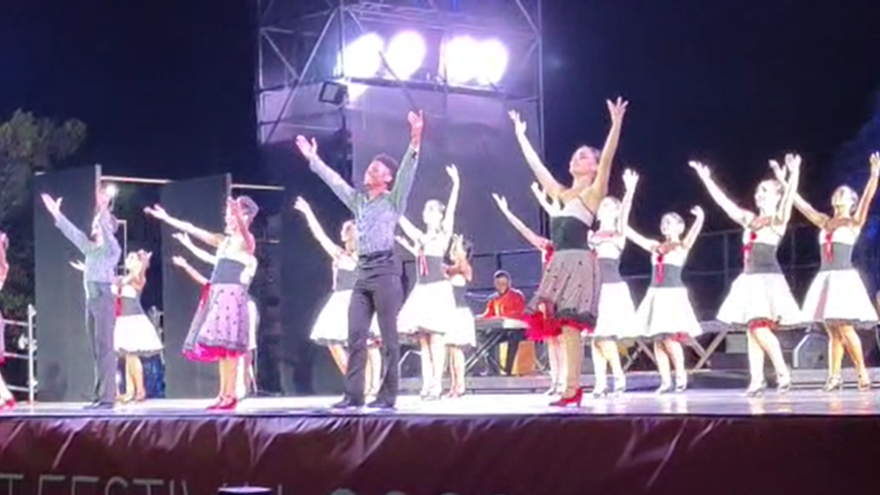
The Lizt Alfonso Dance Cuba company during one of its presentations in Italy. (Nervi Music Ballet Festival/Facebook/Capture)

14ymedio bigger14ymedio, Havana, 28 July 2022 — The drama of the Island on the run seems not to stop. At least eight members of the Lizt Alfonso Dance Cuba company left their delegation and stayed in Spain after finishing the presentations on their tour of Europe, called ¡Cuba Vibra!  

The digital newspaper Cuba Noticias360 reported that these who fled include several of the “main figures” of the prestigious Havana company, and identified them as Helen Rodríguez, Aldair García, Camila Leonard, Jessica Maria, Yillian Cuesta, Chabelis Herández, Lorena Flores and Luis Miranda.

Before leaving the company, the dancers met with their teacher “to symbolize a farewell and told her their plans, to which Lizt Alfonso replied wishing them luck and a good path for their lives,” reported another outlet, Cuballama Noticias, which had access to the testimony of a relative of one of the former members of the company.

Lizt Alfonso Dance Cuba was on an international tour on the eve of the anniversary of its foundation. The tour began on July 5th at the Deutsches Theater in Munich, Germany, and continued on the 14th of the same month at the Nervi International Music and Ballet Festival in Genoa, Italy. The closing performances took place in Spain, with presentations on the 20th and 21st at the Conde Duque Center for Contemporary Culture, in Madrid.

The tour program included a review of Cuban music and dance from the 1950s to the present day, through a two-hour show performed by 19 dancers. The repertoire of their last presentation, together with a concert band, included rhythms such as the chachachá, the mambo, the conga and the bolero, according to the cultural company Madrid Destino.

The escape of the dancers from Lizt Alfonso Dance Cuba is one more example of the massive exodus of professionals, artists and athletes that crosses the Island. International tours or competitions abroad are often the only opportunity for escape that the country’s best educated young people find. continue reading

This week the escape of the Olympic medalist and world discus champion Yaimé Pérez was also confirmed , after the island’s sporting failure at the XVIII World Athletics Championships, held in Eugene, United States, where the Cuban delegation did not win any medals.

Cuban javelin thrower Yiselena Ballar also escaped from that same group of athletes, arriving in Miami, in the United States, before the competition.

Last Friday, Mario Planchet, Christian Temprano and Leonardo Acevedo, members of the Futsal Sub 20 team, also did not appear for the semifinal match between Cuba and Nicaragua, of the Uncaf FIFA Forward tournament held in Guatemala.

Meanwhile, last May, eight members of the Entrevoces chamber choir , belonging to the National Choir of Cuba, stayed in Spain, where they were touring Tenerife. Five took the opportunity to leave the group in the Canary Islands and three in Madrid.

Lizt Alfonso founded her company in 1991 and it is one of the most recognized dance schools in Cuba. She has had international performances such as the City Center in New York, the New Victory Theater on Broadway and the Shanghai Oriental Art Center in China.

In 2016, former US First Lady Michelle Obama presented her with the International Spotlight Award from the US President’s Committee on the Arts and Humanities. Now, after a tour that she has described as “successful,” she will return to the Island with at least half of her company.

____________

COLLABORATE WITH OUR WORK: The 14ymedio team is committed to practicing serious journalism that reflects Cuba’s reality in all its depth. Thank you for joining us on this long journey. We invite you to continue supporting us by becoming a member of 14ymedio now. Together we can continue transforming journalism in Cuba.
“Hey, You Can’t Go Through Here!” a Guard From the ‘People’s House’ Yelled at Me

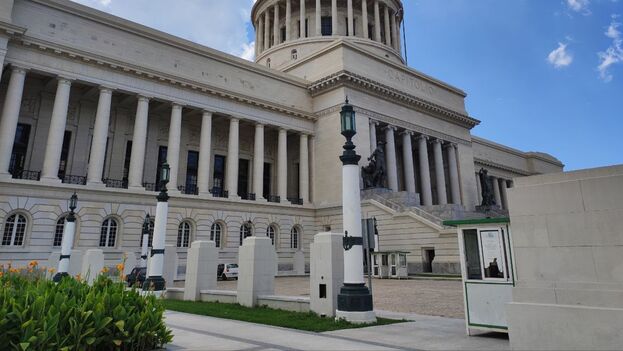
This place almost every Havanan has a memory, is now exclusive to officials and guards. (14ymedio)

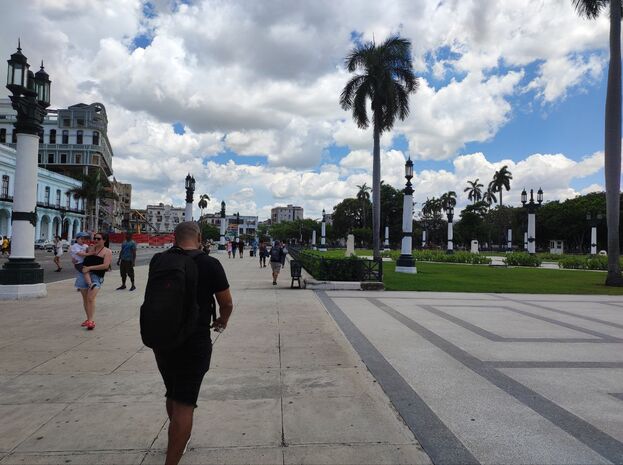
14ymedio bigger14ymedio, Yoani Sanchez, Generation Y, Havana, 30 July 2022 — I pick up the pace. The shared taxi I just got out of was going “at a snail’s pace” and if I don’t take longer strides I’ll be late for my appointment. I cross the Parque de La Fraternidad, I cross the street at full speed with a path that is still closed and leads to the ruins of the Hotel Saratoga, and I enter fully into the gardens of the Havana Capitol building. “Hey, you can’t go through here!” a stern-faced guard yells at me, adding: “You have to go on the sidewalk, it’s forbidden to go through this area!”

They are the same gardens where I practiced as a child with my first skates, the esplanade dotted with vegetation where I sat with my friends to imagine a future that most of them ended up realizing in another part of the world, and the space where Reinaldo waited for me for five hours 30 years ago, in a show of perseverance that sealed that incipient relationship. In other words, this place where almost every Havanan has a memory is now exclusive to officials and guards.

They are the same gardens where I practiced as a child with my first skates, the esplanade dotted with vegetation where I sat with my friends to imagine a future that most of them ended up realizing in another part of the world. (14ymedio)

Although I am in a hurry, I decide to question the man about that prohibition. “Isn’t this Parliament? Isn’t Parliament the People’s House? Why are its gardens off-limits to the people?” separated by several meters from the gleaming facade of a building that was humiliated for decades with neglect, carelessness and official insults. Now, already repaired and with a layer of gold leaf on the dome, the regime has gone from rejecting it to monopolizing it.

I’m already running late for my appointment, so I walk away from the Capitol, its dour guard and its exclusive gardens, while I think about the sensation I felt the first time I left Cuba. It was like an uneasiness that made me fear that in any public square or monument a policeman would come out to tell me that taking a picture with that sculpture, getting too close to that casing or touching that ancient piece of stone was a crime. After days without the uniformed man appearing to scold me, I relaxed and took off the heavy burden of waiting for the whistle, the shout or the fine for my behavior.

Yesterday, Friday morning, I longed for that lightness, when I couldn’t cross the manicured but censored gardens of my own city’s Capitol.

____________

COLLABORATE WITH OUR WORK: The 14ymedio team is committed to practicing serious journalism that reflects Cuba’s reality in all its depth. Thank you for joining us on this long journey. We invite you to continue supporting us by becoming a member of 14ymedio now. Together we can continue transforming journalism in Cuba.
Cuba Launches a ‘Food Sovereignty’ Law in the Midst of a Food Crisis

Line to buy food at Carlos III Plaza in Havana (14ymedio)

14ymedio bigger14ymedio, Havana, 29 June 2022 — “Healthy and adequate food” is already a right in Cuba, or at least that is what Parliament’s Law 148/2022 and Decree 67/2022, signed by the Council of Ministers, determine. At a time when the country is bordering on famine, and when neither money nor lines guarantee food, the Government publishes its Food Sovereignty Law.

“Healthy and adequate food” is already a right in Cuba, or at least that is what Parliament’s Law 148/2022 and Decree 67/2022, signed by the Council of Ministers, determine. At a time when the country is bordering on famine, and when neither money nor queues guarantee food, the Government publishes its Food Sovereignty Law.

The law, approved by the Assembly of People’s Power in May of this year, is complemented by a ministerial decree that defines its application schedule. Although it will enter into force in October, different organizations and producers will have to analyze the content of this law in its municipal and provincial context.

Mayra Cruz Legón, legal director of the Ministry of Agriculture, stated during a press conference that the law will focus on the processes of food production, marketing and consumption. The text also covers the possibility of productive autonomy in the municipalities and a manual of good food practices. continue reading

Cruz Legón foresees that the law will contribute to alleviating the serious food situation in the country, for which implementation and advisory commissions will be created at different levels. However, the correct implementation of this plan is hampered by the different agrarian bureaucracies in the provinces and by the administrative disinterest of the Government.

Some analysts, such as Elías Amor Bravo, already foresaw the possibility that the document is just a diplomatic move by the Cuban government, noted internationally for its inability to guarantee conditions for adequate food.

“One has the impression that this law of the regime has the purpose of trying to remove Cuba from the shameful list of countries that the United Nations World Food Program included as a potential victim of food insecurity back in 2019, placing in said report Cuba at the same level as Haiti,” the economist said in May.

According to Amor, it is necessary to consider that “that evidence was a severe international blow to the Cuban communists, who pulled this law out of the hat, implemented thanks to funds from the European Union under the auspices of the United Nations Organization for the Agriculture and Food (FAO), to try to change the perception of the United Nations.”

Daily life on the Island, however, will hardly benefit from the new law. The lack of products, the lack of maintenance in the factories, the corruption of the agricultural and gastronomic sector, the little labor incentive and the legal obstacles to producers and merchants do not allow “unlocking” the Cuban food dilemma.

Law 148/2022 defines food sovereignty as the “ability of the nation to produce food in a sustainable manner and to give the entire population access to sufficient, diverse, balanced, nutritious, safe and healthy food, reducing dependence on means and external inputs with respect for cultural diversity and environmental responsibility.”

In sharp contrast to this concept, the reality of the Island is far from being the utopia of abundance and effectiveness proclaimed by the Government and its new law.

____________

COLLABORATE WITH OUR WORK: The 14ymedio team is committed to practicing serious journalism that reflects Cuba’s reality in all its depth. Thank you for joining us on this long journey. We invite you to continue supporting us by becoming a member of 14ymedio now. Together we can continue transforming journalism in Cuba.
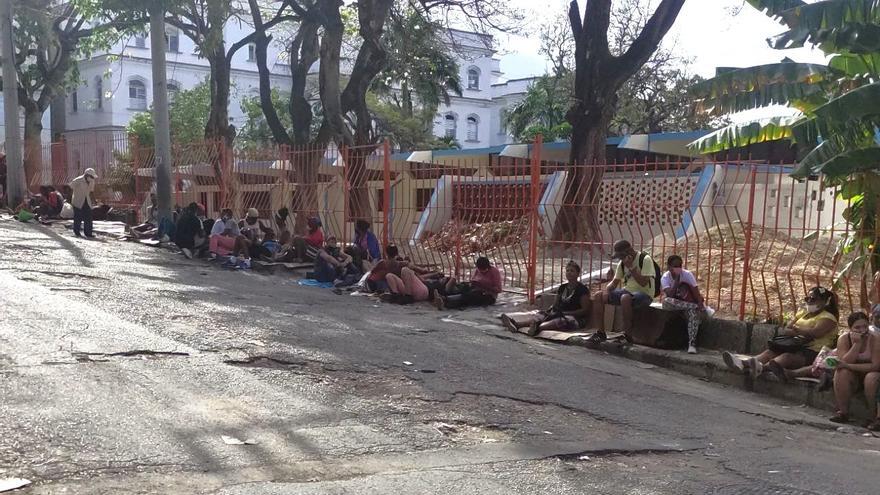
Cuba Detects More Cases of of Dengue Fever in One Week Than in the Entire First Semester of the Year

Some 66.1% of the mosquito breeding sites in Cuba are concentrated in the provinces of Havana, Matanzas, Pinar del Río, Santiago de Cuba, Camagüey and Holguín. (14ymedio)

14ymedio biggerEFE/14medio, Havana, 30 July 2022 — The Cuban Ministry of Public Health detected 4,776 reactive cases of dengue fever in the third week of July (17-23), more than the 3,036 registered in the entire first semester, the Presidency reported in a statement this Friday by official media.

Reactive cases are understood as tests in which the presence of the pathogen is detected, either because the patient recently had the disease or because it is still active in the body.

In this sense, the Presidency pointed out that of the 10,590 tests carried out in that week there was a positivity rate of 45.1%.

In addition, Public Health noted that 23,758 cases with “non-specific” fever were identified, almost 6,000 more than in the previous week. It is one of the symptoms of the disease, transmitted by the aedes aegypti mosquito.

The Presidency’s statement warns that the mosquito breeding sites increased by 115% during the third week of July compared to the same week in 2021.

Some 66.1% of the points are concentrated in the provinces of Havana, Matanzas, Pinar del Río, Santiago de Cuba, Camagüey and Holguín. continue reading

Public Health reported in early July that, for the second year, Cuba broke the 15 year record for dengue mosquito breeding points and described the epidemiological scenario as “complex.”

In a press conference on July 14, Portal clarified that the country is not “in the worst moment” and estimated that in the coming months the number of infected could increase due to the heat and the rains.

The independent press has reported in recent weeks several cases of minors who have died with a high fever, although it has not been officially confirmed that they were due to dengue.

The health workers insist that the population must do everything possible to protect themselves because there are no insecticides such as Abate or diesel to spray every six days, as established by the protocols. These limitations, together with the summer heat and the long hours of blackouts, are leading to the proliferation of a disease that had remained in the background during covid.

In addition, it is estimated that dengue underreporting is still high. On the one hand, many patients refuse to go to the doctor to avoid hospitalization due to the state of many centers throughout the Island. On the other hand, there is a visible lack of means for a correct diagnosis and some patients affirm that they do not undergo the tests required because the reagents are rationed for the most severe cases.

“We are alarmed,” an internist at a Havana hospital told this newspaper, stating that this year there are more serious cases than usual. “In previous epidemics, maybe 10% or so of cases had warning signs (the ones that alert you that the patient is not doing well), but now it’s more than 30%.”

____________

COLLABORATE WITH OUR WORK: The 14ymedio team is committed to practicing serious journalism that reflects Cuba’s reality in all its depth. Thank you for joining us on this long journey. We invite you to continue supporting us by becoming a member of 14ymedio now. Together we can continue transforming journalism in Cuba.
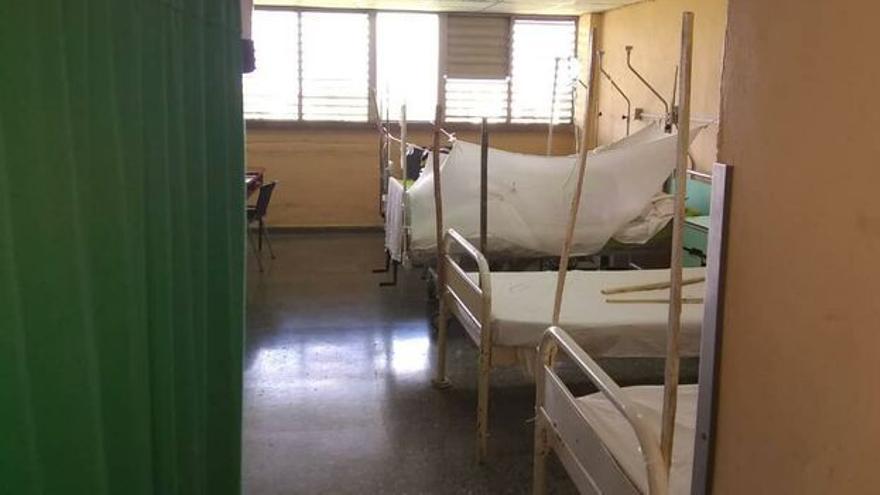
Pastor Alain Toledano Insists that Cuba is ‘In Collapse’

The pastor and his family arrived this week in the United States, where he is in exile. (Facebook)

14ymedio biggerEFE (via 14ymedio), Miami, 30 July 2022 — Cuban evangelical pastor Alain Toledano Valiente, leader of the Movement Paths of Justice and exiled in Miami since this week, stated in an interview published this Friday that “Cuba is a country in collapse.”

Toledano, his wife, Marilin, and their daughters Berenice, 18, and Elisama, 17, left Cuba thanks to the intervention of Outreach Aid to the Americas (OAA), an international organization that defends the rights of religious communities .

The US Ambassador for Religious Freedom, Rashad Hussein, also interceded in the case.

According to Toledano’s statement upon arrival in Miami, Cuban authorities warned him: “Leave the country within 30 days or you and your family will face the consequences.”

In the first interview from exile, Toledano, who in recent years repeatedly denounced “harassment” against his temple in Santiago de Cuba for demanding rights and freedom, told the US public radio station Radio Martí, which broadcasts from Florida to Cuba, that the rights and living conditions of Cubans are “precarious.”

“When you look at the living conditions of men (on an international level), you realize that the Cuban does not have any living conditions. Rights, none. It stopped being really a nation, it stopped really being a country where as a citizen you can live with everything you need,” he said.

The pastor called on Cubans to recover their freedom by confronting “the people who have been empowered by evil and violence” in Cuba. continue reading

“The slaver is never going to give you freedom,” said the religious leader.

In the latest report on International Religious Freedom published by the US State Department, it was included in the Cuba section that Cuban State Security agents arrested Pastor Toledano in 2021 for “spreading an epidemic.”

The arrest was due to the fact that he had reopened the doors of his temple after confinement due to covid-19, but, as he denounced, the accusation was unfounded, since since the first week of June 2021 the Government had authorized churches to restart their activities normally and moderately.

____________

COLLABORATE WITH OUR WORK: The 14ymedio team is committed to practicing serious journalism that reflects Cuba’s reality in all its depth. Thank you for joining us on this long journey. We invite you to continue supporting us by becoming a member of 14ymedio now. Together we can continue transforming journalism in Cuba.
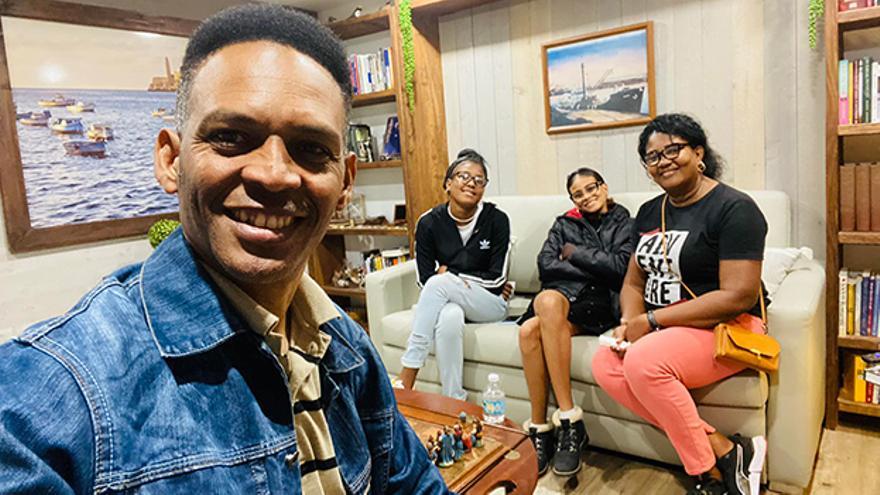
Five Years in Prison for a Cuban Activist for Launching Leaflets ‘Proposing Elections’

Cuban opponent Yuri Valle Roca during an arrest in 2019. (EFE)

14ymedio bigger14ymedio, Havana, 29 June 2022 — The activist and reporter Lázaro Yuri Valle Roca was sentenced to five years in prison for the crimes of “ongoing enemy propaganda and resistance.” The sentence of the Provincial Court of Havana was communicated this Thursday to his wife, Eralidis Frometa, who has spread it on social networks and has described it as “lying and manipulation.”

In the same case, Alien Tijerino Castro received four years for continued enemy propaganda, Ruslán Hernández Reyes, two years, and Yusniel Milián González, one year, both for enemy propaganda.

The sentence accuses Valle Roca and Tijerina of having an “illicit and self-styled NGO” called Delibera in which they held meetings “with the aim of planning actions contrary to the social and political system in Cuba,” in addition to filming them and broadcasting them on social networks to “disseminate to the world an image of social and political instability within the country.”

The sentence accuses Valle Roca and Tijerina of having an “illicit and self-styled NGO” called Delibera in which they held meetings “with the aim of planning actions contrary to the social and political system in Cuba,” in addition to filming them and broadcasting them on social networks to “disseminate to the world an image of social and political instability within the country.”

Both he and Tijerino had leaflets seized — “with José Martí phrases” — and other dangerous activities such as “proposing elections.” Also cameras, memory cards and mobile phones “with counterrevolutionary content.” continue reading

Hernández, whose cell phone was also seized, and Milián, meanwhile, did not possess material considered compromising and their connection to the events is just having responded to a summons. In the case of the latter, moreover, he expressed his “repentance,” despite which he has received a year in prison that he has served as preventive detention.

The ruling highlights that Lázaro Yuri Valle Roca “maintained a socially inappropriate behavior in his place of residence and not because his ideas were contrary to the principles of the Revolution,” the judges concede, “but because his way of showing that disagreement is not the correct way.”

Valle Roca, 60, is the nephew of opposition leader Vladimiro Roca and grandson of communist leader Blas Roca Calderío. Since June 2021 he has been in provisional prison in Villa Marista, for which he has at least four years left to serve.

During the time he has been imprisoned, the reporter has suffered the 15 types of torture described by the Madrid-based organization Prisoners Defenders (PD), which presented a document to the UN denouncing patterns of mistreatment in Cuban prisons.

The list is made up of: deprivation of medical care, forced labor outside of their criminal sentence, forced to maintain uncomfortable or harmful positions, solitary confinement punishment, use of temperature as a mechanism of torture, physical aggression, transfer to unknown locations , intentional disorientation, deprivation of water, food, sleep and communication with lawyers and relatives, threats to their integrity and that of their loved ones, deployment of weapons or elements of torture, intentional subjection to anguish and uncertainty due to the situation of a family member and humiliation, degradation and verbal abuse.

According to the organization, there are at least ten prisoners who have suffered all of this ill-treatment, including Valle Roca.

“The Cuban judicial system does not work because it does not protect, it does not legally protect citizens. I do not intend to review the case or appeal, since we do not have fair laws,” said Eraldis Frometa.

____________

COLLABORATE WITH OUR WORK: The 14ymedio team is committed to practicing serious journalism that reflects Cuba’s reality in all its depth. Thank you for joining us on this long journey. We invite you to continue supporting us by becoming a member of 14ymedio now. Together we can continue transforming journalism in Cuba.
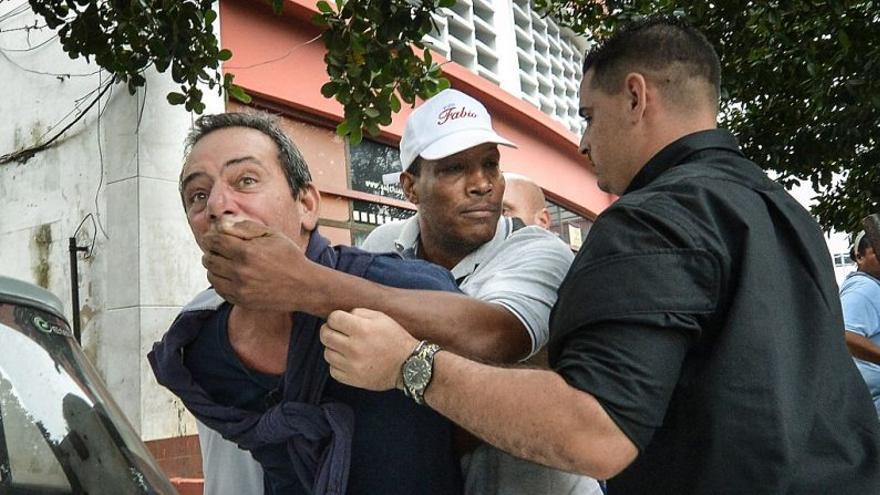
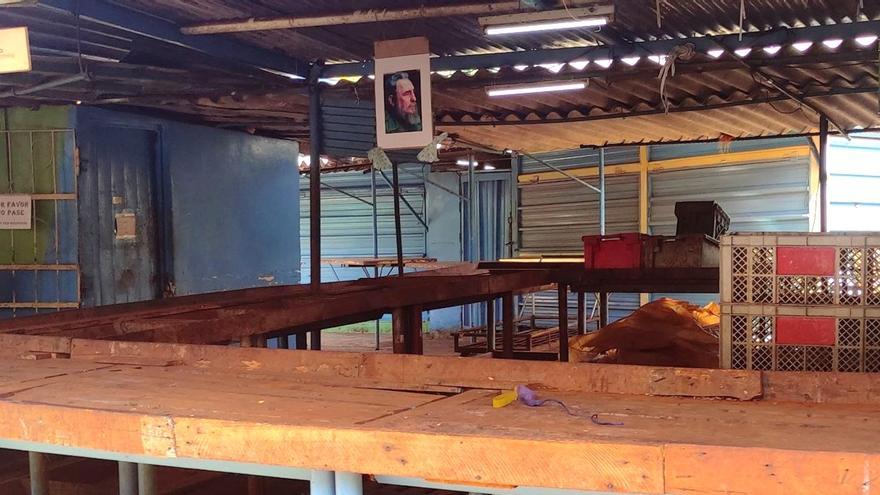
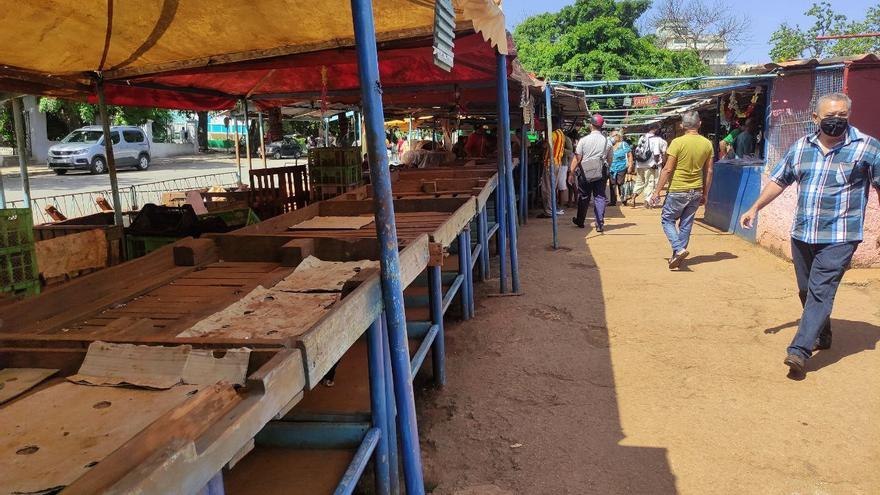
Green Avocados, Ginger and a Portrait of Fidel Castro: All That’s Left in a Havana Market

A market stall on 17th and K in El Vedado, Havana. (14ymedio)

14ymedio bigger14ymedio, Juan Diego Rodríguez, Havana, 27 July 2022 — The scene this morning in the Havana market at 17th and K, in Vedado, could be attributed to the passage of a cyclone. The empty and skeletal platforms, waiting for products that never arrived; the plastic boxes upside down on the floor; the red earth, the rubbish that nobody sweeps and the absent vendors.

In one of the sales booths hung a solitary portrait of Fidel Castro, frowning, in olive green and stained with the residue of mud. When the market is full, Castro’s profile often works as a charm to scare away inspectors, to recognize the merchants who installed him in his place.

The trick is old and perhaps Soviet: the Czech writer and politician Václav Havel talks about a Slavic greengrocer who wrote slogans in his shop so that neither his colleagues nor the “people” of the Party would look at him badly, and thus he could sell his stuff peacefully.

A Cuban farmer, who has to market his products according to the rules of the Cuban State, repeats this ritual of camouflage against power. Although Castro is insufferable to him, he has learned to use him as the patron saint of thieves and bandits.

However, today it is not much use: since it is a holiday, not even the inspectors are prowling the alleys of the market. Only the patient buyer, willing not to be defeated by the decreed shortages that the heroic date — 26 July — brings with it, manages to glimpse an avocado stand in the distance. continue reading

For 15 pesos you can buy a pound of green avocados. The same amount buys some ginger, that Asian root to which Cubans are so little accustomed, and which could serve as a sedative infusion given the prices that are yet to be discovered, if they continue in search of food.

For 15 pesos you can buy a pound of green avocados at the 17th and K market. Ginger costs the same amount. (14ymedio)

Solavaya!”* commented a customer in a picnic area near the market. “Avocados and ginger: that’s a deadly combination.” “And bad for your pocket,” an employee replied with a joke.

The buyer at 17th and K who, defeated, decides to go to the picnic area to warm his stomach, has to pay 70 pesos for a simple pizza. If he doesn’t want to choke on the dough, he should also order an instant soda, which won’t take long to hold his overheated kidneys accountable.

Once satisfied, so to speak, the buyer rethinks his strategy to get food this July 27th.

As he ponders the causes and effects of national hunger, he sees the grimy truck passing by that distributes egg cartons from rationing in his neighborhood. As a soul that carries the devil, he runs to his cellar, only to verify that the steel mass on wheels is stopped in front of the store’s gate.

Thanks, once again, to the glorious event, the employees have the day off and the trucker, who arrives an hour late, will not be able to unload the eggs. He panics and they look for someone who has the key, while the driver threatens the crowd: “Get up, I’m leaving!

The key appears, but a voice confirms to the buyer what he already knows: “Don’t get excited,” they tell him, “that no one will sell a single egg until tomorrow.”

He has to throw two mental insults at the portrait hanging on the remote dais of 17th and K. An older lady, head down, walks past him chewing on the words, for lack of anything else to chew on.

“Look for that,” he says, “the corpse of July 26th is still hot, and today we don’t even have a pumpkin for a sad broth. What did you celebrate so much yesterday?”

*Translator’s note: Solovaya — roughly and idiomatically: “Get me outta here!”

____________

COLLABORATE WITH OUR WORK: The 14ymedio team is committed to practicing serious journalism that reflects Cuba’s reality in all its depth. Thank you for joining us on this long journey. We invite you to continue supporting us by becoming a member of 14ymedio now. Together we can continue transforming journalism in Cuba.
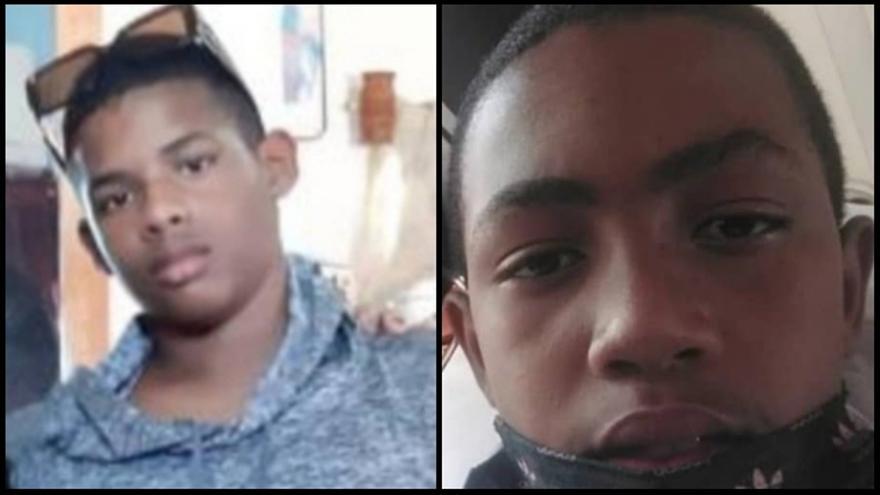
Three Children Arrested During 11J (July 11th) Protests, Released After a Year of Imprisonment and Indoctrination

Erick Yoangel Héctor Plaza and Maikel Michel Miranda Vega, two of the minors released this week. (Collage)

14ymedio bigger14ymedio, Havana, 29 June 2022 — The Cuban regime released three minors who had been arrested for participating in the 11J (11 July 2021) protests, and who were being held at the Comprehensive Training School in Matanzas, under the custody of the Ministry of the Interior.

According to the organization Justicia11J , Eric Yoangel Héctor Plaza, 12, Maykel Michel Miranda Vega, 13, and Llenson Ensos Rizos Cabrera, 14, were released last Thursday, but the situation of at least five of the 59  minors detained in the context of the protests remains unknowned.

Justicia11J has identified these adolescents, of whom there are no reports, such as Alexander Morejón and Jennifer Simpson, both 17 years old, Leosvani Giménez and Rubén Alejandro Parra, both 15, and Yeniel González, 16.

The organization points out that detained minors “suffer even more indoctrinated education and their lifestyles impede their healthy physical, emotional and intellectual development.” He adds that detention at a young age can, in the future, lead them to be victims of stigmatization and humiliation. continue reading

In an April report, Justicia11J, together with Cubalex, established that the authorities had detained 54 minors for participating in the demonstrations, and of these, 14 were still deprived of liberty. As of that date, seven 16-year-olds were in the custody of the Ministry of the Interior. In Cuba, the penal age is established at 16 years.

The document also stated that 22 18-year-olds had been prosecuted, three of them through summary proceedings and the rest in ordinary trials accused of sedition, public disorder, sabotage and contempt.

Justicia11J points out that during the internment of these demonstrators, violations of the norms established in the Convention on the Rights of the Child, on the application of justice to minors, have been committed. They also denounce “the lack of evidence to prove guilt.”

In June, the United Nations Committee on the Rights of the Child urged the Cuban State to review the sentences imposed on minors “found guilty of exercising their right to freedom of peaceful assembly in the context of the July 2021 protests,” and mentioned its concern about complaints received about abuse and mistreatment during the detention of children and adolescents.

In the document, the Committee highlights that there were violent captures of 13-year-old children and considers the penalty opportune only after 16. In response, the Cuban Government affirmed that there are no children under 16 in prison. “Currently, there are 662 inmates between the ages of 16 and 18 in penitentiary centers. Of the ages of 16 and 17 there are 264, the rest are 18 years old,” it said.

In this context, some seven convicted minors saw their sentences reduced, after a “special analysis” by the Supreme Court of the Republic of Cuba.

____________

COLLABORATE WITH OUR WORK: The 14ymedio team is committed to practicing serious journalism that reflects Cuba’s reality in all its depth. Thank you for joining us on this long journey. We invite you to continue supporting us by becoming a member of 14ymedio now. Together we can continue transforming journalism in Cuba.
A U.S. Businessman Believes that Biden Will Allow Banking Relations with Cuba

First American Bank now has the accounts of the Cuban embassy in Washington and the Cuban mission at the UN. (FAB)

14ymedio bigger14ymedio, Madrid, 28 July 2022 – John Kavulich, the first entrepreneur to obtain a US Treasury license for a private business in Cuba, believes that the Biden government will allow banking relations between the two countries, something that he considers a “logical” step, taking into account that his case wouldn’t be the only one.

“It wouldn’t make sense for the Biden Administration to continue to require funds moving from the United States to Cuba to pass through banks in third countries, where they then charge a commission for each transaction,” Kavulich, who is also president of the United States-Cuba Economic and Trade Council, told El Nuevo Herald in a report about the transactions of the island’s embassy in Washington.

Kavulich, who, pending the approval of the Cuban Government, has not given any details about the company in which he plans to invest “up to $25,000,” explained that whoever intends to put his money in Cuban private businesses needs to “have a direct, efficient and transparent means” to send the funds and receive their investment income, dividends and loan payments.

At present, this mechanism doesn’t exist, since embargo laws prevent direct transactions between the two countries. During the time of the thaw, the government headed by Barack Obama authorized U.S. entities and companies to open accounts in Cuba, but not so that the Cuban side could do the same.

Relations between Cuba and the United States are now much more tense than then, and Joe Biden is at a time in his mandate – burdened by the consequences of the pandemic, the supply crisis and the invasion of Ukraine – in which it is doubtful that he will expose himself to a confrontation with Florida, where a banking correspondent (collaboration of entities from different countries) with the island would not be welcomed. continue reading

However, the license granted to Kavulich and the announcements of new policies that will include the expansion of electronic payments and support for the private sector give hope to those who aspire to invest in the island. Added to this is the statement made by Havana last week, when it opened the door to allow foreigners to put money in private companies in Cuba, an idea rejected outright by some Florida politicians.

The information from El Nuevo Herald explains how a bank founded by a Cuban exile has ended up being the manager of the regime’s accounts in the United States, specifically that of the Cuban embassy and the Cuban mission at the New York headquarters of the United Nations.

In 1974, Carlos Dascal founded Continental Bank, the first bank created by a Cuban-American in the United States. This entity was absorbed in 2019 by First American Bank, an Illinois-based bank that acquired Cuban accounts in June after Centennial Bank “cut off all business relations” with Havana for its support for Russia in connection with the invasion of Ukraine, according to sources in El Nuevo Herald.

Centennial Bank had managed the accounts of the Cuban Government since it acquired Stonegate Bank, an entity authorized for this purpose by the Treasury in 2015. According to the same source, which asked to remain anonymous, First American Bank is currently negotiating with the state-owned International Trade Bank to open a correspondent account in Cuba.

Translated by Regina Anavy

____________

COLLABORATE WITH OUR WORK: The 14ymedio team is committed to practicing serious journalism that reflects Cuba’s reality in all its depth. Thank you for joining us on this long journey. We invite you to continue supporting us by becoming a member of 14ymedio now. Together we can continue transforming journalism in Cuba.
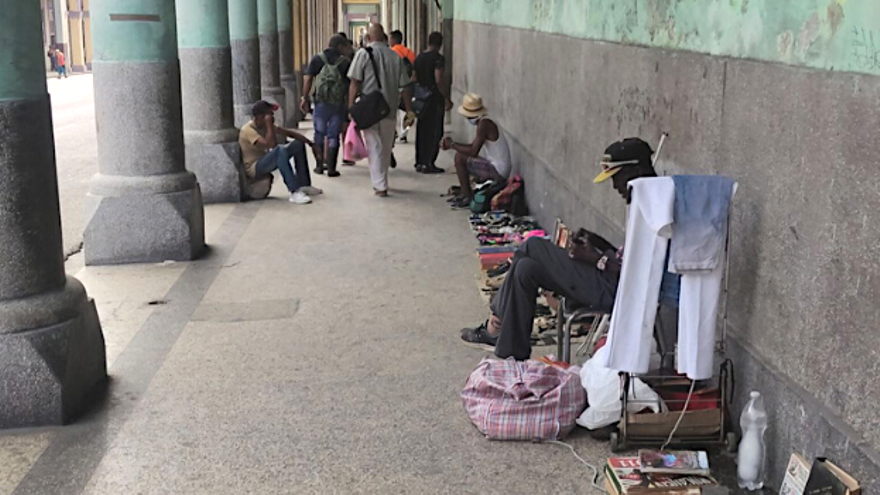
Cuba’s Sidewalks and Colonnades Are a Market for Old Junk

An improvised merchant alternates proclamations about his merchandise with reading of a book. (14ymedio)

14ymedio bigger14ymedio, Juan Diego Rodríguez, Havana, 28 July 2022 — Cuban sidewalks are the scene of a good part of daily life on the Island. Taking the stool out of the house to get around the long blackouts, waiting for hours on the curb for our turn to come in a line, or setting up in that narrow strip , between the facades and the asphalt, a point of sale for anything, are just some of the uses of a space designed for the passage of pedestrians but converted into a scene of the informal market and daily survival.

This Thursday, the high temperatures and the intense sun made it necessary to walk under the shade of the colonnades in Havana. In addition to the danger that a cornice, a roof or a balcony could come off and end up on our heads, avoiding El Indio and the harshness of his rays turns out to be the priority. But the centimeters are limited and looking for the shade also has its problems. The poorest in the city use that piece of road to try to survive.

Used books, old plumbing pieces, empty containers that once held shampoo or laundry detergent, make up part of the inventory of what is exhibited on the sidewalks of streets such as Galiano, Monte or Reina in the Cuban capital.

Under the protection of a colonnade, illegal vendors multiply, but they compete with passers-by to use a strip of territory that belongs to ordinary Cubans, never better said.

With a row of books displayed outside the “Alfredo Gómez Gendra” nursing home, in Centro Habana, a makeshift merchant alternated proclamations about his merchandise with reading of a book. A few meters away, another vendor repeated the scene, which lasted for several blocks although the merchandise on display varied. continue reading

As the sidewalk narrowed, pedestrians dodged a copper pipe as well as some shoes rescued from a dumpster. Sellers and customers thus shared the same goal: to occupy that part of any street where cars do not pass and the sun does not punish so strongly.

Without the skills of the mantas* in Madrid, or the mutual protection that the merolicos** of Havana’s La Cuevita market give each other, trading on a sidewalk is a high-risk profession in Cuba. The same person who buys a scrubbing sponge from you later denounces you for getting in the way. The sun that you avoid under a doorway you pay for in bribes to the corrupt policemen or in scares every time the patrol approaches.

But the portals and the sidewalks are not an impregnable armor either. The policemen who patrol the city make a killing with the fines and arrests of those who do not have their own business premises or a license to offer their miserable products.

Sitting down to pass the time during a blackout or play dominoes with friends is one thing, but opening a venduta — a tiny enterprise — among the shop windows and the rattle of collective taxis is another.

The sidewalk is free territory until the uniformed men are disturbed.

Translator’s notes
*Mantas: Literally ’blankets’, a reference to the street sellers who commonly spread their wares on them.
**Merolicos: Street sellers who ’specialize’ in glib patter to promote their wares which may include “miracle cures,” “amazing bargains,” and the like.

____________

COLLABORATE WITH OUR WORK: The 14ymedio team is committed to practicing serious journalism that reflects Cuba’s reality in all its depth. Thank you for joining us on this long journey. We invite you to continue supporting us by becoming a member of 14ymedio now. Together we can continue transforming journalism in Cuba.

The Mexican Government Will Pay $2,000 a Month for Cuban Doctors

A delegation of Cuban doctors with health authorities in the Mexican state of Nayarit. (Government of Nayarit)

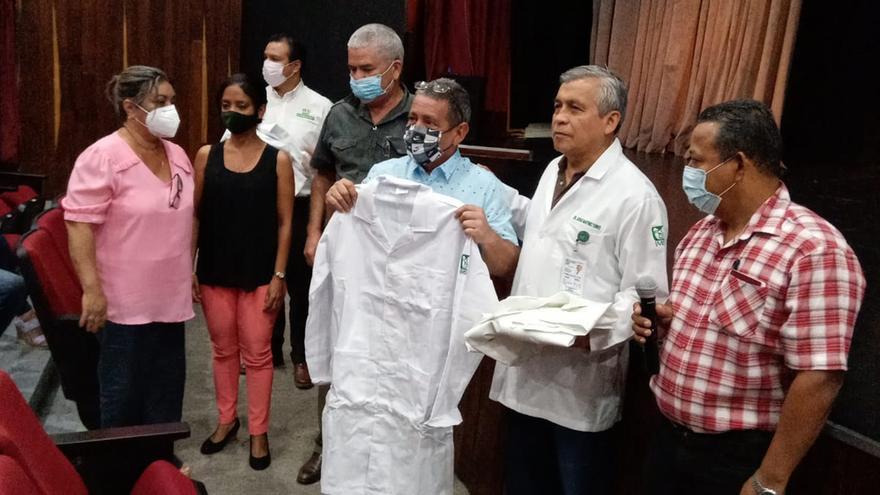
14ymedio bigger14ymedio, Ángel Salinas, Havana, 27 July 2022 — The 500 Cuban doctors who were hired by the Government of Mexico to provide services in marginal areas of the country will receive a salary similar to that of Mexican health workers. “They will receive between 41,784 ($2,042) and 35,237 pesos ($1,722) per month,” an employee of the Institute of Health for Welfare (Insabi) told 14ymedio.

The source specified that, because doctors who are in the state of Nayarit have specialties in anesthesiology, general surgery, gynecology and obstetrics, internal medicine and pediatrics, they must receive $2,042 per month. Although “it’s not established whether the money will be received by them or will go through the Government of Cuba,” the official said.

“Housing and food will be covered by the municipal authorities [of the cities] where each hospital is located,” the source added, and also explained that “every 180 days the immigration permit will be renewed.”

The call issued by the Mexican Social Security Institute and Insabi indicates that the contract for doctors is temporary and will last for four months, and that the doctors will be entitled to benefits and training. Mexican President Andrés Manuel López Obrador said on Monday that Cuban health workers “will be protected” at work. continue reading

López Obrador said that after Nayarit, the next states will be Tlaxcala and Colima, plus the Sierra de Guerrero, a region that was initially pointed out by the president as the one with the greatest health need and to which the 500 doctors from the island would be sent.

On Wednesday, the health authorities of Nayarit confirmed to 14ymedio that 47 Cuban doctors were taken to the hospitals that are located in the rural towns of Las Varas, in the municipality of Compostela, Puente de Camotlán (La Yesca), Jesús María (Del Nayar), San Francisco and Tondoroque (Bahía de Banderas), and to the municipal capitals of Santiago Ixcuintla, Rosamorada and Ixtlán del Río. Seven doctors were incorporated into the staff of the central hospital of Tepic.

The Cuban medical missions that provided their service during the COVID-19 pandemic were criticized for the lack of preparation of their health workers and the high costs they represented for Mexico.

A report revealed that doctors from the island limited themselves to “making beds, taking vital signs, conducting surveys and passing sponges to patients to bathe,” while the Cuban authorities proclaimed that mortality rates had decreased during their stay in Mexico.

In March 2021 it was announced that the administration of Claudia Sheinbaum, head of Government of Mexico City, spent a total of 150,759,867 pesos ($6,986,091) on the hiring of 585 Cuban doctors who were working in the capital from April 24 to July 24, 2020, once 14,884,785 pesos ($689,749) were added for the accommodation and feeding of the doctors. For the other brigades that have arrived in the country, the amounts disbursed to the Cuban Government are not known.

On the same subject, the coordinator in the Mexican Senate of the opposition National Action Party, Julen Rementería, accused the Governments of Mexico and Cuba of orchestrating a fraud by paying,12,692,940 dollars for the hiring of 585 untitled health workers from the island.

Translated by Regina Anavy

____________

COLLABORATE WITH OUR WORK: The 14ymedio team is committed to practicing serious journalism that reflects Cuba’s reality in all its depth. Thank you for joining us on this long journey. We invite you to continue supporting us by becoming a member of 14ymedio now. Together we can continue transforming journalism in Cuba.
Dengue Fever Puts the Cuban Health System to the Test Yet Again

COVID-19 had left dengue fever in the background, but the disease is now spreading again on an island without supplies for prevention. (14ymedio)

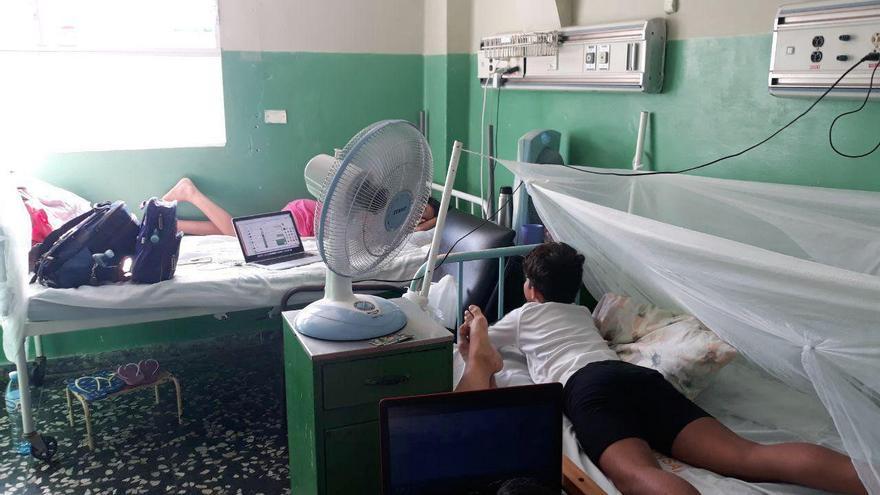
14ymedio bigger14ymedio, Havana, 28 July 2022 — The Mario Muñoz Monroy hospital, in Colón, Matanzas, has been forced to open two rooms of 60 and 20 beds respectively to accommodate the “significant number of admissions” that dengue fever is bringing.

On Wednesday, the official newspaper of the province, Girón, reported an increase in fever consultations that is in line with the news coming from Sancti Spíritus, where the ruling party has recognized that fifty people are cared for daily for dengue fever, and that “some people have developed serious forms of the disease.” The worst cases in this province are concentrated in Cabaiguán and Trinidad.

In the case of Matanzas, the deputy director of Public Health, Andrés Lamas Acevedo, said that cases decreased in the last week in Colón, but from neighboring Calimete the visits of patients with complications are increasing. Jagüey Grande, Cárdenas and the main municipality are other towns that are the most affected.

Last week, the authorities recognized an incidence rate of 19.7 cases per 100,000. The Minister of Health himself, José Ángel Portal Miranda, admitted at a press conference the exponential growth of the disease in recent months and said that the worst is yet to come. In April, the incidence rate was 12.2 per 100,000 inhabitants, while in June it reached 46.3.

Health workers insist that the population must do everything possible to protect themselves because there are no insecticides such as Abate or diesel available to fumigate every six days, as established in the protocols. These limitations coupled with the summer heat and the long hours of blackouts are leading to the proliferation of a disease that had remained in the background during COVID. continue reading

In addition, it is estimated that the under-declaration of dengue fever is elevated. On one hand, many patients refuse to go to the doctor to avoid hospitalization due to the state of many centers throughout the island. On the other, there is a visible shortage of means for a correct diagnosis, and some patients claim that the required tests are not performed because the reagents are rationed for the most severe cases.

“We are alarmed,” an internist at a hospital in Havana told this newspaper, who said that more serious cases are occurring this year than usual. “In previous epidemics, perhaps approximately 10% of cases had warning signs (those that warn you that the patient is not progressing well), but now it is more than 30%.”

In recent weeks, networks have reported the deaths of several people due to dengue symptoms, but the authorities are reluctant to give numbers of deaths despite the demands of the population.

Translated by Regina Anavy

____________

COLLABORATE WITH OUR WORK: The 14ymedio team is committed to practicing serious journalism that reflects Cuba’s reality in all its depth. Thank you for joining us on this long journey. We invite you to continue supporting us by becoming a member of 14ymedio now. Together we can continue transforming journalism in Cuba.