Cuban Civil Society Manifesto

Cuban Civil Society Manifesto

Prominent philosophers of universal history such as Spinoza, Rousseau, and Kant agreed to define Civil Society as a collective body constituted by the individuals of a society, which is positioned outside the limits of the State. The State only makes sense so long as it represents the interests of all its citizens; for this reason, a consensus in Cuban civil society has superior moral force. In any circumstance, it is not civil society that must submit to the State, but the latter to civil society.

Therefore, the undersigned are all well-known for their various Cuban civil society activities at different points in time, past or present, who currently reside inside and outside Cuba, since the Cuban nation extends beyond the Cuban archipelago to any part of the world where there is a Cuban who identifies with the collective aspirations of his compatriots.

The country is facing an alarming situation, which has resulted from governance that is based, on the one hand, on a concentration of business enterprise within the State, a source of inefficiency and corruption of some bureaucratic classes who have dragged down the population for more than six decades to a dire situation.

All the reforms implemented at different times that, as the word indicates, are only changes in form, when what is required is a sustainable economic model that does not depend, in order to survive, on periodic subsidies from external allies.

On the other hand, the systematic coercion of essential rights such as free oral and written expression, as well as artistic creativity, the right to free peaceful association, the right to freedom of movement, in particular the right to be able to leave their own country and return to it, and the right to free economic entrepreneurship of independent citizens, all this exercised by a State whose three main powers, executive, legislative and judicial, are under the absolute control of a partisan elite that no one elected.

We, therefore, declare ourselves in favor of profound and urgent changes that will lead the country out of an unprecedented crisis and avoid a confrontation between Cubans, with tragic consequences.

All convictions and prosecutions of citizens for practicing or defending these and other fundamental rights of human beings must be dismissed, and those who have suffered them, released, in particular all those whose only sin was having publicly expressed their desires and dreams of a better Cuba.

Even those who carried out violent acts only reacted to the brutal repression of which they were victims; therefore, if they deserved to be punished, then, with much more reason, all those pro-government entities that repressed them should have been prosecuted. Public protests are not prevented by applying disproportionate measures of violence and excessive sentences, but rather by taking steps that allow citizens to freely conduct their artistic and productive activities.

Regardless of the pernicious effect that the US embargo may have had on the country’s economy, the excuse of the “imperialist blockade” no longer convinces most citizens who have suffered, in the flesh, the government’s policies which present restrictive barriers to their attempts to satisfy, of their own accord, their pressing needs; these include high taxes, high licensing fees, and extortion by a powerful buyer which forces farmers to sell to it most of their production at a price set by that buyer, and other measures that put the brakes on productive stimuli.

The main blockade, therefore, is not the one imposed by a foreign nation from abroad, but the one imposed, from within, by the governing leadership itself. Lift this and you will see how, in short order, how the resupply of Cuban families will begin.

We must have faith in the Cuban people. When those who are unjustly imprisoned are freed, with the expressed willingness to allow public forums among Cubans–without distinction of race, gender, religion, sexual orientation, and political and philosophical ideas–to reach a national consensus on the future of our country, no one should fear massive protests, because a miraculous light will have been lit in the collective consciousness that has a name: Hope.

August 2022

Translated by Silvia Suárez
Cuba: Protests and the Declaration of the Civil Society

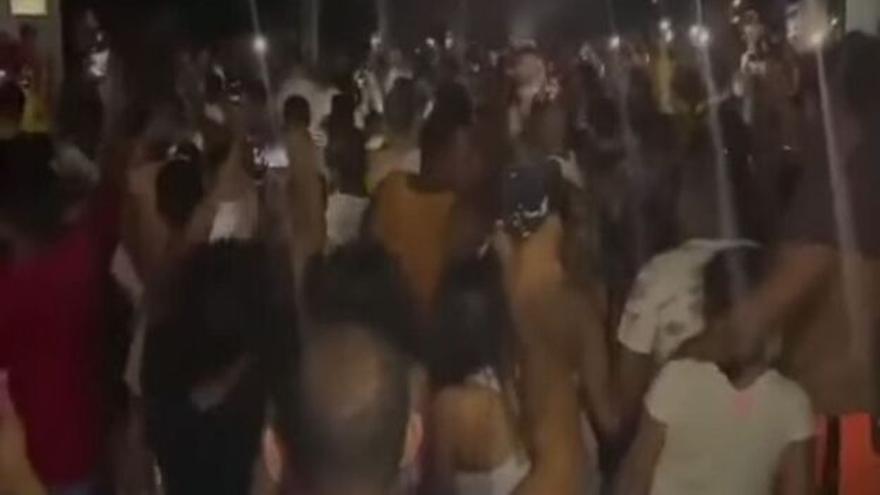
Last Thursday night, the population of Nuevitas took to the streets in protest against the blackouts lasting more than 10 hours. (Screen capture)

14ymedio bigger14ymedio, Ariel Hidalgo, Miami, August 24, 2022 — To those who asked when the Cuban population would return to take to the streets, when another July 11 would be repeated, it must be said: the people have already taken to the streets in many cities every day. Every day is July 11. And this is just the beginning, because, curiously, it’s the authorities themselves who give the signal for the protests to begin.

That “signal” is called a blackout. And apparently they are going to happen more and more frequently. They thought they had found the formula to prevent any mass protest in a city from spreading throughout the country: cutting off the internet, but they themselves are inadvertently putting into practice another formula to summon them: cutting off the electricity.

The difference with July 11, 2021  is that it was then face-to-face and held at the same time in many places at once, like a disadvantageous frontal war against a powerful enemy. Now, it is more like a guerrilla war, where even darkness is the best ally.

However, last week, the people of Nuevitas not only protested in the streets, but also faced the dictatorship’s attack, and there were injuries on both sides. All the demonstrations have been peaceful, but the population cannot be asked to turn the other cheek in the face of a brutal repression that makes no distinction for age or gender.

So where is all this going to go? Because cutting off the Internet no longer works for the regime, when today no city or town waits for a San Antonio de los Baños to initiate a protest. There will come a time when every town and city is protesting in the streets, and the whole country will shudder with another social explosion, this time more forceful, and then no one will be able to stop it.

The only thing that would be missing today is the common position of that civil society in rebellion, something to which Manuel Cuesta Morúa, vice president of the Committee for the Democratic Transition, was referring when he made a proposal a month after those glorious protests last year: “I think that what should happen now is to translate the social explosion into a political proposal.” And he added: “This has to be led, coordinated and activated by civil society.” continue reading

Prominent philosophers such as Spinoza and Kant agreed to define civil society as “a collective body constituted by the individuals of a society, which is positioned outside the limits of the State.” Civil society, being composed of all those who participate in that community, has a moral force superior to the State, so the State must submit to it, and not civil society to the State, especially when the party leadership that controls it was not elected by the citizens. Jean Jacques Rousseau went much further when he said: “The voice of the people is the voice of God.”

When it comes to civil society, a declaration that reflects its common position cannot be ideologized, because it would contain all the diversity of a political tuning fork, but it must address the concrete problems that are affecting us all. And this is precisely what was reflected, in just two pages, by a group of Cubans in their Manifesto of Cuban Civil Society. In a few days they collected more than 80 signatures from inside and also outside Cuba, “since the Cuban nation extends beyond the Cuban archipelago to any part of the world where there is a Cuban identified with the collective aspirations of his compatriots.”

The manifesto, which aims to collect thousands of signatures, doesn’t ask anyone for anything, but demands respect for all our legitimate rights and the release of all those imprisoned for practicing or defending them. Each signatory must give the details of his name, profession or activity he carries out, the organization to which he belongs if any, city and country where he resides, and send them to concordiaencuba@outlook.com, to proclaim to the world and to the oppressors, that the Cuban people are already on the move and that nothing and no one will be able to stop them from reaching their destination: a homeland of freedom and life.

Translated by Regina Anavy

____________

COLLABORATE WITH OUR WORKThe 14ymedio team is committed to practicing serious journalism that reflects Cuba’s reality in all its depth. Thank you for joining us on this long journey. We invite you to continue supporting us by becoming a member of 14ymedio now. Together we can continue transforming journalism in Cuba.

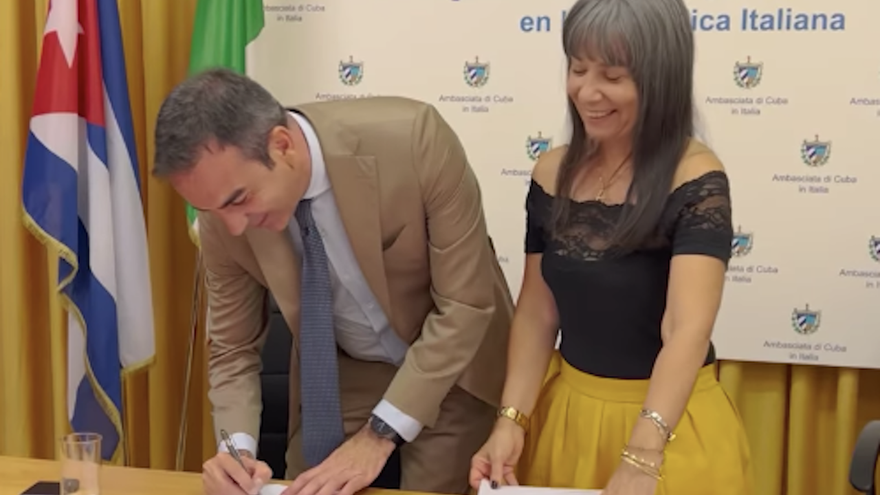
Italy to Hire 497 Cuban Doctors for 28 Million Euros a Year

The president of Calabria, Roberto Occhiuto, and the Cuban ambassador to Italy, Mirtha Granda Averhoff, during the signing of a healthcare agreement on Wednesday. (Facebook/Roberto Occhiuto)

14ymedio bigger14ymedio, Madrid, 18 August 2022 — A total of 497 Cuban doctors will be sent to Calabria beginning in September, as announced on Wednesday by president of that Italian region, Roberto Occhiuto, in a video broadcast on his Facebook page on Wednesday.

Occhiuto explained the decision was necessary due to a personnel shortage that hospitals around the country are experiencing, especially those in Calabria, which he described as having “an unattractive health care system.” “Every region is doing everything possible to recruit doctors,” he says, adding that most have not been able to fill open positions.

“What are we supposed to do? Close the hospitals? Fire the support staff? Not guarantee Calabrian citizens’ right to health care? No!” he says forcefully into a camera before announcing the agreement with a Cuban government corporation, Comercialzadora de Servicios Medicos (CSMC), which handles the export of Cuban medical services, the regime’s primary source of income.

Occhiuto, who is a member of Forza Italia, the right-wing party found by Silvio Berlusconi, praises “the extraordinary work” of the Cuban medical missions sent to Italy in March 2020 at the height of that country’s Covid-19 pandemic. continue reading

He also notes that CSMC is “the same government company that supplies thousands of doctors to many countries around the world with great success in terms of quality and experience because the Cuban medical school is one of the best there is.”

The three-year agreement was signed on Wednesday at the Cuban Embassy  without the the official fanfare that typically accompanies such events.

According to Italian press reports, the two sides spent weeks in negotiations, with Calabria ultimately agreeing to pay 3,500 euros per doctor with an additional 1,200 euros for living expenses, lodging, travel and training.

The reports did not indicate how much each participant would receive though the Cuban government often retains about 80% of an individual’s salary — the exact amount can vary country to country — with the remaining 20% going to the contract employee.

A local newspaper, La Nuova Calabria, reports that this will require CSMC to set up a branch office in Catanzaro, the regional capital.

The newspaper calculated the potential cost: “If the agreement is fully implemented, meaning that if all 497 doctors cited by Occhiuto were employed at the same time, their services would cost Calabria in excess of 2.3 million euros a month, or 28 million euros a year.”

The United States has added Cuba to its list of countries that do not meet international standards regarding to human trafficking, specifically as they concern Cuba’s international brigades. International organizations such as Human Rights Watch and Prisoners Defenders have accused the regime of holding its healthcare workers in conditions of forced labor.

____________

COLLABORATE WITH OUR WORKThe 14ymedio team is committed to practicing serious journalism that reflects Cuba’s reality in all its depth. Thank you for joining us on this long journey. We invite you to continue supporting us by becoming a member of 14ymedio now. Together we can continue transforming journalism in Cuba.

Rolando Cubela, the Cuban Commander who Conspired to Kill Fidel Castro, Dies in Miami

Faure Chomón, Fidel Castro and Rolando Cubela after the triumph of the 1959 Revolution. (El rastro del invasor)

14ymedio bigger14ymedio, Havana, 24 August 2022 — Commander, former political prisoner and doctor Rolando Cubela died at the age of 90 on Tuesday morning in the Miami hospital where he had been admitted for several weeks, according to family sources. A member of the Rebel Army, the guerrilla leader was part of a conspiracy to kill Fidel Castro in the 1960s.

Born in 1932 in the city of Cienfuegos, Cubela studied medicine and was a leader of the University Student Federation (FEU). After Fulgencio Batista’s military coup, on March 10, 1952, he joined the Revolutionary Directorate, a group founded by José Antonio Echeverría and Fructuoso Rodríguez.

Cubela was part of the clandestine cell that murdered Colonel Antonio Blanco Rico, head of the Military Intelligence Service, in Havana on October 27, 1956. After that action, he went into exile in Miami, where he was when his colleagues from the Directorate raided the Presidential Palace, on March 13, 1957, and failed to kill Batista.

Upon his return to Cuba, he established himself with other members of the Revolutionary Directorate in the guerrilla struggle in the Escambray mountains, where in 1958 he signed the Pact of El Pedrero with Ernesto Guevara and Camilo Cienfuegos, an alliance with the July 26 Movement that allowed the capture of the city of Santa Clara, in which Cubela was injured.

After Fidel Castro came to power, he was promoted to the rank of commander of the Armed Forces, and in 1959 he was elected president of the FEU over the other candidate, Pedro Luis Boitel, who in 1972 died on a hunger strike in prison. From the first years, Cubela began to have profound differences with the communist course of the revolutionary process. continue reading

In November 1963, a CIA agent met Cubela in Paris, who then held the position of military attaché of the Cuban embassy in Madrid. There he was given a feather, with poison in the quill, to puncture Castro when he was near him. But Cubela never used the device, since he preferred to use a rifle with a telescopic sight and silencer so as not to be so close to the target.

The delivery of the rifle was delayed, and the Cuban intelligence services ended up encircling Cubela, who was arrested in February 1966 and sentenced to death, although, due to Castro’s direct intervention, his sentence was commuted to 25 years, of which he served 12. In 1979, he went into exile in Madrid, where he worked as a doctor, and in 1988 he obtained Spanish nationality.

His profile in Madrid was very discreet due to the danger of being killed by Castro. In 2007, he participated in two public events organized by the Democracia Ya Platform, one of them in front of the Cuban Embassy in Madrid. Unlike other exiled commanders, such as Huber Matos and Eloy Gutiérrez Menoyo, Cubela did not found an anti-Castro organization during his time off the island.

After retiring from his job as a doctor, he settled in Miami, where he also maintained a low profile. The man who could have killed Fidel Castro survived him by at least six years.

Translated by Regina Anavy

____________

COLLABORATE WITH OUR WORKThe 14ymedio team is committed to practicing serious journalism that reflects Cuba’s reality in all its depth. Thank you for joining us on this long journey. We invite you to continue supporting us by becoming a member of 14ymedio now. Together we can continue transforming journalism in Cuba.

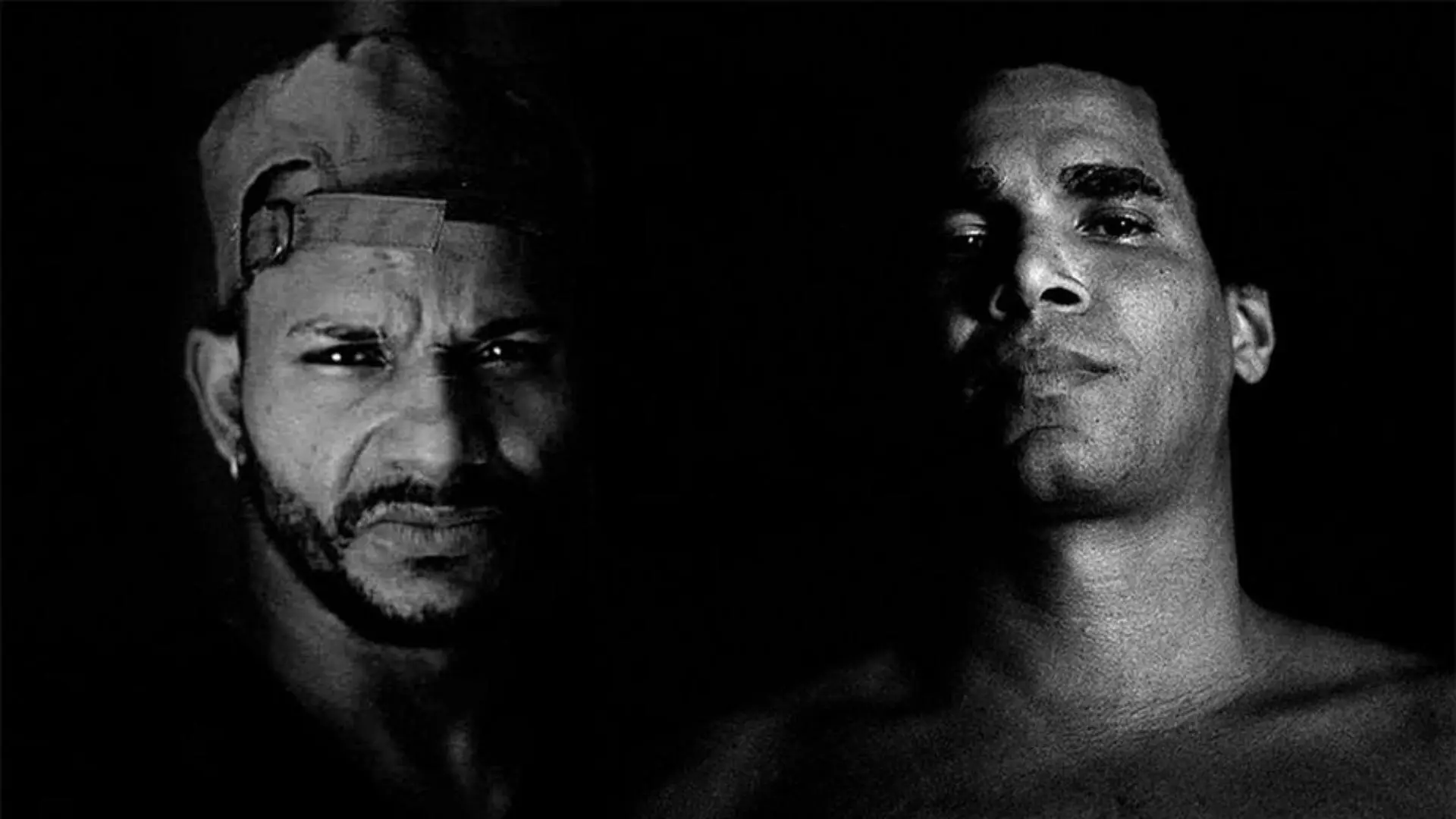
Cubalex’s Assessment of the Sentences Imposed Upon Luis Manuel Otero and Maykel Castillo / Cubalex

Maykel ‘Osorbo’ Castillo Pérez and Luis Manuel Otero Alcántara (Cubalex)

Cubalex, Giselle Camila Morfi, 24 June 2022 — The crimes of disrespecting national symbols, contempt, defamation of institutions and organizations, and heroes and martyrs, are not compatible with international human rights standards. These crimes are an assault on the freedom of expression recognized in Article 19 of the Universal Declaration of Human Rights and the International Covenant on Civil and Political Rights (PIDCP in Spanish), as well as [Article] 13 of the Pact of San José.

The crimes of contempt, resistance, and public disorder are used in Cuba with the goal of censoring and criminalizing the right to protest, based on an ideological imposition that supersedes the right to citizen participation. These crimes are used for social control, rather than for the defense and guarantee of human rights; they are discretionary, lacking clarity and concreteness in the criminal norms. Public order, assessed by judges, has nothing to do with public order within a democratic society.

What is the motivation of judges to destroy these people’s presumption of innocence?

Where are the “sentiments of nationality and pride professed by the Cuban people to the national flag” defined, unquestionably?

The State’s motivation was political punishment to create a deterrent effect, to prevent the rest of society from freely expressing themselves out of fear. We see a great danger in that sentence, with an evidently exemplary effect. The assessment was completely subjective, discretionary, and with a finality that is entirely illegitimate and which promotes a culture of self-censorship.

The result of this and all the sentences against the July 11, 2021 (11J) protesters create an effect not only on the accused but all of society. It is in the public interest to understand everything that happened during the trial and access the sentencing document. continue reading

What judges refer to as “disrespecting, dishonoring and affecting the dignity of the highest authorities of the country, using false, digitally manipulated images of them, which were published on social media,” is nothing more than exercising freedom of expression and legitimate criticism of authorities. In this case, only a meme was shared. Government officials must be accountable to us and are held to a higher degree of public scrutiny, they must be tolerant of criticism because they must respond to the interests of their citizens.

We have very little data with respect to this since the content of the sentencing document is not known, not even the document number, but we can conclude from the information that has been released that none of the limits they refer to are recognized by international human rights standards, rather, it is a punitive abuse of power by the State. None of these reasons comply with the legitimate legality, finality, need, and proportionality required by the Interamerican system’s tripartite test [CHECK: not sure if they mean “test”; I couldn’t find a translation for “tes”. I’m assuming it is something where if three conditions are met, states are allowed to limit this freedom.] allowing states to limit freedom of expression.

Note: Sentences handed down to artists of the San Isidro Movement

5 years in prison for Luis Manuel Otero Alcántara, as author of the crimes of disrespecting national symbols, contempt and public disorder.

9 years in prison for Maikel Castillo Pérez, for the crimes of contempt, assault, public disorder, and defamation of institutions and organizations, heroes and martyrs.

The entry Cubalex’s Assessment of the Sentences Imposed Upon Luis Manuel Otero and Maykel Castillo first appeared on Cubalex.

Translated by: Silvia Suárez

CUBA LIBRE: A CIVIC PLEDGE FOR A TRANSITION TO DEMOCRACY / Cuba Archive

The following tract provides Cubans an opportunity to exercise citizenship in a free virtual space. The text is a collaboration with input from a large and diverse group of Cubans who reside in Cuba and many other countries. The document was inspired by valuable efforts —historical and current— dealing with transition to democracy and/or sociopolitical cohesion to advance freedom in Cuba.

The catalysts of this initiative came together with the sole purpose of developing and advancing it, have not received any remuneration for their efforts and hold no interests other than those appearing in the text. The non-profit organization Cuba Archive certifies that this document was prepared collaboratively and is coordinating its support. (info@CubaArchive.org; +1.973.219-7000.)

CUBA LIBRE: A CIVIC PLEDGE FOR A TRANSITION TO DEMOCRACY

We, Cubans residing in the national territory or forced to leave our country, claim the free exercise of all our civic, political, economic and cultural rights. We wish for peaceful change towards a State organized according to the principles of democracy under the rule of law as the only viable solution to the political, social, economic, and humanitarian crisis affecting Cuba.

Moved by the imperative need to rescue the nation and procure the individual and collective wellbeing, we call upon:

1. All Cubans, to exercise resistance, civil disobedience, and non-cooperation with mass organizations, repressive forces, or any order, mandate, measure, or imposition that violates human rights until the end of the dictatorship is achieved; and to a civic, plural, and inclusive national debate on how to carry out a true and effective transition process that respects the rights of all social actors.

2. The current regime, to dismantle the organs of repression and allow for a peaceful and orderly transition to democracy; and to the heads of the armed and security forces to cease collaborating and supporting the Communist Party and its organs of power.

3. Public officials and employees of government and State entities, to safeguard official documents and archives.

4. The international community, to not extend credits or material assistance to the current regime, to demand that it relinquish power and sanction its leaders if they refuse, to send humanitarian aid only through truly independent institutions and entities, or in extreme cases of disaster to help the people, to support the empowerment of Cuba’s citizens and their
access to telecommunications, and to help the Cuban people in their transition to democracy. continue reading

We urge Cubans of good will, including civic, political, religious, academic, and labor leaders, human rights activists, and other respected public figures from a wide variety of fields individually or on behalf of movements and groups— to coordinate strategies and purposes that foster agreements to enable a transition to democracy, for the good of the Cuban people.

We want a free, independent, and democratic Cuba whose sovereignty resides fully in its people, from whom all public powers shall derive. A transition to democracy is a complex and broad process but it should include all of Cuba’s citizens, regardless of their place of residence.

We suggest taking the Constitution of the Republic of 1940, the last one democratically adopted, as a legal frame of reference until an elected government is formed and/or a constitution is approved by popular consultation, except for paragraph 99(a), that does not allow asylees to
vote, and any others that are exclusive or impractical for these times.

During an initial transition period, we advocate:

1. The appointment of a provisional government of limited duration made up of individuals committed to a transition to a full democracy who will not be eligible to run for government positions in the first elections. Its functions would be to:

a) Coordinate the transfer of power and lead the initial transition period towards the restoration of all fundamental rights.

b) Provisionally administer the country and the State’sresources, prioritizing national security, public order, and essential services.

c) Plan and schedule general elections by universal, egalitarian, and secret suffrage in a prudent but brief period not exceeding 24 months, to elect a government that will advance and consolidate the transition and whose task will include preparing a draft Constitution for the new democratic Republic to be submitted to a national referendum.

2. Prohibit the death penalty and any act of violence or arbitrary action against any citizen, material property, or the public order and social peace.

3. Abolish the control of the Communist Party over the government and the State, as well as over the organs of State power and dissolve existing party organizations during the transition period.

4. Abolish the political police and all repressive organs of the State.

5. Dismiss from office and temporarily disqualify members of the Communist Party, senior civil administrative officials (including Ministers, Deputy Directors and Deputy Directors of State companies, Ambassadors, Extraordinary Envoys, and senior officials of the Supreme Court, the Attorney General’s Office and the Comptroller’s Office), and top officials of the ministries of the Armed Forces and Interior as well as the Police.

6. Provisionally maintain the current administrative structure of the State, replacing the leading cadres and inviting members of the armed and security forces, as well as officials and employees of the government and State institutions who have not committed serious human rights violations to remain in their posts maintaining order and security in accordance with the objectives expressed herein.

7. Remove from office those who have committed crimes against humanity such as torture, murder, forced disappearance and prevarication, or other serious violations of human rights, and refer them to judicial processes, guaranteeing their personal safety and due legal process.

8. Repeal any law, regulation, or practice that suppresses or infringes on fundamental freedoms and citizens’ rights, including those of self-determination, conscience, expression, press, information, association, meeting, movement, labor unions, privacy, and worship.

9. Legalize organizations and associations of civil society and political parties and groups that are committed to the establishment of a democratic system.

10. Guarantee the citizens free access to communications and prioritize the dismantling of state monopolies over the press, education, and communications.

11. Stimulate productivity as well as supply and access to essential goods and services — prioritizing the most vulnerable— through the enactment of urgent measures such as removing price controls prices and permitting farmers’ markets, allowing the free exercise of professions, export/import by the citizens, and those that induce economic and social development to benefit the population.

12. Unconditionally release all those detained, prosecuted, or convicted for political reasons, including those convicted for pre-criminal social dangerousness, for leaving and entering the country, and for crimes against national security (referred to by the current regime as “crimes against the integrity and stability of the Nation and against the powers of the State”).

13. Start reviewing convictions for all causes and invite international human rights organizations to inspect prisons and detention centers.

14. Allow Cubans abroad to return, including exiles and alleged “deserters” from State entities, eliminating all political charges against them and restoring their rights, including participating in the democratic process.

15. Repeal political, military, and economic agreements, as well as collaborations of all kinds with allies and enablers of the current regime, and any covenant deemed contrary to the best interests of democracy, including those granting safe harbor to foreigners linked to terrorism, drug trafficking, and other activities contrary to the national good.

16. Punish, through due process of law, anyone who destroys, hides, embezzles or misappropriates documents, funds, properties, and other assets of the State.

17. Adopt transparency rules that guarantee accountability of the provisional government.

18. Appoint a Working Group that lays the groundwork for a Truth, Justice, Memory and Reconciliation process that coordinates essential aspects of the transition including archives, victims, private property, embezzled assets, national heritage, reparations, lustration, reconciliation, and memory.

19. The enactment of laws, appointment of an official Truth, Justice, and Memory Commission, and restructuring of the governmental/state apparatus shall follow the interim period; these will be up to elected governments or as provided in a new constitution, according to the will of the people.

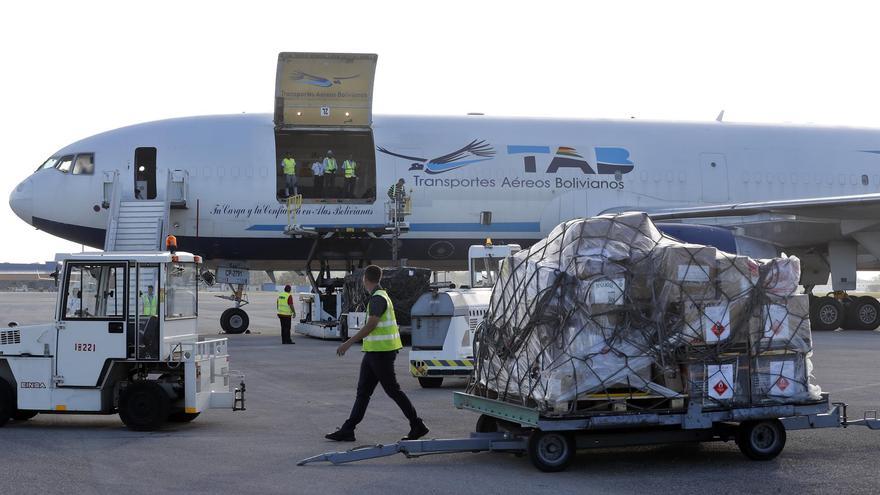
Cuba Receives Humanitarian Aid from Nicaragua and Bolivia Due to the Matanzas Fire

A cargo plane from Bolivia arrives at José Martí International Airport with 62.3 tons of aid due to the fire, this Monday in Havana. (EFE/Ernesto Mastrascusa)

14ymedio biggerEFE (via 14ymedio), Havana, August 23, 2022 — Cuba received shipments of humanitarian aid from Bolivia and Nicaragua on Monday due to the fire in the Matanzas Supertanker Base, the largest in the history of the country.

The donations consist of food, medicine and medical supplies, according to the Cuban Government.

The aid coming from Bolivia — more than 62 tons — arrived at the Havana international airport José Martí, and the Nicaraguan aid arrived at the port of Mariel on the ship Augusto César Sandino, which had left Arlen Siu a few days ago.

During the reception at the airfield, the deputy minister of the Ministry of Foreign Trade and Foreign Investment, Deborah Rivas, thanked Bolivia on behalf of the Island government and added that the country will also support La Paz “whenever they need us.”

Likewise, in the port of Mariel, Betsy Díaz, Minister of Internal Trade, said that the donation reaffirms the “unyielding will to strengthen historical ties” between Havana and Managua, especially “at such a difficult time.”

Other countries, such as Argentina and Spain, have already announced they are sending humanitarian aid to the Island after the accident, which left 16 dead, 146 injured and 17 hospitalized. continue reading

On August 5, a huge fire broke out at the Matanzas fuel tank base, the most important in the country, when lightning struck one of the eight tanks in the industrial park, according to the Cuban authorities.

The fire — which affected four tanks with a capacity of 13,208,602 liquid gallons — caused strong explosions, with flares of hundreds of feet, and a column of toxic black smoke that reached Havana, 60 miles away.

The island decreed two days of official mourning that ended last Friday with a posthumous tribute to 14 of the 16 victims, who until last week were still considered missing, and whose bone fragments were found at the scene of the accident.

According to Cuban experts, the degree of calcination of the remains made it impossible to extract their DNA, but he said that it corresponds to those of the missing, some of whom were young people doing their military service.

The Government revealed last week the names of the 14 people but not their ages, amid criticism of dissent and NGOs that claimed that several of them were young people in military service.

Translated by Regina Anavy

____________

COLLABORATE WITH OUR WORKThe 14ymedio team is committed to practicing serious journalism that reflects Cuba’s reality in all its depth. Thank you for joining us on this long journey. We invite you to continue supporting us by becoming a member of 14ymedio now. Together we can continue transforming journalism in Cuba.

No Blackouts in Taguayabon, Cuba

Taguayabón and Rosalía seem to be among those “untouchable” points on the map of Cuban blackouts.

14ymedio bigger14ymedio, Yankiel Gutiérrez Faife, Taguayabón (Villa Clara), 23 August 2022 — A blackout in the city is not the same as one in a rural area. When the power goes out in an urban center, even in smaller towns, the buzz of voices begins to break the silence, the heat gets people to talk, scream, bring their furniture onto the porch, and it is possible to smoke and listen to a portable radio.

In contrast, in a settlement, on the side of the road, or by an old sugar mill, blackouts are all-consuming and inhospitable. It’s the ideal opportunity for local thieves, nocturnal marauders, and bandits who always know the area’s uneven geography very well.

Amid the energy crisis some places in Cuba are apparently spared the outages scheduled by Unión Eléctrica. The settlements of Taguayabón and Rosalía, between Camajuaní and Remedios in Villa Clara, seem to be among those “untouchable” points on the map of Cuban blackouts.

The residents, accustomed to an Island where nothing is logical, know that at any moment they will lose the “privilege” of electricity. Suddenly, they explain the miracle alleging that both settlements are close to an area the government considers essential to the functioning of the province, however precarious.

In an “exceptional” stroke of circuit luck, both settlements are near General Docente 26 de Diciembre Hospital, at the entrance to Remedio, and the meat packing plant known as Osvaldo continue reading

Herrera in the people’s council of Vega de Palma on the route to Vueltas.

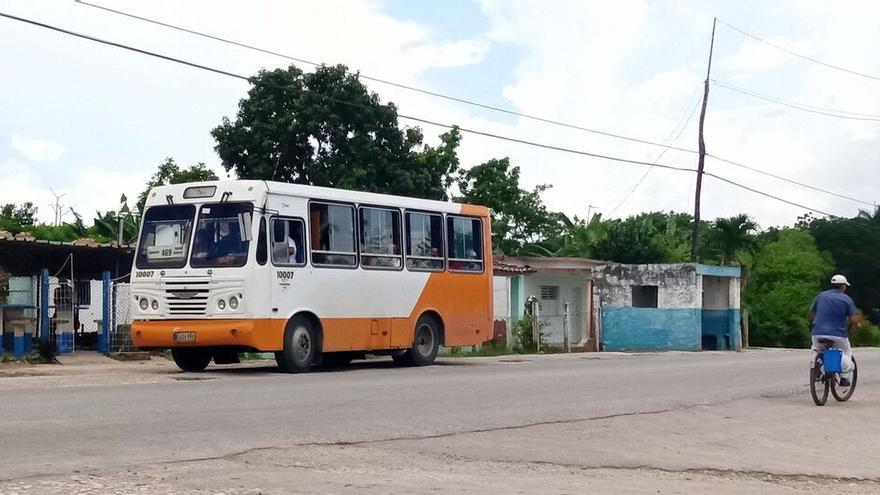
The bus always takes the same route as the meat: as soon as it passes Camajuaní it takes the bumpy road to Vueltas. (14ymedio)

The population of each of these areas is small, and thus they do not use excessive amounts of electricity; Taguayabón has 3,308 residents, Rosalía 235 and Vega de Palma 238. Vueltas, Camajuaní, and Remedios, which have tens of thousands of residents, can’t be spared the blackouts.

“We are well,” a resident of Taguayabón told 14ymedio, “but that does not mean we don’t know anything about the blackouts and the protests in other areas. In Camajuaní and Remedios they shut the power off six or twelve hours in a row, but those towns around here haven’t had a blackout in a month. Some joke that this is the new Marianao [a desirable neighborhood in Havana] and they want to move here.”

One ride on the hellish “Slaughterhouse bus,” which takes workers from Salamina near Santa Clara to Vueltas, is enough to make you understand the importance of the meat packing plant in Vega de Palma. The rickety vehicle, loaded with university students, sleep-deprived travelers, and employees of Cárnicos Villa Clara, runs slowly down the road to Camajuaní and takes a detour toward Salamina.

That slaughterhouse, along with two others — Lorenzo González in Sagua and Chichi Padrón in Santa Clara — is responsible for providing the raw materials to the Vega de Palma packing plant. The bus follows the same route as the meat: as soon as it passes Camajuaní it takes the bumpy road to Vueltas, passing el Entronque, another poor settlement.

The Osvaldo Herrera packing plant is run by the Ministry of Food Industry. It employs 250 workers and produces croquettes, canned goods, and sausages, including the unpleasant Cuban version of mortadella, the consumption of which is rationed by the government. Some of the products, those of higher quality, are sent to hotels in the nearby area of Cayería Norte. Another, non-negligible percentage of the sausage “tubes” ends up on the informal market or available through online food stores, which require prepayment in dollars from abroad.

The products at Vega de Palma also require flour from Cienfuegos, and soy from Santiago de Cuba necessary to make mincemeat, another gastronomic headache for Cubans, while other companies provide nylon, cardboard, and preservatives to package the products.

In Vega de Palma there are two sausage-making machines, one meat grinder and one for boneless meat, five steamers with a capacity of 1,500 kilograms, fans, showers for cleaning the meat, and cold storage.

Yolanda, an employee at the packing plant, tells 14ymedio that for a long time her company has not had a backup generator for emergencies. “It depends entirely on the national electric system,” she states, “and although no one confirms that is the reason we don’t have blackouts, we know. Everything would spoil!”

“Some joke saying this is the new Marianao and that they want to move here.” (14ymedio)

If a blackout would break the cycle, the hotels wouldn’t have sausage, the butchers would not receive the monthly mortadella ration and the government would add another crisis to its long list of unresolved problems.

Nonetheless, not even uninterrupted power guarantees the packing plant’s function. Ernesto, another one of the employees, states that the company does not work every day.

“Sometimes the work is interrupted because there is no gas for the trucks that bring the meat from Salamina. Other times, what is missing is the raw material. We run out of wheat flour and it is impossible to make croquetas. Then we have to make mincemeat or mortadella, while we have the pork or chicken,” he concluded.

The other “guardian angel” against blackouts for these rural settlements is the hospital in Remedios. With 480 workers, of which 67 are doctors and 138 nurses, patients in serious condition are sent here from nearby municipalities including Camajuaní, which only has one polyclinic serving outpatients.

In the old yet very effective hospital, there are pediatric, obstetric, gynecology, anesthesiology, general surgery, intensive care, clinical laboratories, and other wards. A prolonged power outage would be fatal during surgery or for patients on life support.

Of course, neither the colossal packing plant nor the hospital in Remedios provides long-term guarantees. The residents suppose the government has weighed its options: it maintains the power supply because it would be more expensive to fuel generators for both centers.

No one holds out too much hope that the situation will remain as is, of course. If small towns in the Villa Clara countryside have not been affected much by blackouts, it is precisely because they are small. The Cuban government and its energy bureaucracy know where to shut off power and for how long. It is the reason for popular discontent, less controllable as time goes on, and its direct consequence — the nighttime protest.

Translated by: Silvia Suárez

____________

COLLABORATE WITH OUR WORKThe 14ymedio team is committed to practicing serious journalism that reflects Cuba’s reality in all its depth. Thank you for joining us on this long journey. We invite you to continue supporting us by becoming a member of 14ymedio now. Together we can continue transforming journalism in Cuba.

Cuban Boxer Billy Rodriguez Escapes after Winning Against Luna in Mexico

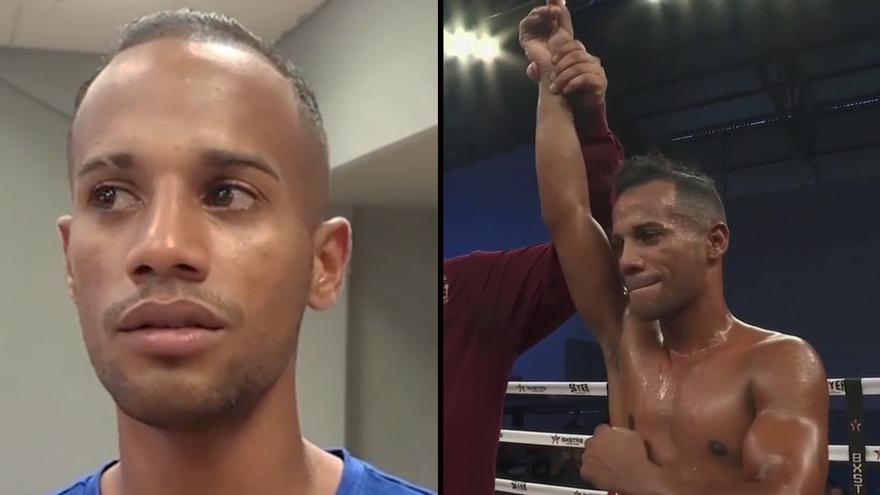
Boxer Billy Rodríguez left the Domadores de Cuba team after his professional debut in which he beat Miguel Ángel Luna. (Collage)

14ymedio bigger14ymedio, Havana, 22 August 2022 — Cuban boxer Billy Rodríguez traveled to Mexico with one goal: “to come out victorious and then enjoy myself,” he stated in an interview with the official site Jit. He showed his qualities last Friday in his professional debut against Miguel Ángel Luna, whom he beat by a technical knockout, and with his escape he gave another hook to the liver of the boxing team Domadores de Cuba.

El Niño Rodríguez, as he is known within the Cuban Boxing School, became, like every athlete who escapes, a traitor, who “turned his back on contractual obligations” and “whose attitude must be condemned.”

According to journalist Francys Romero, with Rodríguez’s abandonment there are now 31 athletes who have escaped this year from Cuban teams during international competitions, including those who have decided to end a contract with Cuba’s National Institute of Sports, Physical Education and Recreation (Inder).

“These 31 include baseball players Alfredo Fadraga and Yosvany Ávalos, who were captured and deported back to Cuba last June,” the journalist said on his social networks. “It’s the reality right now of sport and Cuban society. The situation will only get worse. In 2023, there will be Central American and Pan American Games in the same year.

Billy Rodríguez’s escape is a serious setback for the Cuban regime that highlighted the young man from Havana as a revelation and Cuba’s hope in the 108-pound division. He was due to debut on June 5 in Buenos Aires, but host Sergio Daniel Rosales said he didn’t comply with the weight requirement. continue reading

Last Friday, Rodríguez showed himself against Luna as a fast boxer, with variety in his punches and a solid right, which took down his opponent. He exhibited in the ring the teachings of his mentor, Diógenes Luna, 2001 world champion in Belfast.

Rodríguez has defined himself as a boxer who likes to exploit his right, who likes to strike, dodge and counterattack. He is also a follower of Olympic and world champion Julio César La Cruz, but his idol is Lázaro Álvarez.

El Niño is gone from Cuba. The future may bring opportunities in boxing but also professionally, as this young man has completed his studies as a physical education teacher, said Cubadebate.

Translated by Regina Anavy

____________

COLLABORATE WITH OUR WORKThe 14ymedio team is committed to practicing serious journalism that reflects Cuba’s reality in all its depth. Thank you for joining us on this long journey. We invite you to continue supporting us by becoming a member of 14ymedio now. Together we can continue transforming journalism in Cuba.

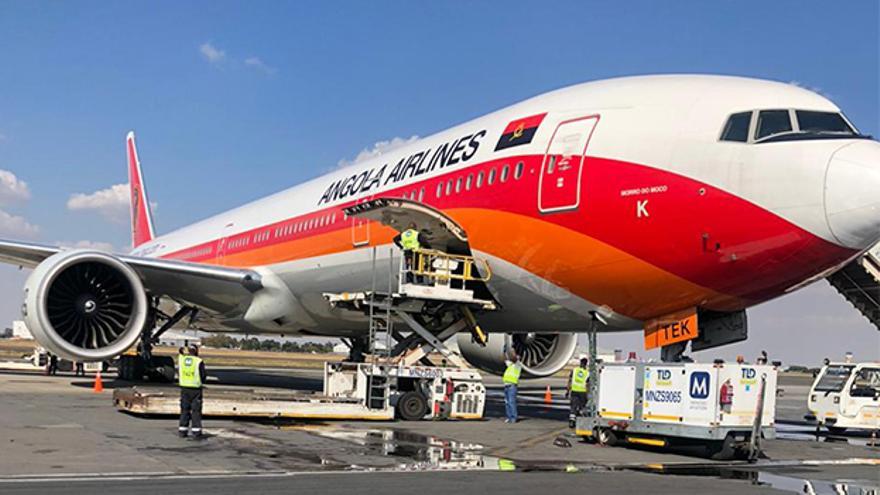
Angola Resumes its Air Relations with Cuba

The flights between Luanda and Havana will start this November 8. (TAAG Airlines)

14ymedio bigger14ymedio, Havana, 23 August 2022 — Angola’s state airline, TAAG Airlines, will cross the Atlantic Ocean again from Luanda to Havana beginning November 8, according to an official announcement by the company.

“After the positive evaluation of business for the intercontinental routes (America and Europe), TAAG is in a position to resume connections with Cuba/Havana,” the Angolan Day published a few days ago.

The flights will be made on board a Boeing 777-300 on a biweekly basis, starting in November, and it’s expected that weekly trips can be made from December. Later, in February 2023, the biweekly frequency will be resumed, says the Angolan newspaper.

There is already a flight schedule that includes November 8 and 22, and December 6, 13, 20 and 27. On the other hand, in January 2023, travelers will be able to book on February 3, 10, 17 and 24, and also on February 14 and 28. continue reading

Departure from Luanda will be at 10:00 p.m. and a landing in Havana is scheduled for 6:00 a.m. the next day, local time. Departures from the Island will be at 11:30 a.m., with an arrival in Luanda at 7:00 p.m. the next day. On its social networks, the airline has begun to promote its relaunch to the island and invites bookings on the first dates.

TAAG Airlines paused its flights due to travel restrictions during the COVID-19 pandemic and was only allowed some humanitarian or cargo trips. This airline had operated without interruption between the two countries from 1984 to 2020.

In June of this year, the CEO of TAAG, Eduardo Fairen, announced that the company is preparing to be privatized before 2025, as has happened with the rest of the companies involved in the aviation sector, prior to the open skies agreement.* Several months before these statements, in February, the company acknowledged that its debts to international suppliers are around $250 million.

Cuba and Angola established diplomatic relations on November 11, 1975 and have maintained close ties since then. Between that year and 2002, more than 300,000 Cuban soldiers participated in the civil war that broke out in Angola after its independence from Portugal, a colonial power for four centuries.

Earlier this year, the Minister of State of Angola, Adao de Almeida, visited the island and together with Cuban Deputy Prime Minister Ricardo Cabrisas reaffirmed the desire to promote “economic cooperation” between the two countries. “Today, Havana and Luanda are focusing on promoting the links between the Mariel Special Development Zone and the Special Economic Zone of the Nation of West Africa,” says a statement from the Cuban Foreign Ministry, dated February 28 of this year.

With the election in 2017 of a new president, João Lourenço, a review of the cooperation with Cuba began, which the former head of state, José Eduardo dos Santos, handled with a suspicious generosity.

In December 2020, Luanda annulled a million-dollar contract with Havana for “failure” of its obligations in the construction of a road. The company Imbondex Construcciones y Materiales de Construcción S.A. belonged to the Cuban military conglomerate Gaesa (Grupo de Administración Empresarial S.A.).

In 2015, Cuba had more than 4,000 aid workers deployed in Angola, including 1,800 doctors and 1,400 teachers.

A few days ago, more than 260 young Angolans returned to their country after graduating in healthcare specialties in Cuba, including Medicine, Stomatology, Optometry and Optics, Rehabilitation, Hygiene and Epidemiology, Nutrition, Health Information System, Veterinary Medicine, in addition to others such as Agronomy and Civil and Industrial Engineering. According to the Cuban Foreign Ministry, the island has trained about 45,000 Angolan students.

*Translator’s note: An agreement in which aircraft can fly between two countries without any restrictions.    

Translated by Regina Anavy

____________

COLLABORATE WITH OUR WORKThe 14ymedio team is committed to practicing serious journalism that reflects Cuba’s reality in all its depth. Thank you for joining us on this long journey. We invite you to continue supporting us by becoming a member of 14ymedio now. Together we can continue transforming journalism in Cuba.

The Official Sale of Dollars in Cuba Begins and Each One Will Cost 123 Pesos

The purchase can be made at 36 exchange offices and a branch of the Banco Popular de Ahorro in Isla de la Juventud. (14ymedio)

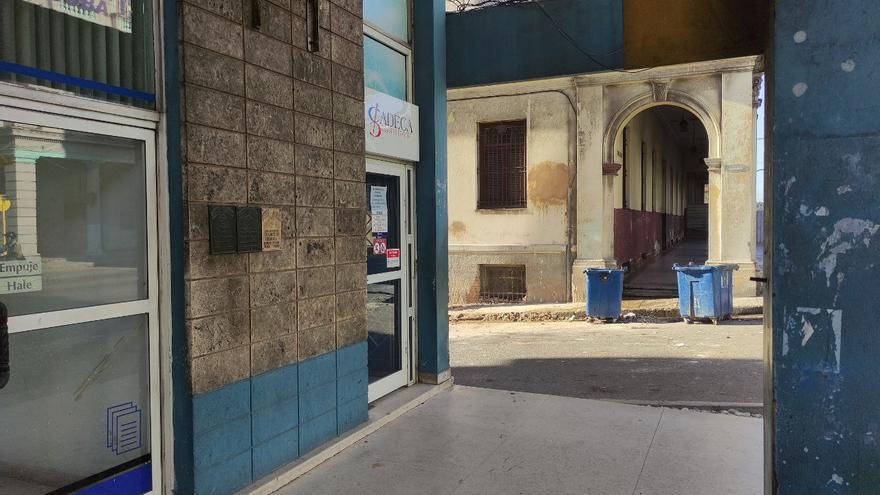
14ymedio bigger14ymedio/EFE, Havana, 22 August 2022 — The Cuban government announced on Monday that it will start selling dollars to the population on August 23 at a rate of 123.60 Cuban pesos (CUP) per dollar. The 37 premises authorized to carry out this operation will report daily the number of people who can buy that day, “depending on the availability of foreign currency,” said the Minister President of the Central Bank of Cuba (BCC), Marta Sabina Wilson González, on the Roundtable television program, hosted by Randy Alonso.

Initially, a person will be able to buy only $100 or its equivalent in other currencies, although Wilson González did not specify how often this can be done. The sale will begin in 36 exchange houses (cadecas) and a branch of the Banco Popular de Ahorro in Isla de la Juventud.

The official said that both the exchange rate, for now 120 CUP for a dollar, and the margins, will be adjusted if necessary. In addition, the purchase limit of $100 per person “can be extended” later.

“If the dollar is the most difficult currency we have for export, then the idea is for people to demand that currency, and we want that purchase to be fundamentally from the dollars we have in stock in the cadecas,” said the minister president of the Central Bank.

The Cuban authorities said that the euro is the currency that has entered the official foreign exchange market the most since they implemented the new exchange rate at the beginning of the month, followed by the dollar, the pound sterling and the Mexican peso. continue reading

The Minister of Economy, Alejandro Gil, for his part, acknowledged that “there is a demand for cash dollars” on the Island, whether to emigrate, to go shopping abroad or for other reasons. However, he clarified that right now the only way out for these dollars is to sell them on the foreign exchange market.

Cubans buy dollars to emigrate, make domestic transactions and leverage their little savings in the face of the collapse of the power of the CUP to buy goods and services. Inflation and lack of productivity have pushed the national currency into abysses never before seen.

“We’re not going to fall behind the exchange rate of the informal market,” Gil said for those who expect the official rate to compete against illegal networks. “The first step is for the State to regain control of the value of the currency,” the minister clarified. “This is not a market economy,” he stressed.

“Little by little, the State will advance in controlling the foreign exchange market,” Gil reaffirmed. But “if you have a partially dollarized market,” there will always be a demand for foreign currency. “We will reach a time of lower demand for foreign currency when we have more products available in Cuban pesos.”

The minister, who repeated the word “challenge” several times to describe the foreign exchange market, warned of the need to relaunch Cuban industry in order to sustain the pulse of the currency and reiterated his criticism of the “voluntarist” vision of the economy. “The strength of the economy is what will allow us to stabilize the exchange rate,” he explained. “You have to come down to earth and understand the sense of urgency,” he confessed.

“This is not for the new rich,” Gil defended himself. “This is not a measure for those who receive foreign currency,” he said in a speech, trying to reinforce the idea that there is an official script that includes, in the medium and short term, an improvement in daily life. “It’s not improvisation; nothing we do is improvised,” he said in the midst of a climate of increased social criticism.

Reactions to the new announcement flooded the social networks. Cuban economist Mauricio De Miranda Parrondo said ironically on Twitter: “I think the next decision of the Government will be to sell foreign currency through the ration book in Cuba. Randy says that they will assign turns in the line. I imagine they will end up making phone appointments.”

Translated by Regina Anavy

____________

COLLABORATE WITH OUR WORKThe 14ymedio team is committed to practicing serious journalism that reflects Cuba’s reality in all its depth. Thank you for joining us on this long journey. We invite you to continue supporting us by becoming a member of 14ymedio now. Together we can continue transforming journalism in Cuba.

Former Cuban Officers Call on the Eastern Army ‘Not to Comply with the Orders of the Dictatorship’

A special forces agent faces demonstrators in Nuevitas, Camagüey. (Captura)

14ymedio bigger14ymedio, Madrid, 22 August 2022 — The group Military Conscientious Objectors (MCO) calls on the agents of the Cuban security forces to put themselves “on the side of the people” and help “end this corrupt mafia dictatorship.”

In a statement issued on Sunday, the organization, founded in 2021 by former Cuban officers in exile, refers to the “new national wave of repression” posed by the actions against the protests in Nuevitas (Camagüey) this weekend, and asserts that “it must be decisively rejected by the whole country but especially by the Revolutionary Armed Forces.”

“Our comrades in arms cannot and should not comply with the orders emanating from a dictatorship that has ignored the well-being of the people and today pushes Cubans into increasing misery,” they say in their statement.

MCO urges General Rigel Tejeda, head of the Eastern Army, to ensure that “his troops don’t act as minions or mercenaries of the new oligarchy.” His was quoting his predecessor, General Onelio Aguilera Bermúdez, who “did not stain his hands with blood on July 11, 2021. Don’t give in to pressure that would smear your name and that of the commanders under you.”

The Eastern Army, the retired soldiers insist, “shouldn’t act as private troops in the service of those who spend time on their yachts while millions of Cubans go to bed without food, without electricity, without medicines and without a roof over their heads.” continue reading

In addition to expelling the current rulers from power, former officers call for the “nationalization” of the Gaesa military conglomerate, which they allude to as “the monopoly that this new oligarchy has registered as a Panamanian company, which controls 60% of the economy and is not accountable to any institution in Cuba. It left tens of thousands of Cubans to die during the pandemic due to lack of oxygen tanks, medicines and ambulances, while spending billions of dollars on building new luxury hotels.”

Translated by Regina Anavy

____________

COLLABORATE WITH OUR WORKThe 14ymedio team is committed to practicing serious journalism that reflects Cuba’s reality in all its depth. Thank you for joining us on this long journey. We invite you to continue supporting us by becoming a member of 14ymedio now. Together we can continue transforming journalism in Cuba.

More Police and Arrests and Fewer Blackouts to Calm Things Down in Nuevitas, Cuba

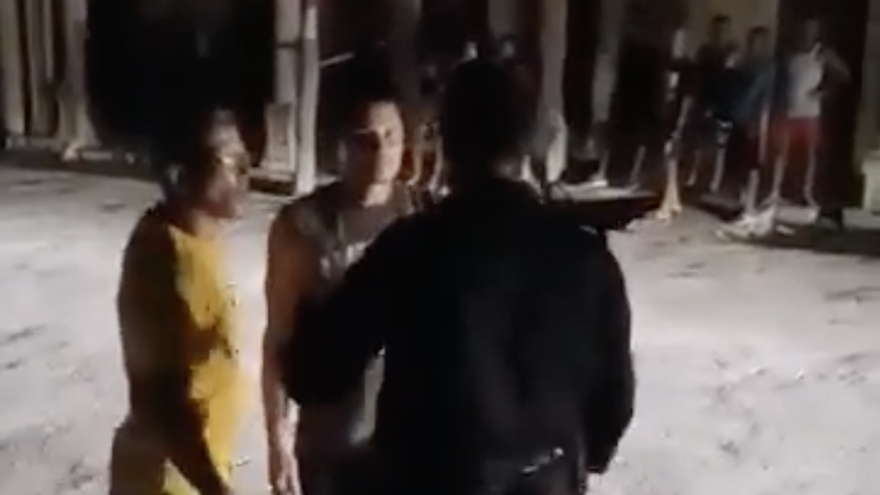
Moment in a video during the second protests in Nuevitas, in the early hours of Saturday, in which protesters are seen facing an agent. (Captura)

14ymedio bigger14ymedio, Havana, 22 August 22, 2022 — The Camagüey city of Nuevitas, a protagonist on Thursday and Friday of the largest demonstrations in Cuba since July 11, 2021, wakes up on this repressed and silent Monday. Throughout the weekend, its inhabitants had their Internet access restricted, and the streets were patrolled by police, soldiers and civilian agents.

Eyewitness testimonies about the protests, published on social networks, have been deleted. Thanks to these videos, it was possible to observe the crowd that made up the demonstrations, where along with demanding an the end of the blackouts — “turn on the power, dickhead” – they shouted other high-sounding slogans, such as “freedom” “homeland and life” or “Díaz-Canel, motherfucker, the people are tired,” and sang of the national anthem.

There is also no trace of what happened in Nuevitas in the official press. The provincial newspaper Adelante limited itself to announcing this Sunday a new “energy schedule,” inferring that there will be fewer blackouts.

In an attempt to appease the spirits of the population, they also reported that the Diez de Octubre thermoelectric plant, in Nuevitas, which had stopped working due to breakdowns, “synchronized” two of its units to the National Energy System. The title of the note published on Saturday, Thermoelectric unit of Nuevitas integrated into the national generation of  was, however, misleading: both blocks later, were again “off-line” because of problems with the boilers, and the only unit that works in the plant is the VI.

Some official media did allude to the protests on their social networks, only to dismiss them. Thus, Radio Nuevitas reproduced on Facebook a publication that calls peaceful demonstrations “disruptions of public order, always encouraged from the outside to incite hatred, popular discontent and violence.” continue reading

The text, signed by Pedro Alexander Cruz Moiset of Radio Cadena Agramonte, extends to the opinion that “none of those who call for a regime change in Cuba have lived under capitalism, much less delved into the history of capitalism.”

The author suggests that “rather than inciting hatred, the call must be for unity, discipline, order, the collective search for the solution to the real and objective problems that the nation is experiencing,” and ends by calling for “the defense of the Revolution and its conquests” with the slogan “homeland or death, we will win.”

The publication was strongly criticized in the comments. “You have to be really cold to blame others for what happens in Cuba! Enough is enough! No one believes you!” writes Indira C. Martínez. “Be ashamed of your complicity and do real journalism!” asks Gissel Herrera.

A Cuban woman, resident in Miami, Alina Jalil, argues: “They could say that Cubans were asleep because there was no internet, and they barely had communication with the outside world, buddy! But now? It’s shameful that they publish this! Who is that note for?”

And the Havanan Niurvis Delgado says: “The people are tired of so many unfulfilled promises. They protest to ask for change and demand that they be heard, because they know that there’s a better life and that what they lead is not life,” while encouraging: “We are all Neuvitas! Poor, brave people!”

Meanwhile, Justicia 11J reported that the relatives of Mayelín Rodríguez Prado, La Chamaca, were informed by the police of Nuevitas that the 21-year-old girl was transferred to Camagüey. “We don’t take this information for granted until Mayelín makes the regulation call that would put an end to her disappearance,” clarifies the legal platform, which registers a total of 42 detainees in the protests that have occurred on the Island since the beginning of the “scheduled blackouts” in mid-June.

On Sunday, the organization mentioned ten others arrested for the demonstrations in Camagüey. Two of them are José Armando Torrente and his wife, parents of Gerlin Torrente Echevarría, the 11-year-old girl who along with two others was assaulted by security forces in the early hours of Saturday.

In addition, they report that the hairdresser Josué Nápoles Sablón, El Nene, and six demonstrators from the peoples council of Camalote were arrested: Yasmani García Ramírez, Michel Escalona Ramírez, Kenay Perdomo Soria, Héctor Curbelo, José Antonio Rodríguez and Richard Conte Betancourt.

Finally, they confirmed the arrest of Julio Gil de Montes, related, says Justicia 11J, “to his critical statements about the first secretary of the Party in Camagüey.”

Translated by Regina Anavy

____________

COLLABORATE WITH OUR WORKThe 14ymedio team is committed to practicing serious journalism that reflects Cuba’s reality in all its depth. Thank you for joining us on this long journey. We invite you to continue supporting us by becoming a member of 14ymedio now. Together we can continue transforming journalism in Cuba.

Every Man for Himself, Blackouts are Growing in Cuba and so is the Market for Generators

Since August 15, Cubans are allowed to import up to two power generators without commercial purposes. (CMKX Radio Bayamo/Facebook)

14ymedio bigger14ymedio, Havana, 16 August 2022 — “Noiseless and efficient,” according to the text that accompanies the photo of a power generator that, for about $4,000, promises to exorcise the demon from the blackouts. The most precious status symbol on the Island is a device that keeps appliances running when the government cuts off the power. Only surpassed by a plane ticket to emigrate.

The energy deficit, due to the poor state of the thermoelectric plants and the lack of fuel, has plunged Cubans into darkness. In large areas of the country, electricity appears for only a few moments, not exceeding ten hours of service per day. Cooking, cooling off or being able to drink a glass of cold water depend on running devices that invariably need power.

Since August 15, with the easing of customs measures, Cubans can import up to two generators with a maximum power of 15,000 watts without commercial purposes. The duty payment may vary depending on the capacity of the device and whether the traveler brings in other goods that are also taxed, but that small opening has been enough to trigger the market for generators.

Ibrahim has been traveling to Panama for six years to import household appliances. “The pandemic almost put me out of business because I couldn’t travel for some time, but now I’m back on track,” he tells 14ymedio. “The most profitable thing right now is to bring in generators, because people are desperate and pay well for them. If you don’t have a generator, you don’t have quality of life.”

Those who don’t have the resources to buy one appeal to ingenuity: blades of a fan that are driven by pedaling a bicycle, improvised beds in the doorway or on a terrace to take advantage of even the smallest breeze in the early hours of the morning, and the traditional hand fan that serves to refresh the skin and scare away mosquitoes are just some of the ways, but they are only palliative and barely calm the discomfort. continue reading

Living in the Havana neighborhood of Nuevo Vedado, Ibrahim’s clients are middle-income people, often with families abroad who can help them with their expenses and who don’t want to go through the blackout without being able to turn on at least one fan, a rice cooker or a television. “I haven’t left Cuba yet, and I already have six orders for generators.”

“The most in demand right now are those that use both gasoline and propane, because there’s no guarantee that one of the two can always be bought. Diesel ones also have their market,” he explains to this newspaper. “The problem is that now it has also become a problem to get the fuel, so buying the device doesn’t end the problem,” he admits.

Among Ibrahim’s clients are families who seek to ease domestic life during power outages but also some entrepreneurs. “I have people who can’t afford to lose power because valuable merchandise will spoil, or they’ll lose a lot of money because they can’t work.” As an example, he mentions “informal shrimp and lobster sellers,” in addition to a home beverage business that sells its products online and promises them “always cold.”

The prices vary. Ibrahim sums it up: “For every watt I generate you pay me a dollar. But if it’s a powerful generator of more than 4,500 watts, I can provide it, and there are discounts that make the price cheaper. If, in addition, the client wants it to be home-delivered, that can be arranged.”

But it’s not all a matter of money when it comes to acquiring one of these devices that saves you from darkness and heat. “My brother has been insisting that I buy one for a long time, but I live on a street where everyone is a big gossip,” laments Juan Carlos, a resident of the city of Alquízar. “If, in the middle of a blackout, the only house that is illuminated is mine, people will start talking.”

Juan Carlos runs a modest business selling fresh cheese and yogurt. Most of his business is informal, and he’s afraid to keep his lights on when the neighbors can’t even see their hands. “The least  that can happen is envy, and the worst is the thieves, who might think I have a lot of money because I have a generator.”

The theft of these devices is becoming more frequent. “In the early hours of the morning they took the generator that we had secured behind a padlocked fence,” a resident of El Vedado, who managed to use her generator for only a few weeks, explains to this newspaper. “It was wonderful, although a little noisy,” she says. “We never filed a complaint with the police because we had bought it on the black market.”

Ibrahim doesn’t want to import a generator for his family. “My thing is to make money to get my wife and my two children out. If I have to spend that time fanning myself with a piece of cardboard, I’ll do it.” In advance, he already knows what devices  to bring to the island in the first days of September. The classified ad he has put in several places shows a large generator, with wheels  and accompanied by a phrase: “Sleep all night without worrying about blackouts.”

Translated by Regina Anavy

____________

COLLABORATE WITH OUR WORKThe 14ymedio team is committed to practicing serious journalism that reflects Cuba’s reality in all its depth. Thank you for joining us on this long journey. We invite you to continue supporting us by becoming a member of 14ymedio now. Together we can continue transforming journalism in Cuba.

Cuban Police Thwarted Andy Garcia’s Release from Prison and His Exit from the Country, His Family Denounces

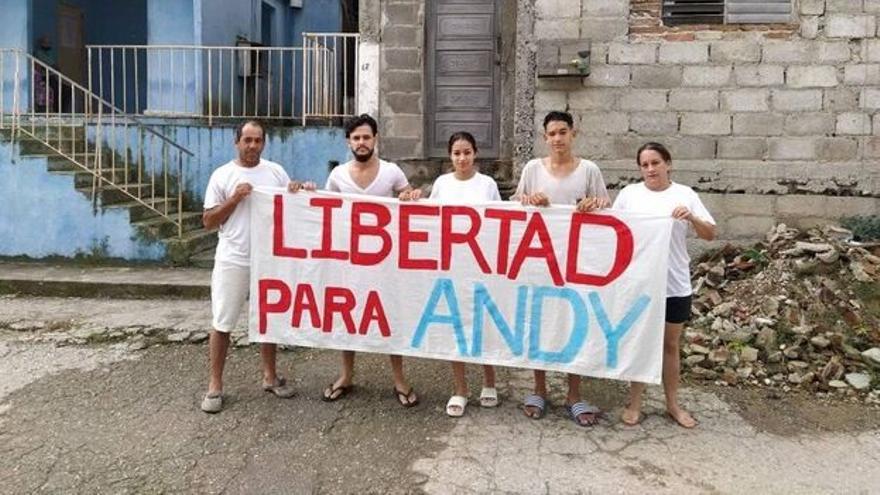
Family members of Andy García Lorezno, one of those arrested for July 11th (11J), in front of his home in Santa Clara. (Facebook)

14ymedio bigger14ymedio, Havana, 19 August 19, 2022–Andy García Lorenzo, one of the men prosecuted for  last year’s ’11J’ (11 July) protests in Santa Clara, was punished once again for his activism. The young man was transferred to a maximum security prison known as El Pre, his sister Roxana denounced on Thursday after the order for him toserve his sentence in a labor camp was revoked.

“That is what they told us, but we’re not sure of it,” said the young woman, who reminded us that it is not the first time State Security has lied to the family.

García Lorenzo’s transfer occurred just two days after his family denounced that the 24-year-old was “in poor health.”

“As of yesterday, my brother had not eaten for two days,” stated Roxana García during a live stream on Facebook, during which she said that Andy was in prison “in terrible conditions, without food. Most likely he hasn’t eaten anything. We don’t really know what is happening with him, what the justification was for his transfer, under what conditions, and in what manner.”

In the video, the young woman addresses State Security and revealed that the family “was preparing itself” because Andy would be out “soon” and the family would leave the country with him. “You have shown us that you will do everything possible to try to break up the family,” she said, but “Andy’s family will be around him for quite a while.”

Since García Lorenzo was arrested on the afternoon of July 11, 2021, Roxana as well as her husband, Jonatan López, and both of their fathers, Nedel García and Pedro López have been very actively defending 11J political prisoners and on several occasions have denounced the harassment of the political police.

The young man was sentenced to four years in prison for public disorder, contempt, and assault during a trial held on January 10, along with 15 other protesters. He was supposed to have served that time interned in a correctional labor camp known as El Yabú. continue reading

Before going to that center, García Lorenzo was able to spend close to two weeks at home while awaiting the paperwork to enter the penal system, but the joy was short-lived; after spending two days with his family, he was arrested on the street, while riding a motorcycle with his father, and transferred to the camp.

According to reports by the Cuban Observatory for Human Rights (OCDH), Andy García Lorenzo’s case is another one among many opponents who endure terrible medical care in prison. On Friday, the Madrid-based organization demanded the International Red Cross and the United Nations Working Group on Arbitrary Detentions be allowed to visit Cuban prisons.

The Observatory allegedly received “information of health conditions that have occurred or have been aggravated among political prisoners and prisoners of conscience. In several cases, the allegations include indifference on the part of prison authorities or the lack of appropriate treatment for their illnesses.”

In addition to García Lorenzo, the Observatory has registered the cases of Angélica Garrido Rodríguez, “with facial paralysis following threats and intimidation by prison authorities”; Maikel Puig Bergolla, who suffers from diabetes mellitus, hypertension, and a skin infection; Félix Navarro, also diabetic and who has been infected with COVID-19 twice, experiencing drastic weight loss and infections.

The organization adds to that list prisoners Yuri Valle Roca, Mario Josué Prieto Ricardo, Dayron Marín Rodríguez and Walnier Aguilar Rivera. “From past experience,” it concludes, “we know the experience in the regime’s prisons has been nefarious for the physical and mental health of many Cubans.”

Translated by: Silvia Suárez

____________

COLLABORATE WITH OUR WORKThe 14ymedio team is committed to practicing serious journalism that reflects Cuba’s reality in all its depth. Thank you for joining us on this long journey. We invite you to continue supporting us by becoming a member of 14ymedio now. Together we can continue transforming journalism in Cuba.