Havana Jargon / Iván García

The other crisis that exists in Cuba, besides the political and economic one, is stationary and comes from our language. We already know that money is scarce and that food is scarce. We live in upset, because we live under a government that controls our lives as if they were our parents. A huge share of Cubans dream of futures in Miami, Rome, or Madrid.

Very well, I understand all of that. But I can’t wrap my head around why we daily speak an incomplete and fast-paced dialect, which only we nationals comprehend. An example of this current “language” spoken on the island is the following dialogue.

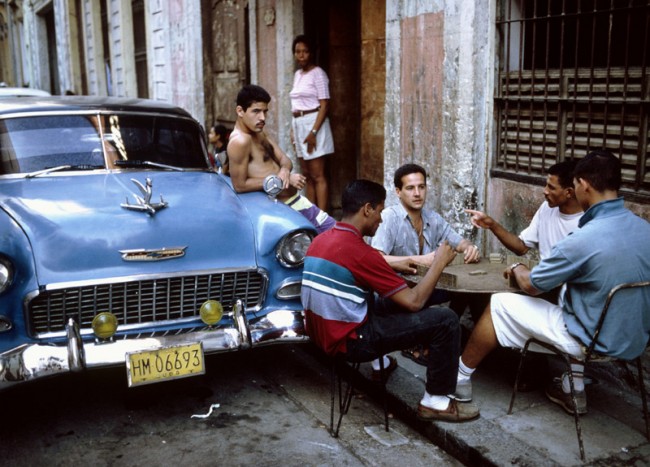
Any random morning. Two friends meet up at any park in Central Havana.

– What’s goin’ on, homey?

– Everythin’ and nothin’, my friend.

– I’m looking for a fool to throw in his face the couple of imported pedals my dad sent me, I don’t have a dime. I’m going to sell them for 30 dollars so I can hook up with that bitch from the neighborhood, she’s driving me crazy.

The homey, with his pants hanging well below his waist and showing off his Nike underwear, replies:

That bitch pretends to be shy. If I don’t show her the money she won’t even move her ass, once I put my dick in her mouth and afterwards I was wasted and broke and she just left me, every time I think about it, I feel like breaking her in half like a pencil.

A policeman with an evil face and a German Shepherd comes near. The two friends decide to leave.

– I’m outta here, see ya later.

He gives his friend a kiss on the face and reminds him:

– Please do not pretend to be the “sugar daddy” (the one who pays) with that girl, that it is not good, rumors say that she’s no good in bed after all.

– Got it, responds the homey.

Even for me, who is bent on trying to understand the ins and outs of the Havana underground world, it sometimes gets confusing and I don’t understand such language.

For Cubans who have been living outside of the island for years, it will be a challenge to try to translate this conversation.

The hell with Spanish. It’s barely spoken in Havana. We speak gibberish.

Translated by Raul G. and Jose O.

August 29, 2010

Unjust Imprisonment / Oscar Elías Biscet

The following letter was written in 2007 by Winnie Biscet, daughter of Dr. Oscar Elias Biscet.

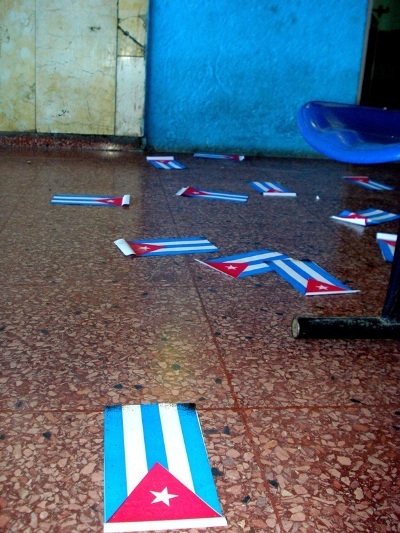
My Father, Dr. Oscar Elias Biscet was born on July 20, 1961 in Havana, Cuba. My father is Founder and President of Lawton Foundation. This organization is considered illegal by the Cuban government. My father, Oscar is a Cuban physician and is a very spiritual man. I feel that he follows the same philosophies as Dr. Martin Luther King and Thoreau. Oscar was unjustly sentenced to three years in prison on February 26, 1999 for a crime of flying the Cuban flag upside down, which is an International recognized symbol of distress. Before his sentence Oscar had been arbitrarily detained twenty six times in eighteen months. On February 1998, he was then expelled from the Cuban National Health System. He and his family were evicted from their home. My father is presently in prison right now because he continues to defend the Human Rights in Cuba. The Cuban prison is a place where no one wants to be. It is a place where persons are restrained from any personal freedom.

The Cuban Government condemned my father to twenty-five years in prison for his role in attempting to promote integrity and sovereignty to the Cuban people. His life is constantly in danger in prison. He is presently experiencing a lot of physical problems. He had lost weight since he has been incarcerated and his teeth and mouth show signs of deterioration. This is all due to the fact that he is not receiving proper medical treatment that should be provided by the military personnel. Most of the time my father is isolated in a cell as punishment. He does not participate in any Communist activities and he does not like to go to the dining hall to eat because of inadequate cleanliness. Proper healthy food is scarce in prisons. Prisoners get into fights and then the authorities issue violations. The authorities treat my father badly and of course they try to take away all of his human rights. I know that prison life is very difficult for him but, even with all of his physical problems, he seems to be coping well mentally. That is something that I am thankful for.

My father is presently serving twenty-five years in a Cuban prison. He is only allowed one visit every three months for two hours. Only two people can be chosen to visit him. This becomes difficult to choose between mother, father, brother, and wife. He tells me that all the conditions are poor, poor, poor. I do remember when I use to go visit my father in prison. I felt very disappointed about the situation and I knew that it was an unhappy place to be. I noticed that a lot of the prisoners seemed angry with their family and friends. They looked depressed and many did not want to talk about anything. There is no safety in a Cuban prison. I feel very depress about my father many times, but I know that the one good thing that I can do is to study and to work diligently. I know that my father will be very proud of me!

I demand the immediate release of my father so that this peaceful Human Rights Activist may continue his struggle to see his country free one day. I ask men and women of good will, Human Rights Organizations, the Press, Democratic Nations, and everyone who has a voice, to denounce the Cuban Government for the unjust incarceration of my father, Dr. Oscar Elias Biscet, whose only crime is to honor the Universal Declaration of Human Rights in his country, Cuba.

-Winnie Biscet, daughter of Oscar Elias Biscet

Originally posted: October 27, 2010

Disenchantment / Claudia Cadelo

Photo: Claudio Fuentes Madan

He comes walking along the same sidewalk as me and can’t avoid greeting me. I understand. He’s weak because I was his fan. His ego is telling him, “That’s Claudia who really admired me and was always emailing me asking for my stories.” What he doesn’t know is that as a writer I admired his daring prose amid the meltdown, “after the socialist realism” had died. This guy who now says “Hi” with an ear-to-ear smile is a ghost who, in exchange for $100 dollars a month on his cell phone account, a new computer at home, a scooter, and a space that he will never be “laid off” from on Cubasí, writes nonsense about Yoani Sánchez and even dares to call her a terrorist.

I look at him stunned. I think if he had a shred of honor he wouldn’t say a single word to me. I laugh at myself. Honor?! What a great word for a Cuba so devastated! I want to tell him I’m very sorry about his death, about him selling his soul to the devil, that he shouldn’t acknowledge me, that he should ignore me the next time he sees me and that all he inspires in me is a deep and horrible contempt. But I feel sorry for him.

“I’ve read what you’re writing now about Yoani. Why do you let them use you like that? Why haven’t you written about me? Are you waiting for your orders?”
“It’s not like that.”

“Of course it’s like that. It’s a shame and an embarrassment. You know it yourself, you know it’s like that.”

We walk away from each other by backing up. He repeated, “It’s not like that,” as I mutely hurried away. I hope I never see him again.

When I got home I reread his first story that had so impressed me six years ago. I still liked it and  felt badly for this man who buried his pen in the putrid stomach of repression. I have no doubt: some souls die in life.

November 1, 2010

My Little Piece / Yoani Sánchez

Five decades of “we,” of indoctrinating us in the behavior of the shelter or the squad, and yet in the park this morning a young man said, “What I want is to have my little piece.” He said it as if he were confessing a sin or coveting something at a great distance to satisfy an evil desire for which he would be publicly scorned. As he spoke of his “ambitions,” he gestured with his hands as if bringing invisible dreams toward his body, dreams that he named: “a roof,” “a decent salary,” “permission to travel.”

Collectivization has not erased in us that human longing to have our own piece, and forced egalitarianism has only fueled the desire to differentiate ourselves.

The Scolopi Fathers of La Víbora / Fernando Dámaso

In the half block between Flores Street and Correa and Encarnacion, in the La Víbora neighborhood, a modern and magnificent building was erected at the end of the forties for the Pious Schools. They also had schools in Havana at Manrique and San Rafael, in Guanabacoa, Pinar del Rio and Camaguey, all for boys. There was also one for female students in El Cerro.

I had the good luck to be among those who inaugurated the new facilities in La Víbora. I remember the majestic main entrance, the huge hall, the granite floor with the inlaid compass, and the tubular glass urns with the flags of Cuba and the school. Also, behind them, a long green granite bench, and on the floor there was a map of Cuba and the Caribbean, also in granite, and a large concrete patio surrounded by the galleries in a U-shape.

In my memory I can still see the spacious and airy classrooms, the library, dining room, chapel, the medical cabinet, and even the bathrooms on each floor. There were also vending machines for Coca Cola and candy. Nor have I forgotten the clean smell, the books, the polished wood and the colored chalk. These are all important memories of a personal nature.

The most valuable, however, was having had teachers such as Carlos Ruibó, Enrique Puente, Jorge Arango, José E. Caramés and the priests Angel Oliveras and Juan Capdevila, true teachers, who instilled in us the Pieta and Letters, the famous motto of San José de Calasanz, founder of the Piarist Order.

Today, many years later, I remember dear Father Oliveras, always restless, spending hours of Theology — by mutual agreement and with the doors closed — imparting knowledge about sex, answering our questions and clarifying our adolescent doubts. Also the time devoted to discussing the problems of the country and different issues in our society.

With the Scolopi Fathers we practiced thinking with their own heads, and I learned respect for the opinions of others and the value of tolerance, as well as the entire contents of the materials of different years. Unfortunately it has been many years since the Pious Schools have existed in my country, and its facilities are quite dilapidated, although they still exist in the rest of the world. I hope for their return, at least so that my grandchildren or the children of my grandchildren, can reassume this generational educational chain, which never should have been broken.

October 19, 2010

Reports I Would Prefer Not to Write / Luis Felipe Rojas

Photo: Luis Felipe Rojas
When I dictated this post this morning to a friend who has always been aware of my aspirations and having and maintaining my blog from Holguin, she told me, and here I want to record it in writing, “You never thought you were going to face, from your writing, a ‘reality’ that the Great Nobel Winner Mario Vargas Llosa would say, “sometimes is stranger than fiction.'”

In just a few months I have received, from the small town of Banes along the northern coast of my province, reports that fill me with sadness. Here is one of them:

The citizen Yosdani Pavón Espinosa was shot in the right thigh last October 1st of this year, by the police officer Vladimir Camejo, chief of the Cañadon in Banes sector of the National Revolutionary Police (PNR).

Mrs. Marta Díaz Rondón told me that the police abandoned to his fate the young man Pavón Espinosa, who was operated on without having the bullet removed, and who was admitted to the surgical clinic of the hospital in Banes under heavy police guard.

The account of the victim’s family complained that the criminologist reconstructed the facts of the case based on the testimony of the aggressor, Camejo’s, nephew, without conducting any alcohol testing (both the official and is relatives are well-known alcoholics).

Marta went on to say that the office Vladimir Camejo already has one shooting death on his record and three whom he has wounded in the same way. One of them is a young driver who didn’t want to pick him up in the truck he was driving and as a “punishment” he received a bullet.

“Despite these facts,” Díaz Rondón told me, “the military has never been warned by the police chief in Holguin. Six citizens were willing to speak on behalf of the victim, Pavón Espinosa, and to testify that he had been abandoned by the aggressor. Among them were Juan Carlos Cruz, Julio Gómez y Héctor Hidalgo.”

“These incidents include that of Mariblanca Avila, Cari Caballero Batista and Marta Díaz Rondón herself, when they tried to show support for Reina Luisa on Sundays, but neither the responsible agencies, nor the high priests, nor the Cuban police listened, as I have told you. There has been no punishment nor reprimands for the uniformed aggressors. Much less for the non-uniformed personnel who were see, allowed, and participated in the ‘tumultuous feast.'”

What will happen the day that a bullet “escapes” from one of these bestial crusades that is launched every Lord’s Day against the family of Orland Zapata Tamayo?

*Hours after Luis Felipe dictated this post he was arrested in his house in San Germán. The motives for the arrest are unknown at this time, and also a violent repression has been launched in Banes against the opponents who accompany Reina Luisa to offer tribute at her son Orlando Zapata Tamayo’s grave.

Voices Magazine / Miguel Iturria Savón

Since August 6, a bunch of copies of Voices Magazine have been circulating in Havana, presented by Yoani Sánchez at the headquarters of Cuba Bloggers Academy, an independent nonprofit organization dedicated to disseminating the technologies that are revolutionizing communications and encouraging citizen journalism on the island, which broke the information monopoly of the military government.
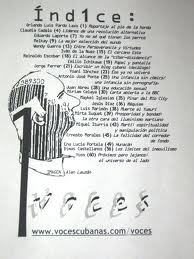
Located On the web at: www.vocescubanas.com/voces and vocesvocesvoces@gmail.com, the magazine represents a literary effort from the “grammar” of the bloggers, understood as a “grammar” of the lyrics, images, hypertext, according to Jose Ferrer, author of the decalogue Writing a Cuban Blog, which figures in it along with some twenty artists who exude freshness, wit and diversity in 62 pages taken from the same number of blogs.

Maybe it’s premature to talk about a handful of pages grouped in cyberspace, where every day projects that call on the constancy and incisive view of millions of readers, hungry for links, commentaries and novelty, come and go. Better to rely on the tenacity of Yoani, Reinaldo Escobar, Claudia Cadelo, Orlando Luis, Miriam Celaya and other voices who post almost daily without avoiding or being devoured by the minefield of politics, which breathes life into this assembly of tones and notes which is the symphony offered to Cubans from diverse angles and styles.

The index of Voices doesn’t include any sections or complex formats, the composition is simple and the design fresh. There is a list of authors, titles and pages. Among the names and articles, the reader will choose from are: Report of the Horde, by Orlando Luis Pardo, to Near But Far Away: The Universe Next Door, by Yoss, who comments on the grotesque parody novel of Eduardo del Llano.

In addition to the above-mentioned, the first issue of Voices includes poems, stories, literature, dissections on cyberspace, cultural issues, assessment of controversial figures, suggestive texts, personal dilemmas and replies to recently published material, including Reinaldo Escobar’s The Reach of the Cyber-Dissidence, and Open Letter to the BBC by Miriam Celaya regarding the irritating Fernando Ravsberg.

Voices also brings us Claudia Cadelo, with Leaders of an Alternative Revolution; Eduardo Laporte with the suggestive I Don’t Know What The Dogs Have; Emilio Ichikawa meditates on Paper and Screen; Wendy Guerra satirizes the rhetoric of the streets in Between Perseverance and Freedom: Ivan de la Nuez reveals the western fascination with The Near East; while Jose A. Ponte, (A Childhood Without Comics …), Juan Abreu (A Sexual Education), Mirta Suquet (Prosperity and Kindness …), Miguel Iturria (Martí: Spirituality and Political Manipulation), and Dimas Castellanos (The Limits of Immobility), complete the scriptural polyphony, flavored by the poems of Maykel Iglesias, Jesús Díaz and Luis Marimon, along with the cathartic Hurricane by Ena Lucia Portela, and the sharp and satirical That One Will Not Return, by Yoani Sánchez, about the phantasmagorical Fidel Castro.

Presented in this way, with names, articles and the bloggers at the end, it is more inclusive and interesting than the Cuban Voices platform, the embryo of that Blogger Journey continued in the Island Blogosphere Alternative Academy, which now adds, multiples and interacts with interested readers on this island in a dialog with time.

September 18, 2010

Cuban Laws Favor State Arbitrariness / Laritza Diversent

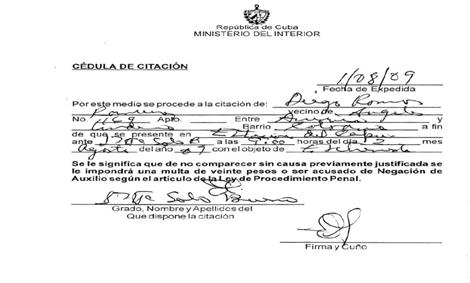
There are many who say that Ministry of Interior agents do not need judicial authorization to officially summon a citizen. However, the Criminal Procedure Act, approved by the Cuban Parliament in 1977, requires that such diligence is done “through a summons issued by the Secretary,” a court official.

The official citation is intended to clarify or prove a crime under investigation. However, State Security agents use the “interview” or “define the situation” of independent journalists, human rights activists, bloggers and political opponents. In the majority of cases they do not comply with the legal requirements.

Procedural law regulates, albeit loosely, a procedure for this. In principle, the authority must substantiate, by judicial decision, with the clerk of court, the reasons for its decision. Then the judicial officer signs and issues the respective subpoena .

The process should ensure that citizens are not unnecessarily disturbed. In fact, in practice, no legal authority meets this requirement. Even though the law itself makes it clear that “citations issued without observing the requirements are void.”

The provision itself, however, clarifies that if the said person summoned appears, than the summons becomes fully legal, just as if it had been issued in accordance with the law. Citizens are unaware of this detail and, in the majority of cases, respond to an illegal summons assuming it to be legal.

The fact undermines the concept of the Rule of Law, which requires state institutions to be consistent with, at the time of exercising power, legal forms predetermined by the political representatives of society (National Assembly) and controlled by the courts.

In this case, the Criminal Procedure Act provides immunity to government bodies for their own actions. It also favors arbitrariness, among those who have the obligation to act in compliance with the law.

October 23, 2010

Language and War / Fernando Dámaso

Cubans, historically, have been a peaceful people. Since our emergence as a nation, the actual time devoted to war has been relatively little: a combined total of no more than twenty years. This does not mean we are cowards, it happens that we much prefer to live in peace. Our bellicosity of recent years is more cyclical than real: it responds to political constraints.

  1. Why bring this up? Well, because the military terminology fills all the days of our lives: we combat the Aedes aegypti mosquito with battles; the fight against cancer is a struggle; the economy is in the spotlight of the leaders; the volleyball matches, the boxing matches, the baseball games, etc. are all fights; street cleaning is an operation; collecting recyclable materials is a campaign; to recover the coffee production is a strategic battle, and so on.
  2. This militarization of everyday language, in addition to distorting the real meaning of words, further complicates grammar for our students, giving a negative impression on our society, which is actually quite peaceful.
  3. The Spanish language is rich. Why not use the words that go with things? Epidemics are treated with medication and health measures; similarly cancer; with the economy we take measures; in sports we compete; the streets are cleaned; the recyclable materials are collected; and the coffee harvested. This would enrich rather than impoverish.
  4. A Spanish friend told me a few days ago, “Fuck, to understand you guys you have to go to military school.”

October 16, 2010

Between Unsuitable and Laid-off / Laritza Diversent

State Health Workers

The restructuring of the business system and institutional changes in the organization of the State, as announced by the government, involves the reduction of payrolls and declarations that workers are to be laid-off. In this process workers are declared unsuitable (lacking talent for their job) in order to sever the employment relationship.

The effects of the declaration of lack of suitability, and thus “availability” — that is the worker will be laid-off — differ. Both figures are recognized in the Labor Code (CT) as reasons for termination of the labor contract. However, they do not have the same origins or treatment with regards to wages.

The worker declared “available” — laid-off — has more protection under the law. The CT states that “an equal rating takes into account age, and equal qualifications plus seniority give more rights to the older worker.”

Those with partial disability, men over 50 and women over 45, can not be declared “available” as long as an entity has vacant jobs in which they can be employed, in accordance with their qualifications and ability to work.

These conditions do not apply to workers declared unsuitable. Skill in the profession is a requirement related to job tenure of an occupation. The legislation defines it as “Demonstrated Competence.” A management assessment takes into account a judgment of the worker’s performance on the job. When performance is considered lacking, the state agency terminates the employment relationship.

The “available worker permanently relocated” — that is a competent person who is laid off — receives the national average wage, 414 Cuban pesos (about $17 in freely convertible currency), or the wage of the position or occupation they have been laid-off from, whichever is greater. Where there is no possibility of their being offered another job, they are sent to work in construction or agriculture, but with the same wage guarantees.

The person who is not suitable — that is declared not competent to perform their job — receives the wage of the new position to which they are assigned. In practical terms, the State, the only legal employer, chooses this latter option as it then has less responsibility and fewer guarantees it must meet.

In the case where there is no possibility of reassigning the ineffective or reclassified person within the same workplace, their salary is guaranteed for two months, starting from the date on which they are laid off.

In the case of workers who are declared laid-off but who “unreasonably” refuse accept it, they have only the right to receive the guaranteed wage for one month after they are laid-off. If a person is declared “unsuitable,” the labor contract is terminated with no right to receive any wages.

Thus, by declaring excess workers “unsuitable”, the State, which says it has a policy of full employment in the labor system, frees itself of commitments to comply with the legal guarantees of Cuban workers.

October 21, 2010

Account Settled / Fernando Dámaso

Tomás Lima, the wisest man in my neighborhood, told me one day when I was a boy, we all bring a debt with us at birth. The only purpose of life is to pay it back. I didn’t understand, then, the meaning of his words and issued no opinion, I limited myself to a shrug of the shoulders.

Time passes and today, I don’t know why, I remembered his sentence. Valdés, who worked with me for seven years without ever even saying good morning, shot off his fat mouth: “Today I got up against all the debts. It doesn’t matter to me whether they are moral or material.” I didn’t know what to answer, and he continued: “The material don’t worry me, because sooner or later I pay them, even with interest, and that’s that.

“The ones that taunt me are the moral, because they don’t seem to ever be paid. They get tangled up in your feet, climb your legs, squeeze your testicles, wrap around your waist, squeeze your chest and, if you let them, they wrap around your neck and strangle you. They are snakes. The important thing is not to let them get to your neck.”

I looked at him strangely. What was that rant about? Nothing less than a fast and I haven’t eaten!

“Yes,” continued Valdés, “the first doubt is what they say we have with God, because Adam ate the apple Eve gave him, who in turn listened to the snake. I don’t give a crap for this debt! This debt is not mine! Let Adam and Eve pay it, if God doesn’t have the balls to claim it, that’s his problem! Let him sell it to the bank and you’ll see them collecting on it!”

He paused. He looked at the people who were starting to gather around.

“There is another they want to charge to me,” he said, “the one I have with my parents for giving me life. That was already paid, before I was born, by the pleasure they experienced in conceiving me! Account settled!”

By now there were more than ten people around Valdés. I meant to tell him to shut up, to get back to his work, but I let him continue.

Valdés, not addressing anyone, continued, “There are also debts to society. If it gives me education, health care, work, etc. that was its job. If not, what is society for? And what’s more, with education I’m the one who wore myself out studying, the doctor never comes (I think society owes me a debt), and as for work, I put in the effort and they only pay me for a part of it. The rest they appropriate, saying that it’s for the collective welfare and general enjoyment. So there I’ve paid for my education and medical care. Account settled! Every day I am more convinced that it is society that owes me.”

He looked at me and continued, “Not they say I have a debt to Africa, to Latin America and finally with humanity. What debts are these? As far as I know, no one in my family had slaves nor exploited slave labor. Nor did anyone use anything from Latin America, or ask for or borrow anything. Still less with humanity: that’s something very generic. If it’s really the case that all these debts are mine, better not to live.”

A murmur ran through the crowd which had grown to twenty people. I tried to signal to Valdés that he should shut up and get back to work. He didn’t notice or refused to understand.

He continued, “I shit on all these debts that aren’t mine. Let those whose debts they are pay them. From today I am against all debts.”

Then he sat down on the wooden box next to his machine, put his elbows on his knees and clutched his head in his hands. We were all silent.  The group of onlookers slipped away. Only I stayed with him.

For some minutes it seemed that he didn’t notice. Then, as if he’d discovered something, he raised his head a bit and looked up and said, “Did I talk too much shit?”

I didn’t answer. I stayed quiet for a few moments and, for some reason, those reasons in life you can never explain, I put my arm around his shoulders and muttered, “Sometimes you just have to do it!”

October 7, 2010

The Before and the After, Without the During / Rebeca Monzo

The underground parking at the Old Plaza when it was being torn down.

Again today, as I walked around Old Havana, taking care of problems and taking pictures, I was struck by the innumerable signs that have been put up showing before and after.

If these signs were meant only for people under forty and with little culture, I would understand. But they seem to have forgotten that there are still some of us who are over fifty years old and, furthermore, who were born in this city.

Since I was a little girl I often visited Old Havana, because my stepfather, who was the best of fathers to me, would frequently take me to visit his clients. I went up and down Obispo and O’Reilly Streets innumerable times. The former was full of elegant shops with exclusive gifts, tailor shops, jewelery stores ans large pharmacies, as well as banks, restaurants and cafeterias. All of those businesses had owners, so they were beautifully decorated, well-lit and clean. it was a pleasure to stroll around those streets. O’Reilly was more a street of big banks and stores. There was a store, Potín, where they had delicious sandwiches made with chicken and asparagus tips, as well as french pastries, chocolates and bonbons in beautiful gift boxes or sold by weight. Of that pleasant store all that remains is its name inscribed in the granite of the floor at the entrance of the miserable and dark rat-hole it has become. So, why isn’t in that place a before and after sign, as in many other businesses, which for the most part have disappeared and in whose place small parks have been improvised. It is true that the Old Plaza’s restoration is almost finished. The only thing missing is the beautiful art-nouveau hotel that, when the revolution triumphed, was converted (like almost all the other buildings around) into tenements and later into ruins, its beautiful front being miraculously saved.

There is a huge sign in the middle of the Plaza that reads Lest we forget and it shows some ruins and earthmoving. This dug-out earth was a big underground parking garage above which there was a park. In the seventies some smarty decided there was no need for it and it was torn down. Many years later, in its place they built a park with a big fountain. In the old days, all the buildings around the square had been stores and businesses very well-tended to by their owners.

Now, after many years, they have realized that there is a lack of parking space in the historic center. Why don’t they add, on the huge sign, in the area where the ruins are shown, a label with dates that says during.

Translated by Espirituana

October 27, 2010

In Dante’s Ninth Circle / Ernesto Morales Licea

One of the merits which I believe can be attributed to the government of Raul Castro, since he took office on the island in 2008, is his obvious concern for the national economic condition.

Being conservative, I believe that in just two years the Army General has publicly shown far more interest and willingness to change the economic sector, than Fidel did in the entire last decade of his official mandate.

Timid, inadequate, naive measures? Perhaps. But the truth is that anything is preferable to state control.

This presidential concern could be motivated by two specific reasons:

1. The country facing Raúl bears no resemblance to that hotbed of exuberance and revolutionary fervor, to the society bursting with faith ,that his brother presided over for several decades.

The Army General has found a nation with obvious signs of distress, very high rates of illegality, battered productivity, and above all, he has found a nation with a dangerous discontent that can be seen in virtually all areas.

The endless exodus of athletes, doctors, artists; the degrading the cunning tricks by which Cubans are claiming Spanish nationality and a chance to leave the county; along with crime under the guise of common practices, are indisputable signs of this.

2. On the other hand, according to certain secret voices, the General has a pragmatic temperament, alienated from idyllic epics and social fantasies, which has led him try to first stop the unstoppable downfall of the national economy.

Of course, to speak of merit in this sense is too extreme. Or is it perhaps a case deserving of applause that a child respects his mother, or cares for her health. Can we speak of merit in citizen behavior that rejects theft or pedophilia? Are not these essential duties? I think that it is what is required of everyone, and does not merit recognition.

Similarly, I believe that Raúl’s effort to revive the Cuban economy is meritorious, but it is also true that this is a primary function, basic to any ruler. It is his obligation. Especially if we take as a starting point that any form of government in contemporary society should not have functions other than to ensure the proper performance of social processes, and to ensure the safety and welfare of its citizens.

This is not just me speaking. In the eighteenth century Jean Jacques Rousseau said it in a philosophical monument called The Social Contract (it shares with Das Kapital by Karl Marx, the status of the most famous and influential book of political philosophy ever written).

Another element to take into account in fairly assessing the current government’s will to transform the economy, is the responsibility that belongs to the Cuban State in this regard. In my view, it is no different from a surgeon who, after making a mistake in a particular patient’s surgery, decides to take a special interest in that patient’s progress and future treatment.

According to the wise words of a church authority I recently spoke with, “The greater share of power the ruler of a country accumulates, and the less opportunity ordinary citizens are given to decide their own destiny, the more responsibility, in the eyes of society and of history, is laid on he who holds the power.”

Under a system like Cuba’s, where about 95 percent of the jobs are working for the State, where the scope for managing personal finances is exactly zero, who can be held responsible for the chaotic situation presented by the national economy?

However, the main problem, which in my opinion can be seen behind this effort to inject vitality into a quadriplegic economy, is the lack of a clear perspective on the sense of where these measures are going to lead.

In economics there are no miracles. Nothing happens for no reason. All possible progress in a sector is the consequence of the implementation of sound policies in the medium or long-term, policies which translate into development.

In 1923, as a result of hyperinflation, the German mark was valued at 4.2 billion for every dollar. Though we Cubans understand what it means to change 25 Cuban pesos for one Cuban convertible peso (CUC), it is almost impossible to imagine what that 4.2 billion figure represented. Quoting the words of an eminent economist, “The German mark was worthless.”

The rapid revitalization of the country, what some then were calling the “German miracle,” was no miracle at all. It was the result of sound economic policies that led that ruined nation — which still had to go through another World War — to what it is today: an undeniable power.

In our continent, the case of two countries in particular, Brazil and Chile, confirm this principle. It was not divine benevolence, nor work at gunpoint, nor happy accident, which has brought these two nations on a poor continent to excel with their high standards of living.

It was, again, solid decisions in the field of economics, which have propelled Chile to become the only Latin American nation that can be considered to have joined the First World.

Why bring this up? Because at times it is clear that in Cuba the effort is not matched by clarity, and we know that the way to Hell is also paved with good intentions.

First, as a plan to revive productivity, they increased the retirement age by five years for workers across the country. Those who were almost ready to retire had to add years to their working lives. Workers, for the most part, unmotivated and discontented by the impossibility of prospering economically after 25 years of sacrifices.

But the new law was passed. We all knew that the public consultation was another game of democracy, with the same enthusiasm and seriousness of children playing house.

And while we’re talking about laws, we could also mention the “Pre-Criminal Dangerousness Index,” where they levy sanctions — including prison terms — to those who have no verifiable employment.

That is to say: they apply a penalty to people before they have committed a crime; in this case the pre-criminal behavior is not working and, therefore, having the propensity to commit a crime. (I’ve always thought that the plot of the movie Minority Report, by Steven Spielberg, where the Pre-crime Police stopped and arrested people before the crime happened, occurred to the brilliant director after his visit to Havana.)

It so happens that now — according to official reports of the event — President Raul Castro himself admitted, during his closing speech at the Ninth Congress of the Union of Communist Youth, that more than one million workers need to be laid off to increase productivity.

Stated clearly and without qualifications: one million people who do not produce will be put out on the street (in other times we would have said “in the cane fields”). The Cuban Workers Union has announced the cut of half a million jobs before April next year.

Against this background, it is impossible not to think: First, those who don’t work are fined or imprisoned; then those who have accumulated the most working years see the retirement age extended; and now, they throw a half million workers into the street in just a few months! But who is making these decisions for our country?

This revision of strategies is not about the will to change, about what can save us from the ruin we have been immersed in for so long. But it is a good first step. But no more than that. The drug addict who wants to ensure his future detoxification must first acknowledge and accept his addiction. But simply accepting it does not make him a “self-critical” individual. He must make good decisions to free himself from drugs.

I think there has never been a time like now, when the Cuban government has a real chance to change direction, to kick-start the transformation of our economy, to give Cubans the transfusion that is needed. But it would have to be done with real commitment and total precision.

It is worth remembering, as a subtle warning, that the worst place in Hell, the ninth circle, was reserved by Dante Alighieri in his “Divine Comedy” for traitors to the homeland in times of crisis, those who closed their mouths or crossed their arms.

September 16, 2010