In a second trial for bribery, influence peddling, and tax evasion, he received an additional sentence of 20 years in prison
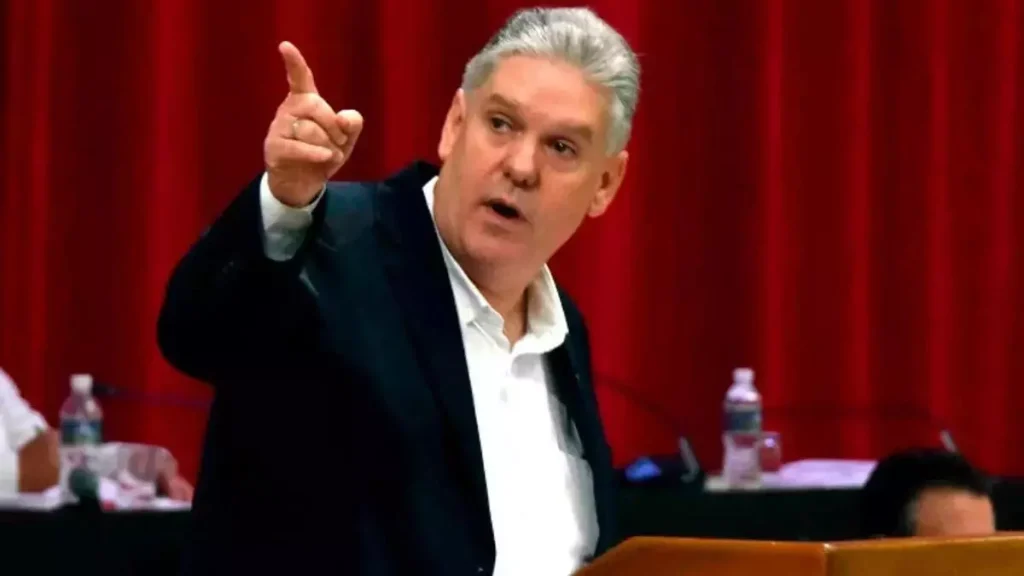
 14ymedio, Havana, December 8, 2025 — The People’s Supreme Court has issued a ruling against Alejandro Gil Fernández, former Minister of Economy and Planning and one of the officials most heavily promoted by official propaganda until his abrupt dismissal in 2024. In language filled with references to “treason against the homeland” and a supposed “ethical, moral, and political degradation,” the ruling sentences him to life imprisonment for espionage and an additional 20-year prison term in a second trial for economic and administrative crimes.
The oral hearings, held in two phases between November 11 and 29, 2025, proceeded — according to the Court — “under full respect for procedural guarantees.” However, as is common in high-profile political trials, there were no independent observers, public access to the sessions, or verifiable details about the evidence presented. Even the daughter of the former deputy prime minister, Laura María Gil González, was not allowed to attend the espionage trial. The Government has limited itself to publishing a summary of the events that reads less like a legal document and more like a political narrative meant to reinforce the image of an internal enemy infiltrated within the State structure.
In the first criminal case, Gil was found guilty of espionage, bribery, theft and destruction of documents under official custody, violation of seals, and repeated infringement of classified information protection regulations. According to statements made by his sister, María Victoria Gil, the authorities linked him to the U.S. Central Intelligence Agency. The official description claims that the former minister removed and “made available to enemy services” confidential economic documents. Based on that accusation, the Court imposed a life sentence.
In the second case, the ruling included ongoing crimes of bribery, forgery of public documents, influence peddling, and tax evasion. For these, he received an additional 20-year sentence, although the Court clarified that once appeals are resolved, a single joint sentence will be formed, as established under the current Criminal Code.
Gil, according to the Court, acted in a “corrupt and deceitful” manner, deceived “the country’s leadership and the people,” received money from foreign companies, bribed officials, and caused “damage to the economy”
The additional sanctions include confiscation of assets, a permanent ban on managing public resources, and the loss of several civil rights. The ruling states that the assessment complies with Article 147 of the Constitution and Articles 29 and 71.1 of the Penal Code, which refer to the “social harmfulness” of the acts.
The official narrative does not spare adjectives. Gil, the Court says, acted in a “corrupt and deceitful manner,” deceived “the country’s leadership and the people,” received money from foreign companies, bribed officials, and caused “damage to the economy.” The document cites Article 4 of the Constitution, recalling that treason against the homeland is the gravest crime and is punished with the harshest penalties.
But the political emphasis does not hide an obvious contradiction: the same Government that for years promoted Gil as the architect of monetary reform, a champion of “economic resistance,” and a fresh face in the Cabinet, now portrays him as an infiltrated enemy. It is a familiar script in recent Cuban history, where high-ranking officials shift from hero to villain in a matter of months, without any acknowledgment of failures in the selection process or internal Party oversight.
As in other high-profile cases — such as corruption trials against party leaders — the authorities have offered no concrete details about the alleged espionage: neither what information was taken, nor when, nor how it supposedly reached “enemy intelligence services.”
The speed of the process is also striking. In less than a year since his removal from office, Gil went from being a central figure in economic policy to receiving one of the harshest sentences given to a civilian in decades. According to analysts cited in previous reports, the rush could reflect the Government’s urgency to suppress debate over the failure of the “reorganization” plan and the economic collapse of recent years.
This time, the target is the man who for years publicly defended, across all official platforms, the same policies that now leave the country facing its worst economic situation in decades
Alejandro Gil was one of the figures most publicly supported by President Miguel Díaz-Canel. Presented as a modern technocrat, he spearheaded the Ordering Task — a project that in practice triggered inflation and severely eroded purchasing power — and defended every measure that deepened the economic crisis. Even after his dismissal, the president continued praising him on the social platform X, offering congratulations, embraces, and birthday messages.
His downfall, announced in February 2024, was followed by an unusual official silence. Only later — and slowly — did references begin to appear regarding “serious misconduct” and “incompatible behavior.” The sentence now confirms the type of narrative the regime tends to construct to convert structural failures into individual blame.
The Court notes that both the defendant and the Prosecutor’s Office have ten days to file the corresponding appeals. In the case of the life sentence, even if no appeal is filed, an appeal will be automatically processed as a “guarantee” for the accused — a formality that, within the Cuban judicial system, is unlikely to alter the political course of the process.
The statement concludes by noting that both Gil and his lawyers acknowledged that procedural guarantees were respected. This is a standard declaration in cases of this type and cannot be independently verified.
This time, the chosen target is the man who for years defended, in every official forum, the very policies that now keep the country in its worst economic situation in decades. The sentence against Gil says much about him — but says even more about the model that elevated him, used him, and now buries him under the label of “traitor.”
Translated by Regina Anavy
____________
COLLABORATE WITH OUR WORK: The 14ymedio team is committed to practicing serious journalism that reflects Cuba’s reality in all its depth. Thank you for joining us on this long journey. We invite you to continue supporting us by becoming a member of 14ymedio now. Together we can continue transforming journalism in Cuba.
