Thank you! / Iván García

When I invited a group of friends in December to send messages for the second anniversary of the Desde La Habana blog, I didn’t expect that so many would reply, much less with such praiseful greetings to the blog and to me.

In my style, I’ll continue reflecting the reality of my country and its people, without asking anyone for permission, be it from the opposition or from the regime. That’s the freedom I’ve earned in these 15 years I’ve been writing as an independent journalist.

Nor will I stop going to troubled neighborhoods or tenement courtyards. Nor will I stop talking to hustlers, pimps, gays, transvestites, drug addicts, pickpockets and common ex-cons, among others marginalized by society.

I received 19 messages in total. Here go the senders:

Delphine Bougeard and her Spanish-language students at the Julliot de la Morandière high school in Normandy, France; Zoé Valdés; Raúl Rivero; Jorge Luis Piloto; Charlie Bravo; Joan Antoni Guerrero Vall; Alberto Sotillo; Isis Wirth; Jorge A. Pomar; Camilo López-Darias; Carlos Alberto Montaner; Pablo Pacheco; Luisa Mesa; Carlos Hernando; Manuel Aguilera; Rolando Cartaya as well as Regina, Helen and María, translators of my posts into English.

To them and also to Carlos Moreira, Tania Quintero and all the readers of the Desde La Habana blog, I give thanks and send my most sincere embrace.

Painting: Catedral, oil on canvas painted in 1972 by René Portocarrero (Havana, 1912-1986).

Translated by: Yoyi el Monaguillo

January 27 2011


A LEZAMA FOR MOPPING (DUPING) / Orlando Luis Pardo Lazo

FROM “THE FLIGHT OF THE CAT”* TO YOUR MOTHER’S TWAT**

Orlando Luis Pardo Lazo

There’s the lyrical Lezama Lima, of unintelligible flight, before whose spirals we bow because to read them would be in vain, and a pain. And good for us. That Lezamian lyricism never had much success, except for quoting and thus accumulating a certain intellectual prestige. That obscure yet not at all secretive writing, crippled by its symbols meant to multiply its meaning, was pure inner space, the intestines of an author that regurgitated everything. Solipsistic saliva, sometimes another mood of our sentimental being, interjections included. The least Cuban thing in the world, let there be no doubt.

But there’s also that big impressive bastard Lezama Lima. The prose-writer that flirts with the prosaic, although, unfortunately, his overdiscursive always impeded it. The man who filled his novels with a homo Bible to defend ourselves not just against the old Catholic God, but also, when it arrived, against the new communoid State. The guy who made guys hurl themselves at other guys, using strange verbs and invented adjectives, just the same at the end of our tiny Republican era as at the beginnings of the overstaying Revolution. The magister penis within whose paragraphs of impossible punctuation the only word missing to label the human cock is precisely that one: cock (at this point, the professional prudes may now proceed to spit on me, they won’t be the first: the Ministry of Culture and the secret police have beaten you to it).

That Lezama Lima of “your mom’s twat” and “no, a thousand times your mom’s twat” (they’re quotes from his Oppiano Licario), the one who disguised genitalia with undershirts because if the vagina appears… I don’t know, Fronesis cannot enter (now this quote is mine, luckily), the one of voyeurism in the dumpiest movie theaters and pissing on the shoes of the man that, during the last macho night, stuck it in you (in his Paradiso, that is), the one of the 20,000 Eudoxus cured of Foción’s father’s madness (army of characters that Cuban literature has not had the cojones to process), the one of incestuous three-ways and illicit trysts and throat-slittings with bound-up balls, plus the nocturnal groping of Parisian testicles by an arid Arab… anyway, that masterful Lezama Lima of anti-lyrical substance (even with his exhibitionistic and extravagantly thundering glands of cornaline agate), the one of certain etymology, for example: templar (“a delicate word in the extreme”), the one who waited for the death of his mother to then escape into desire, or at least publicize it at the UNEAC (National Union of Writers and Artists of Cuba). That underground author shall be forever our best unknown.

Lezama Lima deserves a little phallus upon his tomb the size of Revolution Square (in his work there is no lack of such penile visions, even right in the middle of a ragtag mob of students against the dictatorship of the time). But our baroque man is little by little getting stuck in the cultural swamp of mythic bullshit (even the minister of culture was a Lezama admirer!), as if the classics for their part (not very saint-like in their beginnings) weren’t fundamentalist fornicating fauns.

Lezama Lima was not. A shame. Those will be, I suppose, the limits of his colossal writing, never delirious. There he lacked, I think, the touch of Truth and Life in the experience of reading him. Sex for him continued to be a downfall. He wasn’t able to denounce head-on those who expropriated from him, because social blackmail works marvelously against someone who doesn’t dare to declare out loud his own pleasures.

Lezama Lima died sorely needed. He owed us a bit more. In his novels he was just starting to liberate himself of that more respectable and private pose. Perhaps his last verses tried to erase, by invoking the absolute void, all the back and forth of his countless paths and supposed poetic system, maybe to later insert in that black hole, if death had given him a chance, the macrogenitosomatic magnificence of that massive, pertinent prick.

Ah, spit away.

It’s not without significance that no biographer (he doesn’t have any, of course) has been concerned with identifying a Cuban who physically loved José Lezama Lima. Our man never found the love of another human being (that of the readers doesn’t count for shit, don’t play the anointed ones now). He only managed mediocre maternal friendships, wholesale spies (they sent anonymous threats as easily as they sent ambulances, so that he wouldn’t die without saying that Cuban healthcare was free), and the semen of strays in exchange for his salary. And that imago truly does disconcert me. The whole time he lived in internal exile in respectable suit and tie (except when fantasizing in his writing, and that gift saved him). The whole time he keeps getting parodied for his spicy, asthmatic wit and his affectionate touchy-feeliness (disciples still survive him who speak wheezing with emphysema, as a guarantee of authenticity). We don’t even know if upon ejaculating his prose he once cried out (in this sense, his transcendence is mute, almost null).

José Lezama Lima died a virgin, he could’ve been our first fag martyr. The little joy found in Cuba stuck a tampon on his pride of being the best (in gay pride he didn’t even reach gay shy). Maybe his cross was exactly that. Being forced into a closet, and on top of that saddled in a corset.

Translator’s notes:

*”The Flight of the Cat” refers to El vuelo del gato, the first novel by Abel Prieto, published in 1999. Prieto is Cuba’s current Minister of Culture and widely regarded by Cuba’s independent artists and intellectuals as the cultural gatekeeper of the regime.

**This refers to a very popular Cuban epithet, el coño de tu madre, yelled at someone in anger, which literally means “your mother’s twat”. This epithet, and countless versions of it, is also very common in at least Argentina, Spain and Venezuela.

Translated by: Yoyi el Monaguillo

November 30 2010


Martí, the Timeless One / Rebeca Monzo

Oil painting by Cuban painter, E. Abela

So loved by many, misunderstood by some and utilized by others.

Martí is the instinct of love, of generosity, of altruism, of sacrifice.

So predominant was the creative impulse in Martí that the sweep of his life arched further and further away from the center of his “me”.

“Man loves liberty, even if he does not know that he loves it. He is driven by it and flees from where it does not exist.”

“I do not believe that in matters that interest all and are the property of all, nor even in private matters, should the opinion of one man attempt to prevail.”

“All power broadly and extendedly exerted, degenerates when made a caste. With castes come interests, haughty positions, the fears of losing them, the intrigues to sustain them. Castes seek each other out among themselves, and support each other by the shoulder.”

“In the world, there should be a certain amount of decorum, as there should be a certain amount of light. When there are many men without decorum, there are always those who carry within themselves the decorum of many men. Those are the ones that rebel with terrible strength against those who rob peoples of their liberty, which is to rob men of their decorum. Within those men are thousands of men, an entire people, human dignity.”

Remembering the Apostle*, on the 158th anniversary of his birth (28 January, 1853).

*Translator’s note: This refers to El Apóstol de la Independencia Cubana, the Apostle of Cuban Independence, as José Martí is known reverentially by all Cubans.

Translated by: Yoyi el Monaguillo

January 27 2011


Enriquito, a Good Man, Much Loved, and a Dreamer / Juan Juan Almeida

My name is Ramón Enrique Ferrer Yero, son of Enrique Ferrer (an electrical engineer) and Elisa Yero (a homemaker), I was born on 6 September 1941 in Cuba’s Oriente province, in my dear Palma Soriano, in a home located on Cisneros Street, number 4, top floor, between Martí and Maceo Streets. You can imagine that, with that kind of address, I was born a patriot.

I went to a Catholic school of the Claretian Brothers, then studied at the Sanderson Institute, and later, in the Sinai Baptist school. I didn’t make it to college, due to my views, openly contrary to the evil Revolution, the government didn’t allow me to continue exercising my right to study and chose to cut short my professional life.

In 1962, they started to make my life impossible. They summoned me to the offices of State Security, they pressured me, they tried to blackmail me, they surveilled those who visited my house. All of these things I’m telling you would provoke a discontent in me that I shared with many people.

I’m a practicing Catholic, and I used to attend the church of the late Father Cayo Simón, the parish priest of Palma Soriano. One June day of 1964 or 1966, during a celebration of Saints Peter and Paul, after so much pressure, several of my friends and I agreed to meet in the church to go out and protest, with pots and pans. State Security found out, and together with the Communist Party, brought out many people armed with planks with nails to repress our march. The echo of their cries of “To the firing wall! To the firing wall! Down with the gusanos*!” still sound in my ears… all of a sudden a mob removed me from the church, dragging me before a rudimentary tribunal that they had organized for such needs. I don’t know how I got out of there. The mob that chased me took it upon themselves to stone my house, yelling those stupid chants that struck with the same force as rain against sheets of zinc. Someone I knew well, whose identity I don’t wish to reveal, got me out of that severe nightmare through the patio of my house, put me in a car, took me to the province of Holguín, and, from there to Havana. After some time in the capital, I decided to return to Palma. Immediately after, I was called up to conscripted military service, which wasn’t even military service at that time, but rather the Military Units to Aid Production (UMAPs, by their Spanish initials). There, there were students, doctors, engineers, lawyers… it didn’t matter if they were for or against the Revolution.

They cut the lights off on the town, put us on trucks, and took us, after stopping along the way and picking up youths in Contramaestre, Baire, Jiguaní, Bayamo, Holguín, Tunas… to the stadium in Camagüey, where it rained unceasingly. After registering us, they put me on a cart and sent me, together with a group of lads, to these camps bordered by barbed-wire, in the town of Vertientes, that looked rather like the concentration camps of Hitler’s Europe. Trenches, mud, beatings, torn Bibles, mistreatment, drowning victims, suicides, long walks, early mornings, bad nights, rotten food, thirst, fasting, heat, cold, sickness, skin infections, shivers, rain, sun, forced labor, sugarcane fields, beatings, lost teeth, bayonet-stabbings… Who could forgive such an atrocious thing?

When all of that ended I started looking for work, but I was now labeled and no one wanted to hire me. I got caught by the Slacker Law and they took me to work at a stone quarry, breaking up gravel. On returning to my town, they put me to work sweeping all the parks of Palma Soriano, from where I kept conspiring in activities against the evil Revolution.

The constant threats, disrespect, and summons were my inseparable companions. In 1995, I was taken in by the refugee program offered by the U.S. Interests Section in Havana.

A long while later, and after offering various bribes, they finally allowed me to travel. Upon reaching my destination, I was received with an admirable and emotional welcome that left me speechless. But, to tell you the truth now, in that precise moment, my body was here in the U.S. and my mind over there in Palma, from where I never departed. I want to be among Cubans, so I came to Miami. I could not, nor can I, abandon the cause of Cuba. Here, I signed up with all the different organizations to which I belong to today.

I’m an only child, and my mom wanted to see me after such a long absence. I attempted to go back to Cuba to give her my last farewell, but they denied my entry. That has been the worst punishment. My mother died of sadness; you can imagine how much family separation can hurt. Today I live here with my Virgin of La Caridad del Cobre, with my St. Jude, and with my little dog, Niña. What I most wish for, when that horrific tyranny falls, is to fly off to Palma even if I have to live on the banks of the River Cauto in a house built of palm fronds and timber. I want freedom and democracy in my country; maybe that’s why, each time I lay down in my bed, I can’t fall asleep without first going for a stroll, in my mind, all over my Palma Soriano.

* Translator’s note: although less in use today, gusano, literally “worm”, has been the political epithet historically used by the state, its media, and its supporters in post-1959 Cuba to denounce counter-revolutionaries and citizens who wish to leave the country.

Translated by: Yoyi el Monaguillo


Happenings on My Planet / Rebeca Monzo

Not all things on my “planet” are bad. It’s true that almost nothing works properly and the dilapidation is very noticeable, but, in spite all of these years of frustrations, sacrifices, losses, and painful goodbyes, there’s also something that keeps going: friendship and the warmth among some friends.

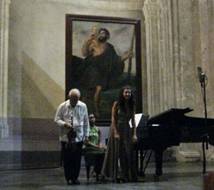
A couple of nights ago we had the immense pleasure and privilege of being invited to a cordial evening at the home of a friend. The main attraction consisted of a mini violin concerto, with which Maestro Evelio Tieles congratulated the host.

It was marvelous to hear that beautiful, impeccably performed medley by the famous violinist. Beginning with Manuel de Falla’s Nana, he went on to present, note by note, a review of the most beautiful Cuban music of all time: Veinte Años, Quiéreme Mucho, La Bayamesa, La Tarde, and, as a finale, El Mambí.

As marvelous as the interpretations of such precisely chosen pieces were, equally good were the conversations after, spanning the most varied topics. We left feeling more than grateful for such an unexpected invitation, like one who emerges from a radiant shower of light.

This undeserved privilege was complimented by another invitation, last Sunday, this time extended personally by the Maestro: a piano and violin recital at the Basilica of San Francisco, in the heart of Old Havana. The chosen setting couldn’t have been better.

On this occasion, the strings and bow plucked by Tieles brought us the whims of Paganini, those nocturnes by Chopin, and crowned the majesty of the repertoire with Schumann’s Sonata in A Minor, Opus 105.

It seemed as if sparks flew off the strings of the violin, to say nothing of the trial faced by Yamilé Cruz, the young accompanying pianist, who soared before the challenge imposed by the mastery of the multi-award winning Evelio Tieles. It was a magical evening, wherein the absence of figures from the nomenklatura and propagandistic introductions was noted with pleasure.

Translated by: Yoyi el Monaguillo

September 21, 2010


Present, Past, Future / Fernando Dámaso

1.  The only thing that a human being truly possesses is his present.  The past is something that already occurred, for better or worse, and the present itself, with the passing of seconds, continually becomes the past.  The future is what might or might not be, in whose roots the present is found.  Seen this way, in all of its simplicity and objectivity, the present is to live, the past that which was lived, and the future that which is to be lived.  The future, upon becoming the present, also starts to turn into the past.

2.  The majority of politicians on the left consolidate their programmatic platforms by questioning the past and proposing a future, skillfully evading the present, be they communists or recalcitrant socialists, moderate or recycled, populists, nationalists, nativists and even Islamists, that new category so in vogue these days.

3.  Once power is taken, be it through violence or peacefully, their first and greatest task is to painstakingly revise the past: land has been ill-distributed, economic development has been unfair, signed treaties have undermined sovereignty, foreign policy has been wrong-headed, school curriculae programs have been ill-conceived, the health system has been badly organized, public transit has been ineffective, and so on, covering the entire political, economic, and social spectrum.  They dedicate time and effort not to the present, but rather to criticize and readjust the past, categorizing the previous presidents as bad or moderate, according to political convenience.

Usually, they start with the redistribution of land: it must be distributed among the farmers and poor, as if it were a dogma, even if it brings as consequences chaos in the agriculture sector and lack of productivity.  It doesn’t matter, for this comprises the first obligatory step in obtaining massive popular support, before proceeding to nationalize large farms and cooperatives, which are also unproductive.  The following measure is for financial reform: the state must monopolize and control all capital in order to squander it and plan a future.  Other reforms follow:  education reforms, healthcare reforms, urban reforms, justice reforms, etc…

5.  The center of attention, as is easy to observe, is concentrated on changing the past, but in reality, the past is impossible to change, unless it’s in the rhetoric of speeches and history books, by new writers, which exist independently of our present.  These changes and attempted changes are carried out against all logic, they are carried out to insure the future.  As we can see, the present is again excluded, for these leaders live distantly from it.

6.  In revising the past, the scalpel is applied deeply and an attempt even made to remove traditions and customs: a people without a past or with a mutilated past are easily manipulated.  The future is offered up as a panacea, whose cost is defrayed by today’s sacrifices.  Except the future has no palpable limits or measurable time: everything is placed in the limbo of things to come, which with every passing day moves further away, as unreachable as the horizon.

Translated by: Yoyi el Monaguillo

August 24, 2010


The Cuban Judicial Puzzle / Luis Felipe Rojas

photo/Luis Felipe Rojas

Using the defence of national sovereignty as a refuge, the secret police in Cuba are utilizing methods of repression against internal dissension that aren’t dictated by the courts, nor is their implementation in that fashion even considered in the Constitution or the Penal Code.

House arrest, detentions, and the ban on leaving or entering certain provinces are part of the low intensity repression that is practiced silently and to the beat of a policy of tyranny. With the offices of Attention to Citizen Grievances and military district attorneys at their feet, the so-called Seguridad del Estado (State Security) applies the tourniquet of improvised jurisprudence that squashes the weakest.

Ex-political prisoners like Abel López Pérez and Anderlay Guerra Blanco of Guantanamo, immediately upon their release, have been banned by Counterintelligence from leaving the first and second peripheries, respectively, of the city. Did a judge order this? Is it on their release forms? Is it a special regulation decreed only against social nonconformists? No one knows.

Two friends of mine, jurists of officialdom, who went to school with me back at the University of Oriente in Santiago de Cuba say yes, that it’s a violation, but “the powers acquiesce to manu militari“. I’ve asked many dissidents across the island up until now if they’ve ever been presented with an order of detention signed by a judge and they’ve said no. Never. The same goes for the issued extent of the official summons, which is applied verbally or on some little scrap of paper that won’t appear in any file. If the summoned refuses, then he or she is automatically detained, but his or her name will never appear in the police station’s registry as a detained person. To the eyes of the statistics that could serve as a report, that person was never there. That’s just how complicated the Cuban judicial system is.

The provincial-level military district attorneys receive the complaints against their colleagues with reluctance, and even more when they’re on behalf of peaceful dissidents. The offices of “Attention to The Populace” have a wretched mechanism for the receipt of the grievance, notice of investigation, and results thereof, that makes even the greatest optimist give up on the complaint process.

Before such judicial neglect, few dare to play that diabolical game of chess where the secret police fancies itself a supreme God in order to move white and black pieces alike on the same turn.

And that’s how checkmate is declared upon the Constitution.

Translated by: Yoyi el Monaguillo
September 10, 2010


The Novel That Leonardo Padura Wrote for Me / Regina Coyula

Intro

Many years ago – I’m talking about the ’70s – I worked for the MININT (Ministry of the Interior), but my military unit’s official cover was MINFAR (Ministry of the Revolutionary Armed Forces), and therefore to all outward appearances I worked in the military. A minibus would pick me up in the morning and drop me off in the afternoon in Playa de Marianao, and next to the Mare Aperto pizzeria I’d get in line for the 79 and the 179 to return home. Since, for as long as I could remember, public transportation had been in a critical state, I’d steel myself with patience and a book for waiting. One afternoon while waiting in that line I was reading a biography of Trotsky, and I was approached by an officer (they hadn’t yet changed the ranks to the equivalents of those of our late sister [the USSR], so I’m talking about what was then a captain), and in a tone between authoritarian and condescending, he asked me how I could be reading that book. I had heard in my study-circles about this revisionist traitor and I wanted to know more. That’s the reason I gave the captain, who waited for my response with a penetrating stare. Through him I learned that Trotsky was forbidden reading for members of the Armed Forces; as far as I knew, this measure was not applied at the MININT. Some time later I got seriously scared while reading ”China, The Other Communism”, when another officer (or maybe the same one, I don’t know) asked me the number of my military unit, concerned, no doubt, about the ideological purity of soldiers, there, where subordinates were so ill-informed of the Index. After that second incident I started making my own book covers.

There’s more.  Around that time and up until 1979, the buses passed 5th Avenue, and many times, from on board the bus, I’d become ecstatic on seeing the royal bearing of those Russian greyhounds being walked along the segment between 42nd and 70th Streets, along 5th Avenue’s wide central promenade, sometimes by a woman who undoubtedly walked the dogs as an obligation; sometimes by a tall man who could have walked right passed me unnoticed if it hadn’t been for the hounds.  It wasn’t until recently that I came to know that those dogs were Ix and Dax, the same ones in my novel, of the novel that Leonardo Padura wrote for me.

Love of Dogs

The Man Who Loved Dogs, like his earlier The Novel of My Life, is narrated in different time periods and with different characters that the narrator conjures with one common denominator: the love of dogs. The choice of historical figures couldn’t have been stronger: Trotsky, – a name spoken in whispers when talking about his writing and out loud when slandering him – seen in the novel as a man beaten but not defeated, who somewhat reminded me of Hemingway’s Santiago, the fisherman.

Mercader, the assassin, a man given unconditionally to the service of a cause, the plaything of an incomprehensible force, but one to which he submits, postponing (or nullifying) all doubts.  An awkward creature who must have left behind unfinished secret inspections, not as a super agent, but rather as a working goal for those who came after. Moscow trusts, but verifies… However, I ended up feeling sympathy for that solitary and undesirable man, quite a potent character; and even more potent, and for sale, his mother.  The mother, from a certain species that, since I don’t understand, I fear: those mothers who, far from protecting their children, expose them, with a peculiar sense of duty.  I’m thankful to the hand that wrote these splendid portraits for me.

The lives of these two men remind me, as only art can, how from such a premature date the Russian Revolution and the communist movement in general became contaminated by human miseries, and the revolutionary concept extends right up to us, falsified and degraded, shackled by immobility, complacency and the cult of personality.  We already know what the disillusion of reason can give rise to.

As if my unease wasn’t enough, light gets shed upon a chapter hitherto unknown to me about the relationship between the secret services of the Soviet Union and the Spanish Republic, one more infamous page which Cuba prefers to keep silent about, under the comfortable philosophy of avoiding the destruction of history.

The third character is Ivan: ahistorical, anti-hero, fearful, fainthearted.  Maybe it’s too many setbacks for just one man, but Ivan is an era, a generation, a country.  His personal story is the history of a collective failure.  He may seem excessive in his disgrace, but so real! With an economy of characters, the necessary brushstrokes are there for an unsuspecting reader, or a prospective reader, to glimpse the shadows of the Cuban Revolution.  Ivan started becoming intimate, familiar, until he became one with me.  I carry Ivan in my DNA.  In an intense symbiosis, Padura put into words all of my disenchantment, the feeling of having been swindled, the sensation of the loss of purity, that emptiness left by the confirmation that there is no Santa Claus.

The plot reaches a crescendo in the style of tragedies, the characters’ fates sealed, condemned to disaster, and doomed and called towards that disaster.

It had been years since I’d sped through a book with that eagerness that in my youth was motivated by (or obligated to) those best sellers, the first I’d known: Papillon, Chacal.  The book that now kept me sailing — and assailed me – I don’t know if I’d categorize it as a best seller, but it’s a book that all of us Cubans who straddle two centuries should read.

And it’s not a perfect book, the Cuban character’s story, the one that most impressed me due to its familiarity, even though to me it’s the least realized, left me with an uncontrollable anguish.  But when one dedicates even one’s sleeping hours to a book, to reach its end, the imperfections don’t matter.  I said it before: I read my book.  For that very reason I can’t avoid my disappointment with Padura when he deceives me with a line that’s only acceptable from Félix B. Caignet: “I felt as if I’d burst if I didn’t wring out once and for all the pus that had become a cyst in the seed of my fear.”  It’s a sentence imposed upon the character and unusual in a narrator who has become known for his clean prose, which he owes so much to his occupation as a journalist.

The edition, borrowed and returned with great heavy-heartedness, is from Tusquets.  I think Leonardo Pardura’s Spanish books have always been available in their Cuban edition.  With this novel, I don’t know, many readers over here are going to gaze over the tops of the pages and ask themselves if it was worth the pain, as did I, who couldn’t avoid, as in the classic tragedies, the catharsis, as these words I write become blurred to me.

Nuevo Vedado-Mantilla, summer of 2010

Translated by: Yoyi el Monaguillo

August 30, 2010


Congratulations, Poet! / Regina Coyula

Manuel Díaz Martínez turns 74 today, one of the most important Cuban poets of his generation. If Manolo wasn’t my friend, he’d still be one of my favorite poets. As if that weren’t enough, conversations with him are full of anecdotes and humor; and when he turns serious, he’s of a great clarity and erudition, with that virtue of knowing much without being pedantic. As an homage on his birthday, I’ve posted one of his poems and I invite you all to leave him birthday wishes on his blog: diazmartinez.wordpress.com

Homeland

For Fabio and Grace

An expanse of land,

An arch of coast, a sea,

Some houses, some streets

Three or four rivers,

A pattern of rainfall,

A garden, some mountains,

Some frustrations,

And perhaps a utopia,

A stew, a song, a tree,

A somewhat moving history,

A way of saying things,

The aging parents

In a provincial patio,

Perhaps some siblings too

That complete the family saga

And some friends…

That and something more is homeland

If there is space for liberty there.

If there is no space, I prefer

to die from a distance.

Translated by: Yoyi el Monaguillo

September 13, 2010


Brain Drains? / Rebeca Monzo

"Now We Are Going to Construct Socialism!"

I still haven’t gotten over my amazement upon hearing, on the short-wave radio, of course, the unbelievable declarations that would be made by the Guru of my little planet to a North American journalist: “The Cuban model can’t be exported, because it hasn’t worked even in Cuba.”

Of course, whoever doesn’t have a short-wave radio here, has neither heard nor possibly will hear about this, since the daily papers haven’t published such statements up until now. These took me back to those statements of December 27, 1986, when this very same figure said: “Now we’re really going to build socialism!”

At that moment, many well-intentioned citizens asked themselves: ‘So, what were we doing until now?’

I think that it shows a great lack of respect, or sensitivity, to make such assertions. If something isn’t working and is detrimental to no more and no less than 11 million people, not counting the almost 3 million in the diaspora, how is it possible that it’s insisted upon? What consolation can be given to those millions who’ve lost relatives, because they’ve died trying to cross the sea, or who’ve been forced by these very measures (which don’t work) to leave the country, leaving behind elderly parents and even children, in search of freedom and better opportunities? And what can be said of those of us who, for a wide range of reasons, haven’t wanted to leave the country and have lost our youth waiting for change? I believe they’ve had 51 years to prove that the model wasn’t working, so, why insist on keeping it going at all costs?

Translated by: Yoyi el Monaguillo

September 10, 2010


The Association of Ideas / Regina Coyula

One of the best things I’ve gotten out of my blog is a renewed interest in my surroundings and a bit beyond, and that’s come with a need for me to study up. First, all the mysteries of WordPress, my blog’s support platform, as well as, and still, a lot of reading about the Internet. I think this collaboration among advanced users to create such helpful programs for which you don’t have to pay is fantastic! Free software, the response of Internet users to the Microsoft monopoly (I don’t know about the other giants). And one thing led me to another: I’d like a government for my country like those online collaborations in which all interested parties improve the functionality of the programs, that marvel of transparency that is open source code. I’m tired of hearing so much, “no, you can’t”, “no, you shouldn’t”, “it’s not the right moment”… secrets, secrets, and more secrets, a mountain of secrets under which we’re entombed.

Translated by: Yoyi el Monaguillo

September 8, 2010


What Does Martí Have to Do with a Single Party? / Dimas Castellanos

un-solo-partido1The official Cuban press insists on justifying a single-party system. Some of the arguments are based on the fact that Martí created a single party, how lack of unity led to revolutionary failures, how the very existence of the nation depends on preserving unity, and how a multiparty system would be co-opted by imperialism. The last time these arguments were presented, they were published in the Tribuna de la Habana newspaper on Sunday, August 15, under the headline “What is the Role of the PCC in Maintaining Revolutionary Unity?”

To expose this mishmash of half truths and absurdities, I will quote six paragraphs written by José Martí containing the core ideas that led him to found the Cuban Revolutionary Party (PRC, by its Spanish acronym).

  1. In January of 1880, in New York, Martí presented a critical study on the mistakes of the Ten Year’s War which concluded with the Pact of Zanjón. In it he said: “Those who try to solve a problem can’t ignore any of its antecedents…”, and then proceeded to enumerate multiple causes, among them the negative consequences of the lack of unity.
  2. In July of 1882, in a letter to Máximo Gómez about past wars, he outlined the objectives of the Party thusly: “…My sole aspiration is that by forming a visible and tightly-knit body, bound by a shared solemn and judicious desire to give Cuba true and lasting liberty, all of those selfless and strong men will appear united, capable of repressing their impatience in the absence of a means to remedy all ills in Cuba with a probable victory in one quick, unanimous, and grandiose war…”
  3. In the Resolutions of November of 1891, considered to be the prologue of the PRC’s platform, he proposed: “The revolutionary organization should not be unaware of the practical necessities derived from the makeup and history of the country, nor should it actively work towards present or future control by any particular class; but rather towards the association, conforming to democratic methods, of all the living forces of the homeland; towards brotherhood and common action by Cubans residing abroad; towards the respect and aid of all the republics of the world, and towards the creation of a just and open republic… elevated with all and for the good of all.”
  4. In April of 1893, he stated: “That is the greatness of the Revolutionary Party: that in order to found a republic, it has begun with the republic. That is its strength: that by the labor of all, it confers rights to all. It is an idea, not a person, that must be introduced to Cuba.”
  5. In April of 1894, on the anniversary of the founding of the PRC, he said: “A people is not the will of one man alone, no matter how pure that will… A people is the composition of many wills, vile or pure, natural or grim, impeded by timidity or hastened by ignorance.”
  6. In the Montecristi Manifesto, signed jointly Máximo Gómez on March 25, 1895, before committing himself to the armed struggle, Martí proposes that war is not “the unhealthy triumph of one Cuban party over another, or even the humiliation of a mistaken group of Cubans; but rather it is the solemn demonstration of the will of a nation exasperated, as proven in the previous war, and disposed to hurl itself lightly into a conflict ending only in victory or burial.”

The contents of the six quoted paragraphs demonstrate: that there were multiple causes of the revolutionaries’ failures, not just the divisions among them; that the function of the Party consists of leading the war out of which the Republic should be founded, with true and lasting liberty; that the Party should not work towards the present or future predominance of any particular class; that its strength is rooted in that the labor of all, bestows rights upon all; that a people is not the will of a single man, no matter how pure his will, but rather the composition of many wills; and that the end of war does not signify the triumph of one Cuban side against another.

The PRC was founded as an intermediate link between planting the seed of the Homeland and molding the Republic, not to dominate and prohibit the existence of different parties after victory was achieved, not to annul popular participation, not to declare that the streets and university campuses belong to revolutionaries, not to imprison those who think differently, all of which demonstrate that Martí’s democratic and humanist ideas have been ignored and distorted to confer upon them an ill-fitting mantle: the genesis of the Cuban single-party system.

Additionally, it should be said that politics are founded on the fact that men are social and diverse beings. In that sense, parties, as the etymology of the word indicates, are a part of a whole that by its diverse and plural nature consists of other parts, wherein each represents the interests or tendencies of a sector of society. This reason explains why, when the ideas of independence were not represented among the existing parties, José Martí founded the PRC. Diego Vicente Tejera created the Cuban Socialist Party in 1899, because the interests of workers were not championed by the liberal and conservative parties. The Communist Association of Havana in 1923, the Communist Party in 1925, and the Orthodox Party in 1947 all arose for similar reasons: because the Authentic Party did not satisfy a segment of its constituency.

The single-party system is unnatural. The best proof of this is that, in order to establish a single-party system, totalitarian regimes must destroy all other political parties or subordinate them and their interests, allowing for the most perfect and complete model of totalitarian regime, and along with it, stagnation and failure. In Cuba, the existence of one sole party was the result of a reverse process initiated during the era of insurrectionist struggle in the Sierra Maestra mountain range that culminated in 1965 with the founding of the Communist Party as the sole political force, subsequently ratified into the Constitution; a process foreign to the ideas and work of José Martí.

From this, the necessary restoration of the right of assembly and decriminalization of political differences are inferred, so that Cubans can play the active and determinant role that they are entitled to in the destiny of the nation. The irreducible diversity and exhaustion of the current model have created the need for a multiparty system as the order of the day.

1 MARTÍ, JOSÉ. Selected Works in Three Volumes. VI, p.216

2 MARTÍ, JOSÉ. Selected Works in Three Volumes. VI, p.235

3 MARTÍ, JOSÉ. Resolutions Recorded by the Cuban Communities of Tampa and Key West in November of 1891. Selected Works in Three Volumes. VIII, p.23

4 MARTÍ, JOSÉ. Selected Works in Three Volumes. VIII, p.192

5 MARTÍ, JOSÉ. Selected Works in Three Volumes. VIII, p.359

6 MARTÍ, JOSÉ. Selected Works in Three Volumes. VIII, p.511

Translated by: Yoyi el Monaguillo

August 27, 2010