Calixto, the Resolute* / Lilianne Ruiz

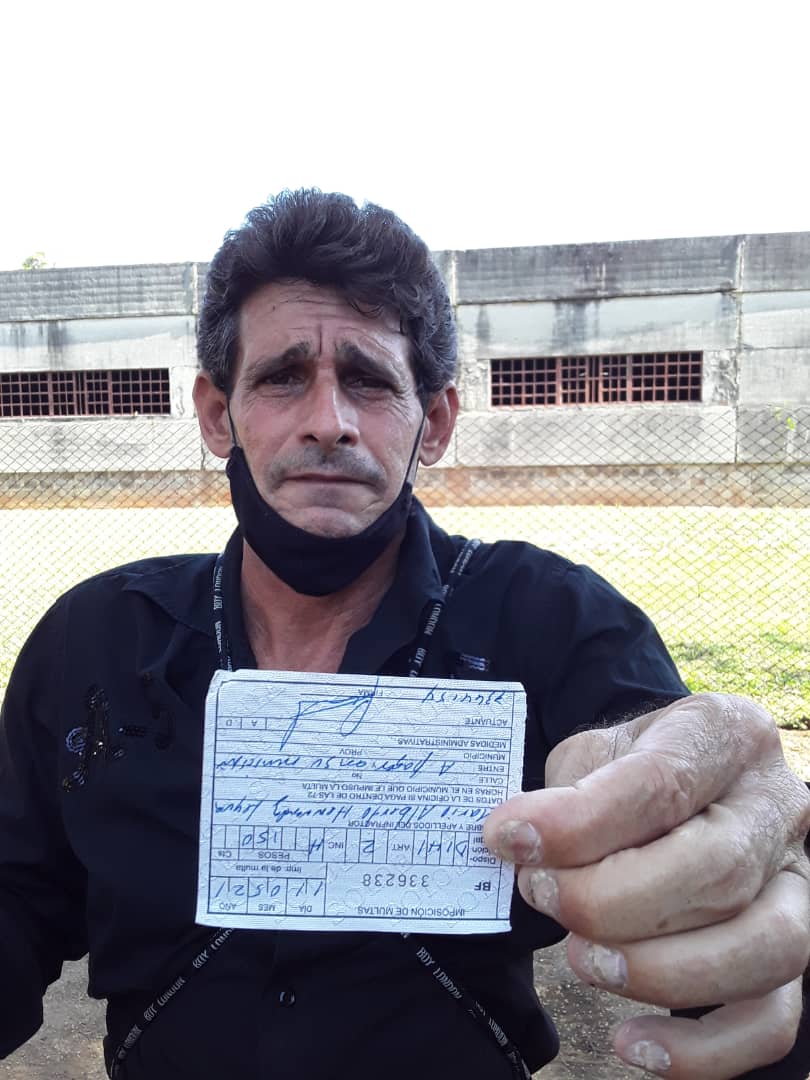
Calixto Ramon Martinez Arias, after his release. Image taken from Cubanet

This past Tuesday, the Cuban authorities finally acknowledged Calixto R. Martinez Arias’s right to go free, after he had served more than six months in prison, initially for the crime of “insulting the leadership figures of the Revolution.” He had no trial.

Martinez Arias twice engaged in what is known in the post-1959 history of Cuban political prisoners as “taking a stand” (literally, “planting oneself”): he declared a hunger strike. In the first, he went 33 days without eating, the second, 22. Until, after the second strike, it was reported by state security that his case had been reviewed and they had “understood” his demand for freedom.

“I started the first hunger strike to protest my stay in the Combinado del Este prison,” Martinez Arias said. “I also refused to wear prison garb. When an inmate declares a hunger strike, the guards use many methods to make them quit. The first thing they say is that you are committing a disciplinary infraction, which hurts your eiligibility for rights such as conditional parole, and for family and conjugal visits. And ultimately they take you to the infirmary where the doctor will take your vital signs and issue you a “suitable cellnotice, which means just that: you are fit to be taken to the punishment cells.”

“The punishment cell measures about 6 by 8 feet. It has no light. It has a “Turkish” toilet, and a water basin you can access twice a day, when the guards allow. There were days when they refused me water because a captain who claimed to be the second-in-command of Building 3, where I was detained, said that I could not drink water and took it away from me.

“By day you have to lie on the floor or stand. To that end, they remove the mattress. They left me my clothes, but took away anything with which I might cover myself. I spent very cold days, especially during the first strike. The cells are very wet and very cold, deliberately prepared to be that way. There were times when I had to sleep sitting on the floor, up against the wall, because the guards would come very late to give me the mattress. Lying on the floor you can contract a lung disease from the cold and moisture. The floor is very dirty because the cells are not cleaned. There are many insects: enormous rats, droves of cockroaches. It is a sacrifice that you have to make, convinced that it is all designed to psychologically torture you.

“During the second hunger strike, of 16 days, they took me to what they call ’the increased’ area, which is more severe. Then they took me out of there after one day to an even harsher cell. There the conditions were more brutal. They kept a surveillance camera on me at all times; they never turned off the light.”

In the second hunger strike, Martinez Arias started bleeding profusely from his gums and his teeth began to fall out. He lost 45 pounds. But he says: “I became a lot stronger.”

The “Official Organ of the Communist Party of Cuba,” the newspaper Granma, on Wednesday April 10, published an account of the “good conditions” in which prisoners live in Cuban jails. Regarding this, Martinez Arias said:

“This is an absurdity. I can assure you that they began preparing this article in December. In the month of December they informed us that journalists from the national and foreign press accredited in Cuba were going to visit the Combinado del Este prison. Major Rodolfo, who is in charge of the building where I was, a building for ’pendings,’ explained to us that the visitors would not be given access to our building because of the appalling conditions. Prisoners there live in a state of overcrowding, because every day many ’pending’ prisoners enter.

“It also has many leaks, and the bathrooms are in an extremely unsanitary condition. The building should be declared uninhabitable. Rodolfo explained that he was not going to take visitors there, because of these conditions, and that this was not a bad decision because, and I can almost quote him verbatim, ’when a visitor comes to your house, you want to show him the best, not the worst parts.’ For that reason, he said, they were going to repair a wing of building No.1. The foreign media should not be allowed to have access to the punishment cells. In fact, in none of the pictures they showed are these cells seen.”

In Cuba, the exercise of the right that everyone has to seek, receive, and distribute information, by any means of expression, without limitation by borders—as stated in Article 19 of the Universal Declaration of Human Rights—may be considered a crime. But on occasion, to put an independent journalist in prison, as in the case of Martinez Arias, the authorities bring charges of common crimes against him, to deflect the political nature of the arrest.

On September 16, 2012, Martinez Arias had been inquiring of some terminal-workers near Jose Marti International Airport about a batch of medical aid provided by international humanitarian organizations to address the outbreak of cholera and dengue and that, because of official mismanagement, had spoiled.

On leaving the airport, as he and others took shelter from the rain, perched on the benches of a bus stop to avoid the puddles, a patrol car arrived and gave them all tickets; but Martinez Arias was transferred to the police unit of Santiago de las Vegas on the charge of being “illegally” in Havana, having an address of the province of Camagüey. Martinez Arias claimed in his defense that “the brothers Fidel and Raul Castro are natives of the province of Oriente.”

“Immediately” said the self-described activist “the police handcuffed me, took me to a dark hallway, and beat me hard.”

The police who detained and beat him then accused him of “insulting the figures of the leaders of the revolution.” He was automatically moved to the Valle Grande prison, and from there, as punishment for continually denouncing through his colleagues the human rights abuses of the prison population, he was taken to the maximum-security Combinado del Este prison.

During the first hunger strike, State Security informed Martinez Arias that the prosecutor’s petition stated that he had been “insulting” and “resistant”, for having offended a policeman.

“If I had reacted during the beating they gave me by dodging a blow, or by landing a defensive blow to the policeman who was giving me the beating, I would have been accused of ’attacking,’” Calixto said. Police in Cuba can feel “offended” and “attacked” if you don’t react with absolute passivity to their arbitrariness and brutality, and then they fabricate the charges of “insult” and “attack”, respectively, resulting in the person’s imprisonment.

Martinez Arias believes that the visibility conferred by having been declared a prisoner of conscience by Amnesty International, together with the solidarity of human-rights activists, independent journalists in Cuba, and many foreign media with the participation of Cubans living abroad, managed to send a message to the government of Raul Castro that a person imprisoned for exercising their right to freedom of expression is not alone, and you cannot keep them in prison subjected to cruel, inhumane, and degrading treatment without paying a high political cost that limits your room to maneuver with impunity.

 *Translator’s note: Literally “the planted one”

 Translated by: Tomás A.

This post appeared originally in Cubanet.org

12 April 2013


Economic Readjustment at the Expense of Rights / Laritza Diversent

The Cuban government recently released its draft guidelines for economic and social policy, for approval at the next congress of the Communist Party of Cuba, scheduled to be held in April 2011. Apparently during the next 5 years the issue of fundamental rights of Cubans, mainly workers’ rights, will be off the state’s agenda.

In Cuba the economic system is based on the “socialist state ownership of all the people” over the basic means of production. The new update of the economic model takes a series of measures to eliminate subsidies, gratuities, and paternalistic treatment, but does not mention citizens’ guarantees against the power of an administration that is completely unresponsive to its constituents.

The socialist state continues to appear as the only entity capable of satisfying the general interests of Cuban society, both at the individual and collective levels. The new policies strengthen its enterprises at the detriment of the rights of workers.

This strategy was already put in practice with recent legislative changes undertaken by the State Council, which have as their main objective the elimination of the legal responsibility of the “socialist state” and its enterprises for the protection and relocation of redundant workers.

In the face of this excessive power of the socialist administration, labor guarantees are minimal. State enterprises have the authority to carry out restructuring plans, to make mass layoffs, and to question the ability of workers, citing lack of fitness.

The worker’s only means of defense is with a “Labor Base Justice Body”, one of whose members represents the administration of the entity that did the firing, or with the courts, which under the constitution receive direct instructions from the Council of State, the same body that enacted the measures restricting the exercise of workers’ rights.

There is no right to strike, and demonstrations are allowed only if they are organized by the state itself or its mass organizations. Anyway, the Constitution makes it clear that no civil liberties can be exercised against the existence and objectives of the socialist state.

Obviously the rights of citizens are not on the priority list of the Cuban state. The economic readjustment seeks only the survival of a system that has conclusively proven to be ineffective, and the staying power of the longstanding historical socialist leadership, at the expense of the welfare of Cubans.

Translated by: Tomás A.

December 19, 2010


Waiting for Changes in State Policy / Laritza Diversent

After two months, uncertainty fills the Cuban scene. The government still has not specified the principles that will govern self-employment. Meanwhile, the number of the unemployed and the expectations of the population are increasing.

One of the concerns raised is whether the government will grant rights to the self-employed in order to extract administrative concessions, bearing in mind that it considers the activity of individuals as an adjunct of the state.

Up to now it has said nothing about this. But several of the activities authorized for self-employment are related to the exploitation of mineral resources, such as quarrying, and producing pottery items for sale.

Others, like producing and selling granite and marble items, remain stalled, according to the official newspaper Granma, because there is no legal market for acquiring the goods.

The Ministry of Basic Industry is authorized to grant or deny mining concessions for small deposits of certain minerals, recognized by the Constitution of the Republic as properties of “socialist state ownership of all the people.”

Two years ago, the citizen Amada Pupo Cisneros presented an application to the National Office of Mineral Resources for exploitation of mineral clay in the town of La Estrella in Las Tunas. His claim was rejected by the recently deposed Minister of Basic Industry, Yadira García Vera.

The former government official denied the right on the recommendation of the National Bureau of Mineral Resources, which determined that the request by Pupo Cisneros was contrary to the general principles of the practice of self-employment.

Since 1992, state assets can be transmitted, wholly or partially, to the proprietorship of private persons or corporations, with the prior approval of the Council of Ministers or its Executive Committee. But the government only recognizes this right for foreign investors.

Cuban nationals like Amada Pupo are excluded. Their participation in the national economy is seriously limited by the Constitution, by Decree-Law 141 of September 8, 1993, “On Exercise of Self-Employment”, and by other complementary legislation regulating this right.

Article 21 of the Constitution recognizes private ownership of the means and tools for personal or family work. But it restricts that right by prohibiting their use in obtaining income from the exploitation of the labor of another.

Despite being a constitutional right, in the last parliamentary session the President of the Councils of State and Ministers, and a member of the Politburo and Deputy Secretary of the Communist Party of Cuba (PCC), announced that his government would lift some restrictions on the exercise of self-employment, including hiring labor.

Nevertheless, the government made clear that it will maintain its policy of identifying, monitoring, and controlling these activities, and who can perform them. It will also oversee the conditions of marketing the products and services of the self-employed. According to the newspaper Granma, an official organ of the PCC, the measures will become effective, without specifying the day, starting in October.

So far, the socialist government denies its nationals the right to draw on public services, natural resources or public works, although the law gives them that possibility. We will have to wait and see if they change the discriminatory principles of state policies and its system of exclusion. It is time that the Cubans become involved, on equal terms, in their own economy.

Translated by: Tomás A.

December 17 2010


Economic Guidelines Ignore Policies of Segregation on the Island / Laritza Diversent

The draft guidelines for economic and social policy proposed by the Cuban communists declare that equal rights and opportunities exist for all citizens, not egalitarianism. But at no point do they give respect to the rights of Cubans.

On the contrary, inherent in the “Update of the Socialist Economic Model” is the continuing discrimination against Cubans in favor of foreigners, principally when it comes to participating in the national economy.

The island’s communists continue promoting the participation of foreign capital, while precluding the formation of capital by nationals, by excessive regulation and state control. Notwithstanding that the Cuban Constitution treats foreigners and nationals equally in the enjoyment of rights.

While only foreigners are allowed to join with the state in large businesses, Cubans must comply with limits on their activities that impede the progress of individuals and families. Is this what they call equality of rights and opportunities?

It is no secret that foreigners enjoy a privileged position in Cuba, from an economic and social standpoint. Of course these freedoms are not a response to external pressures, but are purely government policy.

While a self-employed Cuban must pay tax, up to 50% on income over 50,000 pesos, foreigners pay a maximum of 30% on their profits. The policy is to apply higher taxes on higher incomes, hindering the activity of Cubans in their own economy

The new regulations on self-employment are pure formalities. They still do not encourage new participants, who have the responsibility of contributing to the burdens of state, creating jobs, and increasing productivity in the country. Nor do they take into account that many families depend on the progress of the activity of the self-employed.

It is fair to say that foreign investment in Cuba brings benefits to the economy. But it is not the sole solution for addressing the overwhelming problems, nor a justification for a policy of discrimination.

In the Cuban Constitution, discrimination on the basis of national origin is prohibited, and punishable by law. But there is still no legislation giving effect to this principle. Moreover, the government itself implements policies of segregation, which prevent its citizens from investing in their own economy, from being responsible for their own fate.

Translated by: Tomás A.

December 15, 2010


Legal Representative of the Minister of Justice Appears in Court / Laritza Diversent

This past August 10th, Dr. Diego Fernando Cañizares Abeledo, a specialist in the Legislative and Advisory Directorate of the Ministry of Justice (MINJUS), appeared before the Second Civil and Administrative Chamber of the the Havana Provincial Court, representing Justice Minister Maria Esther Reus González on the administrative claim filed by the attorney Wilfredo Vallín Almeida, based on the silence of the Administration, asserting the right of appeal recognized in the Constitution of the Republic.

In his brief, the Minister’s lawyer described the claim as “nonsensical.” In his opinion, the plaintiff, Mr. Vallín Almeida, chose “a legal wrong way. We do not know for what specific purpose,” he argued. In his view, the President of the Cuban Legal Association should try to gain legal recognition through the Associations Act, without the Ministry of Justice being required to issue anything in writing.

On April 7, 2009, The lawyer Wilfredo Vallín Almeida, president of the Cuban Law Association, a union of dissident lawyers, on behalf of his organization, had asked the Registrar of Associations of MINJUS to certify that there was no Non-Governmental Organization (NGO) in the country with the same name and purpose as the association of attorneys.

The state agency never issued the certificate, a document which is essential to continue the legal procedures for setting up the union. In March 2010, the group reiterated its request and received no response. The lawyers, on administrative appeal to the Minister, Reus González, lodged a complaint for breach of the required legal formalities, which was also ignored.

The Law of Civil, Administrative, and Labor Procedure (LPCAL) provides that if the administrative authority at any level of the hierarchy does not resolve an appeal by the legal deadline, or after the expiration of 45 calendar days, then the application shall be considered rejected, with the effect of establishing that implied rejection for the subsequent appeal.

Cañizares Abeledo, appointed by Ministerial Resolution No. 215 on August 6, 2010, alleged that it was impossible to deliver to the court the applicant’s government record, and the administrative decision of the head of Justice relating to the matter raised by the plaintiff, Mr. Vallin Almeida, claiming that the agency had no documents regarding the matter.

Translated by: Tomás A.

September 9. 2010


Agent 007 Is Running Out of Time / Iván García & Laritza Diversent

Chilean businessman Joel Max Marambio Rodríguez faces a deadline of August 23rd to appear before the Inspector from the Ministry of the Interior (MININT), Lieutenant Colonel Francisco Miguel Estrada Portales. If he does not appear before the time runs, the criminal proceedings initiated against him could proceed to a final judgment of guilt.

How does an intimate friend and protegé of the elder Castro reach this point, managing the business of a holding company that moves more than 100 million dollars a year? Why would a friend of the revolution for more than 40 years become its adversary?

There are still many unanswered questions, some of which will be answered in the course of the trial, where the Chilean businessman will apparently be tried in absentia and evidently he holds the key to the box of secrets. Marambio, age 63, a former bodyguard of ousted President Salvador Allende and former friend of Fidel Castro, is accused by the Cuban government of the crimes of bribery, acts detrimental to economic activity or employment, embezzlement, falsification of banking and commerce documents, and fraud.

The businessman, owner of International Network Group (ING), was a partner of the Cuban state in the joint venture “Río Zaza Foods,” specializing in the production of juices, dairy products, and alcoholic beverages for the Cuban market and abroad. In late 2009, the Auditor General, a state body subordinate to the State Council, chaired by Army General Raul Castro, began investigating the leftist entrepreneur’s businesses on the island.

Unofficially, he was linked to a corruption scandal involving the deposed director of the Institute of Civil Aeronautics of Cuba (IACC) and Major General Rogelio Acevedo.. Max Marambio and his brother Marcel, were also partners of the IACC in the Sol y Son tourist agency. Several directors of the company were arrested, accused of paying kickbacks, misappropriating funds, and diverting resources abroad. Lucy Leal, executive director of ING, was arrested and is being investigated.

Authorities have not officially said anything about the scandal. In April, however, they acknowledged that Marambio’s companies were under investigation, when one of the managers of Rio Zaza Foods, the Chilean Roberto Baudrand, age 59, under house arrest and being subjected to interrogation, was found dead in his apartment. The Cuban autopsy, accepted by the family of the deceased, said the cause of death was respiratory failure combined with the consumption of drugs and alcohol.

Marambio, known in Cuba as “The Guaton” (the fat man) was summoned and questioned by Inspector Estrada Portales, in late April and early August. The officer is in charge of the investigation. The summonses were published by means of two MININT notices in the Official Gazette of the Republic of Cuba, the agency that discloses the laws and governmental acts on the island. To date, he has not appeared.

The Summons was issued on July 19. In it, the MININT inspector summoned the Chilean businessman to appear before him on the 29th, warning him that if he did not appear on the date indicated, an indictment would be issued on August 3. Officer Estrada Portales ordered the police agencies and State Security to search for, apprehend, and present Marambio within 20 days.

The summons expires on August 23rd. If the deadline passes without his appearance or presentation, he will be declared in default. In the case of crimes against the fundamental political or economic interests of the nation, the Cuban judicial system provides that proceedings against a defendant declared in default can proceed to a final decision.

The judicial system in Cuba offers few safeguards for defendants. The criminal case against him is in the preparatory phase, when pretrial proceedings are conducted. If Marambio returns to the island he is most likely to end up in jail, as a precautionary measure to secure his appearance. Until then, he cannot appoint a legal representative for his defense.

Everything seems to indicate that the legal route will be the means of settling accounts. The publication of the summons and indictment in the Official Gazette of the Republic of Cuba is a formal requirement. The island’s government does not intend to pursue the businessman internationally.

The aim is to declare him in default and try him in absentia. In that case, he could appoint a lawyer. He could also appear at any time and revoke the declaration. He could even void the final judgment against him and be heard in a new trial. Marambio could be a time bomb for the Castro brothers. For what he knows and for what he has been quiet about. We suspect he will not return.

Iván García y Laritza Diversent

Translated by: Tomás A.

August 23, 2010


From Revolutionary Friend to Foe / Laritza Diversent

If Chilean businessman Joel Max Marambio Rodríguez does not appear before the Inspector from the Ministry of Interior, Lieutenant Colonel Francisco Miguel Estrada Portales, this 23rd of August (the deadline specified in an indictment), the criminal proceedings initiated against him could proceed to a final judgment of guilt.

Max Marambio was summoned and interrogated on July 10 and August 3, by Officer Estrada Portales, who is in charge of investigating the case, according to two notices published by the Interior Ministry in the Official Gazette of the Republic of Cuba. According to the published documents, the businessman lives in the “Las Condes” Commune in Santiago de Chile, where his business offices are also located.

Marambio, known in Cuba as “El Guatón” (the fat man), arrived on the island in the mid ’60s, when he made personal contact with then-President Fidel Castro. On the island he began his training as a guerrilla, under the direction of the legendary Manuel Piñeiro, known as Barbarossa.

At the end of that decade he returned to Chile and joined the Movement of the Revolutionary Left (MIR) and then led the Group of Personal Friends (GAP), the non-military cohort of President Allende. He took refuge in Cuba after the 1973 coup.

He also worked with Patricio and Tony Laguardia, in the Special Troops of the Ministry of Interior, and survived the political scandal that resulted in the firing-squad executions of Antonio Laguardia and General Arnaldo Ochoa in 1989. Then he was one of the founders of CIMEX, among the largest Cuban state-owned corporations, with annual revenues of more than one billion dollars.

During the decade of the nineties, under the protective wing of Fidel, he went from guerrilla to successful businessman, to the point that today he owns a holding company that does more than a hundred million dollars of business per year. His memoir, “The Weapons of Yesterday”, was presented a couple of years ago in the Havana Book Fair.

There is speculation about what caused his status to change from revolutionary friend to adversary. Some say it was for financially backing the campaign of Marco Enríquez-Ominami, who was dismissed from the center-left coalition that governed Chile for 20 years, and whose candidate lost to the rightist billionaire Sebastian Pinera.

Others believe that it was for indelicately demanding his capital, when a year ago Cuban authorities froze the funds deposited in Cuban banks, and the transfers of all foreign businessmen, because of the serious lack of liquidity in the country.

Translated by: Tomás A.

August 29, 2010


The Logic of the Predictions / Laritza Diversent

Two years ago, in a work I published about “the comrade who reflects,” I said:

“The elder Castro, in his reflections, goes back in time and rehashes the past, mainly the 60s and 70s, which suggests that ‘the providential man’ of the Cuban revolution, age 81, is showing symptoms of senile dementia.

“Easily recalling events of long ago as if reliving them is a manifestation of the disease, which attacks the elderly. The situation is being exploited to create a new history of the Leader, now from his personal point of view. Expect soon a literary work about this.”

On August 2, 2010, “former president” Fidel Castro released his book Strategic Victory, about the guerrilla fighting in the summer of 1958. The book, 896 pages long, chronicles the battle of the Rebel Army in the Sierra Maestra to stop the offensive of the armed forces of Batista, according to the voice of the “leader and strategist” of these events, as described on Cuban television.

Laritza Diversent

Text of the cartoon:
Coño, that’s a nurse! It’s not a Lady in White!

Translated by: Tomás A.

August 24, 2010


Minister Places Citizen in Indefensible Position / Laritza Diversent

Minister of Finances and Prices

In July 2009, The Minister of Finances and Prices, a member of the Council of Ministers, ordered the confiscation of property obtained by Teófilo Roberto, the father of Antonio Roberto, during the period from 1998 to 2008. The action was taken under the authority of Decree-Law 149 (“Regarding the seizure of property and income resulting from unjust enrichment”) known as the law against profiteers (the new rich), and its regulations, Decree No. 187, both from 1994.

The minister claimed that the seized items “are not fruits of honest labor,” but the Cuban Civil Code defines unjust enrichment as the transfer of items of value from one estate to another, without a legitimate basis.

The process also affected Pompilio López Licor, age 61, and Teófila Elsa Ávila Gutiérrez, 60, Teófilo’s brother and his wife, who along with his son Antonio, were named in a ministerial order as third parties who benefited from the unjust enrichment.

The defendants appealed against the ministerial decision through the Recourse of Reform before the same minister, who declared it without merit, confirming his decision, in October 2009. On June 22nd they appealed again to the head of Finances and Prices, the start of a special review procedure.

But the appeals do not stay the execution of the penalty of confiscation. Decree-Law 149 placed those affected in a state of helplessness, preventing them from access to the courts to demand justice against an act of the government that is harmful, according to Article 9 of the Decree.

Pedraza Rodríguez asserts that the three houses, two cars, a motorcycle and various items, including appliances, were obtained and authenticated by Theophilus, and hidden through subterfuge, on behalf of his relatives, without specifying which acts were illegal.

But he did not initiate legal action against the state officials who acted to legalize the goods and property of those affected. In particular the Arroyo Naranjo municipal housing management officials, responsible for implementing the Ministerial Regulation concerning real estate. On July 22, the state agency notified Antonio that he would be evicted within 72 hours.

The confiscation process was initiated and submitted to the Minister by Brigadier General Juan Escalona Reguera, subsequently released from his position as Attorney General of the Republic by the State Council, who may be linked to a corruption scandal involving foreign companies.

The assets seized from the Lopez family amounted to 2,347,834.24 Cuban pesos. The amount was certified by experts who did not specify, as is required by law, what their evaluaiton consisted of, or what the parameters of the process were, or what factors they took into account to estimate that figure.

Teófilo, Antonio’s father, is self-employed as a “producer-vendor of food and nonalcoholic beverages in a fixed point of sale,” according to the rules for the activity numbered 646. In his defense he claimed that he received income from his self-employment amounting to 521,000 pesos. But the minister countered that Theophilus hired labor.

The criminal law regards the use of non-family labor in otherwise authorized activities as illegal. But the ministerial decision issued by the head of Finances and Price did not refer to any criminal penalty imposed on the father of Antonio.

Teófilo receives remittances from the United States from six brothers and a son who live in that country. From January 2007 to December 2008, the National Bank of Cuba established that the relatives of the accused deposited remittances for him of 12,000 convertible pesos (CUC), equivalent to 300,000 Cuban pesos (CUP). The bank report was dismissed by Minister Pedraza Rodriguez, because it did not show that Theophilus had actually received the money.

Article 60 of the Constitution of the Republic states that “the confiscation of property shall be used as a punishment by the authorities only in the cases and procedures determined by law.” The Penal Code, regulates it as a specific penalty and accessory of a crime.

The Constitution, The Law of Criminal Procedure, and the Ordinance of the People’s Courts, guarantee that “No one can be tried or sentenced except by a competent court under the laws in effect prior to the crime and with the formalities and guarantees that they provide.”

In this case, the Decree-Law 149 is unconstitutional and illegal because it provides that the penalty of confiscation be implemented by an administrative authority, as an exemplary measure against those who obtained an illegitimate legacy as a result of theft, speculation, diversion of resources from state agencies, involvement in shady deals, black market activities and other forms of enrichment.

In the same provision of law, the behaviors are classified as “criminal activities” that damage the national economy and social stability. But the prosecutor, who is responsible for bringing criminal actions on behalf of the state, decided to encourage an administrative proceeding before initiating a criminal complaint.

In a fair criminal trial, Theophilus’s relatives would never have had to answer for the acts of others. The responsibility is individual. Moreover, the Penal Code, in force since 1987, provides that “the confiscation of property does not include . . . goods or items that are essential to meet the vital needs of the sanctioned or the relatives of his household.” Thus, housing cannot be seized.

The preferred implementation of Decree-Law 149 is the result of the subordination of the Attorney General’s Office to the State Council. This means that it must first comply with political instructions before it controls and preserves “socialist legality” and ensure strict compliance of laws

The existence of this rule in the Cuban legal system far from protecting the general welfare, destroys the trust and security that any legal system must provide. Its application violates the guarantees afforded to criminal defendants and renders citizens defenseless against the excesses of the government.

Lina Olinda Pedraza Rodríguez was appointed by the government as Minister of Finance and Prices, but is not qualified to administer justice. The powers conferred by Decree Law 149/94 are unconstitutional, and therefore arbitrary.

Since July 22nd, Antonio López Ávila and his family members have lived with the apprehension that at any moment police officers will forcibly evict them and destroy their home.

Laritza Diversent

Photo: Minister Pedraza Rodriguez is also a member of the Communist Party Central Committee, and Deputy for the Province of Villa Clara.

Translated by: Tomás A.

August 11, 2010


Government Measures Raise People’s Expectations / Laritza Diversent

Self-employed

In his most recent speech, General of the Army Raul Castro Ruz announced a series of measures affecting the employment rights of the Cuban people. The most far-reaching of all was the extension of self-employment.

According to Castro, who is also President of the Councils of State and Ministers, the government agreed to extend the practice of self-employment as an alternative employment, and eliminate several existing prohibitions against the granting of new licenses.

The rise of individual economic activity on the island began in 1989 with the collapse of the socialist sphere, as a government measure to readjust the economy, given the lack of credit and the inability to obtain the cooperation of international financial organizations. Starting in 1997, the state began restricting licensing, to reduce the independent economic sector.

At present, self-employment is subject to control and supervision by the government, which considers it a supplement to state activity. It is done at the municipal level, on a case-by-case basis.

Permits are renewable every two years. They cover activities of producing and marketing goods and services, at the address of the permit-holder, and can only be offered to private individuals.

It is prohibited to conduct on the island any activity of producing, processing, or selling goods or services without authorization. The authorized activities are specifically listed in Resolution No. 9/2005, “Regulations on the exercise of self-employed person,” by the Ministry of Labor and Social Security. The law approves 118 activities, and authorizes the granting of new licenses for only 40 of them.

The law requires the self-employed to buy the raw materials in the retail market in convertible currency, but to offer their products and services for sale in national currency. This requirement impedes the development of private economic initiative on the one hand, and on the other it promotes the rise of lawlessness. The self-employed turn to the black market in order to continue their business and keep their license.

At the same time Castro, the Second Secretary of the Communist Party of Cuba, announced that the Council of Ministers approved the implementation of a system of taxes on this type of activity, presumably to ensure that the newly self-employed contribute to social security, pay personal income and sales taxes, and that those who hire workers pay a tax for the use of the workforce.

The measures – especially those concerning the marketing of new products and flexibility in hiring labor – have generated an expectancy among the populace. Their implementation will require the government to reform the legal system: the criminal law that prohibits the employment of labor or the use of methods or materials of illicit origin, also revokes licensure.

Laritza Diversent

Translated by: Tomás A.

August 17, 2010


Customs Back in Action / Laritza Diversent

Postal and Shipping Customs, part of General Customs of the Republic (AGR), imposed an administrative penalty against me, through Confiscation Order No. 978, issued on June 8, 2010, for a shipment sent from the United States of America.

On July 13, I received an envelope sent by the Customs authority through the Cuban Postal Service, which contained the order and four Records of Retention and Notification. The documents included a list of the items seized.

In the order, Raimundo Pérez García, Customs Enforcement Inspector, confiscated the items – mostly cleaning, toiletry, and office supplies – claiming that upon physically inspecting the shipment, he found that they offended the general interests of the nation, constituting a violation of the provisions of Resolution No. 5-96 of the Chief of the General Customs of the Republic.

Among the products mentioned were an MP3, a camera, water purifiers, a pencil sharpener, balloons, pens, pencils, markers, several note pads, crayolas, laundry soap, a toothbrush and toothpaste, deodorant, towelettes, antiseptic and sanitary pads, elastic bandages, and rolls of tape.

These are widely-used, everyday domestic products, and are on sale in state-owned commercial establishments and hard-currency stores within the country.

The customs order issued by Pérez García, Customs Enforcement Inspector, is arbitrary. This official did not explain what criteria he took into account to determine that the items seized offended the general interests of the nation.

Resolution No. 5 of the AGR, in force since 1996, allows the application, within the national territory, of the International Convention on the Suppression of the Circulation and Trafficking of Obscene Publications and traffic.

It prohibits the importation by shipment of “any object whose content is considered contrary to morals and good customs or that goes against the general interests of the nation.” It further provides that the seized products be delivered to the appropriate agency of the Ministry of Interior.

The government regulation was used in previous months in the seizure of shipments from abroad to various dissidents, including Aini Martin, the independent press correspondent, Yusnaimy Jorge Soca, the wife of the physician and prisoner of conscience Darcy Ferrer Dominguez, and Yoani Sanchez, the author of the blog “Generation Y”.

Laritza Diversent

Translated by: Tomás A.

August 14, 2010


The Return to Origins / Rebeca Monzo

Several years ago my downstairs neighbor called and told me he had received a surprise visit, from the daughter of the former owner of the building where we live. She showed great interest in visiting only my apartment, so he had given her my phone number.

The next day I got the call, and we arranged to meet. Still a young woman, she was very excited when I gladly received her. She was apprehensive because of the stories they told her that everyone here is afraid that those who left will come again to take away what had belonged to them. She realized immediately that I had no such fear, and immediately there was a surge of empathy. Of course I showed her the whole apartment and the garden we had built on the roof. She was very emotional and told me that her father had designed the building with three apartments, one on each floor, for the enjoyment of the family. The building was finished in 1958 and two years later they were already in exile, which was very hard for the family. This floor was of particular interest because it was where she lived since birth. Her grandparents lived on the first floor and her uncles on the second.

It was I who really felt excited, and at the same time embarrassed, at seeing with what sacrifice and love a family had saved money and built something so they could always be together; suddenly, by the circumstance of a social phenomenon, they were forced to abandon everything.

Today I heard from her and this time I owe it to my blog. She has become my reader, and I hope, with time, my friend. In short, she and I have been puppets of destiny.

Translated by Tomás A.

August 2, 2010