Cases of Dengue in the Cuban Military School / Ignacio Estrada

By Ignacio Estrada Cepero, Independent Journalist

Havana, Cuba. In recent days, the “José Martí” Military Polytechnic Institute (IPM, ex-Belén College), located in the capital municipality of Marianao, has had to increase medical attention in the military infirmary due to the appearance of constant cases of fever.

According to information not published by any medical official, the military school is keeping a total of 54 cases isolated from the rest of the students. It is unknown how many of these patients have been diagnosed positive for Dengue through the known laboratory IgM test.

Students of this military school confirm the existence of the sickness, but are afraid to speak of its presence at the institute for fear of retaliation by their superiors.

The military school is located in a marshy area, and thick underbrush surrounds its sides. Besides the presence of tunnels and an old rail line trench, there are other places prone to the appearance of sources of the Aedes Aegypti mosquito, the transmitting agent of this sickness.

The “José Martí” Military Polytechnic Institute has a student body of around 5000 boarders, in addition to a small number of youth from the General Obligatory Military Service (SMGO), these last destined for work at the center.

Translated by: M. Ouellette

October 8 2012


The Impact of Hispanics in the United States / Miriam Leiva

Miriam Leiva, Havana | 09/27/2012 9:52 am

From Cubaencuentro

National Hispanic Heritage Month in the United States, from September 15th to October 15th, holds particular importance this year, since it occurs during the electoral campaign heading up to the elections on November 6th. Hispanics can determine the results, especially if they use their right, which they do not always exercise, granted as American citizens.

Among Hispanics, Cuban-Americans could contribute to the country and the people that took them in, sharing opportunities, and even with the Cuban people living in our small archipelago through their support for the continuation of the measures adopted by the current administration.

Celebrating Hispanic heritage started on the national scale in 1968 with a celebration that lasted a week, the week chosen so as to coincide with Independence Day in Costa Rica, El Salvador, Guatemala, Honduras, and Nicaragua on September 15th; Mexico on September 16th; and Chile on September 18th. In 1988, President Reagan approved a law that extended the celebration to a month, from September 15th to October 15th.

The population of the United States is 311,000,000 people, of which 50,500,000 are Hispanic (63% of Mexican origin), or 17.9%, and this is expected to rise to 30% by 2050. 19,500,000 of these Hispanics were eligible to vote in the 2008 Presidential Elections.

Each month, 50,000 youth reach adulthood, and in 2012 there are more than two million new voters, for a total of 23,000,000; however, only 60% are registered to vote. In the previous elections, 2 out of 3 voted for Obama. In swing states, the Latin population is 245,000 (14.2%) in Nevada, 104,000 (5.9%) in Utah, 455,000 (12%) in Colorado, 749,000 (8.5%) in Illinois, 128,000 (1.5%) in Ohio, 254,000 (2.2%) in Virginia, and 2,100,000 (16%) in Florida, where, as it is well-known, Cubans play an important role, go to vote, and, in this opportunity, could do even more.

The different visits to these states by President Barack Obama and the Republican candidate Mitt Romney, their interviews in Spanish-language television, radio, and newspapers, as well as their campaign materials in this languages, confirm the importance they place on how Hispanics can influence the results.

The notable participation of Marco Rubio, senator of Cuban origin, at the Republican Convention and Julián Castro, mayor of San Antonio, Texas, and second-generation Mexican, at the Democratic Convention demonstrate the importance of Hispanics in the current contest.

Rubio, a young man supported by the Tea Party, reached his current position in the last elections, but his captivating impression made people wonder if he would be presented for Vice President, or if he would prefer to wait and aspire to the Presidency four years from now.

Castro, 37 years old, is seen as a potential candidate, as he is a great orator, capable of reaching the public, and shows the aggressiveness required to be President of the United States.

Although President Obama is indebted to this segment of the American population, which mainly supported him in the 2008 election, above all for the hoped-for law for immigration reform (there are around 12 million undocumented immigrants), the advantage currently goes to Romney, for 63% against 28%. In addition to positions unbecoming to traditional Republican Party members, the current candidate has expressed opinions detrimental to eliciting sympathy, and which actually spark great fear.

For its part, the populace of Cuban origin has been able to participate in all of the opportunities that competitive, thriving American society offers, and with its efforts, has elevated itself to outstanding positions in business, culture, sports, science, religion, politics, and more.

There are Representatives and Senators of both parties that reach these notable positions through their capabilities and attention to the diverse interests of voters. In Florida, in particular, they carry out an important role as the decisive vote in this state, so that relations with Cuba constitute not a theme of international (exterior) politics, but rather domestic (internal) politics.

Keeping in mind that they have been the driving forces behind the commercial embargo, they lamentably coincide with the immovable ruling on the Island over the course of the last 53 years, which in reality favors the interests of those who hope to remain in power and bequeath it to their heirs or chosen people.

The embargo, called “blockade” in Havana, benefits the regime against which it acts, since it is  used as an argument to justify the regime’s whims and failures, blaming imperialist aggression, but fundamentally to suppress any opinion contrary to what is dictated.

However, for more than a decade, since the presidency of George W. Bush, fortunately for the poorly fed Cubans, the United States has been the main supplier of food to Cuba, and it occupies fifth place in the socio-commerce of goods, mainly for this reason.

The Island population very positively recognizes the measures of President Obama to allow visits by Cuban-Americans and to send money, which have: contributed to normalizing family and friendly contacts; largely mitigated the economic precariousness; notably reduced dependence with respect to the Government, almost the only employer; and favored expanding information about the exterior reality, especially regarding possibilities for personal and social development in the United States, as well as visits to the country.

Currently, a change in the politics of bringing the peoples of both sides of the Straits of Florida closer together is greatly feared in Cuba. The course of the American elections is followed with great interest, in great contrast to what occurs with the elections in October to select delegates to the People’s Power, whom everyone knows are chosen beforehand, and which will neither resolve any problems for the citizens, nor will have an influence on the serious economic, political, and social crisis prevailing in Cuba.

Translated by: M. Ouellette

September 27 2012


Glosses / Regina Coyula

Since I was in the hospital waiting for my mother to undergo a small surgery (as you see, I keep going with hospitals), I had time to read the entire Granma newspaper from Friday, the thickest of the week with its 16 pages.

Page 1

The person in charge of a business is the director.

Ergo, the person in charge of a ministry is its Minister; the person in charge of an institute is its Director; the person in charge of a country is its President.

Pastors for Peace cross the US border with Mexico.

Defying the US blockade for the 23rd time. Either these pastors are really defiant or the blockade is weak!

Page 2

Contract violations impact the direct sale of agricultural products to tourist outlets.

More than 30 million CUC enter the Ministry of Agriculture for these sales, but they later clarify that of 181 production centers that have signed contracts with hotels, only 45 occur in a regular way. 136 are in breach of contract?!

Summer Festival in Jibacoa.

If I am not wrong, this is Rotilla in disguise. [See also.]

Page 3

The North American occupation fed the most spurious racist sentiments and the official press did not hide its complicit stance.(From the speech made by Miguel Barnet on the 100th anniversary of the massacre of the Independientes de Color.)

I do not doubt it, but said today, where in the US a black man has arrived at the Presidency thanks to the fight for civil rights, this sounds as if one simply has to speak badly of the Americans. And anyway, what was the official press of the time?

Page 4

The BCC’s report to Parliament

In the payment system between businesses, they note that balances due and accounts receivable have decreased; it talks about contractual disrespect, but not about the offender’s punishment. Plastic money continues to wait in line and there will be no increase in ATMs.

Challenges of Higher Education.

… conducting ideological political work creatively and with marked intention, to guarantee the formation of highly competent professionals, who are engaged in society and revolutionary principles.

I seem to have heard the same so many times before!

Page 5

Resources and responsibility to prevent water loss

It is already known that an amount of water is lost equal to what the largest reservoir in the country can store. If 16% is lost in pipes, and 20% in the aqueduct, and 22% in homes, I get 60%. Does the State waste the remaining 40%? Now is when they speak about strategy? This is not serious, although I imagine that the people in Santiago are not laughing at this news.

These pages about the meeting of the National Assembly leave me with the feeling that this government has just reached power, having inherited serious problems.

Page 6

The white mulberry, an animal feed option.

Nothing against the white mulberry, but as Lezama would say: this report smells like Oporto.

Page 7 (international)

Ben Alí condemned to life in prison.

Probably the most newsworthy item in the entire newspaper, lost in the small section Direct Feed.

Small spokespeople.

The article criticizes the manipulation of child spokespeople on behalf of the Syrian opposition.

…they are using the natural innocence of a child to win supporters and play with people’s sensibility… It seems that their parents are not worried about sending them to demonstrations… Simply, they end their childhood for their own benefit, cutting their innocence short.

And where was the journalist during the Elián González case? I am not only speaking about Elián, but about the many children that we see haranguing like adults on the Mesa Redonda (Roundtable TV show) and in “anti-imperialistic tribunes.”

Page 8 (international)

About the US elections: informative; I wish they would speak with this breadth about domestic politics.

Obama launches a plan to “control the internet” in case of emergency.

Wow! This piece, taken from Rebelión, reports that the Americans could wind up with Internet like mine? False alarm: after reading the piece, the title is sensationalist.

Pages 10 and 11 (letters to the Editor)

It is too exhausting to try to write about these two pages. I was already tired when I got here. Likewise for the rest, up to page 15, where culture and sports are. I would have changed the great title We Knock Out Japan, referring to the Harlem baseball tournament, for another more modest one in view of the Cuban team’s bad start. On the 16th and final page, I am informed obliquely, knowing the inside world of a salt works in Guantanamo, why salt in Cuba continues to be rationed.

How good I am for reading the entire Granma, and how good you are for reading this.

Translated by: M. Ouellette

July 23 2012


What Hygiene Are We Talking About? / Wendy Iriepa and Ignacio Estrada

De qué Higiene estamos Hablando (1)

De qué Higiene estamos Hablando (2)

De qué Higiene estamos Hablando (3)

Havana – In recent days, the health authorities on the Island reported the presence of a cholera outbreak in the town of Manzanillo in the western province of Granma. Starting from that same day, July 2nd, the rumors have created fear and distrust about something that seems like it will become, yet again, another one of the many state secrets.

Since the appearance of this illness in Cuba, only the health body has drafted two very succinct notes that appeared in the official Granma daily newspaper and on TV. They mention that the outbreak is under strict control, but it is apparently not so, since they have detected new cases in other provinces in recent days.

What most catches my attention is the way in which the government tries to sidestep reality by making a call to intensify hygienic measures and water chlorination or treatment. As is expected, the response is immediate for each Cuban who hopes to not contract this sickness.

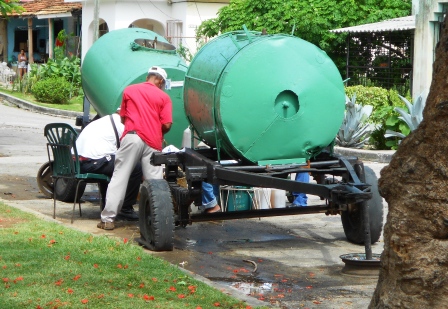
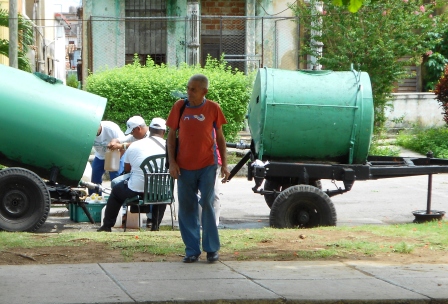
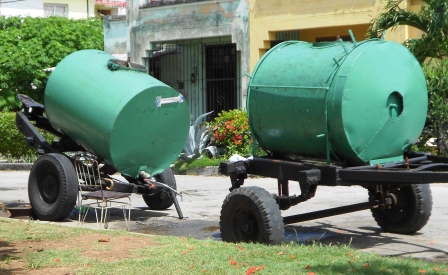
It would be reasonable to ask all the competent authorities on the Island if the call to sanitizing extends just to the private sector while the State continues without due control. To judge by the images, they continue selling refreshments in the streets from poorly cleaned movable tanks, offering consumers a very low-quality product.

The images show some of these tanks that remain at the park in La Ceiba, a suburb of Playa: the people crowd around and collect the liquid in bottles, these many times taken from the streets. The tap on these tanks is very close to the ground and so it is rare that a bottle is not placed on the ground prior to filling.

Who can guarantee that this refreshment, in most cases baptized with water from Lord knows where, is not also one of the means of infection? If we are really called to maximize the sanitary means on the Island, we will do it no matter whose business it is. Let us keep in mind that what is first is the preservation of the human species.

We speak sincerely and we do not leave the responsibility for our health only in our hands or those of our families; we call for every institution, organization, or ministry to take on the responsibility of hygiene in each local area. There is no potable water, chlorine, or detergent in many of them. Are they not also responsible then? If the situation returned to the same way described before, it would be worthwhile to ask the Health Ministry in Cuba and the competent authorities, “What hygiene are we talking about?”

Translated by: M. Ouellette

July 16 2012


Repression of Religious Minorities / Wendy Iriepa and Ignacio Estrada

The levels of intimidation and repression of religious freedom on the island are the highest since 1980, according to a report by Christian Solidarity Worldwide, published in May 2012.

Their report documents a total of forty religious freedom violations in different regions of Cuba and compares them to those from previous years.

Benedict XVI’s visit to the island in March 2012 caused a strong display of security which prevented defenders of human rights and pro-democracy activists, many of them practicing Catholics, from attending the events of the papal visit. Because of this, hundreds of Cubans were jailed or imprisoned in their own houses through police harassment.

The report highlights the case of people like the Lady in White Caridad Caballers, who was regularly prevented from attending religious services, especially Sunday mass. Her family has been the victim of verbal and physical abuse and, in spite of relying on the support of religious leaders in their community, some family members have not been able to make their first communion.

The report illustrates the pressure that the government exercises over some religious groups to expel leaders who are not in agreement with the regime.

Many congregations belonging to the Western Baptist Convention have been threatened with church closures and the confiscation of vehicles and other goods.

They mention the case of pastor Omar Gude Pérez, who was condemned to six and a half years in prison and was freed in 2001. He is prevented from leaving the country in spite of the fact that the United States has granted political asylum to him, his wife, and his children.

Marriage of religious groups works to disclose the persecution of the Apostolic Movement, a network of churches constantly attacked by the authorities.

The report highlights an increase in physical aggression against pastors, as well as the brutality used. The pattern repeats in every case: victims have been leaders of small denominations that don’t have a support network and are found in isolated places.

Local security agents are responsible for the beatings, but since they have never been investigated, it is suspected that they rely on the backing of the government.

Last week, Cuban religious leaders gave testimony before the Congressional International Religious Freedom Caucus in the United States and members of the United States Commission on International Religious Freedom, and prepared a petition to include Cuba on the list of Countries of Particular Concern in relation to religious freedoms, according to the Capitol Hill Cubans blog.

Translated by: M. Ouellette

June 25 2012


Letters from the San José Prison, Part 4 / Wendy Iriepa and Ignacio Estrada

Mayabeque, Cuba — My name is Yulemi Herreras López. I am 26 years old. I have been sentenced to 14 years without freedom. I lost my career. They sentenced me without anyone accusing me; the police accuse me and I acquired HIV/AIDS through unstable sexual relations.

As a nursing student, I can say that medical attention here is the worst. A week ago, I had a high fever and I was taken to the infirmary and the only thing there was for me was Cogri. My fever only decreased thanks to one of my companions who gave me a pill that his mother gives him from the outside.

The physical and verbal abuse, the poor food: this is what is most seen here, and we cannot place ourselves at their level because they mistreat us physically; they put us in the punishment cell.

If they gave me the opportunity, I would ask for improvements from the Cuban authorities. If they are going to keep us here, why is it like a concentration camp? If only it would improve. We want the medical attention to improve, the preparation of the food to improve, everything that can improve to improve.

Most of those found here are young and here as in our country our errors are chains that we drag. We do not have freedom of speech: if a jail and prison inspector comes in, we cannot say anything because apart from the fact that they have us coerced, it does not resolve anything.

This was the best prison that rose to the national level, but is is like a fruit: pretty on the outside, but rotten on the inside. The inspections take place: everything on the outside is very good, but the problems are really on the inside, and they are not resolved.

When someone comes, they prepare the outside and when a prisoner expresses some problem, he is branded crazy.

They are practically killing us; they are killing us psychologically.

I have been imprisoned for four years and I have seen no positive results for us here in the AIDS Jail of San José de las Lajas. If there is some preventative work with those sick with HIV/AIDS, we do not know, and if there is, they do not work with us.

I would like to send a message to the Cuban youth, so they do not arrive here. The mistreatment is chilling and they should protect themselves 100% because as the saying goes, AIDS has no face.

Translated by: M. Ouellette

January 23 2012


Short Words for Uncle Banano / Dora Leonor Mesa

From jazzcuba.com

Unmoved. Challenging the laws that prohibit street sales, looking for the shelter from the bad weather, for a while Uncle Banano has been moving forward with his wheelbarrow and good humor. He shouts out of tune: I selllll bananaaas, the bessst!!!

Cuban bananas are expensive and Uncle Banano knows their price better than anyone. It is still not clear to me why his tenacity reminds me of a forty-something Cuban woman when we casually walked into an ETECSA (Telecommunications Company of Cuba) office (callpoint). She used a cellphone for her business even though there was still the shameless law in effect where their purchase and use was reserved exclusively for foreigners, unhappy and surprised at the absurd injustice. “Things of the Red Caribbean,” the lady commented with cynical jocularity.

Through her I also found out that the above-mentioned law — ETECSA or the Ministry of Communications? — was “seasoned” with an almost secret clause, much used by state vendors. It was the second time that she had paid to activate the phone line at a price similar to that of the jewels of the Queen of England. On the purchase contract, the owner was John Doe, a friend that walked away happy for the favor and when, so stupid, she returned to the ETECSA store with the property received, she encountered the same happy face that had sold her the device, this time saying:

“I’m sorry. John Doe has to personally come to do the paperwork.”

“The type of paperwork doesn’t matter. If it weren’t for the number of people tricked, it would seem to be a Les Luthier skit,” she stressed.

She calmly described how with a single blow, her only means of communication disappeared, and although the weight of the lost money was daunting, in a few minutes she left to try the property trick with another cell phone… a luxury in Cuba according to fools.

Uncle Banano jokes and does not give up; he only thinks about his affairs, his earnings, his merchandise. However, at the moment, day by day, he stops selling. The kids run to hide when he approaches. The persistent merchant pretends to look in the humble nursery. He takes a bunch of bananas from his wheelbarrow, half magic, half game. Free for his favorite customers! The kids are excited by the known prank and the no less-expected gift of the sturdy golden sweets. The shouts of “Uncle Banano is here!” ignite a party. Lunchtime. The assistant that watches the children, slowly collects the treasure and smiles gratefully. So it happens year after year, day after day.

Each bunch that the seller regularly gives to the nursery is almost half a day’s wages at a state job. There is no way to know how much the boys and girls know about Uncle Banana. It is likely that they never forget the delicious flavor of that fruit or the ecstasy that precedes them. It is nice what they learn from the beauty of the gesture although they do not recognize the invincible banana man. Who knows if they will be able to tell their own children about that good citizen, who gave them humble bananas, so appetizing, so dear, at times unreachable.

Translated by: M. Ouellette

January 20 2012


It Will Change / Mario Barroso

The city that looks toward the heavens, that looks toward the sea, at the infinite / asking itself from within what our destiny will be

A neighbor from Taguayabón, scandalized with the growing brutality of the system, peculiar to dictatorships in decline, and sincerely worried about me, begged me with all her heart after my arrest last October 19th, that I stop talking and start acting in accordance with the prophetic role to which I have no doubt been called by God before the beast that is Cuban Castroism. To compensate, I told myself, use music. Although she didn’t attend our church, she was referring to the chants she heard with such frequency coming from there, which I so often amplify in order for the many pedestrians to hear them, as well as to the concerts we offer from the vestibule, filling the streets with people alive with faith and feeling, but with high doses of fear about crossing through the doors of a place where we preach, in the words of Bonhoeffer, the gospel that frees from all who oppress and overwhelm.

I confess that I am very thankful for this neighbor’s pleas, and those of so many other people who truly love me and approach me with worry, but I cannot silence God’s encouraging push: do not be afraid! I must recognize nonetheless, something very wise in the appraisal of my neighbor: the power of music against this tyranny. My experience related to this past International Day of Human Rights in homage to the universal principles signed on December 10th, 1948, supports the certainty of my neighbor.

A brief trip to attend to some personal matters placed me in Havana in the maelstrom of December 8th and 9th, at the same time they led me away from the hunt, this time unsuccessful, that was organized against me in Taguayabón to prevent my free movement on a day as transcendental as that of the 63rd anniversary of the Universal Declaration. In the midst of dozens of arrests of friends and the immobilization of so many others, I became aware of the things that were happening through my Twitter account @maritovoz, things like the civil act of Cubans from the other side who had the healthy intention of shooting off fireworks only twelve miles off the coast of Havana’s seafront. I thank God I was offered the inescapable opportunity to discourage some desperate youths, who without doubt were incited by the bad intent of State Security to throw themselves into the sea under the deceit that some fleet of Democracy would be a way of escaping this island prison, when in reality they were to be used as a boycott of a healthy act free of all provocation by being bearers of a message of love and peace.

I don’t know if it was UNICEF or someone else that made the wise decision to convene an open-air concert with the successful singer-songwriter X Alfonso at just a few blocks from the seafront (Ave G and Calzada), and right at the end, greeting the brothers from the other side on the night of December 9th at 10:00pm! This allowed many to see the fireworks, charged with significance on the horizon, closing with the culmination of a silver so strong as if it were the presentation of the disk of X “REVERSE”, completely free and in the open-air.  Thousands of young people, still without the courage to go out on the street like those admired women dressed in white brandishing gladiolas like swords of peace, nevertheless had the courage and passion to sing with energy and a certain freedom words charged with authentic rebellion and nonconformity like those of the talented X Alfonso, so sensibly named an Ambassador of Good Will by UNICEF.  Again, art succeeds where the harassers have not been able.

I was one among the multitude. Before the seafront, on one side without access because of the enraged sea, and hundreds of policemen watching its access on the other side, I climbed unnoticed to the top floors of the Giron building, on the corner of F and Malecon. Running the risk of being taken for a thief, since I was a stranger, I stayed an hour, between 8:30 and 9:30, stationed like a guard to watch the signals on the horizon in one of the corridors. A number of curious neighbors, not because of my presence, but because of the lights of freedom in the horizon, gave me peace. I imagine the same show was happening in all the buildings along the eight-kilometer strip of seafront, and furthermore, especially in the neighbors of Eastern Havana like Cojimar and Alamar, where there were many reports and photos of this luminous embrace that will one day cross the twelve miles that remain for us to melt into one single people. Undoubtedly, the emotion of being able to make out physical lights was much smaller than that of the lips of a people divided for more than fifty years trying to kiss each other in spite of the weight of those twelve miles.

Leaving the Girón at 9:30 to melt with the mass of people that gathered on Presidents Avenue in spite of its being a military zone, and singing with an enormous crowd that seemed to not notice such worried uniformed civil police was an unforgettable emotion. Words like those in this song sum up everything:

The city that looks toward heaven, that looks toward the sea, toward the infinite

asking itself what our destiny will be

hiding its answer in the air of a breath

and waiting for the time to pass, like bored fish.

Politics incapable of resolving any conflict,

government taxes that make them rich,

officials who waste the effort obtained,

workers rising early, giving their souls for their children.

Everything will change, oh, some day it will change,

everything will change, I have faith that it will change.

The poisoned lie that preaches fanaticism,

the ban, speak softly, that you get me into trouble,

the importance of selling a paradise to the outside,

the reasons for taking away my rights, my principles,

those that ignore your problems for obeying what is established,

who point with a finger for thinking differently,

make families unable to share the most beautiful moments,

loneliness that is not a name, is a really messed-up feeling.

Everything will change, some day it will change,

everything will change, I have faith that it will change.

The city that looks toward heaven, that looks toward the sea, toward the infinite

 asking itself what our destiny will be,

this anguish of the silence of knowing if we are alive,

sacrifices without an answer at the end of this road.

Everything will change, someday it will change.

Everything will change, I have faith it will change.

Everything will change.

I should confess that I often remember the words of my neighbor and recognize that art and faith, in the case of Cuba, are achieving what political orders and tendencies cannot, decimated by too much aggression by an intolerant system and concentrated on ways to confront so many valiant people, while a people expires from physical and spiritual hunger. As if to corroborate this, I submerged myself in another sea of people the next day, in Villa Clara, in a provincial gathering among my Baptist brothers, accompanied and protected by the people of my church who, to demonstrate valor, only need to accompany me, as they did. There I sang, our Cuban gospel music this time, and I felt the certainty of what X Alfonso predicts will happen with the impulse of art and faith, like this faith in Christ that not only frees and saves the soul for eternity, but also converts enslaved human beings into citizens with dignity, full of civic consciousness in the here and now, as it did with the possessed Gerasene. I have no doubt that everything will change; what is more, I have faith it will change.

 Translated by: Kimberly De La Cruz, M. Ouellette, AnonyGY

January 3 2012


A Poem by Pablo Neruda / Wendy Iriepa and Ignacio Estrada

Allow me to share with you this beautiful poem by Pablo Neruda, which I found on one of the walls near San Francisco square in the historic heart of our dear Old Havana.

Someone was reading it when I found it. Wendy and I situated ourselves behind this person to see what they were reading. To my surprise, it was a poem by Neruda: one of those poems that makes us breathless when we read or recite it.

I did not hesitate an instant to share with my wife, in my own voice, the same poem that on that wall gave its letters to us; I know that when I recited it, I did so in my best voice. When I ended, we both looked at each other with the same conspiratorial, loving look we have shared since we first met.

The person that was in front of us, listening as I recited to my wife this poem that I share with you today, smiled at us.

It Is Forbidden

It is forbidden to cry without learning,
getting up one day without knowing what to do,
being afraid of your memories…

It is forbidden to not smile at your problems,
to not fight for what you want,
Abandoning everything to fear,
not converting your dreams into reality…

It is forbidden to not try to understand people,
to think that their lives are worth less than yours,
to not know that everyone has their own path and happiness…

It is forbidden to not create your history,
to not have a moment for people in need,
to not understand that what life gives you,
it can also take away…

It is forbidden to not look for happiness,
to not live your life with a positive attitude,
to not think that we can be better,
to not feel that without you, this world would not be the same…

Translated by: M. Ouellette

April 16 2012


Pushing the Limits: Yoani Sanchez Interviews OMNI ZONA FRANCA

Omni Zona Franca in Alamar, with Yoani

Alamar – a pile of concrete blocks without order or agreement – is in this case the work, the artistic object, the clay and the wall on which one has molded and daubed. The artists can be you, me, or anyone else, although for the moment we are going to call them Juan Carlos, Amaury, Luis Eligio, René, David, Fito, Yoyi, Yohamna, Livio, or Ailer. The name of the project could move around Generación OmniFranom-UnoGrupo Uno, but we select – at least until the next mutation takes place – a mix of mantra and space for convergence and liberty.

Omni-Zona Franca does not allow us to remain without giving an opinion, which can go from the common insult “eccentric” to the quiet admiration by the “anti-establishment.” What they really are, not even they want to define it; “creating spaces in which to grow” is enough along with people from Alamar, Havana, and Cuba living in these places and expanding them with their spirituality.

We arrive at the omni-territory, we enter the frankness of the zone and we we make the evocative action of throwing some questions at them. We keep in mind that they may respond with a poem, a burst of hip-hop, or a vote of silence.

Why in Alamar?

Because this city without a cemetery, without industry, without churches, but yes, with a funeral parlor, can accept novelty like no other municipality in Cuba. New rhythms and art forms are welcome here. Perhaps because Alamar needs to be reinvented by its inhabitants, in the absence of a handle on some previous history to validate their existence. It needs to be humanized and recreated. Art is born here with lots of freshness and youth. For example, social action groups, environmental art (group La CuadraDon QuixoteArt-Native), graffiti, rock, and hip-hop have proliferated in Alamar, and even the Havana Abierta project and the group Criteria had a base here. Events also occurred that marked them all, such as those related to Maria Elena Cruz Varela and the Carta de los Diez .Poets like Angel Escobar and Mario Benedetti lived here and wrote part of their work here and radiated with the city for a generation of young poets. The visual arts also had figures like Belkis Ayon, who lived, created some of his paintings, and committed suicide within these buildings.

Alamar was the Project Haus of the Revolution. It was supposed to be the most beautiful development in all Havana. Before the Revolution, it was thought this place would be a luxury development, and they even constructed part of the sewer system. Each house would have a beautiful ocean view.

Later it was projected that this would be the city of the “New Man.” For example, on a visit that Leonid Brezhnev made to Alamar, he forecast that in the future this would become a “prosperous suburb.” Many people came here from all over, including many Latin American political exiles and foreign technicians from the former socialist camp that grew out of the 70’s and 80’s. It now has about one hundred thousand inhabitants. Because of this, Alamar is the most heterogeneous and rootless neighborhood in Cuba. We ourselves were not born here, but came from other places and we live with people from all over the island.

Living here is to inhabit an area with poor structures, with many limitations when it comes to moving around, but it is also an incredibly favorable space to create, precisely because of all those deficiencies that make spirituality and creativity soar.

Foundation for Omni-Zona Franca

Omni was founded in 1997; right now we are celebrating our tenth anniversary. At first we started making sculptures in wood that we took from collapsed buildings in the city, and we managed to sell some at fairs in Malecon and the Plaza de la Catedral. We mix everything into the sculpture: our ancestors, gestures, nature and a lot of internal forces that we dump out into the wood.

Juan Carlos Flores was the axis around which we began to turn. He came from San Agustín and began working here as the custodian of the gallery. He brought with him an impressive body of poetry and an extremely influencing management of the form. He had won a David prize and a Premio de la Crítica. He came here with the idea of forming a group of poets and experimenting with new forms of literature. Other young poets from Alamar were added, like Grisel, Leonardo, John Curri, Luis Eligio, Nilo and Yohamna, and Zona Franca was born. Uniting those from the ZF and Omni, we formed a bond between the visual arts and poetry that converged in the Fayad Jamis Gallery. We were attracted by a journey to our origins, to what we were in a primitive stage. Everything was pure intuition; we had no preconceived idea or schematics.

The idea was to work for the community and in time we adopted forms such as painting, photography, installations and, later, performance. We took on discussions that others considered marginal and expressed ourselves through them.

Performance

For us, performance is an attitude that favors the constant demonstration of the creative state, but it is also the artistic demonstration that characterizes us best, and through which we can combine all of our creative possibilities. Through it, we assume elements of the body, orality, poetry, writing in its visual aspect, dance-theater, music, singing, and all of the visual arts, those that we emphatically project on urban spaces as well as in theaters and galleries. Finally, performance is like life, and through it we adopt a civic-minded behavior of involvement in the nation’s issues and public spaces.

In relation to the Fayad Jamis Gallery and the Center for Art and Literature

The Center for Art and Literature, situated in the Fayad Jamis Gallery and currently directed by Alejandro Pujol, in this cultural house in Alamar, is unique in Cuba. However, this center has never been part of the national avant-garde. Nor has it been allowed to commercialize its work, although we have fought a long battle to allow sales.

The Culture House was constructed practically under protest by artists forming part of the “El Quijote” group. Once created, the Gallery has radiated its spirituality and been the center of wonderful things, thanks to the dedication and determination of people like its first director, Alarcón. Nancy Maestequi and Pablo Rigal, for their part, supported numerous projects, among which are Omni and Zona Franca.

One of the first expressive actions was precisely to defend the autonomy of the Fayad Jamis Gallery in relation to the Culture House. We prefer to not be subordinate to the Culture House in Alamar, since enthusiastic artistic work is being realized. Therefore the space that we occupy here belongs to the City Cultural Management.

Then are they usufructuaries of this space?

Rather, we are squatters.

When we arrived, this place was torn apart. We had to reconstruct it, paint, raise walls, and make it suitable to what we wanted. I had started Native Art here before, and from that group Jorge Pérez (Yoyi), Nilo Julián González, and Jesús Miguel Roura (main Gallery specialist) joined us. This is a space of convergence and tolerance where any expression of spirituality fits. For example, on this same site, Catholic, Buddhist, Jehovah’s Witnesses, and Rosicrucian movements have reunited. This space of liberty that we have created serves everyone.

We create and meet in this Culture House, which is an intermediate point between the people and the cultural authorities. We have direct contact with those people, we direct ourselves to them, and it does not matter if they are an opponent or lieutenant colonel.

The best is that we are in a neutral space. Our objective is neither capitalism nor socialism, but rather that Omni-ZF is marked by spiritual fusion. We are neither above nor below anything, neither against nor in favor; but we are for poetry, liberty, and collective spirituality. Among the things that interest us most is Martí’s patriotic sentiment for Cuba, which is expressed as:

  • Community of interests
  • Unity of traditions
  • Unity of goals
  • Sweet, comforting fusion of loves and hopes (note the use of the plural)

 Diffusion in Cuban media

Within the emerging Cuban culture, we have had the opportunity for a little diffusion of our work, but we prefer alternative means of spreading. Since the beginning, some of us have talked about non-publication, because we believe that the media here and everywhere distort the legitimate metaphor that we bring to the Nation and the world. When our work spreads through the media, it is not on our initiative, but for the sole right to also be in the media.

The magazine Esquife has echoed what we do and the last issue of the magazine Extramuros is dedicated almost entirely to Omni-ZF. Caimán Barbudo and Gaceta de Cuba have also run articles about us. The catalog of the Biennial Exhibition in Havana and in the Magazine of the Cuban Rap Agency have made reference to what we do.

The truth is that our tranquility to create and to really connect with the people is very important to us. Because of this, we are not interested in the bombast of the media. We do not want to be like those artists that have already separated themselves from reality and who are just creating for the media and publicity. So, most things we make have that mystery behind them and are protected by it.

Control and censorship

We are making original art and the policing authorities have no precedents similar to this, although Arte Calle and Volumen Uno had already made history. For example, we made one of our first acts there in 1997, when the whole city – and especially Alamar – was full of trash on the corners. It piled up weeks after weeks, without anyone coming to collect it, with the flies, the rats, the people passing close to it. We then had the idea of burying ourselves in the trash. The people gathered around us when they saw a pair of legs or a hand rising up in the middle of the waste. The police arrived quickly along with other authorities like the Municiple Director of Culture. Minus the garbage truck, everyone met there. We ended up being detained for six hours.

At the beginning, the police did not understand that we would make these sorts of public acts. Because of this, we almost always ended up in the Unit after a presentation. However, our perseverance has meant that we have continued to run along the border of what is allowed. There has been a lack of dialogue between the institutions and the new players in society. But we have been pushing the limits. This does not mean complaining about what they have not allowed us, but rather about creating a space of liberty where it is possible to do all of what we are doing today.

There is also a lot of sensationalism about what really happens to us. We have had enough shocks and encounters, but we have never been jailed, only detained and warned.

It happens frequently that Cuba’s key problems are much discussed out there, although they are not talked about inside the country. At times, when dealing with these themes, there is a desire to satisfy some morbid pleasure, to see political motivation in everything. Of course the Cuban system is to blame for this, since it has a war-like attitude and censorship is its fundamental mechanism. But we do not like the distortions that are sometimes made about us; we prefer to see ourselves as people that create space, move borders, push the limits. But without sensationalism.

For us it is more important to free ourselves from self-censorship. This has not been an easy task, but we have achieved a space where everyone can be themselves without fear, complexes or blame, without all of these obstacles that on many occasions have caused Cuban intellectuals to not talk about the true problems of the people.

The disk Alamar Express

The disk is a film that shows how space on the Island is being inhabited, reduced to the scale of Alamar and structured in zones just like this city. It is a sample of the poetic-sonorous discoveries and the experience of intervening in reality that we have reached in ten years. One could say it is an anthology of the counterculture in Alamar. Many artists appear in the film, from Juan Carlos Flores, passing through poets from Arte-Nativa, El Quijote, Omni-Zona Franca, Grupo Uno (founder of the Rap Festival, which brought together the new movement of Cuban protest), up to Tania Bruguera, a real performance legend in Cuba.

It is an entirely homemade disk. We distribute it personally throughout the island and we have also sent it to many people abroad. Here, it has been received in silence by the media, although Norge Espinosa published an article in La Gaceta de Cuba, where he links us to the most important anthologies in Cuban literature. The magazine Esquife has also put the disk up on its website.

The disk received support from the Spanish Agency for International Cooperation and the Spanish Embassy in Cuba, without which we would have never made it. Alamar Express is very original for all of what it contains, the form in which it is articulated, and by presenting poetry in a sort of medium rarely used in Cuba for its spread. We know that the disk is also listened to in small towns that do not even appear on the maps. We have proof of this. But the idea of the disk was never a commercial question; it was rather to reach the Generación Omni and collect the work of a group of artists that had never been anthologized on any prior CD.

Documentaries, bulletins, or web pages 

As of now, there are three documentaries that deal with our work: Cuba performances, by Elvira del Puerto, Omni frente al espejo, by Raydel Araoz, and Alamar Express: el hombre nuevo, by Patricia Satora.

We never undertake a new project without having guaranteed its complete realization or its continuity. For example, we are now working on a bulletin called Bistec de red, which will have both printed and digital versions. It will not have a large circulation, but it will be in the same spirit of calm and mystery that characterizes us. Regarding our having a web page, there are already various sites on the Internet that circulate our creations. Some are sites from other people or projects that have shared their space with us, but we also have our own: http://www.alamarexpress.com. Access to the Internet is very complicated and it is a problem to update and maintain the site, which is still very simple and outdated. However, we plan to improve it and upload our videos, photos, and music to it.

One of the latest performances

A short time ago, we made a march walking backwards from the Capitolio to Coppelia as proposed in an alternative event to share vital experiences, organized by the group Gigantería. In a single line of more than 15 people, we also walked through Calle 23 on the yellow strip that separates the two roads. Some people joined us on the way. Near Habana Libre, a police officer stopped us, and when we explained to him that this was an artistic event, he said, “Ah, now I understand. Well then, I am going to tell that to everyone calling me here, saying that this is a counter-revolutionary march!” And he let us continue.

Hip-hop

Hip-hop arrived in Cuba, first in English, copying what came from abroad, but immediately fusing the best of the Cuban musical tradition and thought, and also taking on civil discourse of social criticism and political questioning, which has lead the Cuban cultural authorities to mobilize themselves and quickly create the Cuban Rap Agency. The creation of this entity is born out of politics on the part of official institutions to assume and absorb alternativeness.

At the last Rap Festival organized by Gruop Uno, for example, the police still did not see the rappers as artists, but rather as delinquents. They constantly asked for identity cards and hounded them. René, who is part of the Festival promotion team, spoke with the police and explained things to them. Afterwards, the mood relaxed a little and things continued with fewer problems.

Many people tell us that we are an example of resistance, but the truth is that we are not resisting; although this also is a component of our art, it is not fundamental. Hip-hop, for example, is a rhythm of protest, of resistance, and Omni-ZF has a lot of that as well. In place of resistance, opposition, or rebellion, we prefer to say that we work to open spaces of understanding.

Outside of Alamar and the City of Havana, what other acts have you made, and where?

In Santiago de Cuba, we did one called “Three hours of discourse” at the Caribbean Festival in 2004. There, we made reference to the prisoner of influence, specifically the Cubans, and to the excess of nationalism. We walked papered with newspapers and flags, with a tube that left our mouths and allowed us to “breathe” from a suitcase, also papered. We walked like so to the Parque Serrano where we undressed and danced in a circle of fire to demonstrate that one can break away from influence and artificial respiration.

At the beginning, people watched us out of curiosity, but they slowly became involved in our act so that at the end, when we we put the beggar (another participant) in the suitcase and carried him like a prisoner of information to the Cabildo de Santiago, shouts of sympathy and support were heard from all sides.

When the police started to act, we had already finished. This is something we have learned: in the midst of the agents’ dilemma – they do not know if this is a spontaneous demonstration or an artistic act – we have already transmitted our message and involved the people in our actions. At the end, the organizers of the Caribbean Festival pointed out to us that the Parque Serrano and City Hall were not suitable places to do that, but we could not turn back time. Therefore, one of our principal recourses is surprise.

We have attended various artistic events throughout the country, among which are the Visoarte Internacional de Cienfuegos (2001), the Jornada de Performances in the same city, also in 2001, the Romerías de Mayo (2003), the Jornada Nacional de la Poesía de Santi Spíritus from 1999 to 2002, at Puente Sur – Encuentro de Performances de Melena del Sur – from 2002 to 2007, at La liebre muerta – Festival de performances de Matanzas in 2004 and 2006, and up to the Biennial Exhibition in Havana where we proposed the city of Alamar as a work of art.

In ten years we have realized more than 300 different acts, always investigating and counting on all the live elements of the space in which we work.

Spirituality

This is a place where we meditate daily and now we are also going to do it in public spaces in the city and throughout the country. Every one of us has our own method of meditation. This is a space for spiritual dialogue, since Cuba is multiple and diverse and this manifests itself a lot in spirituality. We want this space that we have created to multiply, and as a result, we will sow the same love wherever we go.

We recently held a spiritual mass dedicated to poetry. We wanted to contact, get down to the spirit of poetry in a traditional Cuban mass, with various mediums. It was a great experience because we were in the middle of the mass and together with the prayers, Hindu and Buddhist mantras also joined in.

Every year we make a procession to El Rincón, where the sanctuary dedicated to Saint Lazarus is found, carrying a huge “drawing” to ask for the health of the poetry and dedicated to the hidden energy of the people. We leave from Alamar and mount the drawing on a camel, and from the sports city we go to El Rincón on foot with our request on our shoulders.

For us, poetry is the foundation of our creation; it is our road through life; we are essentially poets, beyond the written poem. The pilgrimage is part of the poetry festival “Poetry Without End” that we have held throughout the month of December for the last nine years. In 2007, it was called “Poetry Without End: The Sacred Family,” because after all these years of going, we have arrived at the center, the foundation of society: the Family, the Great Cuban Family, and we want to nourish and illuminate this center through poetry.

Because of this, we like to think that we are a space of dialogue that helps us to feel the nation not through fear, but through love. We try to find a solid basis; we have Buddha here with us as much as Christ and Olofi; even the Taínos are included. And finally, all of the divine beings that have reincarnated once and again to teach us the road to follow.

PS Ah! Oil has now appeared in Alamar…

To contact Omni-Zona Franca

Telephone: (+53 7) 765-3253 (Fayad Jamis Gallery, Alamar)

 (+53 7) 862-0797, 208-8979 (Luís Eligio); (+53 7) 763-2156 (Amaury Pacheco)

 email: zonafranca14@yahoo.comomnizonafranca@gmail.com

Yoani Sánchez, Havana
1975 Bachelor’s in Philology
Member of the editorial board of the digital magazine Consenso

Translated by: M. Ouellette


Neighborhood Churches / Fernando Dámaso

Giral street, in the El Moro development in the Mantilla district, was the only asphalt street, extending from Calzada de Managua to Avenida de Dolores in Lawton. In its first stretches, it crossed the dirt roads outlining the development area, then continued between the different ranches, so abundant in the area, that supply fresh milk to the nearby Lucero Creamery and provide meat to the slaughterhouse. Electrical lines and the aqueduct end and give way to oil lamps, kerosene lamps, and artesian wells. Nights that were previously full of shadows have become luminous.

On this street two blocks from the Calzada, one finds a small church constructed in wooden mortise and tenon, with a gabled roof of French tilesand a large front patio-garden crossed by a concrete sidewalk leading from the street to the church doors. It was here where we children from the district attended catechism dressed in our best clothes each Saturday afternoon. When it was over, the priest, a young, happy man, hosted a children’s party with sweets, candies, chocolates, cookies, and drinks that lasted until about six in the afternoon. This was the hook to attract us and ensure we abandon our games and pranks. However strange it may seem, we only went to this church on Saturdays.

Mass on Sundays was destined for the stone church, larger and brighter, which was found – and I think it can still be found – on the Calzada, in front of the old Route 4 bus stop. Perhaps because it was more distant and outside the district, it represented an outing that continued with a snack in the bus stop cafeteria and ended by dropping in on friends that lived in the area. Sunday mornings were practically dedicated to these occupations and Sunday afternoons were reserved for the cinema or going to some fun park or circus, depending on the season when they were set up on some development land or close by.

On the corner by my house,a Baptist church was constructedat the end of the 40’s (it had a large nave with high brick walls and a gabled zinc roofwith many large windows) but we never went there: most of our neighbors were Catholic, even if they did not really practice; others were spiritualists, but with Catholic roots as well.

On their respective feast days, processions left from both Catholic churches, accompanied by most people, adults as well as children, intoning religious canticles. Some quarreled over the honor of being able to carry the images on their shoulders, much as they did over carrying the lit candles and banners. The apotheosis occurred on the day of Caridad de El Cobre: it constituted the greatest, most well-attended and eye-catching procession. It ran through practically all the main streets in the neighborhood before returning to the church. Holy Week and Christmas were also important, full of different activities, from handing out the palm fronds, blessed in the first week, up to the beautiful nativities in the second.

These were the churches I remember from the Mantilla district, and around them, among laughs and games, some fights and first loves, the first approaches to Catholicism were developed outside the family house.

Archive photos.

Translated by: M. Ouellette

April 5 2012


They Have Lost the Ruler / Lilianne Ruíz

Sometimes one has the crazy idea that if the little soldiers of power were reading us, even they would understand us. That is, even if they didn’t agree with us, they would understand that in the world we dream of, there would be room for everyone, and only crime would be penalized, of course. Crime is anything that threatens the integrity of any human being. But one has to start by observing, understanding, stating as close to the truth as possible the meaning of this mystery that is our humanity.

Even when I am aware I am the person behind my eyes, I don’t know if my name is really Lilianne. Culture, religion, philosophy exist. But pain, death, suffering exist. And none of these should be inflicted on anyone. Maybe if I didn’t have in front of me the obstacle and the war of the State Security against the Cubans, I would condemn the Pentagon’s war.

From here, knowing the essence of totalitarianism, out of step with ethics that better agrees with the happiness of humans, without preferring one bad thing to another, it worries me a thousandth of a second less that it is the West with the weapons of mass destruction and not the religious sultanates, or Korea, or Venezuela, or Cuba.

Because in those “left” countries, the ”socialist” ones, the law dictates a leader protected by thousands of subjects, and that law, when the leader has already fixed it to imprison our liberty and our rights, is broken from one day to the next. And this means that if those socialist leaders had weapons of mass destruction, not only would dissidents be exterminated, as were the Jews at Auschwitz, but nuclear weapons would be used more quickly. Because the mutation has been worse in those countries.

We have never been good in history, but there was an ideology behind Hitler and Stalin, and there was doctrine behind the Inquisition; the pain of human beings was not contemplated by any of the institutions that exterminated people accused of dissent or of being racially inferior or ideologically marginal. In Cuba, those youths who like Pope Benedict XVI have been educated in an ideology that at some moment meant to position the Cuban Revolution as a Universal Paradigm of virtue and justice. The General President of Cuba still says “all the justice.” When people say “all the truth” or “all the justice,” they are lying.

But the idea is that the paradigm that our parents believed in, already distanced from the values of our grandparents, which were still those of the Republic, cracked completely when Soviet subsidies ended. And then the dollar appeared, both loved and hated by the Cuban family. Today, most Cuban youths have neither a spiritual inheritance connecting them to the spiritual development of humanity nor the ethics of the left that the intellectuals of the 1970s made fashionable; they have nothing more than a desire to have money and the desire to have power by serving power.

Because of this, the new generation of security guards is not going to read what we write, as if one day, when they detain us by force, they could sit and talk with us. In these days during the Pope’s visit, my friends were detained and obliged to talk with State Security. Threatened, or simply tricked, they were interrogated, and the principal accusation was that they wanted to attend the Papal mass in the square.

Such a thing did not even interest many but at the very least, when and how did seeking an audience with the Pope become an offense? But this did not happen either, and the terror felt by “those who govern” and its Nomenklatura of losing the immense satisfaction of governing us, controlling us, subjugating us, and threatening the entire world above us, envying world power, made the political police try to terrorize us.

Does human nature suffer a mutation in the cauldron of totalitarian violence? Yes. And it is worse than cancer and HIV because it is a condition of the soul and not just the body. The mutants are not interested if power is just or unjust; they like power.

They have been educated without others, without a needle on the balance that was universal, international. If they have something, it is the ideology of the “Revolution,” that deals with all persons as if they were not human beings, conscious souls with real desires, with human rights. I am referring to the fact that there is no scale of universal values, higher than a party, that can be compared to.

They are alone in front of us, but they are armed. They are not interested in the search for truth; those are aristocratic values and they have left the “people,” condemned for being poor, inferior to the power and nomenclature of the politburo.

A neighbor told me that one has to apply the politics of conviction and after, if the person is not convinced, apply the politics of defeat. This man studied and graduated with an honors degree in history from the University of Havana. This is the training that they all pass through, with professors that are not humanities chairs, but rather take part in perverting the value of human beings. Its brutality and barbary attack us spiritually and physically because they cannot really communicate; they are not interested in the truth. They are programmed to impose themselves, to “defeat,” to lie if necessary. It is the most frightening anthropological vacuum.

They are like dry trunks without vital sap that could have accomplished a number of things before dying, but which are cut instead, so their destiny is condemned by the historical chronicles and by God.

They are mutants; their ethics is to obey and earn “money” and privileges according to national standards. Later, when delegations of foreign students or people on the left come to visit, they show them what we have been taught since childhood: to simulate a country better than theirs, because they are capitalists and have to pay for school, and sometimes those foreigners leave with this idea.

Everyone in the world with a conscience, directly affected or not, we should fight against totalitarianism, because they are not going to agree to being alone in their countries. They want all the power that even Western countries have today, in spite of any shortcoming preferable to this.

It is possible that there is a crisis of faith in the entire world. I learned to live in pure faith by suffering the result of a society that changed by not believing in prior values into an ideology that taught them to be bad, to lie with out scruples of conscience, to be sadistic, overbearing, forceful, greedy, mimicking. The security guards are mutants; there is no human behind them and nevertheless, some day, God willing, although they apparently already do not serve any other purpose, we will have to respect their rights in order to not be like them.

Translated by: M. Ouellette

April 2 2012