The Minister of Culture, Abel Prieto, was invited to one of these activities and, among other things, he explained that currently they were pursuing another campaign of defamation and that kind of thing, and then a student … (after the announcement Prieto played the university card, to use the students to express the Revolution’s opinion on the theme they were discussing. … a student proposed creating a project organized in the UCI, which was the university most technically able to do it, to send out to the world the truth about Cuba, the truth put forward by the government about Cuba. Also the context of the Five Heroes. The second important objective of the Operation Truth Project was to tell the world about the Cuban vision regarding the Five Heroes.
I think the Project had been going some months because it was then fairly well developed and they had gained a lot of experience. There was already a signed document of the Project at that time. It had been in operation for some time. continue reading
And you were running the Project?
No, I was the principal in charge of the Project. I was responsible for a part of the Project, which was very well structured. The Project had about 7 or 9, you could probably call them divisions or sections each of which had to carry out certain functions; mine was technological surveillance, which consisted of, as I explained to you at that Alarcon meeting, knowing at every moment all the information to do with Cuba, with the government, with Fidel, or the main leaders, about what they were up to instantly anywhere. It was practically a 24-hour monitoring.
Only monitoring or also acting on that information?
The Project functioned as an integrated whole. We detected the information and there was another group who were the analysts, which in effect formed part of the whole, but everybody had their functions. There was a group of analysts. They were students who were orally articulate. They provided a bunch of ideas and they came up with the answer that should be given, each time, to everything written in blogs, in websites, in whatever discussions arose, in order that everything should hang together coherently.
That’s very interesting because we are also talking about a period of time when several critical blogs started to emerge in Cuba with known names or rather, without pseudonyms. People began to put in their name, their face, their ID number in virtual space offering criticism so that at the time when you were participating in Operation Truth I imagine that one of the people that you were supposed to monitor was the one who is interviewing you today – correct?
I have already admitted it was you, you were one of the principal people we always had to keep up-to-date on what you were up to, but there was an interesting detail; it was not about reading, interpreting and analyzing what you wrote. It was to do with you as a person, who had all the names given to you (a caricature image typing on a computer, with the sign “cybermercenary”, and with a dollar sign on your head) and so we had to fight you as an entity. It’s important to understand, as I told you, that our role centered on always squeezing the person and in doing this I then understood how it is you operate.
It’s a strategy?
Exactly. I came to read you in depth, to analyze what you said when I left the UCI. Nevertheless, your writings passed through my hands.
There was also a fear of contagion …
No one got into contradicting the facts you presented, because if you say “that structure is falling down”, I could say “that construction is being maintained”. It all turned on discrediting you as a person or intellectual expressing opinions.
There were people there who ran out of ideas and when you read (unintelligible) it was always the basic stuff.
How did they form these Operation Truth groups? On what basis were they selected to be a part of the operation? Was there some academic requirement to be a part of the Union of Young Communists?
The Operation Truth project was one more project of the UCI. It ended up as a productive project, and they measured performance against targets, monthly and weekly. It was a production line. What was the output? A political product: how many report they produced, how many blogs they put comments into, how many debates of forums they participated in and opposed opinions being expressed there. That was in essence a kind of production.
I should also explain that the function wasn’t just political. This is closely related to the technical question; because at the same time another part of the same project was focused on creating technologies which could position our own government web pages much better in the international search engines so that, when someone enters a particular combination of words in a search, the government web pages come up and not other sites.
There is a kind of tool which allows you to arrive at this kind of question on the computer.
OK, let’s see if I understand this properly. Operation Truth was a multifaceted group of people who took turns being so-called trolls in the sites, attacking, insulting, diverting the conversation. Others who wrote up more complex replies to the alternative blogs, independent journalists, people who criticized the Cuban government. And, on the other hand, a group which dedicated itself to promoting and positioning the official sites more effectively in the search engines. That’s roughly what I am understanding.
Exactly. It was a technological-ideological combination, serving the same objective. It also proceeded in steps. If somebody entered a blog or a forum and didn’t feel able to oppose, which is what they were trying to do, the opinions there, or the analysis, then they had to go and consult a group of specialists which was closely linked to the project in order that they could put together much more complex and finished responses.
Was there a confidentiality clause in relation to these people? That’s to say, did they have to promise not to reveal …?
This was built in. Those people who formed part of the project, we can assume, were the most prepared and committed ideologically of all the FEU brigades. The analysis was very political in that sense. And in terms of the project’s technology there were very talented students who were the best the University had (unintelligible).
Did you also have to accept at a given moment that confidentiality clause?
Yes, I was strictly forbidden to circulate messages containing the information we were dealing with. There were only accounts authorized by the professors who, in this case were the managers of the project and I could only send my group’s information to the Party professor who dealt with me in this connection, because the professors were also forbidden to share the information.
They functioned as cells, correct?
Exactly.
Levels of confidence?
It was compartmentalized in that sense.
In total, roughly how many people would there be in Operation Truth?
In total the project ended up with about 300 students involved.
Quite a lot! Out of a total enrollment in the UCI of …?
10,000 students. There were students from all over, plus the professors and the attached specialists.
24 hours a day, or on a rota?
Well, I would say that it wasn’t 24 hours every day, but close enough.
I have noticed as someone who has suffered from this avalanche of “soldiers in the web“ as I call it, that, for example, during vacation months, their aggressiveness is considerably lower, as is the intensity of the trolls, of those who attack the forums, of the individuals who write comments to denigrate the blogger or the writer of the website. I have also noticed that at certain hours during the day, after 4 pm, there is a marked decline in the virulence of these computer soldiers.
Indeed, there were different work shifts, which could take on an intense nature if demanded by the situation, from late at night through early morning. We called these shifts “special periods” (unintelligible). It was an important situation in which the entire operation had to be active; for example say: elections in an ALBA country, any political event, like that call by Raúl to all workers, exhorting them to speak their minds. At the moment those events were taking place, it was essential that we expressed ourselves in a detailed way in public comment threads or that we started a comment thread ourselves and created trends (unintelligible). And so, we were there the entire time.
Did you have unlimited access to all sites or was your access also controlled?
For my group specifically, which was in charge of monitoring, we had a fairly broad and efficient accessibility and did not have the kind of restrictions that the rest of the students did have. Supposedly, we were ideologically armored.
But I imagine that the attacks were not only against sites that had a different ideological stand to that of the government, critics. There are other sites that have suffered a lot, such as “Revolico,” which simply is a classified ads website. Were these kinds of sites on the spectrum of reaction?
Well, on the spectrum of reactions we had sites that somehow were beyond the mental understanding of our shift supervisor who would be in charge of the project. The project was even followed by someone from the Council of State.
Directly?
Directly. We would get visits from the Council of State from time to time. It was also under the direct supervision of someone in the university dean; supervision came from the highest levels. Therefore, if anyone anywhere, including official sites, gave an opinion that was inconsistent with the discourse of the Revolution, well… of course, always in very elaborated responses, according to who was saying it and what they were saying, each would get their dose and would be given an “answer.”
Did you have any cases where you remember seeing anyone contradicted or somehow “infected” with a critical opinion that they had read somewhere? Anyone who began to have doubts?
All the time. I think we all went through that at a certain point. It particularly happened to me a lot, but the thing is that I was always very rebellious, and I was seen as “a rebel within the system.” We even took the arguments to the classroom many times, but they were seen through the following language: “that could be fine, or more or less fine, or more or less bad, but this is not the context to talk about this issue. It has to be said in the Congress of the Communist Youth Union, in the Congress of the University Students’ Federation, in the Communist Party. There are people who already talk about that stuff therefore, there should not be any ridiculing Cuba on the Internet.”
And do you think that the Eliécer Ávila of January 2008 who stood up before Ricardo Alarcón and asked him that very difficult to answer question had already been influenced in some way by what he had read in the internet in those prohibited rebellious sites?
Yes definitely I was influenced in some way because at the end of the day the internet has a life of its own. The internet is something which when you get to know it it changes you. Without doubt, even though you try to maintain a defined profile, because I should tell you that this project was a most important guarantee for almost everything, could be a mission in Venezuela, or what you need to be successful as a student. I believe many people asked themselves questions but they kept on at their work.
And the resources, I imagine everything you needed.
OK, one of the first projects of UCI in which they modernized their techniques was ours. We had very good technology and if we needed it we could use everything that UCI had to print or whatever we had to do. And, if we had to ask for something from the State Council, we did,
Apart from expressing opinions, and opposing by screaming and with not much argument, did you also hack and mount cyber attacks on sites and portals?
Sometimes, because you know geeks are always addicted to the hacking drug and stuff like that; and therefore it occurs to some of them that we should, in total secret “I suggested it and it was agreed subject to these conditions” create a little group of 3 or 4 persons who knew each other very well and at least begin to study and get deeper into that type of question: how to put a particular site out of action, how to interrupt a service.
Because the logic was that we could do it therefore we should have the capacity to be able to do it. More than anything because we were studying a document put out by the US State Department which talked about cyber warfare, of a special group they had created, and many of us started to believe that we were its opposite number and therefore we took more seriously the idea of carrying out a serious attack.
And what sort of sites were listed for possible attack?
I think sites which could have advance critical information which they could put out at a given moment which could decide specific matters such as the state of opinion regarding Chavez in Venezuela.
We are not talking here about a personal blog nor a straightforward site, but important services?
We made a decision to try and do something with the News 24 site as a test.
I know it … very critical.
It was one of our principal targets because it always carried up-to-date news particularly about those who opposed Chavez’s policies.
Was there ever anyone who said something like “I’m not carrying on, I’m getting off this train, I can’t continue in this matter which seems more like “Operation Lie” than “Operation Truth”?
It happened often, I believe. I was in charge of the highs and lows. (unintelligible) It happened because people believed they weren’t advancing their education. It was a constant complaint; we are supposed to be achieving a certain level of computer knowledge and we are wasting our time in a project which is obviously political and our classmates are getting ahead of us technically; and I think that the majority of them left because they went to a productive project, or at least that was the excuse they gave. “I prefer to be programming stuff which will definitely be my work rather than being here arguing over these sorts of answers”.
All this stuff you have been telling me about has been in the past tense because it was your experience while you were in UCI, but have you any news about Operation Truth continuing?
What I understand is that the project has mutated. They have done name changes, altered the structure and extended it. I have also understood that they have called Youth Club members Operation Truth, and have created replicas in many parts of the country. We should also set out certain details: UCI is a university with students from all over the country and the proxies which they trained for this type of defense or warfare did not appear on the internet as university students but rather as if we were ordinary people from different parts of the country: rom Las Tunas, from Guantanamo, in order to give the impression that the whole country was responding and it was only a specialized group from UCI to represent Cuba. Also it was able to go out as if from Latin American countries.
That I know because somehow I’ve experienced it with my blog. Do you think that Operation Truth has mutated beyond the point of countering opinions, of trying to hack websites, if not the creation of sites, blogs, portals that pretend to be independent, but are totally controlled by the government?
At first I said there were about 6, or 7 to 9 groups. There was a group specifically called “Websites,” and there was another group called “Blog Sites;” the same individuals who were in this group (unintelligible) would create a blog and would update it and would have to maintain it (unintelligible).
But, it would be a blog of an apparently normal guy; it would even have some sort of hook to get people to read it; it could be art, music, soccer or anything else that would attract people’s attention, to then get “the message” transmitted. But that was what your job. How many times have you updated the blog this week? How many visits do you have? They were very strict; they would carry out an analysis when the blog had few visitors. Why are not you getting more visits or better ranking? And that’s how the efficiency of the individuals who were in this group was measured. It was a job.
In recent years, we have seen that the Cuban government has tended to create national versions as substitutes of very well known sites like Wikipedia, and so we have seen the birth of EcuRed, even a Cuban Facebook though I do not know what has become of it. Do you think that this is also was also one of the lines of work of Operation Truth?
I think it’s all part of the same strategy because after graduating from UCI, I was sent to a Youth Computer Club in Puerto Padre, as everyone knows. It was then when I had the second rough experience as an employee at this Youth Computer Club where I had to write from 8 to 10 articles per month for EcuRed, otherwise it would have an impact on my wage.
On different subjects?
Almost of anything you wanted. The point was to create an encyclopedia loading it with thousands and thousands of articles on local history… of whatever you could find.
On botany, for example?
Anything.
And did you know anything about that?
No idea. Besides, what the instructors at the Computer Club complained the most about was: “I am here to do my job, teach computer skills, teach Photoshop. What do I have to do with creating articles for EcuRed?”
But that scares me because EcuRed is being distributed throughout many schools in Cuba. It’s given to our children and teens as a reference, as a database to search for information.
What would they normally do? An instructor who obviously does not have the education and perhaps not even the capacity or, specialty, nor the desire nor the vocation to write any of that, they go to a book that contains the biographies of the October Socialist Revolution and say: “How many do I have? How many do I need to write? 100 biographies? Problem solved with this book.” And they start copying the book.
And in the end, we even ended up copying from Wikipedia….
That’s the worst, and we laughed a lot about that. “What are you going to do? Look what I found here.” That’s how it was: to copy from Wikipedia changing the references.
That was something that did catch my attention since I was a teenager: the issue of why nothing spontaneous could happen in Cuba. Do you need people that defend the country? Then, give Internet to the people, and if the people believe they should defend the country, defend Communism, defend a one-party system, defend an electoral system where they do not get to vote for their president or defend whatever they believe in, then let them do so. I totally agree and will be satisfied with whatever they do, but they must do it under their own will.
And, don’t you think that this fear of letting Cuban citizens connect freely to the Internet, without ideological boundaries, is the reason why the long-anticipated fiber optic cable between Cuba and Venezuela is not working yet?
I do not think so. I am absolutely sure because I participated in meetings and events where that was the issue that was talked about: “the country had to be prepared technologically,” in case of enemy aggression. Since they can control a so many things, they think they can even control an entire country with this cable, as if that would be possible.
First, they would have it in specialized centers where they could filter it to Cuba, so that it [the information] comes out already filtered; then they have to filter what comes out of Cuba to the world. I think they are going to do that. They won’t build roads, won’t care for our buildings; Havana will collapse, but that [the filtering of information] is definitely going to have all of the support in the world to get it done, and it is unbelievable that they do not realize that it is totally unnecessary.
I remember that one thing that greatly caught my attention was that during the elections in Venezuela we were flooded with almost all kinds of opinions, and people were speaking against Chavéz: “I do not agree with Chávez for this and that reason.” “He is giving things to the lazy, he does not encourage investment, he does not encourage entrepreneurs. The benefits that he gives us are in exchange for an ideological commitment, and so this is why I am not supporting him,” and so on.
However, we had to issue an opinion and turn it into news, starting from having many of us all posting our opinions, and then we had to say the exact opposite sometimes (changing the tone of voice to imitate a debate): “All of us here massively love and support Chávez.”
Sometimes, opinion surveys would also be carried out; for example when Chávez lost, it had been said he was not going to win. It was a operational issue, quickly: Put the surveys in there and sometimes even a name in English was made up, which was the sure winner of the survey referendum.
Distorting reality…
Constantly. That was becoming generalized.
But that is very serious because it is practically an interventionist work, changing information trends…
But since you, Cuba, change the name of everything you do, it is not considered interference in internal affairs like guerrillas are not either…
That is called proletarian internationalism… solidarity among peoples…
Like people who are unemployed are called “availables” and policies are called reforms, not social cuts, etc…
Private sector, self-employed…
It’s the same, but they are called something different.
Looking at it today, how do you view all that stuff you took part in, that you got involved in with Operation Truth?
Well, the first thing I would like to say is that I don’t regret much because at that time I did what I needed to do in the circumstances of my knowledge and education, and I was very aware of what I was doing, and now, in the light of the facts, the information, the arguments, what I have read, what I have known, I am doing what I it seems to me to be rational to do.
Now, in my case, something simply happened; at that moment I was almost certain that the system was not the problem. The problem was all those people who were doing things wrong. Then experience taught me what a coincidence that my best friends, people I admired a lot, after a little while in whatever position of responsibility, weren’t any good as people or managers, or anything! Therefore there must be something which was corrupting them.
It is a cycle of loss of values which is the fault of the self-same system. The way things are, how policies, procedures and laws are designed; and, yes, this certainly has a first name and a last name, but it is at the highest level. And I asked myself, apart from the highest level, from there right down to the bottom, being in the Operation Truth project. But later — because I ended my participation in the project in the fourth year, in order to prepare myself in the fifth for my thesis — they themselves suggested it to me forcefully …
After the Alarcón incident …
After that incident they did not allow me to publish anything at all. And they said to me go off and do your thesis. But being in the UCI I came to question the government in the Youth. Why does Raúl have to be the president of the country? or, Why did Fidel have to be heading up the country for fifty or more years? I would have liked it to have been a someone from Guantanamo, or Pinar del Rio. Why had there not been other talented, morally adequate people in Cuba to participate in elections and to be chosen?
I think that in the UCI I had some things which were a bit ahead of their time.
I felt and I feel great respect for those professors and also the students who formed part of this project because they really were talented people, and there were kids who were dedicated, who lived the way they did in a given context in the university in which they felt they were doing something very useful and important. What I would also like is that those who are right now carrying out this kind of work ask themselves also if it really is worth it (unintelligible)…
A little while ago the Blogazox Cuba meeting occurred. There is a blog group which believes that they are independent and I get the impression that they don’t realize that they aren’t, and that to the extent that these blogs start to evolve, because a human being, no matter how indoctrinated he may be , always has the ability to understand, to learn and it seems to me that even those kids who do those blogs have evolved to some extent and have had to accept a bunch of things which simple reality confronts them with. They would have to cover their eyes to not see them.
I agree with that Eliecer because of the extent to which the government has to create small spaces, little bubbles of connection or of liberty in order to permit expression expression of certain opinions, so as to give the impression that in the Revolution you are allowed to disagree. To that extent, people gain the taste for criticism, speaking, signaling, having their own space in which to speak, and that is an irreversible process. I have known many blogs which started up with very fundamentalist positions, very attached to the official line, and which have changed and evolved into blogs which are truly critical up to the point where one of them has been closed down.
I think that happened recently. I have heard many opinions expressed by those kids from Santa Clara, whose activity has been much reduced, and they have also been suspended.
I think that what’s happening is this: to the extent that the guys sitting behind their desks have become aware that their soldiers are looking at other things and are learning, are listening, are making new friendships, they don’t like it. (unintelligible). that’s departing from the desired objective. And what those soldiers should understand is that in reality they have nothing in their hands; they don’t have connections, nor a personality, nor policy, nor any kind of internet and that they are simply instruments of others who can cut off their water or electricity whenever they think it necessary.
In that same event (unintelligible). I would not take part in any blogger event or whatever I might be banned from participating in where no official representative was invited.
One of the things I take part in are the activities they sometimes organize in the State of SATS where no-one tells you not to come in, not to listen, not to participate. I think there is a difference between the person who says “Let’s include people. Let’s talk” and the other who says “I have nothing to say. I think of the future and of death.” The second position doesn’t help (unintelligible) Doesn’t help those who truly want the best for the country and want to change and reinvent things.
With all my heart what I hope for is that in a future, hopefully not too far distant, I want to argue with free men, discuss with independent people. I want to argue with people who have opinions. People want to open up, no-one wants to shut up and be quiet. People want to share
I believe that in the end they will insist on that because that is truly Revolution.
Without any doubt, and you viewers too who are listening to us, one day, and it doesn’t matter if right now you are working in the lines of Operation Truth or are one of those who are being attacked by those soldiers. It doesn’t matter, one day you will be also be able to be seated on this chair. Thank you very much.
Translated by GH and Chabeli
11 February 2013
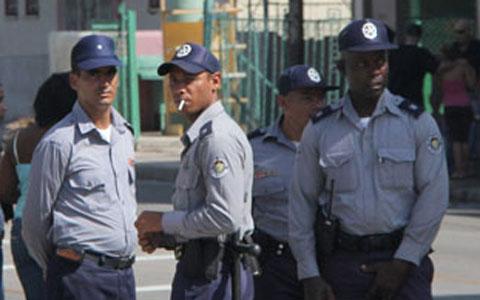 The reforms of the Penal Code and the Penal Procedure Act adopted by the State Council to “ensure greater effectiveness and efficiency in the prevention and the fight against crime” raises a red flag about the situation of human rights in Cuba.
 This power enables them to judge and punish with fines, which represent 27% of the penalties established in the Penal Code. With the new amendments, these will now represent 52% of the penalties, and police officers will only need approval from a prosecutor to enforce 26%, a good way to contribute “to the consistent enforcement of the Penal Code policies outlined by the State.”