Our apologies for not having subtitles for this video.
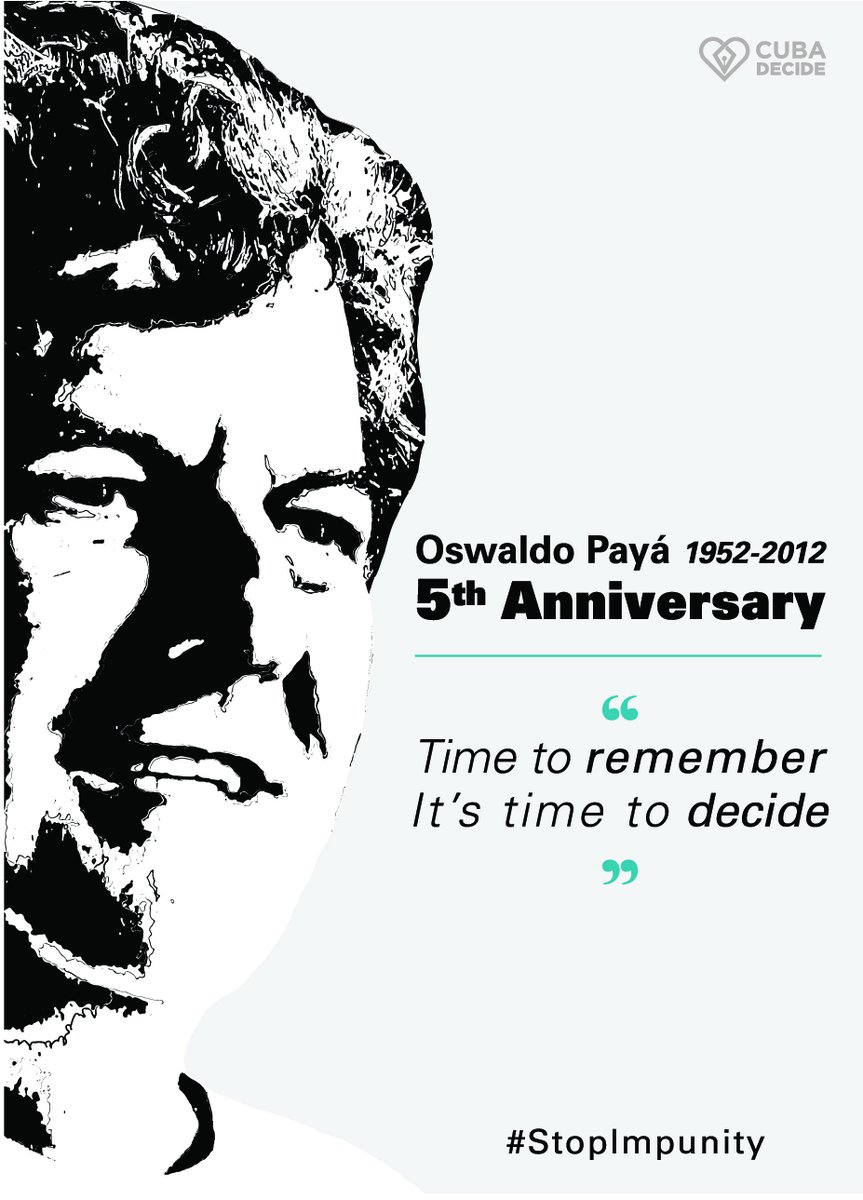
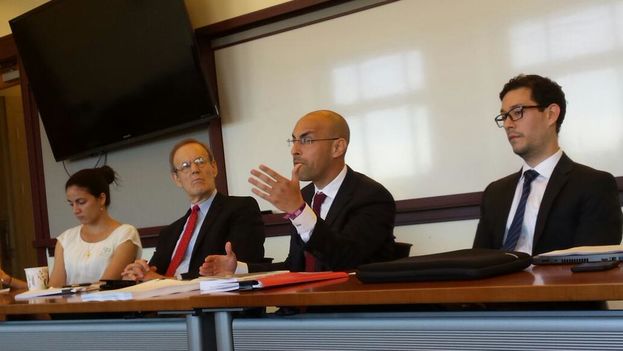
14ymedio, Havana, 21 July 2017 — At least 40 activists attended a mass in tribute to opponents Oswaldo Payá and Harold Cepero on the fifth anniversary of their deaths, on Thursday evening. The ceremony took place in the church of Los Quemados in Marianao, Havana, and passed without incident.
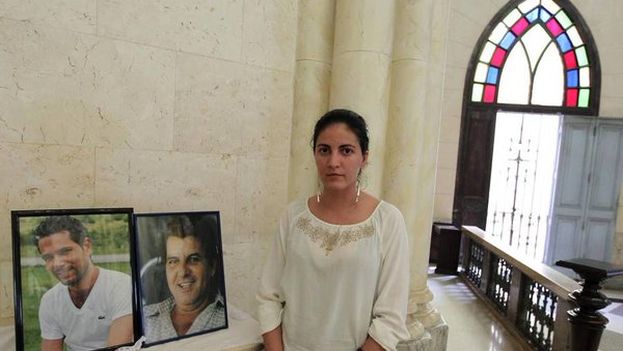
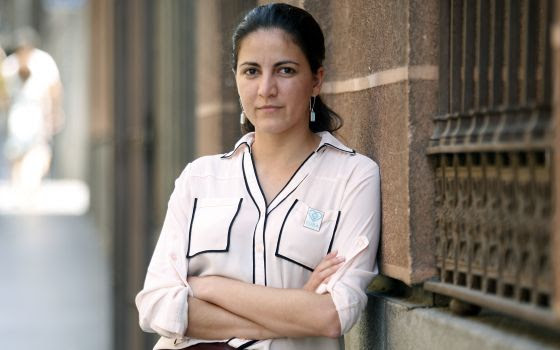
The daughter of the leader of the Christian Liberation Movement (MCL), Rosa María Payá, traveled from the city of Miami, where she lives, to participate in the memorial. About 60 people attended the mass, among whom were family, friends and opponents of the Castro government.
Among the activists who participated were former Black Spring prisoner Félix Navarro, the dissident Manuel Cuesta Morúa and the leader of the Ladies in White, Berta Soler.
Speaking to 14ymedio Rosa María Payá said she found “the whole of civil society represented” to honor the memory and legacy of his father. “[All opponents] agree fundamentally: this system does not work and we have to change it.”
Berta Soler said that “the Cuban regime thought that killing Oswaldo Payá was going to do away with him” but that was not the case because “he lives among us.”
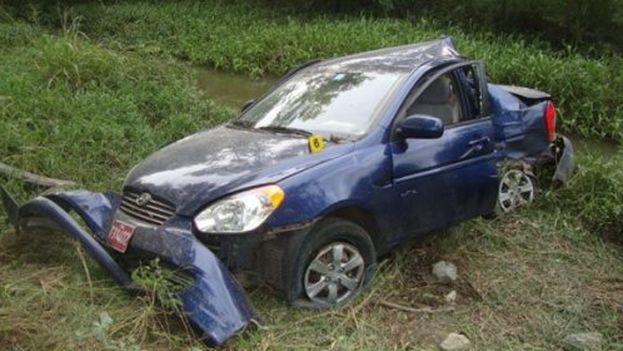
Oswaldo Payá founded the MCL in 1988 and died on 22 July 2012 with Harold Cepero, after the vehicle in which they were traveling, driven by the young Spanish politician Ángel Carromero was driving, went off the road and hit a tree.
Payá’s daughter is carrying out an intense international campaign to demand an independent investigation of the case and maintains that the death of her father was a murder orchestrated by the authorities of Havana, and that the car was purposefully run off the road.
A report by the international Human Rights Foundation (HRF) points to “solid indications” that the car in which Payá and his companions were traveling was hit by another vehicle before the crash.
Almagro, Calderón and Chilean delegate Mariana Aylwin were unable to travel to the Caribbean country on Tuesday to participate in the event called by the Latin American Youth Network for Democracy, chaired by Rosa Maria Payá, daughter of the late Cuban dissident Oswaldo Payá, which the Cuban government Cuban has labeled a “provocation.” continue reading
Around Payá’s house, in the Havana municipality of Cerro, a police operation deployed in the early hours of the day prevented activists from reaching the home. From Manila Park, near the house, State Security agents dressed in civilian clothes demanded documentation from any dissident or independent journalists who approached.
Payá told this newspaper that her phone had been “out of service” in the afternoon although “in the morning it worked.” The ceremony was attended by seven activists who had spent the night in the house “plus another 20 people who where able to reach it,” said the dissident. Among them was the head of the political-economic section of the US Embassy in Cuba, Dana Brown, as well as diplomatic representatives from Sweden and the Czech Republic.
Payá told this newspaper that her phone had been “out of service” in the afternoon although “in the morning it worked”
Payá said that the award ceremony had been surrounded by a lot of repression on the part of the regime, Cuban State Security and the Foreign Ministry.” She condemned the reprisals “suffered by civil society members who wanted to participate in the ceremony, resulting in many of them being arrested and others prevented from leaving their homes.”
All of the leaders of the opposition groups on the island “were invited,” Payá told this newspaper. “There are some with whom we have lost communication over the last few days because of everything that is happening, and others who are not in the country and others who couldn’t get here.”
“We hope that this aggression, this rudeness, will find a response and a reaction in all the governments belonging to the Organization of American States (OAS), in all the governments of our region and also in the European Union,” said Rosa María Payá.
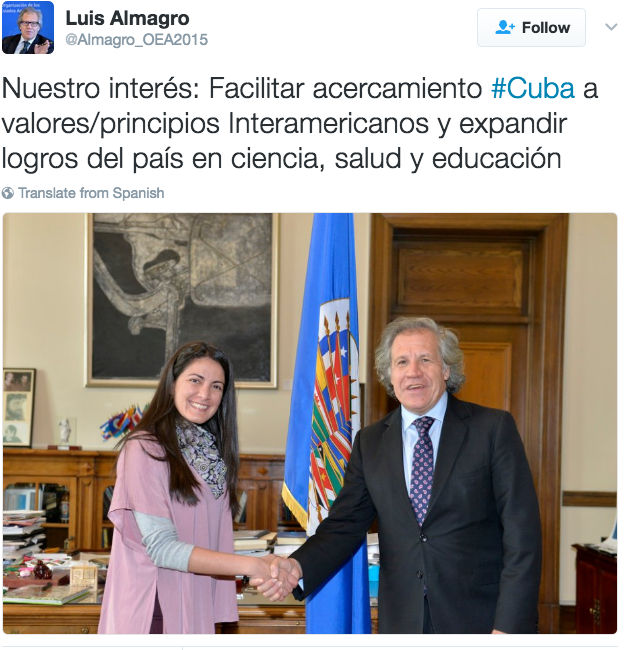
Luis Almargo tweeted: Our interest: To facilitate #Cuba’s approach to Interamerican values/principles and to expand the country’s achievements in science, health and education.
The Chilean and Mexican Chancelleries regretted the decision of Cuba, and Chile announced that it will call its ambassador on the island for consultations.
Meanwhile, the only official response from Cuba has come from the Cuban embassy in Chile, which issued a communication referring to the matter as “a grave international provocation against the Cuban government,” with the aim of “generating internal instability” and affecting Cuba’s diplomatic relations with other countries.
According to this note, the act was created “by an illegal anti-Cuban group that acts against constitutional order and that arouses the repudiation of the people, with the collusion and financing of politicians and foreign institutions.”
The only official response from Cuba has come from its embassy in Chile, which issued a communication referring to the matter as “a grave international provocation against the Cuban government”
The ceremony finally took place without the presence of the international guests. “The chairs will remain empty” until the awardees “can land in Havana” to pick them up in person, assured Rosa María Payá. Other Cuban guests were prevented from leaving their homes or arrested on the road.
Constantín Ferreiro is vice-president of the Inter-American Press Association for Cuba and remains in custody without his parents being able to see him or provide him with personal hygiene supplies, according to his father.
Havana’s decision not to authorize the arrival of the head of the OAS was known after a night of uncertainty in which it was not clear whether Almagro had traveled to the Cuban capital, where he initially planned to fly from Paris, where he had participated in institutional activities yesterday. Rosa María Paya today called on the OAS to support the right of the Cuban people to decide on their destiny.
“To the point that Cuba is democratizing, all democracies in Latin America will also gain stability,” said the opposition leader, who hoped that “today is the beginning of an OAS commitment to the cause of rights and freedom in Cuba.”
She pointed out that they do not expect the OAS to “speak out against anyone,” but instead to put itself “on the side of all Cuban citizens in their right to begin a transition process.”
The Secretary of the OAS was also unable to enter the country using his Cuban passport, which does not require an entry visa (@ agro_OEA2015)
14ymedio, Havana, 22 February 2017 — The Secretary General of the Organization of American States (OAS), Luis Almagro, has published a letter explaining why he can not attend the Oswaldo Payá “Freedom and Life” Award ceremony. In the letter, addressed to Rosa Maria Paya, Almagro states that he will not come after the refusal of the Havana authorities to grant him an entry visa to Cuba.
The Cuban consulate also denied Almagro entrance to the country using his Uruguayan passport, with which it would not need entrance visa.
According to the Secretary General of the OAS, an official of the Organization, Chris Hernández-Roy, was summoned to a meeting last Thursday by the Consul of Cuba in Washington and the First Secretary of the Consulate in which he expressed, also, the Cuban authorities’ surprise over the reason for the visit and its astonishment at the “involvement” of Almagro in anti-Cuban activities. continue reading
The award is not recognized by the Cuban State and the activities of Cuba Decide, an organization led by Rosa Maria Payá, “undermines the Cuban electoral system,” according to what they told the OAS.
For all these reasons, the authorities refused to grant Almagro a visa and warned him that he would not be admitted to the country if he attempted to board a flight bound for the island.
Almagro laments in his missive the “analysis as superficial as it is alarmist,” that has led to his visit being interpreted as a problem for relations with the United States
“We have responded to these arguments by pointing out that the only interest on our part has been, is and will be to facilitate Cuba’s rapprochement with the values and principles of the inter-American system, both as regards the defense of democracy and the promotion and respect for human rights, while expanding Cuba’s achievements in science, health and education to our region,” said Almagro.
Almagro laments in his missive the “analysis as superficial as it is alarmist,” that has led to his visit being interpreted as a problem for relations with the United States. He considers it “rather ridiculous” that bilateral relations between the two countries depend simply on the holding of the award ceremony.
He emphasizes, furthermore, that his presence on the island scheduled for Tuesday has nothing to do with a desire to evaluate the internal situation of Cuba or its political or ideological trends, issues on which he says he does not consider himself competent to give an opinion.
As Almagro writes in the letter, this is not the first time an act of this kind has been carried out in other countries of the region, and so, he says, he has made it known to the Cuban authorities. According to the secretary general of the OAS, these acts in other countries “are carried out without the government necessarily supporting them, but without censoring them, because they are part of the tolerance of democratic systems and values,” he argues.
His only concern, he says, is that he hopes that as a result of the Cuban government’s boycott of the Oswaldo Payá Award, there will be no repression of those who organized the event. “This would be absolutely unfair and undesirable,” he warns.
The Secretary General of the OAS also rejects the “criminalization” of Cuba Decides and notes that his intention was to honor the memory of Oswaldo Payá
Almagro argued that his presence and activities are not anti-Cuban “in any case” and, on the contrary, his interest is that the country develops at all levels, not forgetting the guarantee of all the rights of its citizens.
For that reason, the Secretary General of the OAS also rejects the “criminalization” of Cuba Decides and notes that his intention was to honor the memory of Oswaldo Payá, so he asked that the authorities reconsider their decision and allow him to enter the Island. “But that was not possible,” he laments.
Almagro closes his letter by reiterating to Rosa Maria Payá the high regard he has for her, in addition to his desire to “continue working within the framework of cooperation established between the Latin American Network of Youth for Democracy,” of which she is the current president, “and the OAS.”
The relationship of the Secretary General of the OAS with the Cuban Government has gone through distinct phases. In November of 2014 Almagro visited the Island for fourth time, in his role foreign minister of the Republic of Uruguay. On that occasion he was interviewed by Cuban Foreign Minister Bruno Rodríguez. However, on assuming his current position in the OAS he became a frequent target of criticism in the official press.
In 2009 the OAS lifted the suspension that weighed on the Island and supported its eventual rejoining
The OAS and the Government of the Island have had tense encounters for decades, since the country was excluded from the regional organization in January 1962, after defining its Marxist-Leninist course. In 2009 the OAS lifted the suspension that weighed on the Island and supported its eventual rejoining of the organization.
Almagro reiterated the invitation to Havana in early 2016 when he stated that his heart felt that Cuba “should be back” in the body, although his brain indicated that the process “will not go that fast.”
During a meeting of the Association of Caribbean States held in Havana, President Raúl Castro reiterated that “the OAS from its foundation was, is and will be an instrument of imperialist domination and that no reform could change its nature or its history. Cuba will never return to the OAS. ”
Eduardo Cardet, national coordinator of Cuba’s Christian Liberation Movement. (Flickr)
Eduardo Cardet, national coordinator of the Christian Liberation Movement (MCL) who has been under arrest since the night of 30 November, as of Thursday has found a lawyer to represent him. His relatives have denounced in several media that no lawyer wanted to take on the activist’s defense. Although the lawyer has not had access to his file, the family is optimistic and affirms that the attorney “fight for his right to bail.”
Yaimaris Vecino, the activist’s wife, told this newspaper in a phone conversation that she was able to see Cardet just after they moved him to the so-called “provisional prison” of Holguin, located on the Bayamo highway very close to the airport. continue reading
Yaimaris said that the regime opponent still has notable injuries on his face that he suffered during his arrest, and she clarified that ultimately the accusations have focused on the crime of attack, for which the prosecution would ask for a sentence of between one and three years, as stipulated in the Criminal Code.
Under the law, it is a crime when the use of “violence or intimidation against a public authority or official or its agents or assistants impede them from realizing an act appropriate to their duties.”
However, according to the testimony of numerous witnesses consulted and the family, it was the agents of authority, represented by two members of the State Security in plainclothes and two in uniform, who pounced on Eduardo Cardet when he arrived on a bicycle at his mother’s house.
“It was they who knocked him off his bike and exercised unnecessary violence to arrest him,” his wife explained. No one has officially explained why they went to arrest him at this time. “The first answer when I asked the reason for his arrest was from a State Security official, who told me everything was for his counterrevolutionary activism and they there were not going to allow any actions of this time,” his wife said.
Yaimaris Vecino explains that the attack occurred at the door of her house in front of their children, one age 11 and another 13 years old. “The only police officer who suffered something like an injury was one who injured his hand when he threw my husband against a fence with spikes to try to injure him,” she adds.
The Christian Liberation (MCL) Movement was founded in 1988 by the dissident Oswaldo Payá (who was killed in 2012); the MCL promotes a peaceful change towards democracy and seeks respect for human dignity.
Note: The video is a brief excerpt from the interview and is not subtitled in English.
14ymedio, Mario Penton, Luz Escobar, Miami, 22 July 2016 – His name is tattooed on the skin of a Cuban graffiti artist (Danilo Maldonado, known as El Sexto) or is suggested by the letter L, standing for Liberty, formed by the angle between the index finger and the thumb, increasingly displayed by those asking for democracy. The legacy of Oswaldo Payá Sardiñas (1952-2012) and Harold Cepero (1980-2012) lives on in the nation for which they worked their hearts out and ultimately sacrificed their lives. Four years after the tragic crash that claimed their lives, and that their families and international organizations have classified as a settling of accounts by the repressive Cuban apparatus, 14ymedio speaks with Ofelia Acevedo, widow of Payá, former president of the Christian Liberation Movement (MCL).
14ymedio: A few days ago the one year anniversary of the reopening of the embassies between the United States and Cuba was celebrated. Could we be closer to justice in the case of Harold Cepero and Oswaldo Payá? continue reading
Acevedo: The restoration of diplomatic relations has been good. It is clear that it is the Cuban government that does not continue the normal process that this rapprochement should take. On the other hand, justice is the most important step to achieve real change in the Cuban nation. To look forward in our country we need justice. The Christian tradition makes it very clear: if there is a recognition of the truth, there will be justice and forgiveness.
Once we have achieved justice we can talk about reconciliation between Cubans. We Cubans must seek it, starting by reclaiming our rights. This is a key step for the future. The greatest injustice is to deprive the Cuban people of our rights, because of this there has been so much misery and we have not progressed. Human rights are natural and inherent in the person. When we achieve justice we can build a new society, and for this it is important that this crime does not go unpunished.
14ymedio: How has the family faced the loss of your husband?
Acevedo: We are a very close family. We love each other very much and miss him so much. We live in our faith that sustains us. Our faith makes us believe that truth, justice and democracy are possible for our people. All of Oswaldo’s work is imbued with a great deal of hope, of Christian hope. That is what helps us go on in the midst of the adverse environment in which we sometimes live. Oswaldo believed greatly in the betterment of humanity and in the individual, as José Martí said. He looked for ways to give Cubans the tools to decide their future. He understood that change begins with the ability to decide. He affirmed that dialog is the only way to change Cuba, an unconditional dialog, one without exclusions and among all Cubans.
14ymedio: How do you perceive the Cuban opposition four years after the death of its most prestigious leader?
Acevedo: In Cuba there are probably more opponents than there were in Central Europe in 1989. The Cuban opposition has done a great job. We know that the government and intelligence services create moles, “construct” figures, infiltrate groups, defame and blackmail their opponents. This has existed and does exist, they are intransigents with those who don’t think like they do and who have the courage to raise their voice to express it. We Cubans who want changes have to think for ourselves and think about others, think about the Cuban people. We have to forget about egos and go where the people are to explain what are the steps for them to begin to demand their own rights, because they are the ones who should decide. We have to be with the people in this.
Acevedo: The movement received a very strong blow with the death of Oswaldo and Harold. Even before, the persecutions against them were very strong. It was the movement that had the most political prisoners and they were all exiled to Spain without the option to stay. At this time, within Cuba, the MCL is decimated, is my impression. The repression against them is very strong.
14ymedio: How was the experience of exile for your family? Will you return to Cuba?
Acevedo: My family never thought of going into exile. After Oswaldo’s murder I made the decision to go into exile for my children, because State Security was focused on my oldest son. They prevented my daughter Rosa María from starting work at a research center where she already had a place. I panicked and decided to leave because of “them” (State Security). Friends, neighbors, everyone was terrorized, because the whole world knew what had happened and that they enjoy total impunity.
I am working as a teacher and wondering when I can return to my country. I want to return to Cuba, but I hope that things improve because it costs me a lot to have to face them. My rejection of them is huge. I know I have to deal with them but it’s very difficult, because of what they are doing, what they did, how they have made my family and our people suffer.
The car in which Harold Cepero and Oswaldo Payá were killed four years ago
Acevedo: The only meeting I had with them was a week after Oswaldo’s funeral. They called me in to ask if I was going to ask from compensation from Angel Carromero [the leader of the youth organization New Generations of the Popular Party of Madrid, who was driving the car in which Payá died and who was convicted of manslaughter). I told them I would not accept their version and I wanted to talk with the survivors. They never granted me that. The Cuban penal code does not give the victims a chance. My children were not allowed to attend the trial, which the regime had announced would be public. There was an immense repression in Bayamo [where the trial was held]. We could not carry out any legal action because a lawyer friend of the family said there was no chance to demand anything because of the criminal code.
I asked the government and the hospital for the autopsy report. They have never given it to me. I spoke to State Security, with Legal Medicine. Everyone told me that the hospital had to give me the report. The hospital administration, at six in the evening, after I did whatever paperwork was possible, told me to send it to them by mail and gave me a telephone number. The number didn’t work and we are still waiting on the autopsy. I wrote to the minister of Public Health. Rosa María tried to deliver a letter to the Cuban embassy, but they wouldn’t even let her enter the diplomatic site. Then we sent the letter in Cuba and we we had a receipt for it, but they have never answered.
14ymedio: What did Aron Modig (former leader of the Swedish Christian Democrat Party youth organization who was also in the car at the time of the crash) say about the day he Payá and Harold died?
Acevedo: Modig maintains his position. He doesn’t remember anything until reaching the hospital. It is a selective loss of memory. To me there are things that bother me sometimes in the media, because they talk about an accident, when we all know that it was a murder. A report by the international organization The Human Rights Foundation and another by physics professors at Florida International University demonstrated that it is impossible for [the crash] to have happened in the way the Cuban State says it did.
14ymedio: What legacy have Harold Cepero and Oswaldo Payá left?
Acevedo: The blood of freedom fighters is the seed of free men. This applies to Harold, Oswaldo, to all who have given their lives for human rights. The blood of innocent people, those who give their lives for others, is not spilled in vain. They crashed Oswaldo’s cars* when he was in the street. We keep fighting to give the Cuban people the possibility of deciding, which was Oswaldo’s fight as well. The Cuban government, in exchange, fights to destroy Cubans’ hopes.
*Translator’s note: There was a similar incident with another vehicle Oswaldo Payá was traveling in prior to the fatal crash.
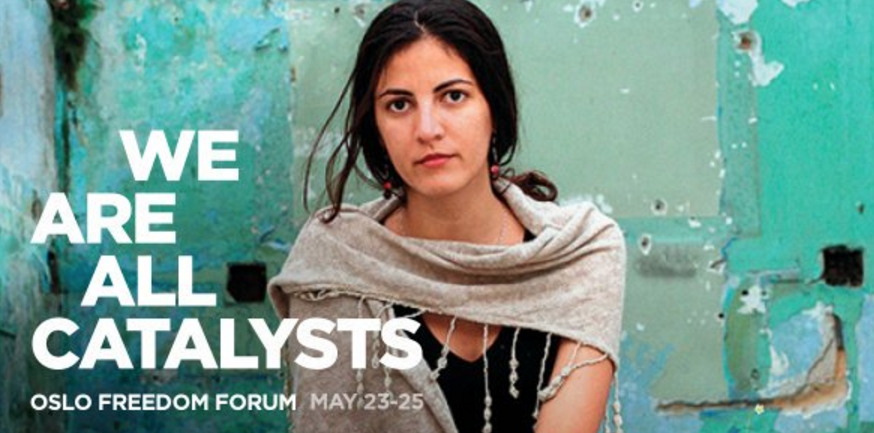
EFE (via 14ymedio), María Tejero Martín, Oslo, 23 May 2016 — Cuban opposition member Rosa María Payá said Monday ,in an interview with EFE, that the “totalitarianism” of the government led by Raul Castro “has not broken” despite the open contact with the United States and the European Union (EU), and so she asked that these approaches be used to achieve “concrete progress.”
“Rapprochement with Cuba is very good, but it depends on how and how it is sold. It also has negative consequences, such as the rest of the world perceiving an internal process of openings toward democracy, and this has not occurred,” said Payá in the Norwegian capital, where she has come to participate in the Oslo Freedom Forum (OFF). continue reading
The dissident said that “totalitarianism has not been broken” despite the “legitimacy” with which it might have re-clothed itself after the visits of personalities such as US President Barack Obama, the high representative of the EU for Foreign Policy, Federica Mogherini, Pope Francis or the Rolling Stones.
Payá, daughter of the prominent opposition leader Oswaldo Payá, who died in 2012 in a car crash which his daughter blames on the Cuban regime, believes that the international community has an “opportunity to pressure the regime for this change toward freedom.”
Payá criticized the “excuses that can be cynical, but are invoked as pragmatic” which are used as an argument to initiate dialogue with Cuba placing special attention on economic relations and relegating to the background demands for human rights and freedom.
“People say things like if we negotiated with China, why not with the Cuban regime. Under this line of thinking, why not with North Korea?” she said.
We regards to negotiations between Brussels and Havana, she considers it “worrying” that no light has been shined on the text that serves as a basis for contacts between the two parties and warned that it is not enough to simply include “a mention of human rights, because tyrannies have already learned to deal with these mentions.”
“The support has to be concrete, specific and on measurable issues. Not only speeches in support of democracy, of human rights,” she said, calling for support for the holding of a plebiscite on the island, access to communications media and information, and the release of political prisoners.
“Totalitarianism, which has not been broken, is broken when the ability to decide does not reside in the same group of generals. At that moment the transition will have begun, which won’t happen in a single day. We cannot pretend this is happening,” she said, in a message she directed to “the international community,” from whom she asked for “support.”
” Cubans are human beings just like everyone else, like Spaniards or Belgians. We did not endure five decades in order to have Airbnb, but rather all out rights (…), having more Americans to travel to the island is not enough, it is a racist approach to think so,” she claimed.
To Payá, inaction may also affect the international community itself and democratic countries.
In this regard she pointed to how the situation in Venezuela has been evolving under the leadership of Hugo Chavez and president Nicolas maduro, but also the ideas that have come from “political parties in Spain.”
Looking ahead to the upcoming Spanish elections, Payá stressed that “the Spanish people are sovereign, so it is up to them to decide,” although she expressed her concern for “the influence of the totalitarian regime in Havana and the Chavista regime which is concerned with undermining Latin America and exporting its ideas to Europe.”
About the rise of anti-democratic positions, the Cuban opponent once again called on democratic countries to act.
In terms of rights, “Cubans were already in the worst situation ten years ago, but now the rest of the world is worse off as well,” she warned.
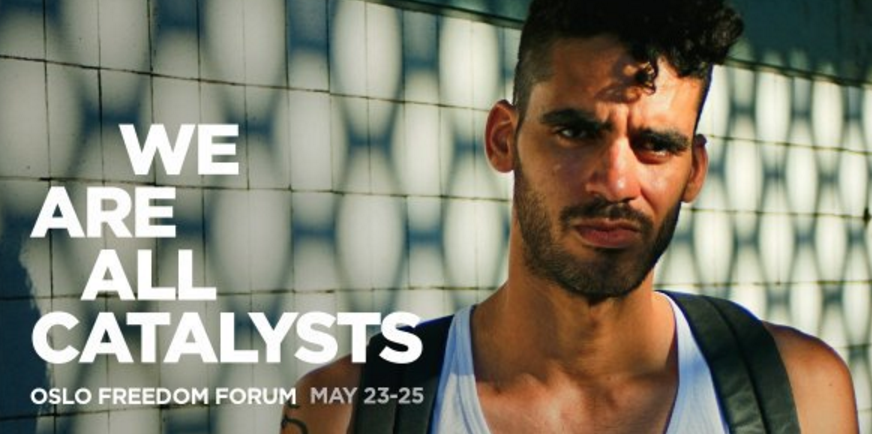
Danilo Maldonado, known as “El Sexto,” is also speaking at the Oslo Freedom Forum this week.
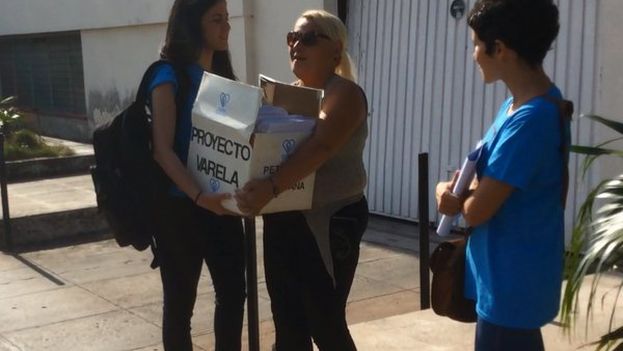
The delivery of the more than 10,000 signatures for the Varela Project, on Thursday, to Cuba’s National Assembly of People’s Power. (Facebook)
14ymedio, 24 March 2016 – On Thursday morning several activists delivered 10,000 signatures on the Varela Project, which are in addition to the 25,404 signatures previously provided to this legislative body. Participating in the delivery were Rosa Maria Rodriguez from the Christian Liberation Movement (MCL), Saily Navarro and Rosa Maria Paya, members of the Cuba Decides campaign, along with former political prisoner of the 2003 Black Spring, Felix Navarro.
The dissidents transported the signatures to the headquarters of the National Assembly on 42nd Street in Havana’s Playa district, in a box on which was written “Proyecto Varela” with the logo of Cubadecide. This afternoon Rosa Maria Paya will hold a press conference in the municipality of Cerro, about the current status of the initiative, which was promoted by her father Oswaldo Paya, leader of the MCL.
The activists commented that initially the National Assembly officials seemed “confused” at the delivery of the signatures. However, after making several call, they accepted the signatures in the Assembly’s Department of Correspondence.
The Varela Project seeks to promote political reforms on the Island aimed at “greater individual freedoms,” according the press release from its organizers. The text reaffirms the “constitutional right” of Cubans to push for a change to “democratic pluralism.” To achieve this, “more than 35,000 Cubans, with residence in the country, signed their names,” along with their identity card numbers “as a way of supporting the Varela Project.”
After delivery the of the signatures, Rosa María Payá, president of the Latin American Network of Youth for Democracy, said that “we are advocating for them to respond to thousands of signatories of the Varela Project and to the rest of the Cuban people, with the holding of a binding plebiscite for citizens to decide their future in freedom.”
The National Assembly of People’s Power of Cuba’s Committee on Constitutional and Legal Affairs did not respond to more than 25,000 signatures presented initially by the Varela Project and instead amended the constitution to make socialist character of the Cuban state irreversible.
Rosa María Payá in the parish El Salvador del Mundo in the Havana neighborhood of Cerro. The photos are of Harold Cepero and Rosa María’s father Oswaldo Payá. (Twitter)
14ymedio, Havana, 29 February 2016 – A Mass in memory of the 64th anniversary of Oswaldo Payá’s birth was held Monday afternoon in the parish of El Salvador del Mundo in the Havana neighborhood of Cerro. Celebrating the Mass was the Auxiliary Bishop of Havana, Monsignor Alfredo Petit Vergel.
The ceremony was attended by the daughter of the deceased opponent of the Castro regime, Rosa María Payá, who is now the president of the Latin American Network of Youth for Democracy and who traveled to the island for the occasion. She was accompanied by numerous friends and activists from Cuba’s independent civil society, and the Mexican Congresswoman Cecilia Romero. continue reading
Rosa María Payá told 14ymedio that her presence on the island is also intended to promote the initiative of the citizen platform, Cuba Decides, demanding a plebiscite so that “Cuban citizens will have the opportunity to choose their leaders, through free and multi-party elections.”
This is the second trip that Rosa María Payá has made to Cuba after settling in Miami with her family in 2013.
After the liturgy Rosa María Payá addressed the attendees and read a text of Oswaldo Payá’s where he said, “God puts you in a place and at a time with a neighbor who is around you. Who is my neighbor? It is not an abstract being: my neighbor is the Cuba of today, here and now.”
Oswaldo Payá, founding leader of the Christian Liberation Movement died on 22 July 2012, along with the young activist Harold Cepero, on the road leading to the city of Bayamo. The incident has been described by the family as a deliberate crime organized by the political police, but the authorities have refused to review the case and maintain the version of it having been a car accident.
Martha Beatriz Roque believes that work to defend human rights “is becoming more difficult for the internal opposition,” in Cuba. (14ymedio)
14ymedio, Havana, 3 February 2016 — The Czech organization People in Need has given its Homo Homini Award for this year to the 11 former prisoners of the 2003 Black Spring who continue to live in Cuba, as confirmed to this newspaper by several of the laureates. The entity, focused on the defense of human rights, has recognized the work of those who have continued to exercise their peaceful activist for decades, despite the rigors of prison and political repression.
Last year the award celebrated two decades since its founding. The award is intended to honor individuals for their “dedication to the promotion of human rights, democracy and non-violent solutions to political conflicts.” continue reading
Among the honorees with distinction, is Cuban opposition member Felix Navarro who told 14ymedio that he was “very pleasantly surprised with the news” and dedicated the honor to all those who struggle “peacefully inside Cuba to produce the changes that will make Cubans free.” The activist went on to ask whether the Cuban government will allow the winners to travel to receive the award, given the travel restrictions they have endured since their release from prison.
The only woman in the so-called Group of 75, Martha Beatriz Roque, welcomed the recognition for her work “within the country to defend the cause of human rights.” The activist points out that this task “is becoming ever more difficult for the internal opposition” and agrees that it is likely that none of the 11 will be allowed to leave the country, so that “there will be an empty chair, with everything that’s going to mean.”
“Moral and political backing and support,” is how the dissident Angel Moya described the Homo Homini Award, adding that this is a recognition that extends “to all those within Cuba struggling to establish the rule of law”.
For the leader of the Patriotic Union of Cuba, Jose Daniel Ferrer, this is a good time to remember that “the first Cuban to receive it was Oswaldo Paya Sardinas in 1999.” At the time, Ferrer was an activist in the Christian Liberation Movement, who spread ” the news throughout the eastern part of the country.” He added, referring to Payá’s death, “It is now up to us and this award makes us very happy.”
Among the winners from previous years, as well as Oswaldo Paya, are Sapiyat Magomedova (Russia, 2013), Intigam Aliyev (Azerbaijan, 2012), Azimžan Askarov (Kyrgyzstan, 2010), Liu Xiaobo (China, 2008), Su Su Nway, Phyu Phyu Thin and Nilar Thein (Myanmar, 2007), Ales Bialiatski (Belarus, 2005) and Sergej Kovaljov (Russia, 1994), among others.
The NGO People in Need was founded in 1992 and is defined as a non-profit organization ” based on the ideas of humanism, freedom, equality and solidarity.” It has employees and volunteers both in the Czech Republic and in a dozen countries seeking to “provide assistance in regions of conflict and support the commitment to human rights throughout the world.”
The issue of human rights must permeate every point of the agreement between the EU and Cuba
20 December 2015 – Corrected version
El País, Rosa Maria Paya, 18 December 2015 – In more than a year of negotiations with the Cuban government, the European Union still does not exhibit significant advances beyond commenting on the establishment of a structural framework for an accord and trade issues.
The Cuban government played its cards right. It made public part of the conversations it has maintained (for years) with the government of the United States, and the already precipitated rush for “positioning” in Cuba went berserk. Under the assumption, among other naivetés, that the biological end of the brothers-in-chief would spontaneously bring democracy, European and other entrepreneurs tried to assure themselves of a place on the island before “the coming of the Americans,” no matter how much money they lost in the process.
I will not dwell on the obvious nonexistence of a Cuban market, where the people have no purchasing power nor the democratic resources to engage with foreign investors and self-management, because in Cuba the only legal company is the government. It is clear that privileged foreigners, always in a minority role with the government – given that it is the sole owner on the island – are guaranteed lack of competition. But it is at the risk of losing everything the instant they start to be “inconvenient,” whether because they demand to collect what is owed them, or because a more interesting (and submissive) partner appears. There are examples of European entrepreneurs who have even ended up in Cuban prisons, like the Englishman Stephen Purvis. continue reading
The reality is, when one deals with mafias there are no win-win solutions. Despite the precarious economic situation the country finds itself in, paradoxically the Cuban government manages to appear as if it has nothing to lose in the negotiations with the EU. However, it would be a failure for European diplomacy to end the process of negotiations and to have to admit that the Cuban government is not willing to compromise on anything and, what’s more, that it will not meet the basic requirements on matters of human rights that the EU requires of its partners. The pressure at this point increases contrary to logic, and this increases the possibilities of ending up signing anything, in a desperate effort to show some results, and thus satisfying only economic interests.
To close a negotiated agreement, the EU requires the inclusion of a human rights clause, which the Cuban government is trying to define in a way that they can manipulate or simulate compliance with its conditions. But if in a stroke of common sense and coherence, Europe realizes that it is the Cuban government that needs Europe, not Europe that needs Cuba, the EU has in its hands a lever to support democracy, and with it true peace, progress and stability in Cuba and in the region. A condition necessary, this time, to establish a framework of guarantees for European economic interests.
For 65 years years now there have been no free and plural elections held in Cuba, and there is no legal framework to conduct them. The space for economic reforms is also very limited, because the constitution was illegally altered in 2002 to make “irrevocable” and set in stone the economic, political and social system of the island, which is linked to the control of the “highest leading force”: a Communist one-party system and its monopolistic management. The EU cannot ask for a constitutional change, but it can support the right of Cubans to choose their own future, to choose the system they want to live in, and to participate in the economic and political life of the country. The alternative is called apartheid, it is insupportable and it is immoral.
There is a non-partisan citizen’s initiative called Cuba Decides, which promotes the holding of a binding plebiscite that would allow Cuban citizens to vote for the changes necessary to initiate a process of democratic transition. No matter how many cosmetic reforms are made by the powers that be, this process will not have begun as long as Cubans cannot participate fully in it. The issue of human rights must permeate every point of the agreement between the EU and Cuba and cannot be treated as an issue independent of the others. The conditions that the EU establishes now should be measureable and verifiable in the short and medium term. We therefore hope that the realization of a binding plebiscite on the island is supported, with concrete conditions that guarantee an international presence and a clean process. Like what happened in Chile in 1988, with the support of a good part of the world.
Neither the EU nor the Obama administration is charged with resolving the Cuban problem. But they do have a historic responsibility to execute specific steps of effective solidarity with a real transition to democracy. Supporting the participation and citizen sovereignty of the Cuban people – instead of the exclusive management of a corporate-military caste that has been in power 56 years without ever having been freely chosen by the people – is, in any case, the decent choice.
Who could be against the Cuban people’s right to choose?
From El País, Americas Edition: Rosa María Payá is a promoter of “Cuba Decides” and the daughter of the late dissident leader Oswaldo Paya. Twitter @RosaMariaPaya
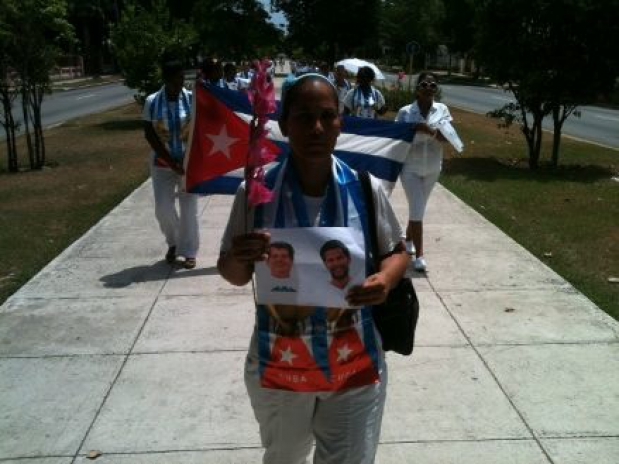
Ladies in White marching this past Sunday, 26 July*, in Havana (Ángel Moya)
Diario de Cuba, Angel Moya, Havana, 26 July 2015 – Some 60 activists were arrested this past Sunday in Havana following the customary Sunday march of the Ladies in White, reported government opponents on social media. The arrests took place within the context of an act of repudiation described by the opponents as “violent,” and were carried out by “civilian mobs,” tweeted Ailer María González Mena.
The Ladies’ Sunday march was preceded by the arrests of several of the women, along with independent journalists, dissident sources were reporting as of midday. continue reading
The women, as usual, attended mass at St. Rita’s Church, and later met at Mahatma Gandhi Park, from where they began their march along Fifth Avenue.
During the meeting they paid homage to the deceased opponents Oswaldo Payá and Harold Cepero, who died under mysterious circumstances three years ago last week.
Former political prisoner Ángel Moya posted on his Twitter account that the Ladies Oilyn Hernández and María R. Rodríguez were arrested, as well as blogger Agustín López. Other activists had their residences surrounded by State Security agents.
Activists had predicted there would be a major police presence in the area.*
*Translator’s Notes: *26 July is the date commemorated by the Cuban government as the start of the Revolution
Presentation of the HRF about the death of Oswaldo Payá. (@RosaMariaPaya)
14ymedio, Havana, 22 July 2015 – The human rights defense organization Human Rights Foundation (HRF) thinks that the Cuban government has “direct responsibility” in the deaths of dissidents Oswaldo Payá and Harold Cepero, according to the conclusion of an 88-page report presented this Wednesday at the University of Georgetown (Washington), on the third anniversary of the death of the opponents.
“The accident (…) is the result of an automobile incident deliberately caused by agents of the State,” assert the authors of the report, lawyers Javier El-Hage and Roberto C. Gonzalez, both of HRF. According to the lawyers, there was “intention to assassinate Oswaldo Payá and the passengers who were travelling with him.” The authors of the report also think there was the intention of “causing them serious bodily injury” or that the event “was carried out with negligence and/or extreme indifference – and an unjustified high risk – for the life of the activist.”
The foundation highlights the “errors” and the “contradictions” of the official investigation into the events of 22 July 2012, documenting numerous violations, such as a faulty autopsy of the “most prominent pro-democracy activist in Latin America in the last 25 years,” according to the president of the HRF, Thor Halvorssen.
The report maintains that the evidence, deliberately overlooked by the official investigation, suggests that it was not a traffic accident and implicates the government in the crash between the vehicles.
The organization believes that the Spaniard Angel Carromero, who was driving the car in which Payá was travelling and who is now on probation in his country, was ”obliged” to confess himself to be responsible, and that Cuban Justice paid no attention to the complaints of the dissident’s relatives, excluding them from the trials. Carromero himself, who was then a leader of the youth branch of Spain’s Popular Party (PP), has asserted on several occasions that the accident was an “attack” orchestrated by the Island’s regime. Those responsible for the report insist that Carromero had no access to a lawyer for weeks and that, later, he was forced to be represented by lawyers with close ties to the Government.
“The State of Cuba is responsible internationally for having violated Angel Carromero’s right to an effective legal defense,” says the report, since the authorities refused his defense access to the case file and the opportunity to present new evidence.
“Cuba is not a democratic State in which individual rights are respected or in which there exists independence among the powers of the State,” warns the report, which labels trials that involve dissidents as “a mere formality” in which “all the actors (prosecutor, judge and defense attorney) direct their work towards legitimizing the Government’s decision and not towards the search for the historical truth of events and the punishment of the responsible parties.” The investigation and the later trial in the death of Payá and Cepero were not exceptions, having been carried out in a “context of complete authoritarianism.”
Cuban authorities also did not permit the family of the deceased to speak with the two survivors of the crash (Angel Carromero and the Swede Jens Aron Modig), and three years after the event, they have still not communicated the result of the autopsy. The dissident’s relatives received the clothes that he was wearing the day of the incident already washed which kept them from opting for an independent examination.
“Havana’s authorities believed that it was necessary to destroy my father,” said the daughter of the opponent, Rosa Maria Payá, present at the University of Georgetown. “This report will be an important tool against the impunity of those authorities,” she added. According to the activist, the document “is the end of the first part” of her efforts, and the process to clarify what happened to her father “is only beginning” with “the analysis of the evidence” in the hands of the family.
“We plan to use this report as a tool in front of all the international bodies,” said Payá, who calls on Cuban authorities to release her father’s and Cepero’s autopsy reports.
The authors of the report accuse Havana of having violated the Universal Declaration of Human Rights as well as the American Declaration of the Rights and Duties of Man.
“The United States is negotiating with the Cuban caste.”
Cuban regime opponent, daughter of Oswaldo Para, speaks of the shortcomings of the thaw.
Alba Casas
Madrid, 3 July 2015, 23:03 CEST
To Rosa Maria Paya (b. January 1989, Havana), daughter of the late Cuban dissident Oswaldo Paya and a member of the Christian Liberation Movement — founded by her father — is not afraid to say the thaw will not end “the embargo on freedoms” that the Cuban Executive imposes on its inhabitants. “The United States is talking with the Government and those surrounding it. But civil society is left outside. It is a privilege reserved for the Cuban caste. For the rest, it is a situation of exclusion,” she says. continue reading
Although she looks favorably on the advance in relations between both countries — in her own words: “And attempt to include Cuba as part of the international community is good, provided the inclusion is of all of Cuba, not just the government.” Paya believes that the reestablishment of the talks offers a “halo of legitimacy to a Government that every day violates the rights of its citizens.”
And she defends, over and over again, the need for this process to come with a change for society. “The confrontation with the United States is the excise the government has used to justify some of its repressive measures. Now the excuse has fallen but the situation continues the same, which shows that it was not the United States that was oppressing Cubans, but rather the government itself.”
Among the North American giant’s motives, according to Paya, should be to defend “the opening of Cuba to Cubans themselves,” to offer legal security to entrepreneurs who want to embark on new commercial activities on the island.
“Totalitarianism is a tacit threat to them, like negotiating with the mafia. I don’t expect an altruism from foreign investors, but to negotiate without the guarantees of democracy is to accept the rules of the Cuban government,” says this young woman of 26, with some political ideas of her own who spend this same time leading rallies in front of the cameras.
In drawing a parallel between this “game that follows the rules of the Cuban government,” with the current situation of the thaw in which the United States, despite its initial demand to ensure the rights of Cubans, has finalized the embargo and removed Cuba from the list of countries sponsoring terrorism, without a real advance in freedoms for society.
Paya says, “It is terrible when talking becomes more important than the objectives of the talks. When this happens, the impunity is total and the government feels free to assassinate a Sakharov Prize winner and nothing happens.” She is referring to her father, Oswaldo Paya, who died in 2012 in strange circumstances in a traffic accident. “To call it an accident is to use the government’s words,” she says.
Paya’s criticism against the executives who prefer “to ignore the violations of human rights” is not directed solely at the North American giant. The young woman even links to “the 15 years of recession experienced by the democracies in the region,” with the Cuban dictatorship.
“I’m not saying it’s the only reason, but it is a common denominator. And you can observe the complicit silence of the senior Latin American politicians with all the crimes of the region, not only those of Cuba,” she says.
The instrument that the Cuban Christian Liberation Movement proposed to achieve that advance in rights and initiate a process of the democratic transition is to hold a plebiscite to ask the citizens of the island if they want to participate in free elections, in which any citizen can stand as a candidate of the opposition, with full media coverage and, above all, “with guarantees for the voters that there will be no consequences from the powers-that-be.”
Looking at this utopian scenario cannot, however, ensure that Cubans taking to the polls is going to translate into the end of the Castro mandate. “I believe that if Cubans could vote, they would vote for freedom. But if they do not do it, all we can do is to give them the tool. Cubans will be free when they want to be so.”
Ángel Santiesteban-Prats, 17 May 2015 — Any good Cuban should visit the tomb of Oswaldo Payá Sardiñas, one of the greatest defenders of liberty and justice in the history of Cuba. His name is inscribed, in its own right, in the pantheon of Cuban heroes. I even heard the national intellectuals mention his name with respect, sometimes with fear. They always accepted, even though they were “official,” his intelligence, valor and honesty in his political demands for Cuban citizens. continue reading
Even today my hands can feel the clapping when they received his remains in the little church in Cerro, which Payá used to attend. The injustice of his assassination and that of Harold Cepero summoned all the dissident factions. The grief was generalized. I spoke with men and women, citizens of the people, who had no contact with the dissident movement, nor with officialdom, and who in some way felt the need to express their repulsion at the government, and their solidarity with his family.
We all remember that we were monitored and persecuted in those ill-fated hours, as well as beaten and captured at the exit of the burial. We traveled to the cemetery together with the great poet and exalted Cuban, Rafael Alcides.
I will not forget the pain of his widow, his daughter and sons. We shall never be able to explain to them how that vile assassination could happen. But the people who crowded against the walls of the church joined the family in their sorrow.
Although the dictatorship took his body away from us, it returned him larger, with the ability to remain in our minds and hearts eternally. His death made us stronger and, above all, deepened our need for freedom.
May my voice and moral support accompany his family.