Degeneracy Among Cuban Military Officers/ Juan Juan Almeida

Some official, unofficial and foreign media outlets have been subject to a certain government manipulation, serving as an echo chamber by focusing special attention on the fight against corruption, which seems to have the become the principal challenge facing the Cuban president. It was for this reason that in 2009 he created the office of Controller General, the bureau in charge of conducting audits of state businesses and institutions.

“We can`t think twice about the battle against crime and corruption,” said the General in a speech before the Central Committee of the Cuban Communist Party. He thought it sounded catchy and since then the refrain has become a leitmotiv.

I ask myself how far the mighty sword of the controller’s authority or scope of action might reach. I suspect that the purpose of this imaginary wordplay is more mythical than real. It has the hint of a purge and less transparency than a Tamagotchi screen.

We all know that the concept of corruption goes a little deeper than the corrupt bureaucrat. It does not enjoy “real official consent,” yet it leads to unnecessary and superfluous expenditures from the state treasury. I prefer not to call it “stealing,” which is such a horrendous word.

The anti-corruption verbosity of the president-general is simply a Stanislavsky-like mannerism — something energetic and appealing to the ear. He should channel all this talent into something more constructive, or more respectable, like not ordering crowds of paramilitaries out into the streets every Sunday to attack defenseless women.

Cuba does not realize that this is just another infection eating away at society.

Has the General forgotten that during his term as head of the Revolutionary Armed Forces military leaders participated not only in military campaigns, but also in popularity contests and licentiousness?

I cannot believe that Raul Castro, a symbol of Victorian puritanism and a man obsessed with scrutinizing other people’s lives, has not read even one of the many reports dealing with incidents of assault or sexual abuse by Cuban military personnel.

The president of the Council of State and the Council of Ministers of the Republic of Cuba knows perfectly well that there is an endless list of high-ranking leaders and important officials with gargantuan appetites, who are as high spirited as festival clowns. They have been seen to be involved in one or another “little scandal” related to inappropriate sexual practices in which they have made use of pressure, position, rank, deceit, subjugation or shamelessness.

How to combat this degeneracy? Here is a telling figure. According to the Ministry of the Revolutionary Armed Forces’ own figures, which are no doubt overly conservative, more than 40% of Cuban women who served in Angola during the war years or afterwards were victims of sexual assault or rape. And this does not include those who remained silent out of fear.

The island’s leadership is made up of perverts, who are very attuned to all the meanings of the word corruption.

1 March 2013


Castro’s Moves: A Light, Tenuous, at the End of the Tunnel / Juan Juan Almeida

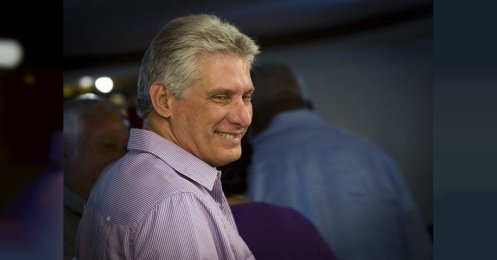
diaz-canelA February 24th with young talent, a breath of fresh air. Yesterday Cuba’s National Assembly of People’s Power ended its session, a session where new appointments were made: Homero Acosta as secretary of the Council of State; Gladys Bejerano as vice president of the Council; José Ramón Machado Ventura as controller general; Ramiro Valdés Menéndez; Lázara Mercedes López (first secretary of the Communist Party in Havana); and Salvador Valdés (general secretary of the Workers Union).

Ratified as members of this body were Inés María Chapman, Leopoldo Cintra, Abelardo Colomé, Guillermo García, Tania León, Álvaro López, Marino Murillo and Sergio Rodríguez.
They changed the facade, the membership of the Council of State now has 17 new members, something like reshuffling the deck. But I won’t dwell on them because the important thing is the investiture of “Compañero” Diaz-Canel as First Vice-president of Cuba, someone who many envision as the “promise of renewal and mutation.”

I want to share with you that Diaz-Canel, Miguel, or Miguelito–as he’s called in the closed circles which, to no one’s surprise, reelected the President of Cuba–has become the “number two” of the Revolutionary government not exactly for practicing the so-called hard line. Continue reading


Overseas Cubans, the Most Faithful of Friends / Juan Juan Almeida

The leaders of the revolutionary government and of the Cuban state enjoy an odd isolation in which they live isolated (I believe redundancy is good) from the rest of society, thereby generating and manipulating a morbid curiosity in which many people wonder if there is any difference between an imperialist tycoon and a communist bigwig.

Although not impossible, it is in fact very difficult to enter into this protected ghetto. Cuba’s leaders socialize together, relax together and mate together. There are cases – and not isolated ones – in which the wife of some military official ends up as the casual acquaintance of the comrade General. She does this not in pursuit of pleasure but because it presents a better game plan. He is a widower and has a doctorate in Marxism, so he understands perfectly well the meaning of “communal property.”

The sad though understandable fact is that certain dissidents (and for now we will set aside the unseemly self-confidence of the top leadership) marginalize themselves for various reasons and live inside a bubble. I am not unaware of the real danger they face, but I do not confuse it with the emotional aspects. I am, however, certain that, if one wants to have a real impact in political life, such self-confinement is a mistake because, although it protects them, it also makes them invisible. Continue reading


Raul Castro, the Loner / Juan Juan Almeida

CF4556BE-5604-46D8-9997-96D46F00CACB_w640_r1_s_cx0_cy17_cw0[1]From January 14,We Cubans abroad are waiting and hopeful about the authorized departures from the country of several Cuban dissidents. It’s normal, and right, as is the solidarity with everyone facing a dictatorship that has shown that it does not believe in democracy. Although this seems to me part of the dirty tricks of the always suspect Revolutionary government that is trying, one more time, to divert our attention from the self-evident events which, from within the island, promise to become historic.

“The key element of social control is the strategy of distraction consisting of diverting public attention from important issues.”

Undoubtedly, with the entry into force of the so-called “Raulista” measures, certain individual freedoms have been gained by the Cuban people who — in well-known cases — could carry their speech a little beyond the computer screen; but within the island the repression is gaining strength, especially against those who can’t count on the good protection of the umbrella of the media and friends in cyberspace. Continue reading


A Russian Is the Major Buyer of Expensive Cuban Real Estate / Juan Juan Almeida

imagesCAE9EYL3According to figures from National Institute of Housing, there are approximately 3,700,000 homes in Cuba, 85% of which are privately owned. We all recall that the new housing law was one of the much anticipated measures enacted by “the National Assembly and the president-general to update the country’s economic model.”

Since then there have been an endless number of property listings appearing daily in Cuban cyberspace. Some experts have already described the dizzying rise of the housing market as a new boom, one in which property exchanges, sales, donations and asset allocations by native-born Cubans residing in the country or permanent resident foreigners living on the island predominate. Continue reading


The Unruly Ghosts of Camilo and Arnoldo / Juan Juan Almeida

Camilo y Ochoa

Left – Arnaldo Ochoa. Right – Camilo Cienfuegos

February 6 marked the 81st anniversary of the birth of one of the most emblematic figures of the Cuban Revolution. A personality who, simply by mentioning his name, arouses passions, conflicting opinions and some unknowns; I am referring to the man with the open smile, Camilo Cienfuegos.

Undoubtedly charismatic and popular, the strange conditions of his demise, plus the lack of information with respect to it, continue to fire the many questions that stimulate a controversy still open after fifty years. The interesting thing is that an equal controversy can be sparked simply by referring to Arnaldo Ochoa. Continue reading


A Military Unit Where One Can Find Young Men / Juan Juan Almeida

altoThe old Communist dogmas dictated that certain behaviors were seen as socially immoral actions. There are several testimonies of people interned in concentration camps were they tried to reeducate the so-called “Dispersed Sexual Addresses.” Loving someone of the same sex was a criminal act that entailed consequences and established punishments.

I will not write about a degrading “yesterday” that is restless when you dig into it. There are more than a few leaders who, knowing the power of weapons, especially when they point, decided to hide themselves and squeezed into a closet where social differences had no distinction. The prudish modesty of the barricaded closet just like the Caesars, Alexanders, conductors of the new path, and Moncada heroines.

But times change, the USSR died, and Socialist Camp came to an end, and the days of the Messiah Hugo Chavez appear to near their end, the Revolutionary eyes no longer see a certain enchantment in the battlefields and with an extravagant touch, perhaps something obscene, convert soldiers into magnets for investors.

The new Cuban fashion mixes the lines of pleasure, torture and humiliation, transforms martial units into sadomasochistic dungeons, and for discriminating tastes even arranges home delivery.

With a simple call to the military unit UM 1011 in its enclave south of Havana in the municipality of Managua you can receive, direct and with no additional cost, like Valkyrie stags of the gods, and with no fear of a glorious death for waiting the reward from the lewd pimp that is your fatherland: young recruits who will be willing to offer their noble and manly charms.

After hearing “at your service” on the other end of the line, you have to answer in code something like, “I need a green jacket for my blue passport.” That the recipient is free, does not mean that the dream is free, yet the clientele seems to increase.

The sad excuse of a human seems chilling to me. Incredible sincerity, unparalleled effrontery. A spiral of decadence, the degradation of the market, I would have to be very indolent not to want justice.

Military service in Cuba is obligatory, every young man on reaching 16 must go to the military office where he lives and register; not to do so is to subject himself to criminal law.

Now I repeat terribly convincing phrase of a “distinguished entrepreneur” who assured me he had been a casual user of this type of service, of official pandering: “There is no creature on earth who does not fight for survival. Cuba encourages the causes, and fights the consequences like someone who says close your eyes, hold out your hands, and open your mouth.”

February 10 2013


The Man the Chileans Are Looking For Would be in Nuevo Vedado / Juan Juan Almeida

Raul Castro at the CELAC summit

Raul Castro at the CELAC summit

Taking advantage of the arrival of General Raul Castro in Chile, where he traveled to participate in the recently concluded CELAC summit, members of the Chilean Independent Democratic Union party (UDI) protested outside the embassy in Santiago de Cuba and attempted to deliver a letter there. Of course, they were greeted by the disrespectful rudeness that has already become customary on the part of Cuban diplomatic authorities.

This is a letter which asks the President of the Republic of Cuba for the favor of collaborating with the Chilean courts in the capture and extradition of the perpetrators of a crime committed in April 1991, on the outskirts of East Campus of the Catholic University of Chile. The attack on the Chilean lawyer and senator, Dr. Jaime Guzman. It is rumored, with traces of certainty, that the guilty are living “hidden” in Cuba. Continue reading


A General with Open Doors / Juan Juan Almeida

ulicesBorn March 8, 1942, in the district of San Fermin, municipality of El Cobre, Gen. Ulises Rosales del Toro is a member of the Political Bureau of the Communist Party, and the Councils of State and Ministers of the Republic of Cuba.

The son of peasants, he is stubborn, rather untamed, intense, hard, sensitive, kind, compassionate, has a naive attraction for ridicule and mystery.

His first education he took the course at a school located next to Boniato Prison, on the outskirts of Santiago de Cuba, learning about the life of the prisoners developed a certain sensibility faced with the suffering of others. He climbed the Sierra Maestra not for political ideas but from an understanding of the problems of the farmer, as well as from a young man’s passion for adventure itself.

In 1963 he was part of the Cuban military expedition to Algeria, and in 1967 he went to Venezuela. Angola was a crack that began to open in the wall of his loyalties and from then he was a general at the academy; chief of staff of the Army.

In December of 1988 days after the signing in New York of the trilateral accord between Angola, South Africa and Cuba, where Namibia’s independence was agreed on, the acceptance by South African of no further support for UNITA, the withdrawal of the Cuban troops from Angola; General Rosales del Toro, tired of the ineffectiveness of bullets and convinced of the effectiveness of dialog to achieve consistent agreements, brought to Cuba the proposal to negotiate with the United States and so to try to put an end to many years of tension; but instead of an answer, he received the order — with hints of punishment — from the Presiding Military Court that tried General Ochoa in 1989.

It’s not easy to recover from such a vile thing. It is well-known that General Rosales ceased to be one of the Revolution’s “privileged,” talks now like Raul is no longer the imitation but a Gothic aversion. Maybe because of this and because of the respect Ulises still arouses among the soldiers and the officials, what’s more that old tendentious and sadomasochistic manner of submission to a chosen one, in 1997 he was named Minister of Sugar.

Neither the best attempt to eradicate the old military habit, nor long hours of study were capable of cleaning up bad procedures that take root in this sector. The harvest maintained its accelerated pace, striding toward its inevitable disaster; marked by neglect, inefficiency, corruption, and poverty-level wages that drives the diversion of resources.

The constant industrial breakage and interruptions aggravated the sugar production to the point where it fell into the tank. In November 2008, before the Ministry of Sugar was eradicated, the veteran general, rationalizing and voluntarily despite his disappointment, is named Minister of Agriculture.

It’s worth nothing here a refrain that’s particularly apt: when the charity is great even the saint worries. With prudence and great skill, his door remains open to investors, diplomats and businessmen.

Like a strange disease that becomes a cure; Ulises Rosales del Toro is emerging as a good ally for whomever, in the mood to negotiate, tries to attract (buy) soldiers.

February 1 2013


Ricardo Alarcon: The Ascent of Shamelessness / Juan Juan Almeida #Cuba

AlarconIn Cuba, a State defined by pimping and patronage, the National Assembly of People’s Power (ANPP) which cannot be anything other than a sort of private club where the criminal jet set meets, serves as the highest legislative body. Ricardo Alarcón de Quesada is the human detritus with great histrionic ability who presides over this institution.

A man with the worst reputation, Alarcón is like a fire that gives off neither light nor heat, a symbol of cynicism and ineptitude. Born in Havana on May 21, 1937. The face of an idiot, gradually increasing in intensity over time, combined with intentional social-climbing and growing ambitions, he entered the University of Havana in 1954. Continue reading


Raul’s Son-in-law, Extortionist and Ambitious, Heading Up Amorin / Juan Juan Almeida

paoloIn geology, a fault is a discontinuity that is formed by the fracture of the surface rocks of the earth, when tectonic forces exceed the resistance in these rocks it causes tidal waves and earthquakes. The same thing happens with power; readjustment is accompanied by apparent cataclysm.

In Cuba, the punishment, harassment and expulsion campaign for foreign businessmen based in Havana started in 2005, days after the General Raul Castro, his entourage and family, returned from a tour of Spain and Portugal, where they had gone as guests by the grace of a man named Amerigo, not Vespucci but Amorim, who is, according to Forbes magazine, the richest man in Portugal; his fortune amounts to 7 billion dollars.

Américo Ferreira de Amorim long ago inherited a small cork factory founded by his late grandfather in 1870; today the Amorim Group is the largest cork producer in the world. A diversified emporium, ranging from oil to banking, textile, forestry, agriculture, real estate and tourism. They have representations in countries such as the Czech Republic, Romania, Hungary, Germany, Bulgaria, Russia, Angola, Canada, Chile, Brazil, Mexico, England, Netherlands, USA, and Spain.

Mr. Américo, a personal friend of Fidel and Raul Castro from the 60s, set up his company (Amorim Trading Import and Export SA) in Havana in the 80’s. Located at 6604 5th Ave between 66th and 68th in Miramar. Amorin, is principally involved in the provision of inputs for the Cuban ministry and industry of fishing. It finances major commercial operations of the Cuban government such as purchasing fuel, milk powder and frozen fish for the army and the population. It has the exclusive right to export Cuban seafood to the European market. With the French group ACCOR it maintains investments in the construction and management of hotels such as the Sevilla in Havana and the Punta Arenas in Varadero. Why does this company stands out above the rest of all foreign firms based in Cuba?

During the trip to Europe mentioned above, and over a platter with brie and raspberry jam, a perfect delight to the eye and palate, General Raul Castro asked his old friend Amorim, that for better enforcement of joint ventures (without specifying the meaning of “sets”), one person in particular should carry the reins of the Amorim Group in Cuba. Wish granted, favor paid. In 2006 Mr. José Guimares, a Portuguese businessman, and one of the oldest directors in the management group was replaced; by someone unscrupulous with ambitions and a bandit’s heart who knows the danger of betrayal. Paolo Titolo, Italian by birth and extortionist by profession, husband of Mariela Castro, Raul’s son-in-law.

Corruption in Cuba is a common practice that has always been present in the most inaccessible of the halls of power, and from there it descends, contagious. The flood of smugglers we’ve seen recently, cases of embezzlement we read about in the press, the diversion of resources, foreign firms dissolved, and the many officials who are publicly renounced or are sanctioned by an apparent anti-corruption policy, is no more than a smoke screen and temper tantrum by power to subtly hide the indecency of a brothel.

January 21 2013


Raul Castro’s Government: A Crime Against Public Health / Juan Juan Almeida #Cuba

AguaWithout being very skilled in medical matters, and with onlyslight knowledge, I read that cholera is a very infectious disease, sometimes serious, produced by bacteria of the genus Vibrio. Itmanifestsas an epidemic where deficient sanitary conditions, overcrowding,war and starvationexist. And, its high mortality because ofdehydration is due fundamentally to the delay of patients in going to hospitalor to the lack of access to health services.

It was a sickness eradicated on our island, and according to information extracted by the Medical Sciences Information Center of the Matanzas Province, before this reappearance, the last cholera patient in Cuba was Manuel Jimenez Fuentes, who died of this illness August 3, 1882, when the island was still a colony of Spain.

Nevertheless, the number of people afflicted with this gastrointestinal infection exceeds four figures; and a well-informed friend from theMinistry of Health assures me that the institution expects this epidemic to affect more than 15 thousand people across the national territory because already the illness hascrossed the borders of the eastern provinces; today cases are reported in Camaguey, Santa Clara, Matanzas, Havana and Pinar del Rio.

The health authorities are urgently developing measures and, it is believed, a system of epidemiological vigilance over acute diarrheal illnesses. The international doctors arrived from Haiti have experience in treating patients with this disease. But this is not a task onlyfor the Ministry of Health; it should also include each and every one of the areas of government. They are all responsible.

It is true that with the absence of cholera cases on the island for more than a century, they managed to maintain in the population a low perception of risk; aside from the terrible conditions of national unhealthiness.

The fault, the abundant rains and high temperatures. In Cuba it has always rained cats and dogs, and the heat is geographic; the true cause is the lack of cleanliness, the lack of social awareness, and the inaccessibility of the population to information and themeans of prevention and keeping good hygiene. The epidemics are inextricably linked to — among other factors — the consumption of poor quality water, contamination, and thecrowding of the population in slums that lack basic infrastructure.

What is unfortunate and brazen is that Raul Castro’s government opts again for silence, complicity and deceit.

Why manipulate opinion and lie? Why say that they are working on the creation of a vaccine capable of fighting the epidemic if the available vaccines against cholera in the world only offer partial protection, 50% or less, and for a limited period (from three to six months at the maximum)? That is exactly the reason why immunization is not recommended, because it offers a false sense of security to the people vaccinated and, also, to the health authorities.

The most effective prevention in the face of an epidemic is personal and collective hygiene. Even so, this government applies taxes to imported hygiene and cleaning products, which makes them scarce, and basically they can only be acquired with convertible currency. For me, that is profiting from the health of the country; and in the penal code those are wellestablished as CRIMES AGAINST THE PUBLIC HEALTH.

I remind the General; for he who does not know how to lead, resigning is an excellent option.

Translated by mlk

January 19 2013