Loss of Values in Cuban Civil Society Officially Recognized / Anddy Sierra Alvarez #Cuba

imagesThe prime time news on Cuban television provides an account of the loss of values of Cuban civil society.

In it they highlight a complaint by a doctor who is bothered by the loud music at night recreation center near his house. The victim in this case, the doctor, complained for several days without getting any response.

Several people are victims of lack of education! Where do they put the churches and underground gay shows?

These two in recent years have expanded throughout the whole island. The activity with microphones or loud music or building a very musical church! They do not consider the place that is always surrounded by neighbors.

The Cuban Revolution with its more than 50 years of existence has brought many irreparable customs that in their promoters’ eyes are good.

What did the Revolution teach us?

In a bus today today, a person with a small child, be it a man or a woman, should be given a seat, but men and women both, many of them turn away to show they’re not looking, but sometimes you see someone chivalrous, but you don’t see it every day.

Formal presentations by the TV is a waste of time, the practice has always been the best way but since even that has fruit, a society destroyed by a revolution of equality where some work and others who work live. “This is what we will continue to develop.”

The Revolution taught us to organize a line of people has already failed, no one lines up to catch a bus (the word “last person” does not exist*).

Formal educational presentations on the TV are a waste of time, the practice has always been the best way but it no longer bears fruit, a society destroyed by a revolution of equality where some work and others live on their work. “This is what we will continue to develop.”

*Translator’s note: In Cuba, it’s customary for new people arriving at a line or a waiting room or area to ask “who is the last person?” and to organize themselves in that way, versus standing for long hours in line.

December 3 2012


Interview with a State Security Official / Anddy Sierra Alvarez #Cuba

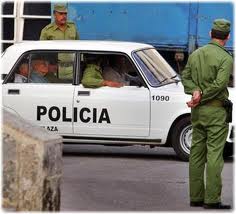
At 2:00 PM on November 22, 2012, I was interviewed at the People’s Revolutionary Police (PNR) Capri Station, located in the Arroyo Naranjo municipality of Havana, with the Lieutenant called “Junior” from Department 21 (the State Security department that deals with dissidents).

The interview began after 20 minutes since he could not find a place to hold it:

Official: (He introduced himself as a Department of State Security (DSE) official but did not show identification, and began)

What has motivated you to do these types of things? I believe it’s probably due to something that happened in your past, such as losing in sports, or due to the time you were assaulted and not fairly treated.

Interviewee: That was in the past, it no longer interests me.

Official: How did you find out about the course in journalism from the United States Interests Section (SINA)?

Interviewee: Well, I don’t remember well, but I think that since 2009 I was in CAPF (Commission of Attention to Prisoners and Relatives), and visiting the embassy I found out about the course.

Official: I did not know that you were from CAPF, why do you write blogs? referring to everything published that is true and not invented.

The official continues to ask me why I’m writing blogs because it is not in line with my character. You have nothing in common with those people, you are a professional, he says.

Interviewee: I’m not the only professional, Miriam Celaya, Yoani Sánchez, Reinaldo Escobar, and many others.

Official: Yes, but there are only a few.

Interviewee: That’s what you say.

Official: Tell me what you intend to change with what you are doing?

Interviewee: Everything that’s wrong. Explain to me why is Estaban Lazo in charge after he had the problem with the pig farm in Oriente.”Nothing happened because the people  were not made aware of the situation and instead of being ousted, he was promoted”. You profess that children in Cuba do not go hungry and if you go to Lumumba there are children there who go to bed with bread in their stomachs but don’t have shoes to wear to school. If this is a free country why is there no freedom of expression?

Official: Well, freedom of expression is relative all around the world. If you watch the news you see protesters suppressed with tear gas and beatings. Here we don’t do that.

Interviewee: So why was Rodiles kicked on the floor?

Official: In reality it did not happen that way. Rodiles resisted arrest.

Interviewee: But that did not warrant being brutally beaten.

Official: What happens is that sometimes, due to insufficient police training, some errors are made. That’s why we are always there to make sure nothing happens. However, department 21 does not look after people like Rodiles, it is department 3.

Interviewee: Then you don’t need to look after me.

Official: Yes, you are from CAPF

Interviewee: I was.

Well, now you know what I think. Tell me, what motivates you to be an official?

Official: Well, “that none of the hungry children in the world are Cuban, that none of the illiterate people in the world are Cuban, that education is free, that violence in Cuba is minute compared to the world index,” he said.

Interviewee: So you are the one that takes care of me.

Official: Yes, since you graduated from the course on journalism.

Interviewee: Then if something happens, I’ll come to look for you.

Official: Yes, you tell them to find the Official Junior from 21 and that’s it. Keep in mind that how the situation evolves depends on you. We are here to maintain a dialogue, not to confront. That depends on you. I don’t wish to call you some day to say, look, what you published here is a lie because I saw that person, “this, this, and this are lies”.

Interviewee: Look, the first time that I was taken prisoner to the Unidad jail in Lisa (Havana municipality), I was interviewed by a young lieutenant like you whose name was Marcos, and he said I was making fun of him, and that he was going to hit me. What would have happened if he had hit me?

Official: You would have been in a fight.

Interviewee: No, if I defend myself by hitting him in the head with the chair, what would have happened given that I did not start the fight? “They would have accused me of disobeying the authorities and other things.” Who would have lost? Me.

Official: Stop, I hope that when I send you a citation, you’ll come.

Interviewee: No, I hope this is the last encounter, why come back to you now that you know what I think.

Official: We need to continue to meet because we must talk about other things, and also one day I’ll tell you not to go to Estado de Sats — to make an example of you, if you go I’ll put you in prison. “I hope that when we talk man to man you’ll have the decency to do what I say.”

Interviewee: Well, if you know that Yoani works for the CIA why don’t you jail her?  What’s published in the newspapers and broadcast on television must be lies since you don’t arrest her, only a way to defame her so that people stay away from her.

Official: I don’t like to talk about people when they are not present, but Yoani is a mercenery. If you don’t know what that means, it means “people who are paid to serve the interest of a foreign country.”

Interviewee: Well in regard to the citations, send them personally to me, don’t go through my mother. If you do, I will not come. That’s personal.

Official: The reason is that you need to be at home but yet you stay elsewhere.

Interviewee: I have rights, don’t I?

Official: Tell me the number of your house.

Interviewee: I don’t remember the number. There are three houses with the same address.

Official: Which is it? The first, second, or third?

Interviewee: The second one

Official: The one with hibiscus on the fence.

Interviewee: All the fences there have hibiscus.

Official: Then what’s the color of the house.

Interviewee: Yellow.

Official: Is it the only one of the three that’s yellow?

Interviewee: Yes

Official: The name of your girlfriend I think is a name of an older person: Caridad, María, Carmen. I have it written with the first surname, I don’t have her last surname, so that I can look for her address and give you the citation personally.

Interviewee: OK

Official: What’s her last surname?

Interviewee: What’s her first surname?

Official: I don’t remember. I have everything written down, but I can’t remember everything.

Interviewee: Caridad is her name. Last surname is Torres.

After two hours of conversation he told me I could go.

Translated by: Marina Villa

November 26 2012


Currently, Havana Is Suffering the Same as the People of Santiago /Anddy Sierra Alvarez

In spite of the internationally offered help, Havana suffers because of damage in the province of Santiago de Cuba caused by Hurricane Sandy.  Food is in itself the major preoccupation of the Havanan.

The government has forgotten that it is in charge of keeping economic balance in the streets.  Chickpeas no longer circulate, nor beans in general, nor are there any state markets.

Nevertheless private individuals are those who have beans; black, red, kidney or white, garbanzos and lentils. But the unaffordable prices have risen, for example: The black bean, the one most eaten, costs 18 pesos a pound from 12 pesos that it used to cost and the price from the state is 8 pesos a pound.

We Havanans are at the disposal of the Santiago people, let there be not the slightest doubt, but our government’s lack of economic knowledge makes every corner of the country feel the crisis as if it were in the same location as the tragedy.

So, who controls the situation, the self-employed or the government?

Translated by mlk

November 12 2012


A Second Round in the Municipal Elections in Arroyo Naranjo / Anddy Sierra Alvarez

November 4, 2012. The second round of voting was held, where both aspirants tied to become delegates from that constituency. Part of the population didn’t vote because they consider it an unnecessary activity.

The neighbors of the constituency gave a “no” in not participating to choose in a delegate. María González who is 46 years old, said, “why vote for someone who does not represent me at all,” saying also that the delegates simply solve their own housing problems and are the first to steal from the State.

Raquel Garcia, 50, comments that the street in the area is a disaster and the person in charge of this is the delegate. “We’ve had the same delegate for years and nothing is resolved,” says Garcia. “But if you go to his house he has everything. Where does all that come from?” she adds, indignant.

November 5 2012


Santiago de Cuba — “Hero City” — Victim of Government Inflation / Anddy Sierra Alvarez

Santiago de Cuba is characterized by being one of the provinces than most supports the Castro government. Its citizens, its major, are loyalists. The native city of the Castros has been destroyed by Hurricane Sandy.

Was Sandy the principal cause of the destruction and the deaths? And what did the government do?

Normally, when a Hurricane comes no matter how small, the measures taken in Havana are always unlimited. Trees are felled to avoid accidents as happened in the east of the country, where because of falling trees several perished and the electricity was cut off leaving the population without power.

The living conditions of the very poor consists of nothing more than wattle and daub houses, and the best have a tile roof — a material susceptible to wind. Then, did Civil Defense do its work 100%?

Thus is was that Cuban citizens perished in their houses because they collapsed and because trees that weren’t cut down fell on them.

October 29 2012


Will the Boat of Food Sent by Venezuela Fulfill its Objective? / Anddy Sierra Alvarez

The boat sent by Venezuela for the victims of Hurricane Sandy in the east of the country will not fulfill its objective. Most of the merchandise will be diverted to the hard currency stores to enrich the Cuban government.

It won’t be the first, or the last time that the government diverts some of the merchandise meant for the Cuban people sent by some foreign country. This is what some of the capital’s population say in the streets. “It’s nothing more than a benefit for the families of the military,” say the great majority.

We wait what will happen, but history has demonstrated that the products don’t get to the ordinary Cuban.

October 31 2012


Estado de Sats Enveloped in Venemous Spines / Anddy Sierra Alvarez

Like every other citizen, the invitation to the Estado de Sats is taken with enthusiasm, in order to take part in a work of illumination dealing with human development, both spiritual and socially.

This brings up the understandable work schedule for those who work for the Estado. The positive culture projects help offer tranquility and happiness to an island with little room to breathe.The project helps break the silence of those who are in fear and oppresed.

The repressive regime is felt stronger after every encounter, fitting perfectly with the motto and hymn of the enforcers of the state: “What will you do, retire… or be retired?”

Words so simple make you reflect; and for the most part, people do retire. There’s no need to seek physical punishment if your objectives are set aside by the desperation of those who are your superiors, who in fact fear losing their power in a not too distant future.

Translated by: Carlos Andrés Garcia, BC CASA

October 22 2012


Havana neighborhoods reject the Cuban government by not celebrating the 52nd anniversary of the CDRs / Anddy Sierra Alvarez

More than half of the Committees for the Defense of the Revolution (CDR) of Havana did not celebrate their 52nd anniversary of September 27-28.  This celebration was marked at 90% only in the central and eastern zones of the country.

September 27 was celebrated in anticipation of the September 28 day of the 52nd anniversary of the CDR.  Since its inception this revolutionary Fidelist project only served to guard the government’s interests, not the Cuban people’s.

A square is made of four blocks, and each block has a CDR, so a square has four CDRs.

Currently four out of ten squares throw a party in anticipation of the 28th.  Therefore the others rest at home watching TV or performing some other activity.  Only 16 out of exactly 40 CDRs celebrate that day and 24 CDRs do not participate in said celebration. So 40% celebrate and 60% do not.  The chosen municipalities were Arroyo Naranjo, 10 de Octubre, Boyerso, La Lisa, Cerro and Plaza.

After the special period the disenchanted population little by little stopped celebrating this day until it went unnoticed.

September 28, state media communicated the 52nd anniversary of the CDR as a support of the revolution and made an example of an eastern region CDR where there was more citizen support of the government.

Fiftyfour-year-old Miguel Torres says that in his neighborhood (Santa Malea) there is no longer any mention of a party for the CDR, “The president does not go by the houses so that the neighbors might support with broth — a tradition at these parties.”

October 1 2012


Hunger Strikes Are an Effective Method with a Clear Objective(s) / Anddy Sierra Alvarez

The 21st century. A country called Cuba, where it citizens fight for a transparent democracy and for the freedoms that this encompasses. There are very few resources to achieve the power of the people in a country tossed into the abyss 53 years ago.

The Cuban counterrevolution, the opposition or the fighters for human rights in Cuba; whatever you want to call them, they have exhausted almost all their resources. The only one left is the most drastic option, the HUNGER STRIKE.

The opposition in Cuba has always tried to come to an agreement with the government, but it has always avoided any change and its governmental ideal.

Thus, the hunger strike has become a weapon against the Castro tyranny. Despite the fact that it is a weapon that destroys human being who undertakes it.

In reality the government has no interest in the deaths that could happen with this desperate measure. They are only focused on not losing their totalitarian power and avoiding democracy on the island. Space

But with a clear objective and a well defined goal, this weapon has become the Achilles tendon of the Castros.

October 8 2012


Census …! / Anddy Sierra Alvarez

Cuba is preparing for the 2012 census between September 15 and 24. They are officially explaining the date to be collected, what the interviewee should say, without any guarantee of the validity and veracity of the document filled in.

Saturday, September 15, the census will begin, carried out mainly by high school students, who will each collect census data from 50 to 80 households, throughout the whole country.

Javier Lopez, 17, says that people see the census as a game because “I ask a citizen, ’do you have a computer?’ And she answers can’t you see it right in front of my eyes, but I have to put what you say, I don’t see this as having any use, I think I’m wasting my time!”

Lopez says he has canvassed 8 houses and hasn’t done more because people aren’t aware and aren’t home and other say they don’t have time right now and he goes back later no one is home.

Alberto Peña, 56, says they’d already been to his house and he was surprised that this census was being conducted by students and not social workers, and he asked the student if there was someone advising him and was told it was a university.

“I myself saw these young people without responsibility, apparently this 2012 census doesn’t have much validity, God knows if everything they put on the paper is what the citizen said, you can see that in 2 days these students go to 2 or 3 houses and they make up the rest.”

You have to wonder if, having done this, is this going to be valid for the government to have any idea of the cultural level of the population, the number of people living together in a house, the state of the house, etc.

September 17 2012


Cuban Public Health System and "Quality" / Anddy Sierra Alvarez

“There is no greater honor than to be the guardian of public health.” Fidel Castro

Cuba boasts of its public health system, and its hospitals are overflowing with cases of viral dengue fever. This outbreak is caused by this country’s poor performance in supplying water to homes, especially in the capital province.

The township Arroyo Naranjo was one of the most affected by dengue in 2012, after which the measure was taken to suspend the water supply every other day (one day on, one day off).

According to the official version, the supply of water to this area was every four days, because four motors were broken out of six total and the measure taken would prevent the remaining two working motors from breaking down because of overload.

More than seven months passed, and the problem with the water supply continued, the desperate citizens began to store water in pots, tanks, etc.  With passing days, this accumulated water prepared the conditions for the Dengue-carrying mosquito larvae, creating a considerable hatchery in each home.

The sprayings and the groups fighting the mosquitoes were diminishing with each passing month, the visits to the homes and the sprayings were increasingly rare.  Then the cases of dengue began on a grand scale.

The “Covadonga” hospital located in the capital township “Cerro” like the “Julio Trigo” and the “Enrique Cabrera” (National Hospital) were overrun with cases of dengue, but none was  hemorrhagic.

Then!  The government decided to announce that the water would be on every other day for this township, like it had before.  It all happened because the government had no interest in fixing the motors so that the citizens could have safe water.

Only Cuban problems are solved after there is a big, harmful event among the people.  The government’s system has shown this throughout these 53 years of “REVOLUTION.”

Translated by mlk.

September 10 2012


Estado de Sats in Troubled Waters / Anddy Sierra Alvarez

A Security of State operation carried out in cooperation with the National Revolutionary Police (PNR), blocked participants from attending Estado de Sats this Friday, August 10, 2012; but those in charge of the Cinema at All Costs didn’t cancel the projection of the documentary “Knockout” planned for this day. Around 30 people participated.

The Estado de Sats projects was sabotaged by Cuban State Security in the afternoon. Starting at 6:45 pm the participants began to arrive, but not all of them could reach Antonio Rodiles’ house, several were arrested, others on seeing the wave of police decided to return home.

Antonio Rodiles and Ailer Gonzales worried about the low attendance, the comments of those fortunate to arrive on time — 7:10 pm — suspected they were letting people pass who were: bloggers, writers, independent journalists, lawyers, etc. They went out to verify their suspicions and were right.

Antonio Rodiles commented that he had heard about a possible act of repudiation planned for in front of his house, through a friend, and had to go to the 5th police station, at 7th A and 62nd in Miramar where he delivered a document to the 2nd Station Chief, badge number 0037, warning of possible consequences of such acts and provocations.

The projection of the documentary took place, it was made by Dr. Darsi Ferrer, and was about 11 champion boxers, a sport that has brought much glory to the country (Cuba), all of them athletes with one great dream, to participate in the professional boxing league, but time passed and they retired from the active sport and their dream vanished.

Currently these champion athletes fight to live well, against unemployment, the little attention paid to them by the government and many of them lose themselves in alcohol to forget.

Agustín López (Blogger) says, “This documentary reminds me of the Roman circus, where the athletes (gladiators) fought to entertain the people and the leaders. The profits were divided between the personalities in power.”

The activities ended at 10:00 pm and there were still some police circling the area; of those fortunate in having seen the documentary none were arrested.

August 13 2012